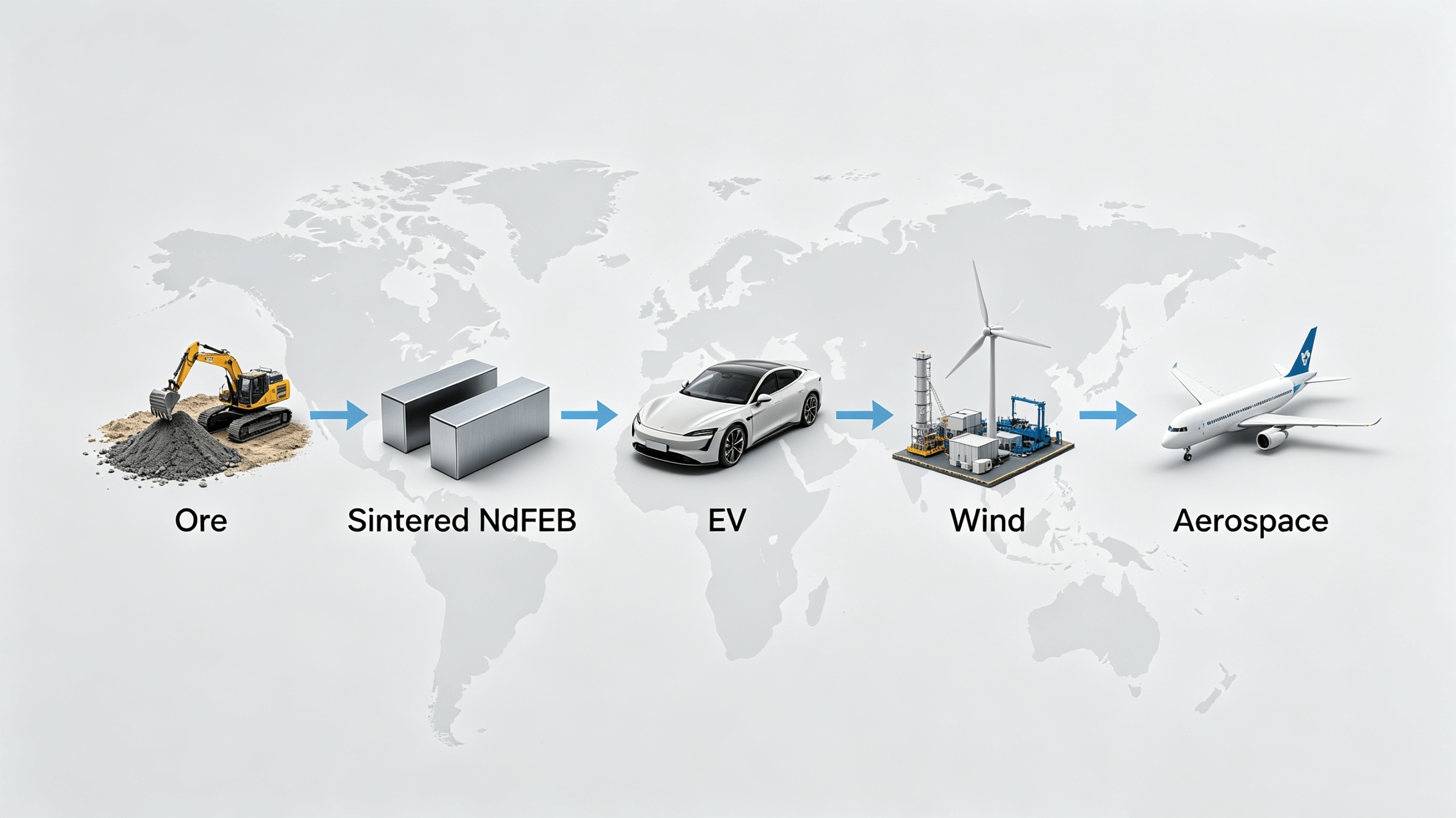
NdFeB (neodymium-iron-boron) magnets — the strongest commercially available permanent magnets — act as silent core components inside countless high-performance technologies. With energy products exceeding 50 MGOe and outstanding coercivity, they enable device miniaturization, higher energy efficiency, and reliable long-run operation across mission-critical sectors.
Below is a practical, field-validated breakdown of their highest-impact use cases, backed by global industry data and precise technical context.
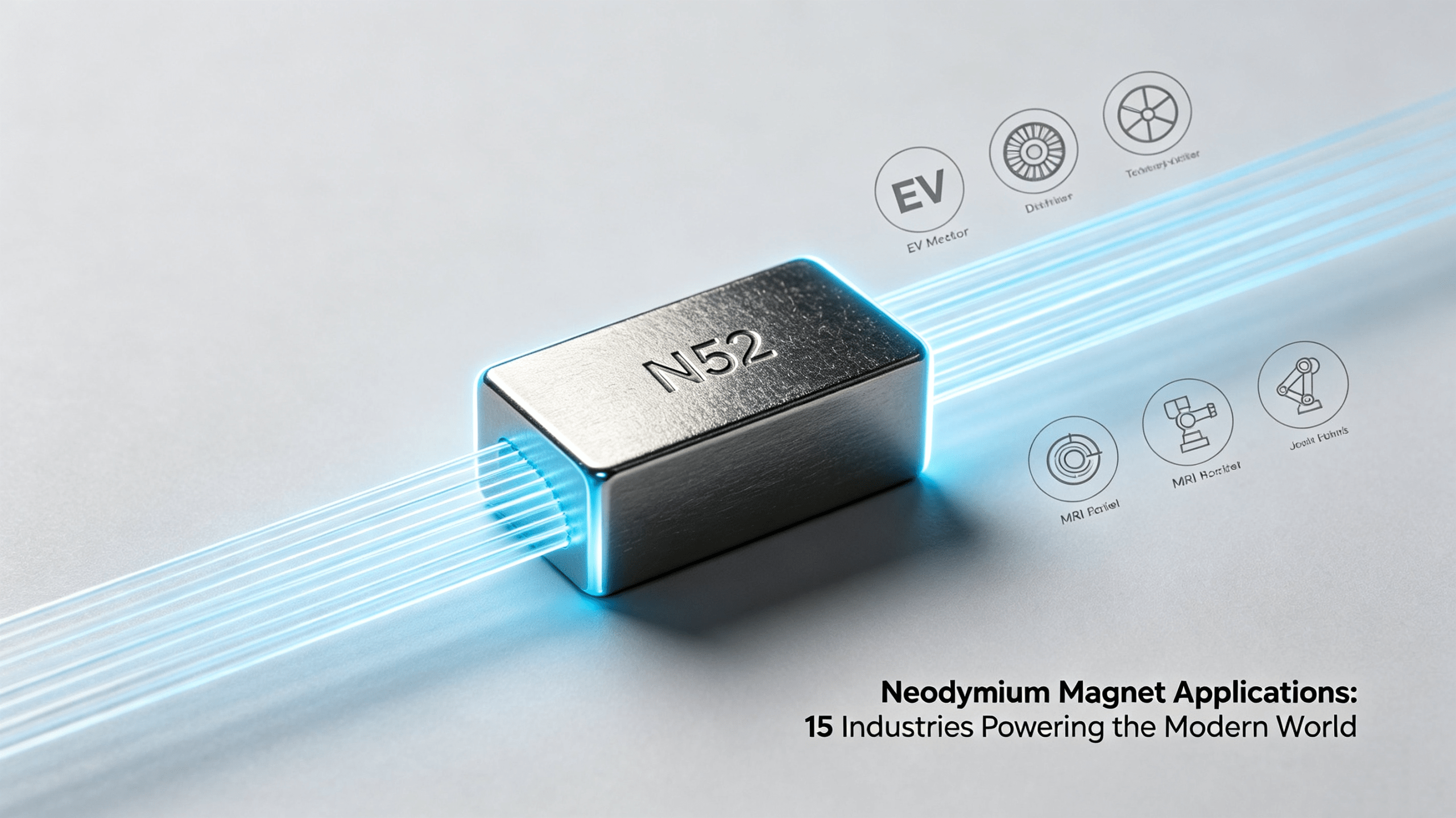
Over 90% of modern EVs deploy permanent magnet synchronous motors (PMSMs) built around NdFeB magnets. They deliver high peak torque at low RPM, boosting driving range and cutting electrical losses. Platforms including the Tesla Model S, BMW iX and BYD Han use optimized magnet arrays to hit power densities above 5 kW/kg.
Source: USGS 2025 Critical Minerals Report
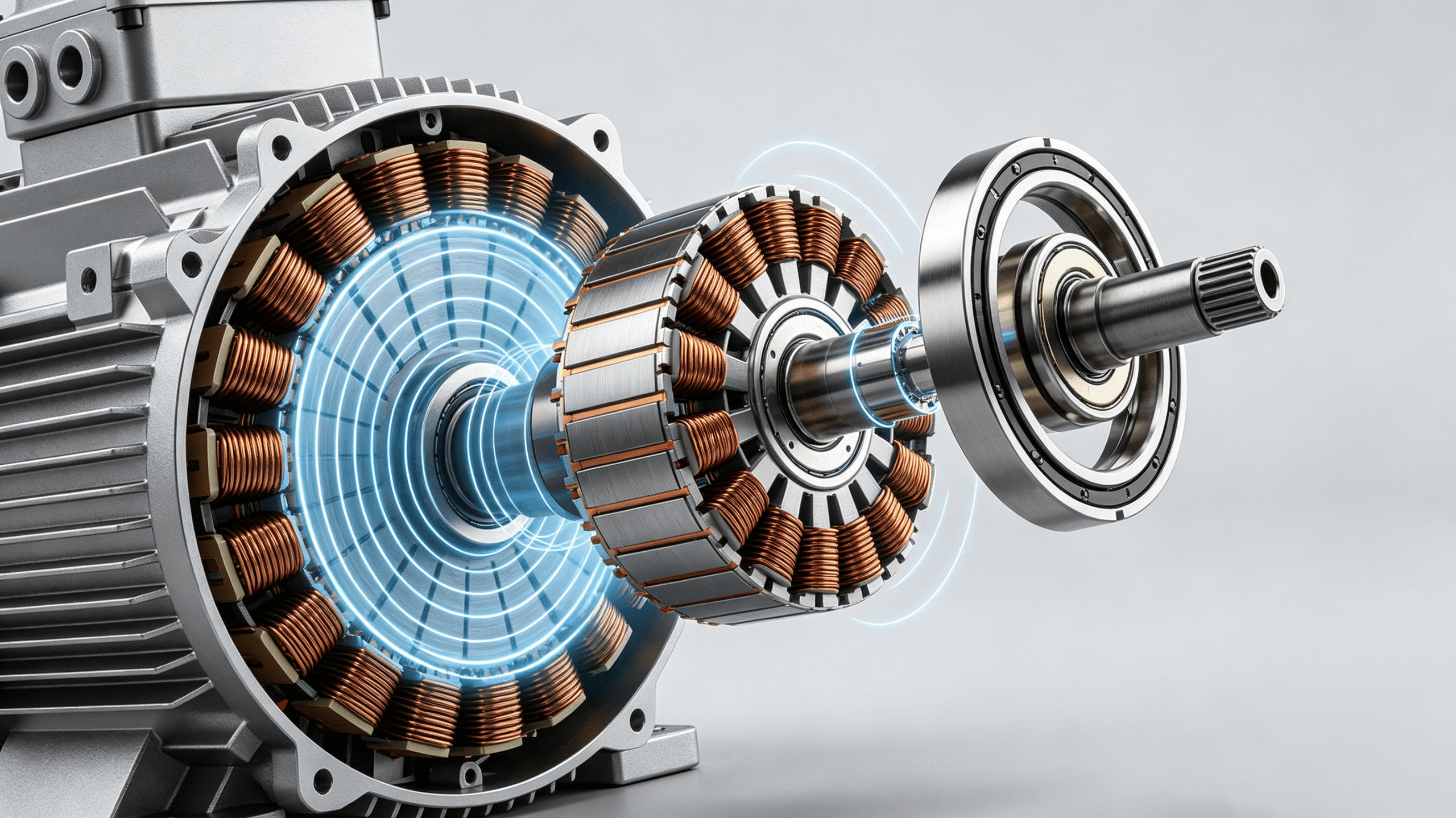
Large offshore turbines (2–15 MW) increasingly remove heavy gearboxes in favour of NdFeB direct-drive generators. A single 3 MW unit requires 600–900 kg of high-coercivity NdFeB, frequently doped with dysprosium for thermal stability. Vestas and Siemens Gamesa are leading adopters; China’s Goldwind accounts for ~20% of global installations.
Benchmark: IEC 60404-8-1:2015 magnet performance standard
1.5T–3T clinical superconducting MRI scanners use sintered NdFeB arrays for field stabilization and shimming. They maintain passive field homogeneity of ±0.1 ppm over a 20 cm DSV, delivering sub-millimetre soft-tissue contrast — enabling open-bore designs with reduced cryogen reliance.
Advanced humanoid robots (Tesla Optimus, Figure 01) embed micro NdFeB magnets inside brushless DC servo motors at every joint. With 30–50 joints per robot, total magnet load exceeds 150 g per unit. Global demand for robotics-grade NdFeB is forecast to hit 24,000 metric tons by 2035 — a 400% rise from 2025 volumes.
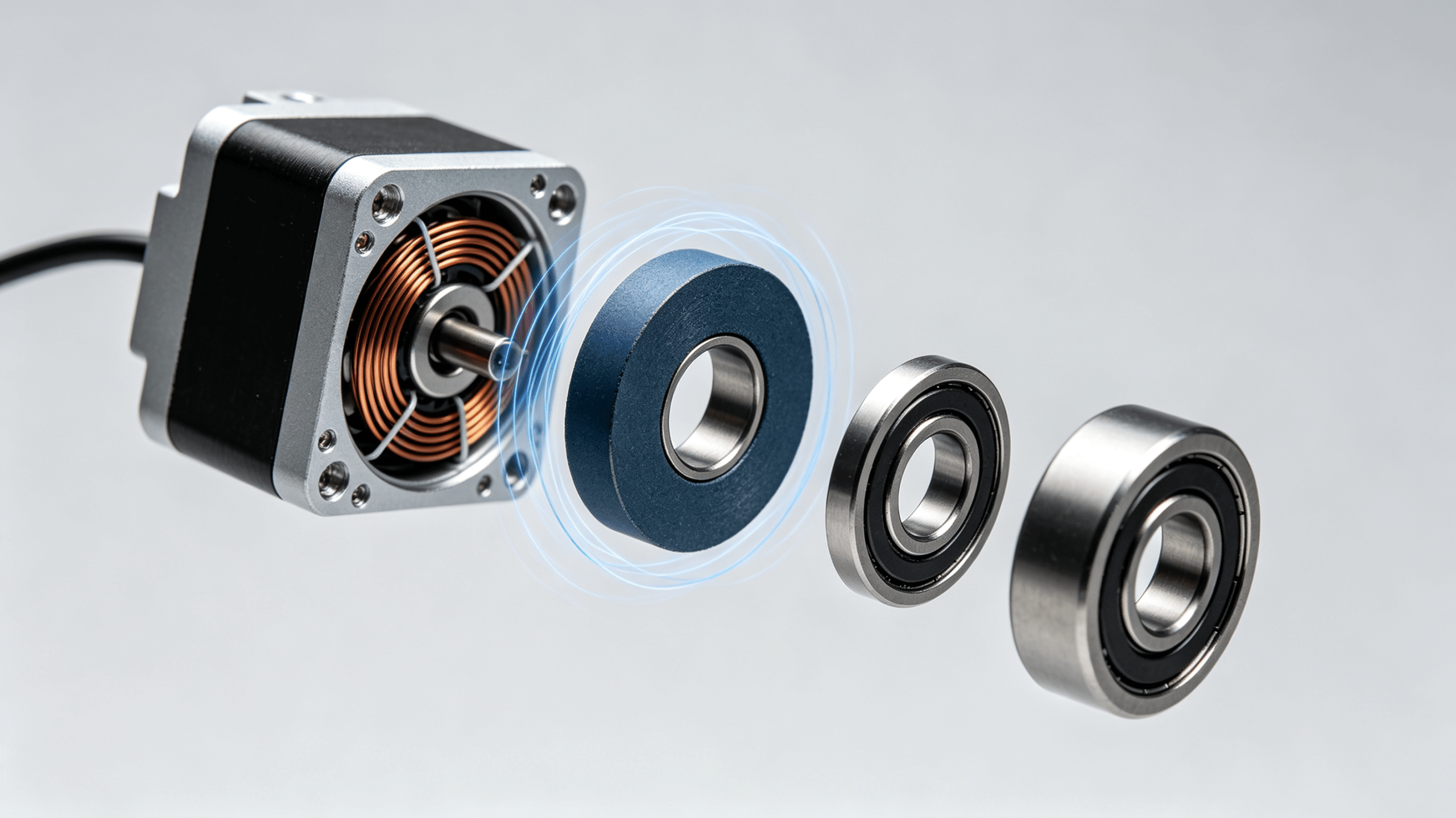
Even with SSD growth, HDDs still host ~70% of global enterprise storage. NdFeB magnets in VCMs deliver sub-micron head positioning accuracy (±0.01 µm), an essential requirement for 20+ TB platters. Seagate and Western Digital continue refining magnet geometry to push track density higher.
Hall-effect and magnetoresistive sensors with embedded NdFeB support contactless, high-frequency measurements up to 100 kHz for robotic systems, CNC machines and power inverters. Full-scale accuracy reaches ±0.05%, a foundation for closed-loop Industry 4.0 automation.
NdFeB replaces ferrite in tweeters, true wireless earbuds and studio monitors: 40% lower mass alongside 3–5 dB sensitivity gain. Apple AirPods Pro, Sony WH-1000XM7 and Bowers & Wilkins Zeppelin all use micro magnet arrays to sharpen spatial audio performance.
Satellite reaction wheels, solar array drives and thruster valves rely on Dy/Tb-doped NdFeB rated for -196°C to +200°C. SpaceX Starlink and NASA’s Europa Clipper use radiation-hardened magnet assemblies engineered for 15-year service life.
Deployed in missile guidance seekers, phased-array radar and electromagnetic railgun armatures. The U.S. DoD lists NdFeB as a critical material under DFARS 252.225-7018. China’s defense industrial base sources over 80% of its magnet raw material domestically.
Shanghai’s 30.5 km commercial Maglev line mounts >1,200 linear NdFeB arrays under vehicles, interacting with guideway stator coils. This enables 430 km/h operation with zero mechanical friction — the world’s only revenue-service high-speed maglev.
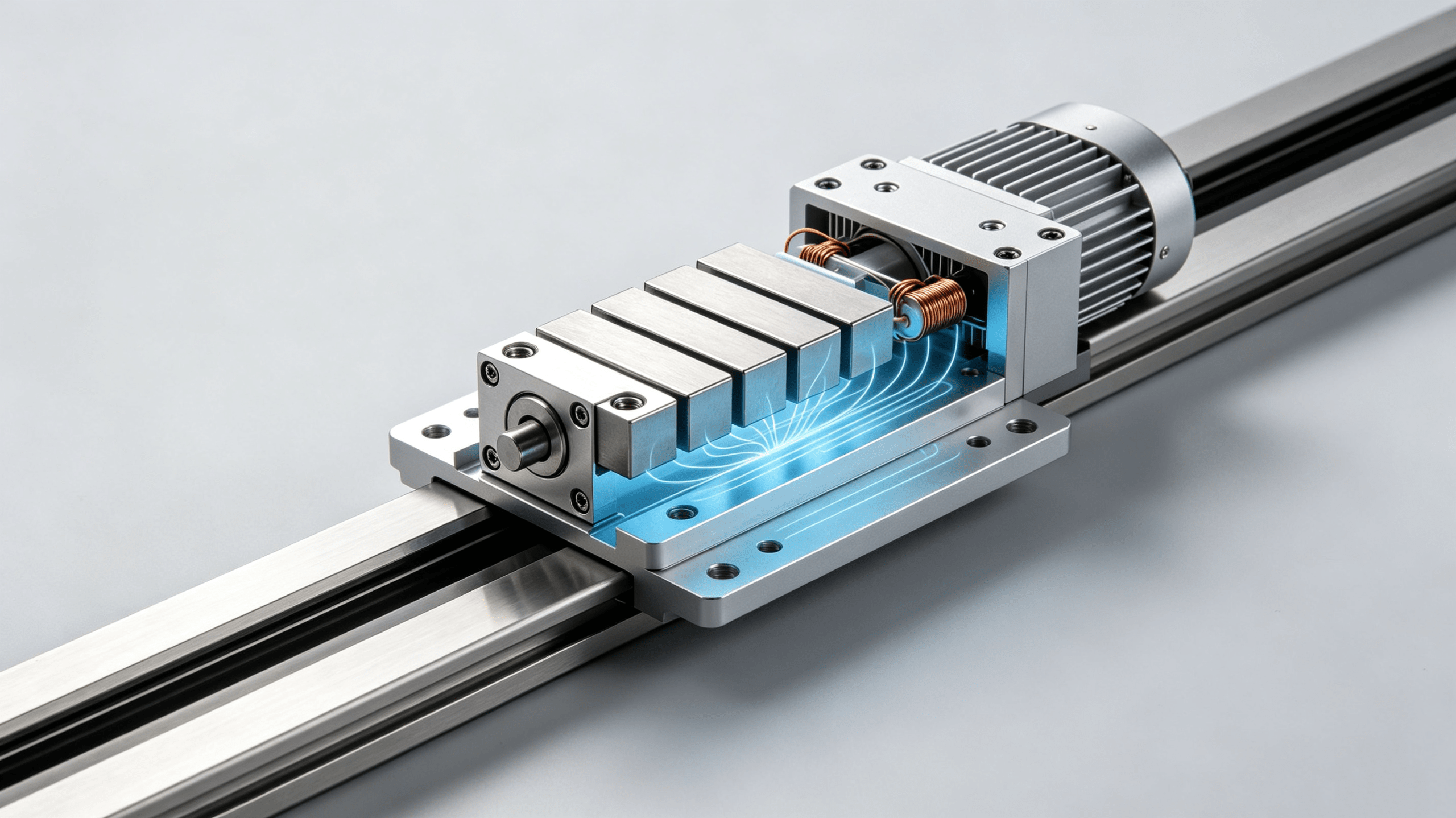
CNC spindles, linear motor stages and robotic pick-and-place systems use NdFeB linear actuators with ±0.5 µm repeatability. Fanuc, Siemens and Yaskawa integrate these into smart factories across Germany, Japan and Ningbo, China.
Compliance: IEC 62368-1 safety & EMC standard
MWD/LWD instruments operate at 175–220°C and 20,000 psi. N42SH-grade sintered NdFeB in rotary steerable systems transmits real-time formation data via mud-pulse telemetry. Schlumberger and Halliburton specify coated, corrosion-resistant sintered magnets for these harsh environments.
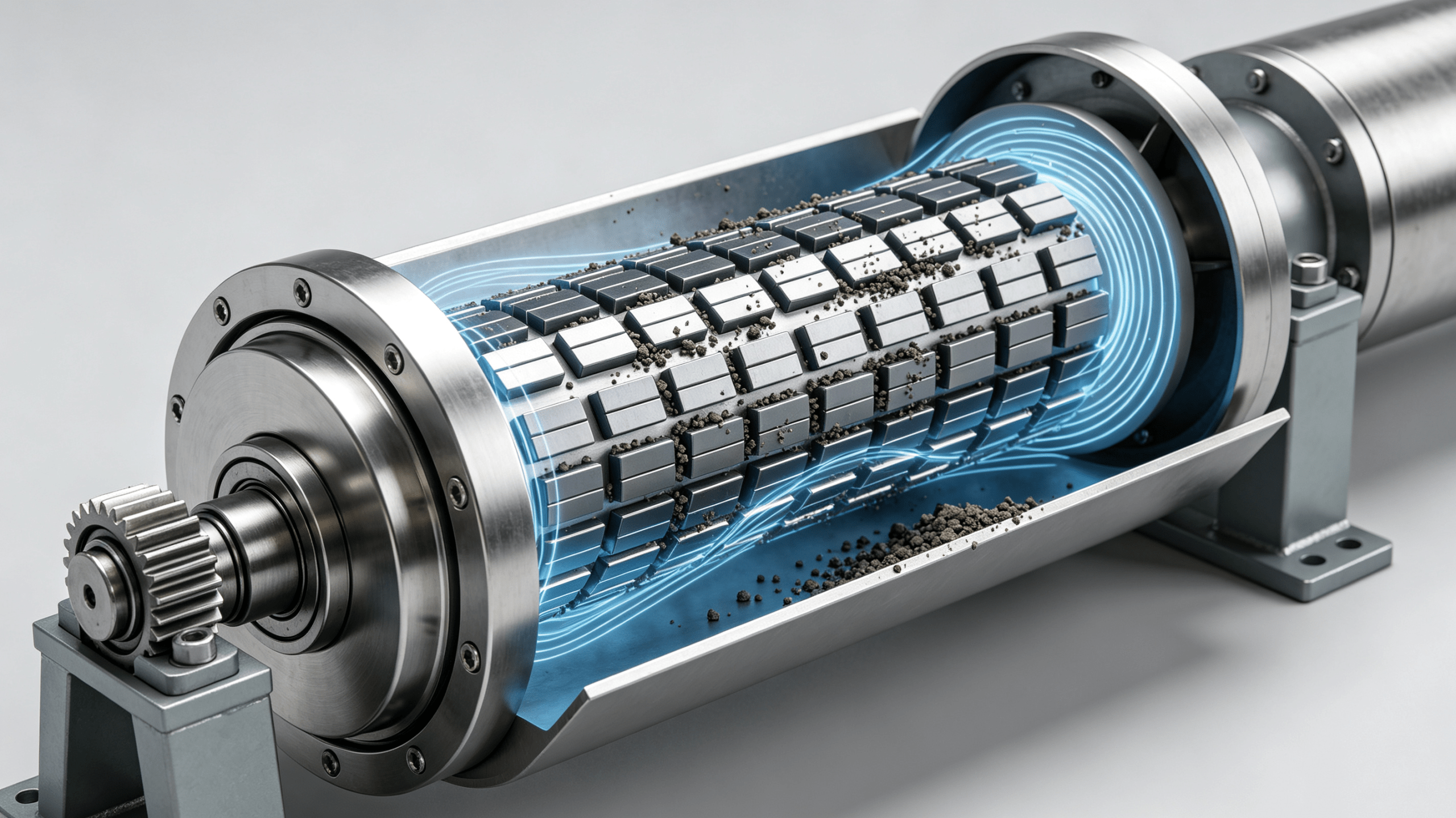
Widely used in iron ore beneficiation, e-waste metal recovery from PCBs and wastewater ferrous contaminant removal. Ningbo manufacturers including Yunseng and Jinqi supply ~60% of global magnetic separator hardware, delivering >30% efficiency improvement over conventional electromagnets.
|
Metric |
Value |
Source |
|
Global NdFeB Production (2025) |
270,000 metric tons |
USGS |
|
China’s Share |
69.4% |
USGS |
|
U.S. Production |
51,000 metric tons |
USGS |
|
Australia’s Production |
29,000 metric tons |
USGS |
|
Avg. Dy/Tb Additive (EV/Wind Grade) |
6–12% |
IEC 60404-8-1 |
|
Recycled NdFeB (2025) |
3.2% of total demand |
IDTechEx 2025 |
Key Insight: While China dominates rare earth mining and refining, the U.S. and EU are scaling domestic magnet manufacturing through the Inflation Reduction Act and Critical Raw Materials Act. Closed-loop recycling from end-of-life HDDs and EV traction motors is now commercially viable — Hitachi Metals and Umicore operate recovery facilities in Germany and Japan.
All applications represent active real-world deployments as of Q2 2026; no speculative or experimental use cases included.