
No products in the cart.
A Halbach array is a specific arrangement of magnets; however, before examining this structure, let us first look at the magnetic field line distributions of some common permanent magnets.
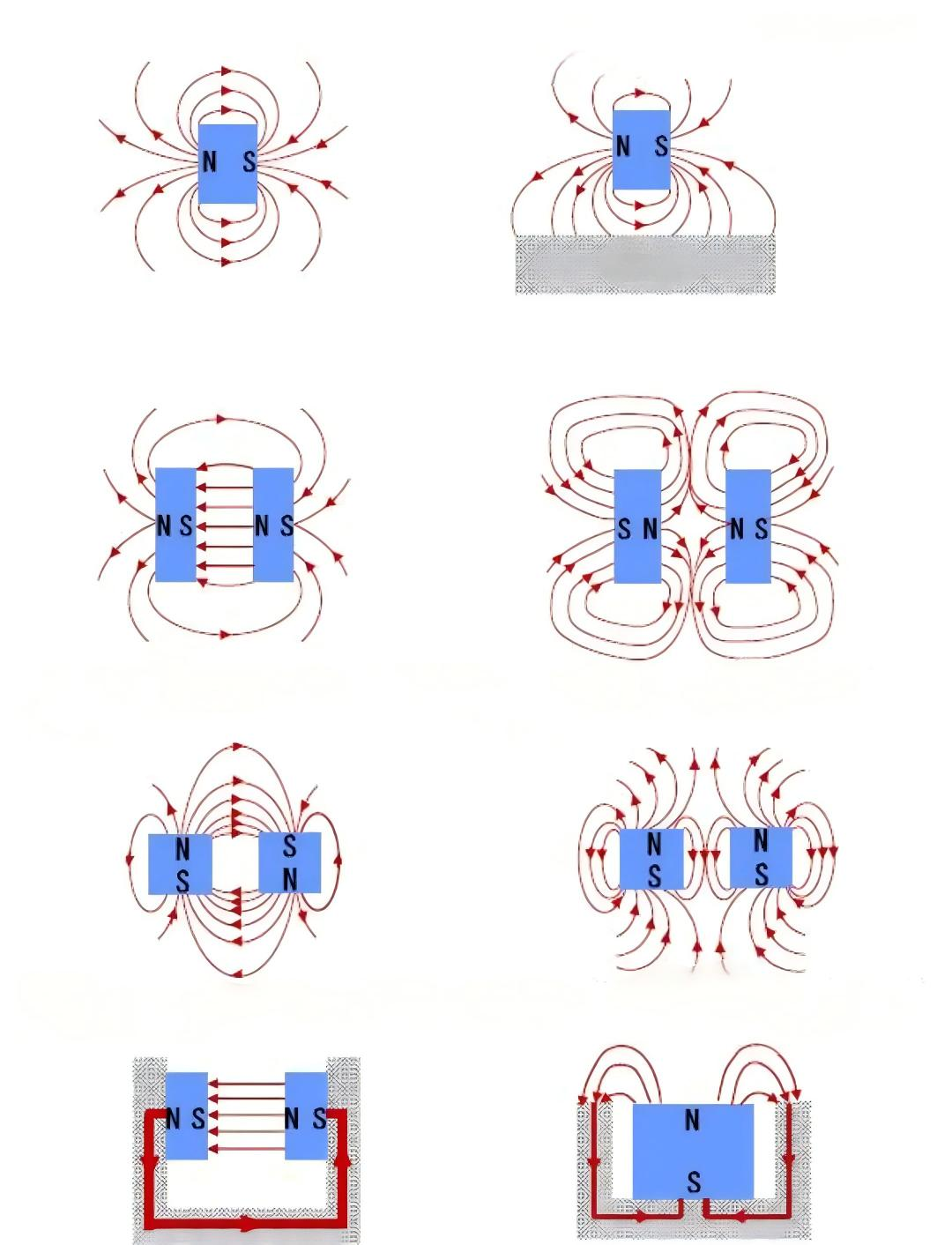
As is evident from this illustration, the orientation and arrangement of magnets directly influence the distribution of magnetic field lines—and, consequently, the configuration of the magnetic field surrounding the magnets.
**The Concept of the Halbach Array**
A Halbach array (also known as a Halbach permanent magnet array) is a specific type of magnetic structure. This unique permanent magnet configuration was discovered in 1979 by the American physicist Klaus Halbach while conducting experiments with electron accelerators; he subsequently refined the design, ultimately giving rise to the so-called "Halbach" magnet. Representing a near-ideal structure from an engineering perspective, it utilizes a specific arrangement of individual magnetic elements to concentrate magnetic field strength in a particular direction, with the ultimate objective of generating the strongest possible magnetic field using the minimum amount of magnetic material.
This array is composed entirely of rare-earth permanent magnets. By arranging permanent magnets with varying magnetization directions according to a specific pattern, the structure effectively concentrates magnetic field lines on one side while attenuating them on the other, thereby achieving a highly desirable unidirectional magnetic field. This holds immense significance in the field of engineering; thanks to its exceptional magnetic field distribution characteristics, the Halbach array is now widely employed across various industrial sectors, including magnetic resonance imaging (MRI), magnetic levitation (Maglev) systems, and specialized permanent magnet motors.
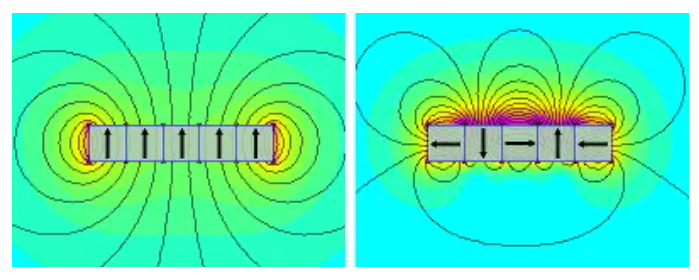
On the left is a single magnet with its North pole oriented entirely upward; as indicated by the coloring, the magnetic field strength is concentrated at the bottom and top of the magnet. On the right is a Halbach array, where the magnetic field is stronger at the top surface of the magnets while remaining relatively weak at the bottom. (For equivalent volumes, the surface magnetic field strength on the strong side of a Halbach array assembly is approximately √2 times—or 1.4 times—that of a traditional single magnet, particularly when the magnet's thickness in the direction of magnetization falls between 4 and 16 mm.)
Perhaps the most common example of a Halbach array is the flexible refrigerator magnet. These thin, pliable magnets are typically printed with designs and affixed to refrigerators or the backs of cars; although their magnetic strength is quite weak compared to Neodymium-Iron-Boron magnets (possessing only 2–3% of the strength), their low cost and practical utility have led to their widespread application.
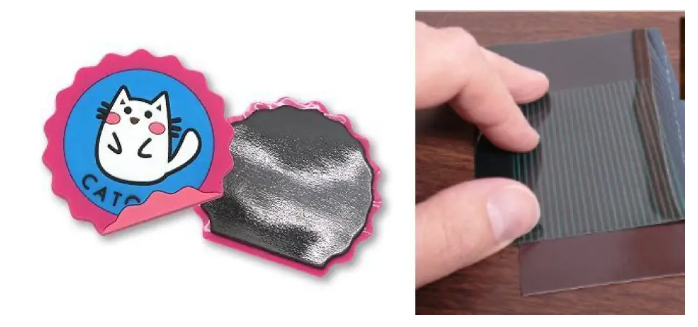
Forms and Applications of Halbach Arrays
Linear Arrays
The linear configuration represents the most fundamental structural form of a Halbach array. This type of magnetic array can be regarded as a combination of radial and tangential arrays, as illustrated in the figure below.
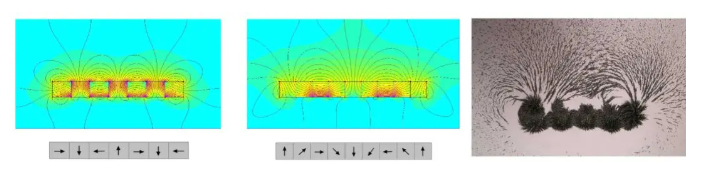
Linear Halbach arrays are currently primarily applied in linear motors. The levitation principle behind maglev trains relies on the interaction between moving magnets and the magnetic fields induced by the currents they generate within a conductor; this interaction produces a levitation force, albeit accompanied by magnetic drag. Improving the ratio of lift to drag is critical to enhancing the performance of the levitation system. Consequently, this necessitates the use of onboard magnets that are lightweight, generate strong and uniform magnetic fields, and possess high reliability. By horizontally mounting a Halbach array in the center of the vehicle body—where it interacts with windings located in the center of the track to generate propulsive force—it is possible to maximize the magnetic field strength while minimizing the quantity of magnets required. Furthermore, as the magnetic field strength is significantly weaker on the opposite side of the array, passengers are shielded from exposure to intense magnetic fields.
Circular Arrays
A circular Halbach array can be conceptualized as a linear Halbach array configured into a ring shape by joining its ends together.
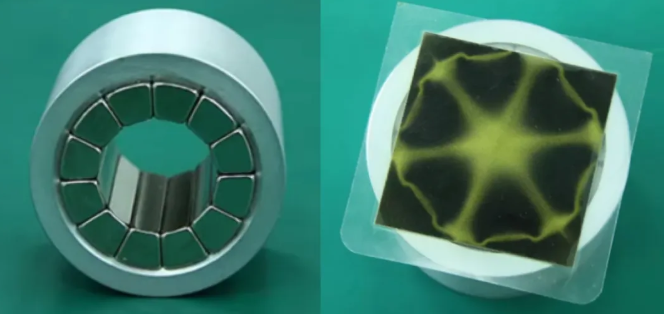
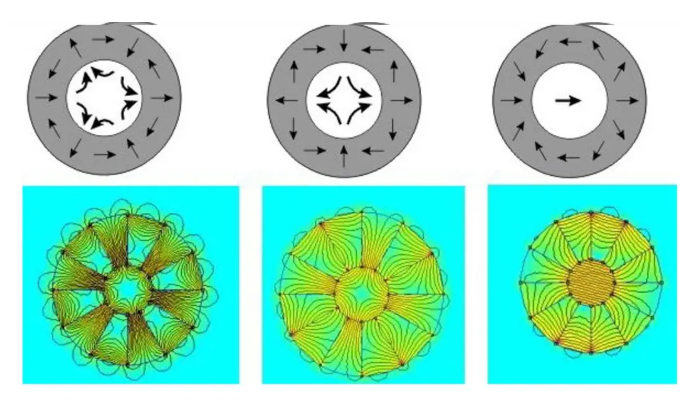
In the realm of permanent magnet motors, those utilizing a Halbach array structure exhibit an air-gap magnetic field distribution that is closer to a pure sinusoid compared to traditional permanent magnet motors. Given an equal volume of permanent magnet material, Halbach permanent magnet motors achieve a higher air-gap magnetic flux density and incur lower iron losses. Furthermore, circular Halbach arrays find extensive application in various devices, including permanent magnet bearings, magnetic refrigeration equipment, and magnetic resonance systems.
**Fabrication and Production Methods for Halbach Arrays**
**Method 1:** Based on the specific topological structure of the array, pre-magnetized magnet segments are bonded together using a specialized magnetic adhesive. Due to the strong mutual repulsive forces acting between the individual segments, a mold or fixture must be employed to clamp the components securely during the bonding process. While this method suffers from relatively low manufacturing efficiency, it is comparatively easy to implement and is therefore well-suited for use during the laboratory research and development phase.
**Method 2:** This method begins with the fabrication of a single, monolithic magnet unit—typically achieved through molding or compaction techniques—which is subsequently magnetized within a specially designed fixture. The resulting array structure produced by this method resembles the illustration shown below. This approach offers high processing efficiency and is particularly conducive to large-scale mass production. However, it necessitates the specialized design of a dedicated magnetizing fixture and the formulation of a specific magnetization process.

Method 3: Utilizing a winding array of specific geometry to achieve a Halbach-type magnetic field distribution, as shown in the figure below.
