
No products in the cart.
The magnetic properties of sintered NdFeB mainly originate from its crystal structure, which is easily magnetized. Under a strong external magnetic field, it can achieve very high magnetization, and this magnetism remains even after the external field is removed. Therefore, magnetization is a critical step for sintered NdFeB to obtain its magnetic properties.
In the production process, magnetization is the final step before delivery. However, the magnetic field orientation of the NdFeB blank—and thus the future magnetization direction—is already determined during the powder compaction stage.
Magnetic materials are classified into isotropic and anisotropic magnets. Isotropic magnets have identical magnetic properties in all directions and can be magnetized freely. Anisotropic magnets exhibit direction-dependent properties, and the direction with the highest magnetic performance is called the orientation direction. For a block-shaped sintered NdFeB magnet, the magnetic field is strongest along the orientation direction and significantly weaker along the other two directions.
If an orientation process is applied during production, the material is anisotropic. Sintered NdFeB is typically formed by magnetic field-oriented pressing, making it anisotropic. Therefore, the orientation direction—i.e., the future magnetization direction—must be defined before production. Powder magnetic field orientation is one of the key technologies for producing high-performance NdFeB magnets. (Bonded NdFeB can be either isotropic or anisotropic.)
Magnetization is the process of applying a magnetic field along the orientation direction of a sintered NdFeB magnet, gradually increasing the field strength until technical saturation is reached.
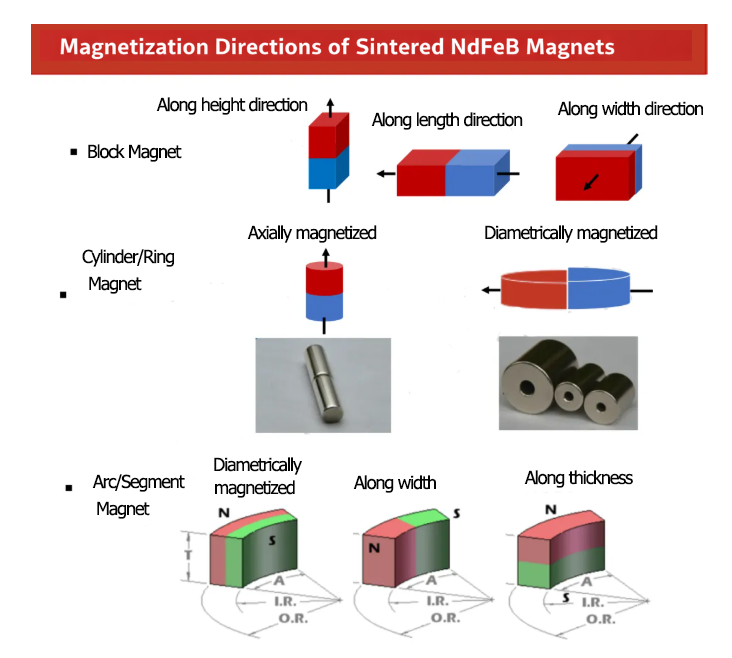
Sintered NdFeB magnets are commonly available in shapes such as blocks, cylinders, rings, and arc segments. The magnetization direction varies depending on the geometry, which will be outlined below.
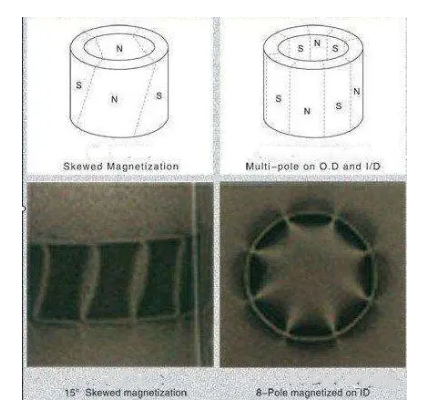
In addition to standard single-pole magnetization, sintered NdFeB magnets can also be magnetized with multiple poles as required. After magnetization, multiple N and S poles can be distributed on the same surface.
A magnetizing machine is used to magnetize magnetic materials or components by applying a magnetic field to NdFeB products. If the applied field does not reach the technical saturation level, the magnet’s remanence (Br) and intrinsic coercivity (Hcj) will not achieve their specified values.
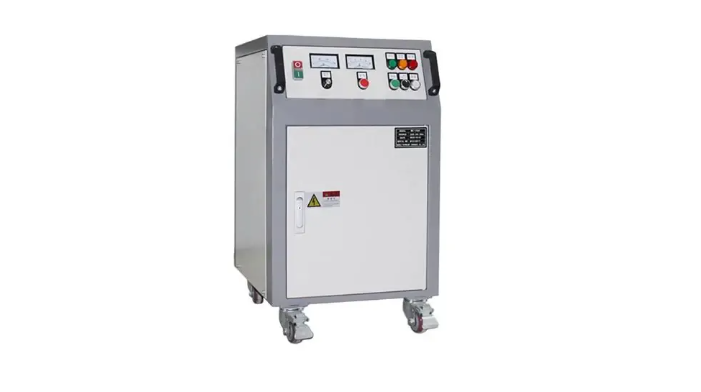
The required energy of a magnetizing machine is determined as follows: first, define the fixture size based on the magnet’s dimensions and magnetization direction. Then calculate the magnetic field at the center of the fixture, which should be 3–5 times the magnet’s coercivity. Next, determine the required magnetizing current. Based on the current and machine voltage, calculate the required capacitor capacity, and finally determine the total energy of the magnetizing system.
The basic principle of magnetization is to place the magnetic material in a magnetic field generated by a coil carrying direct current. The main methods are DC magnetization and pulse magnetization.