
No products in the cart.
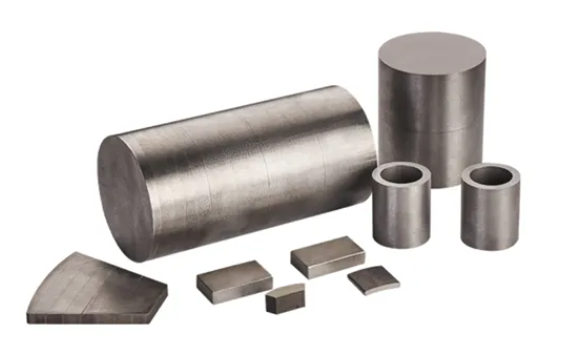
Samarium-cobalt permanent magnets are primarily composed of elements such as samarium (Sm), cobalt (Co), copper (Cu), iron (Fe), and zirconium (Zr). Structurally, they are classified into two types—the 1:5 type and the 2:17 type—and are categorized as first- and second-generation rare earth permanent magnet materials. Samarium-cobalt magnets possess exceptional magnetic properties (including high remanence, high coercivity, and a high maximum energy product), an extremely low temperature coefficient, a high maximum operating temperature, and strong corrosion resistance. Currently, they represent the optimal permanent magnet material for high-temperature applications and are widely utilized across industries involving microwave devices, electron beam equipment, high-power and high-speed motors, sensors, and magnetic components.
2:17 Type Samarium-Cobalt Magnets
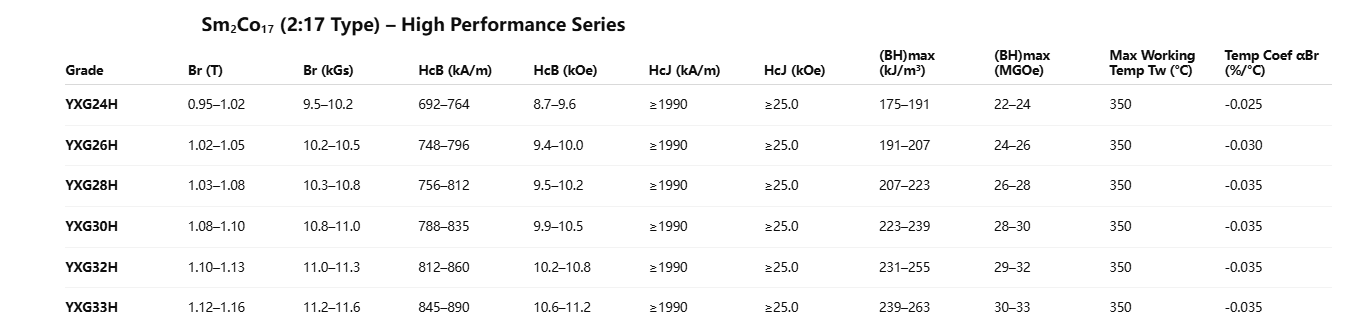
2:17 type samarium-cobalt magnets, also known as Sm2Co17, feature maximum energy products ranging from 20 to 35 MGOe across various grades, with a maximum operating temperature of 500°C. Possessing a low temperature coefficient and excellent corrosion resistance, 2:17 type magnets outperform Neodymium-Iron-Boron (NdFeB) magnets in terms of magnetic performance at high temperatures. Consequently, they are widely utilized in aerospace, military applications, high-temperature motors, automotive sensors, various magnetic drive systems, magnetic pumps, and microwave devices. 2:17 type samarium-cobalt magnets are highly brittle, making it difficult to fabricate them into complex shapes, extremely thin sheets, or thin-walled rings. Furthermore, minor chipping or corner damage may occur during the manufacturing process; generally, provided that such imperfections do not compromise the magnetic properties or functional performance of the product, they are considered acceptable.
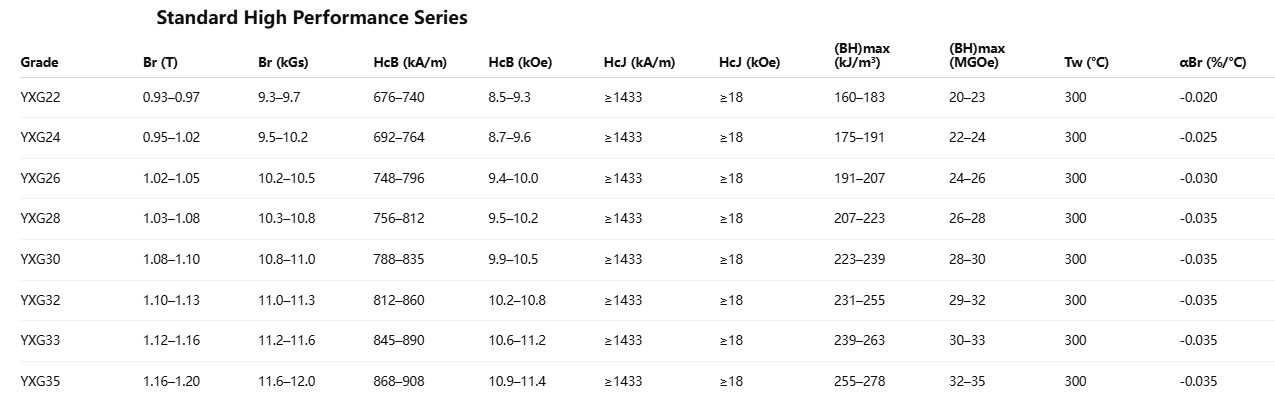
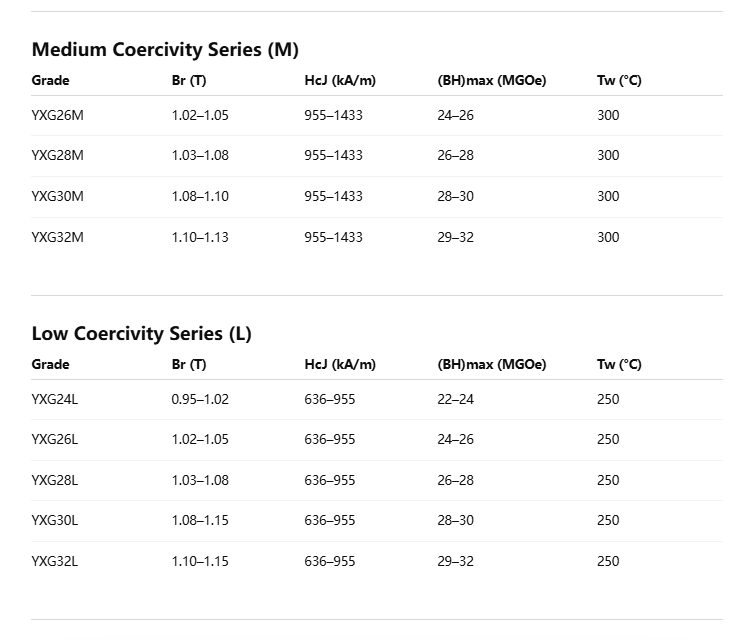
In terms of performance characteristics, samarium-cobalt permanent magnets can be broadly categorized into three series: the High-Performance Series, the High-Stability Series (featuring a low temperature coefficient), and the High-Temperature Resistance Series.


1:5 Type Samarium-Cobalt Magnets
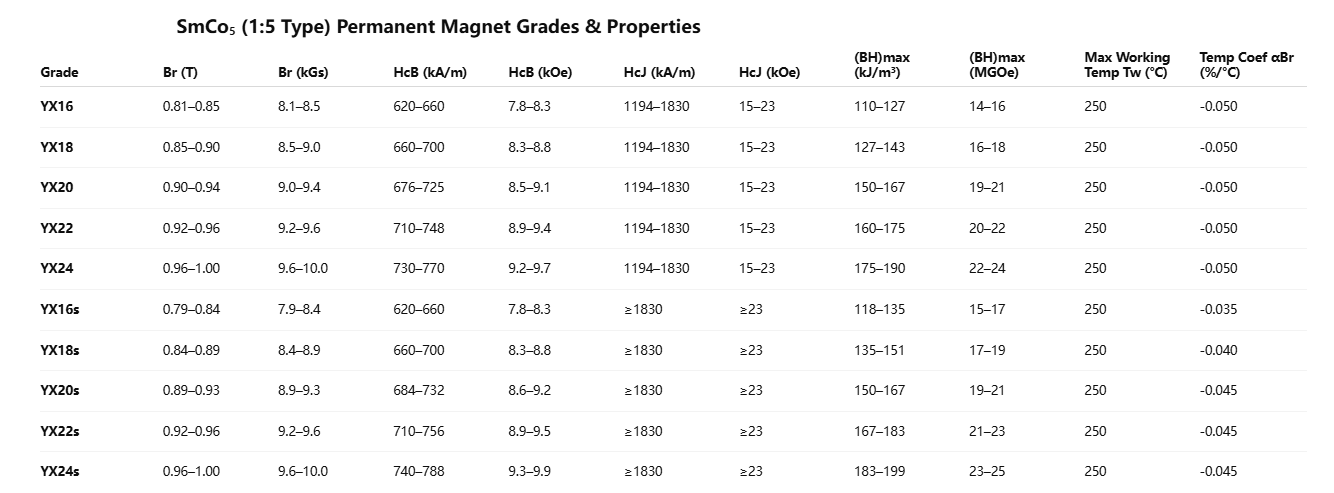
1:5 type samarium-cobalt magnets are also referred to as Samarium-Cobalt 5 or SmCo5. Across various grades, their maximum energy product ranges from 16 to 25 MGOe, and they possess a maximum operating temperature of 250°C. While their maximum energy product is lower than that of the 2:17 type samarium-cobalt, their mechanical properties and ductility are slightly superior to the 2:17 type. Consequently, they are well-suited for being machined into shapes and specifications that are difficult to produce using the 2:17 type—such as discs, squares, rings, and various complex or irregular geometries featuring particularly thin cross-sections or walls.
The magnetizing field required for 1:5 type samarium-cobalt magnets is lower than that for the 2:17 type; typically, a magnetic field of 40,000 Gauss is sufficient to achieve magnetic saturation, whereas high-coercivity 2:17 type samarium-cobalt magnets require a magnetizing field of 60,000 Gauss or higher. Furthermore, the composition of 1:5 type samarium-cobalt magnets contains a rare earth content of nearly 40%, resulting in a higher unit price compared to 2:17 type samarium-cobalt magnets.
Other Properties of Samarium-Cobalt Permanent Magnets
The national standards for the auxiliary electromagnetic properties and selected mechanical and physical properties of sintered rare-earth cobalt permanent magnet materials are as follows:
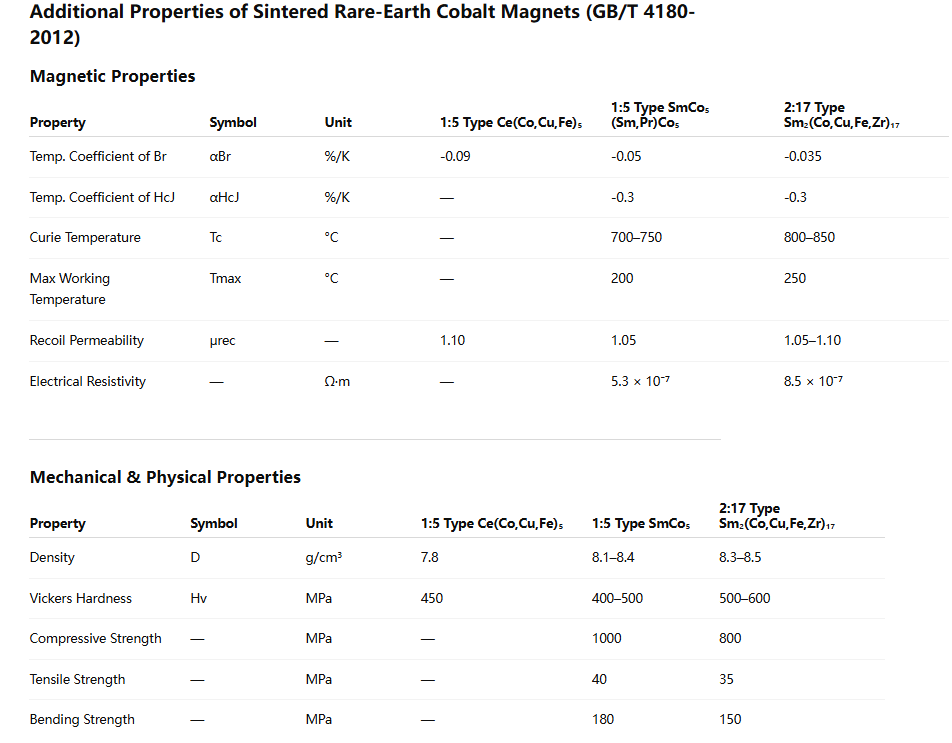
Due to variations in the organic binders and molding methods employed for bonded rare-earth cobalt permanent magnets, their magnetic and material properties exhibit significant differences; consequently, the state has not established a unified standard for them.
Differences Between Samarium-Cobalt and Neodymium-Iron-Boron Magnets
In Neodymium-Iron-Boron (NdFeB) permanent magnets, the rare-earth metal neodymium accounts for approximately 29% to 32.5%; the metallic element iron accounts for 64% to 69%; and the non-metallic element boron accounts for 1.1% to 1.2%. Additionally, small amounts of other elements—such as dysprosium, terbium, niobium, and copper—are added.
For Samarium-Cobalt (SmCo) magnets—taking the 2:17 type as an example—the rare-earth metal samarium accounts for 23% to 28%; the metallic element cobalt accounts for 48% to 52%; and the metallic element iron accounts for 14% to 17%. Furthermore, small amounts of other elements, such as copper and zirconium, are present.
As indicated by the performance tables mentioned previously, the overall magnetic properties of Samarium-Cobalt permanent magnets are generally lower than those of Neodymium-Iron-Boron permanent magnets. An examination of the elemental ratios in both types reveals that NdFeB magnets possess the highest iron content, whereas SmCo magnets consist of approximately 70% samarium and cobalt. Consequently, when comparing two magnets—one SmCo and one NdFeB—of identical magnetic energy product and volume, the price of the SmCo magnet is typically slightly higher.
The operating temperature range for Neodymium-Iron-Boron permanent magnets is between 80°C and 220°C, whereas the operating temperature for Samarium-Cobalt permanent magnets can reach 250°C to 350°C.
Due to their high iron content, Neodymium-Iron-Boron magnets are susceptible to oxidation and corrosion; therefore, surface treatment is an essential process. The service life of these magnets depends largely on the effectiveness of the protective coating. In contrast, Samarium-Cobalt magnets contain a lower proportion of iron and are composed primarily of metallic elements that are inherently resistant to oxidation and corrosion. Under normal circumstances, surface treatment is not required for SmCo magnets; plating is typically applied only when the operating environment is particularly harsh or when an enhanced aesthetic appearance is desired