This neodymium disc magnets guide explains how NdFeB disc magnets work, how to choose the right dimensions, and the differences between axial and diametrical magnetization.
Neodymium disc magnets are compact permanent magnets used in sensors, motors, electronics, industrial fixtures, and magnetic assemblies. Their performance depends on magnet size, grade, magnetization direction, operating temperature, and installation conditions.
Looking for standard sizes? Browse our neodymium disc magnets and compare available diameters, thicknesses, and pull-force specifications.
For specialized dimensions, magnetic grades, coatings, or magnetization requirements, explore our custom magnet manufacturing services.
Neodymium disc magnets are cylindrical NdFeB permanent magnets with two flat circular faces. In typical disc magnets, the diameter is greater than the thickness.
When the length or thickness equals or exceeds the diameter, the magnet is often described as a cylinder or rod magnet. NEOMAG groups both shapes within its disc magnet product range for convenient selection.
Most standard disc magnets use axial magnetization, with the north and south poles located on opposite flat faces. Diametrically magnetized versions can also be considered for specialized custom applications.
For additional information about the rare earth materials used in NdFeB permanent magnets, see the U.S. Geological Survey's rare earths reference.
Our standard Disc Series covers small craft-grade discs through large industrial holding magnets. Typical published specifications:
| Parameter | Standard stock | Custom capability |
|---|---|---|
| Diameter | 4 mm – 80 mm (0.157" – 3.150") | Outside this range on request |
| Thickness | 2 mm – 20 mm (0.079" – 0.787") | Outside this range on request |
| Dimensional tolerance | ±0.3 mm to ±2.0 mm, scaling with part size | Tighter tolerances on request |
| Grade | N35 – N52 | Grade selected to the application |
| Max operating temperature | 80 °C (176 °F) standard | Up to 200 °C with high-coercivity grades |
| Coating | Ni-Cu-Ni (nickel-copper-nickel) | Epoxy, zinc, gold, parylene, rubber overmould |
| Magnetization | Axial | Diametrical, multi-pole |
| Stock | Selected sizes held in Redlands, CA | Made-to-order |
Always confirm availability for the exact size and quantity you need before you commit to a production schedule.
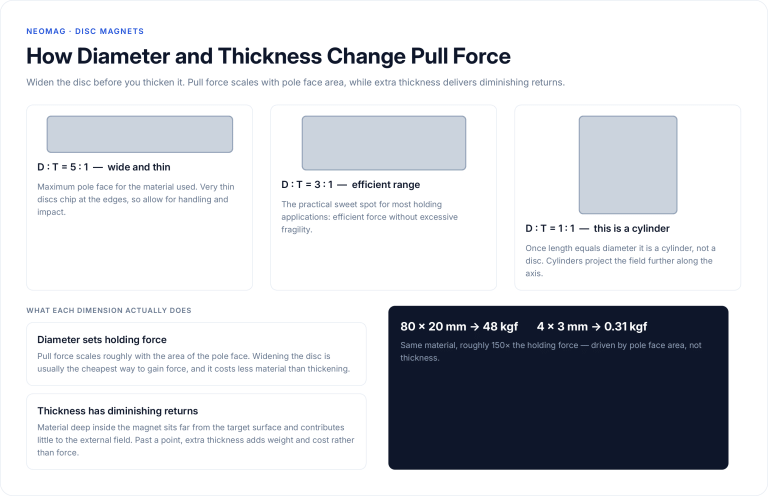
Diameter and thickness do different jobs. Understanding the difference is the fastest way to avoid over-specifying a magnet.
Published figures from our own catalog illustrate the point:
| Size (D × T) | Weight | Pull force | Surface gauss |
|---|---|---|---|
| 4 × 2 mm | 0.2 g | 0.68 lb (0.31 kgf) | ~2,200 Gs |
| 4 × 3 mm | 0.3 g | 0.68 lb (0.31 kgf) | ~2,300 Gs |
| 80 × 20 mm | 652 g | 105.82 lb (48 kgf) | ~1,100 Gs |
The 80 mm disc reads the lowest surface gauss of the three yet holds roughly 150 times more — because its pole face covers a far larger area. And at the 4 mm size, going from 2 mm to 3 mm thick changes the published pull force very little. If you need more force, widen the disc before you thicken it.
Treat published pull force as a comparative reference, not a design value. Real holding force depends on the mating material, surface finish, air gap, temperature and the magnetic circuit around the magnet. Test in your own assembly.
The grade number broadly indicates the maximum energy product: a higher number means more magnetic energy from the same volume. But grade alone does not tell you how much heat the magnet can take — that is what the temperature suffix is for.
| Grade family | Max operating temperature |
|---|---|
| N (N35 – N52) | 80 °C / 176 °F |
| M | 100 °C / 212 °F |
| H | 120 °C / 248 °F |
| SH | 150 °C / 302 °F |
| UH | 180 °C / 356 °F |
| EH | 200 °C / 392 °F |
Standard stock discs are typically N-grade with an 80 °C limit. If your assembly runs warm — inside a motor, an enclosure, or anywhere near a heat source — the temperature suffix matters more than the grade number. A standard-grade magnet that overheats loses magnetism permanently, no matter how strong it was at room temperature. See Curie temperature vs operating temperature for why the two are not the same thing.
For reference on energy product: N35 falls in the 263–287 kJ/m³ range, N42 in 318–342 kJ/m³, and N52 in 398–422 kJ/m³. If you are weighing grades against each other, our neodymium magnet grades guide and the N35 vs N42 vs N52 comparison go deeper.
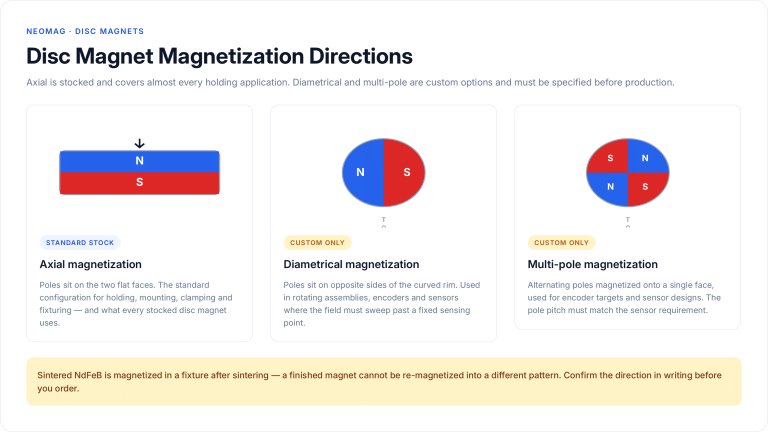
Getting the magnetization direction right is one of the few decisions on a disc magnet that cannot be corrected after production. Confirm the direction in writing before you order. See orientation and magnetization of NdFeB magnets for the underlying principle.
Because sintered NdFeB is fully magnetized in a fixture after sintering, a finished magnet cannot be re-magnetized into a different pattern. Ordering the wrong direction means replacing the parts.
Disc magnets are supplied plated because bare NdFeB corrodes quickly in humid air. Standard stock is Ni-Cu-Ni — a triple-layer nickel-copper-nickel deposit that gives a bright silver finish and good protection in dry, indoor environments.
Where the environment is humid, wet or chemical-exposed, or where the part sees impact, a different finish is usually the better call: epoxy, nickel-plus-epoxy duplex, parylene, gold over nickel, or a rubber overmould.
Coating also consumes dimensional tolerance — a disc diameter grows by roughly twice the coating thickness, so state whether your dimensions are before or after coating. Our neodymium magnet coatings guide compares thickness, salt spray performance and temperature limits, and how to select a coating for NdFeB magnets walks through the decision.
| Disc magnet | Cylinder / rod magnet | |
|---|---|---|
| Proportion | Thickness < diameter | Length ≥ diameter |
| Field concentration | Broad, flat pole faces | Field reaches further along the axis |
| Best for | Surface holding, mounting, clamping, sensing | Deep-reach applications, probes, push/pull along an axis |
| Typical examples | Cabinet catches, fixtures, speaker drivers, sensor targets | Retrieval tools, plungers, linear actuators |
Both are stocked in the NEOMAG Disc Series. If your holding surface is flat and you need maximum contact area, choose a disc. If you need the field to project further from the magnet body, or the part must fit a deep bore, a cylinder is usually the better geometry. For a full comparison across shapes, see neodymium magnet shapes — or jump to our block magnets, ring magnets and countersunk magnets pages.
Industrial holding and fixturing — workholding, magnetic chucks, jigs, positioning and assembly fixtures. Larger discs provide substantial holding force for machining and production tooling.
Motors, actuators and drives — small motors, actuators, and voice-coil assemblies where a flat, uniform field is required across a defined gap.
Sensors and detection — reed switches, Hall effect sensors and position sensing. The consistent field across the flat face makes disc magnets predictable in sensing applications; diametrically magnetized discs are used where the field must sweep past a sensor.
Speakers and audio — driver assemblies, where the flat face delivers a uniform field across the voice coil gap.
Consumer electronics — compact speakers, vibration motors and magnetic connectors, where space constraints make high-grade NdFeB the practical option.
Magnetic separation and filtration — capturing ferrous contamination in processing lines.
R&D and prototyping — laboratory rigs, engineering test beds and product development, where quick access to a range of stocked sizes shortens iteration cycles.
Craft, retail and light assembly — closures, holders, signage and POS fixtures. For distributors and retail buyers, stocked standard sizes and bulk packaging are usually the deciding factors.
More detail in 15 key industrial NdFeB magnet applications.
Include the following on an enquiry and you will get a quote back faster, with fewer clarification rounds:
Our guide to specifying custom neodymium magnets covers the eight decisions in detail, and how to describe a magnet procurement requirement explains what your drawing should show.
U.S. stock and fast fulfillment. Selected in-stock disc magnets ship from our warehouse in Redlands, California, giving U.S. customers shorter lead times and simpler logistics.
Bulk supply for distributors and OEMs. We support volume buyers with repeatable inventory and scheduled supply rather than one-off shipments. If you are weighing stocked sizes against made-to-order, see standard vs custom neodymium magnets.
Inspection before shipment. Every order is checked for dimensions, magnetic performance, coating quality and batch consistency, with batch traceability retained.
Custom manufacturing. Non-standard sizes, tighter tolerances, special magnetization directions, alternative coatings and complete magnetic assemblies.
Custom packaging. Packaging specified for safe handling, protection in transit and retail-ready presentation.
Twenty years in NdFeB. Technical support on grade, geometry and coating selection before you commit to tooling or volume. About NEOMAG.
Axial magnetization places the poles on the top and bottom flat faces. It is the standard configuration for holding and mounting, and it is what all NEOMAG stock products use. Diametrical magnetization places the poles on the curved sides and is used in rotating systems, encoders and specialised sensor designs. Diametrical is a custom option — see orientation and magnetization of NdFeB magnets.
Standard Disc Series sizes run from approximately 4 mm to 80 mm in diameter and 2 mm to 20 mm in thickness, with tolerance scaling to part size. Availability varies by size and quantity, so confirm current stock for the exact part you need.
Increase diameter first. Pull force scales roughly with pole face area, while extra thickness delivers diminishing returns because material deep inside the magnet contributes little to the external field. A thin, wide disc usually outperforms a thick, narrow one of the same volume.
N35 to N52 covers most requirements. Choose the grade from the magnetic output you need within your available space, then check the temperature suffix against your actual operating temperature. In warm assemblies the temperature rating matters more than the grade number — see N35 vs N42 vs N52 and the N52 magnet guide.
Standard N-grade discs are rated to 80 °C (176 °F). With high-coercivity grades we can supply parts rated to 100 °C, 120 °C, 150 °C, 180 °C or 200 °C. Exceeding the rating causes permanent loss of magnetism. See Curie temperature and operating temperature.
No. Sintered NdFeB is hard and brittle; cutting or drilling can fracture the part, and the heat and mechanical shock can demagnetise it. Machining also removes the coating and exposes the material to corrosion. Order the size you need instead — see common processing methods for neodymium magnets.
Ni-Cu-Ni is the standard stock finish and is suitable for dry indoor environments. For humid, wet, chemical-exposed or high-impact conditions, consider epoxy, nickel-plus-epoxy duplex, parylene or a rubber overmould. Our coating selection guide compares thickness, corrosion resistance and temperature limits.
No. Diametrical and multi-pole magnetization are custom options. Share the pole pattern and drawing so we can evaluate the requirement and quote lead time.
Yes. We work with distributors, OEMs and industrial buyers on standard products, bulk supply and custom manufacturing. Send the specification, estimated quantity and purchasing requirements for review — see standard vs custom neodymium magnets.
Avoid strong impacts, keep magnets away from electronic devices and magnetically sensitive media, and watch for pinch hazards — larger discs in particular. Use protective gloves when handling big parts, and store discs with separators so they do not slam together.
Whether you need stocked standard sizes shipped this week or a custom geometry built to drawing, NEOMAG can supply it. Browse the Disc Series and filter by size, or request a quote with your diameter, thickness, grade, coating and quantity.