No products in the cart.
Permanent magnet materials—also known as hard magnetic materials—refer to substances that are difficult to magnetize and, once magnetized, are equally difficult to demagnetize. Their primary characteristic is high coercivity. Representing one of the most critical categories within the realm of magnetic materials, we shall begin our journey into this fascinating world by starting with permanent magnets.
Permanent Magnet Materials
│
├── Rare Earth Permanent Magnets
│ │
│ ├── Samarium-Cobalt Magnets (Sm-Co)
│ │ ├── SmCo5 → Discovered in 1967 (1st Generation Rare Earth Magnet)
│ │ └── Sm2Co17 → Discovered in 1977 (2nd Generation Rare Earth Magnet)
│ │
│ ├── Neodymium-Iron-Boron Magnets (NdFeB)
│ │ ├── Sintered NdFeB
│ │ ├── Bonded NdFeB
│ │ └── Injection-Molded NdFeB
│ │ → Discovered in 1983 (3rd Generation Rare Earth Magnet)
│ │
│ └── Rare Earth Iron Nitride Magnets (R-Fe-N)
│ → Under Development
│ → Discovered in 1990 (4th Generation Rare Earth Magnet)
│
├── Ferrite Permanent Magnets
│ ├── Barium Ferrite
│ └── Strontium Ferrite
│
├── Metallic Permanent Magnets
│ ├── AlNiCo Alloys
│ └── FeCrCo Alloys
│
└── Composite Permanent Magnets
Rare earth permanent magnet materials constitute one of the most critical categories of magnetic products. Since their inception in the 1960s, three generations of these materials have successfully reached mass production and commercial application; meanwhile, the fourth generation—rare earth iron-nitrogen permanent magnets—is currently in the research and development phase and holds the potential to emerge as the next generation of rare earth permanent magnet products.
The first and second generations of permanent magnets—based on samarium-cobalt (Sm-Co)—are fabricated using powder metallurgy techniques. Their primary raw materials are samarium and cobalt; however, given their high cost—and the fact that cobalt is classified as a strategic resource—the mass production and large-scale deployment of Sm-Co magnets have faced significant constraints, preventing them from achieving widespread adoption. Consequently, their application has remained largely confined to the aviation, aerospace, and defense industries.
The successful development of the third generation of rare earth permanent magnets—neodymium-iron-boron (Nd-Fe-B)—marked a milestone of profound significance. Not only do these magnets exhibit astonishingly superior performance characteristics and record-breaking maximum energy products, but they also utilize inexpensive, abundant iron and neodymium to replace costly strategic materials (such as cobalt) and scarce resources (such as samarium). The combination of high quality and low cost inherent in Nd-Fe-B magnets—coupled with their immense production potential and broad prospects for application—has created a tremendous stir among magnet researchers and manufacturers worldwide. Since Masato Sagawa and his team in Japan first announced the discovery of Nd-Fe-B magnets in 1983, records regarding their various performance parameters have been repeatedly broken, and these magnets have frequently served as a central topic of discussion at international academic conferences.
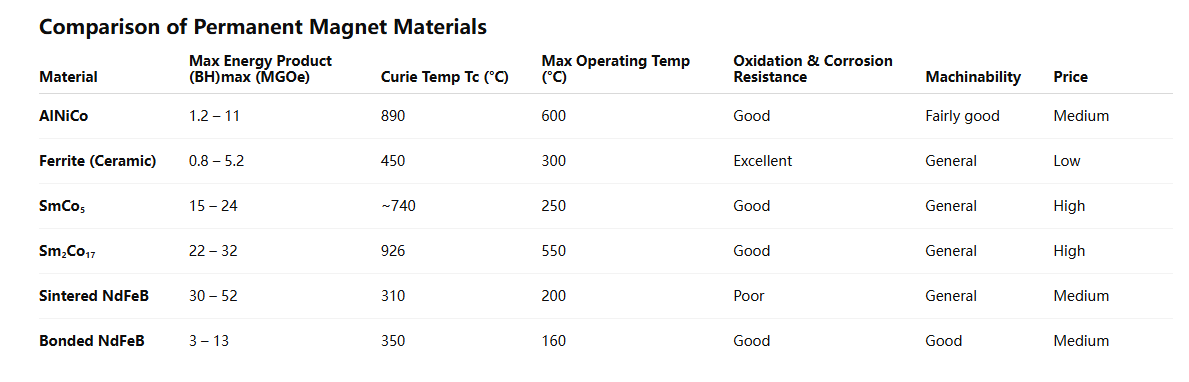
NdFeB is currently the most cost-effective rare earth permanent magnet material; while sintered NdFeB exhibits superior magnetic properties compared to bonded NdFeB, bonded NdFeB offers better machinability.