
No products in the cart.
A circular Halbach array is a specialized magnetic structure designed by assembling multiple magnets—identical in shape but varying in magnetization direction—into a ring formation; this configuration serves to enhance the uniformity and stability of the magnetic field at the working surface or within the central region. Permanent magnet motors utilizing a Halbach array structure exhibit an air-gap magnetic field distribution that more closely approximates a pure sinusoid compared to traditional permanent magnet motors. Given an equal volume of permanent magnet material, Halbach permanent magnet motors achieve a higher air-gap magnetic flux density and incur lower iron losses. Furthermore, circular Halbach arrays are widely employed in various applications, including permanent magnet bearings, magnetic refrigeration systems, and magnetic resonance equipment.
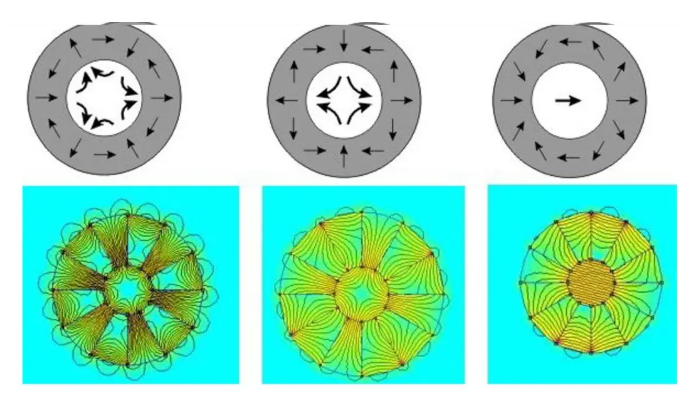
Annular Halbach magnet arrays offer the following advantages:
1. **Powerful Magnetic Fields:** The annular design of Halbach magnets allows the magnetic field to be concentrated and focused throughout the entire ring structure. Compared to conventional magnets, these annular magnets are capable of generating magnetic fields of significantly higher intensity.
2. **Space Efficiency:** The ring-shaped structure of annular Halbach magnets enables the magnetic field to loop within a closed circular path, thereby minimizing the physical space occupied by the magnet. This makes annular magnets particularly convenient for installation and use in space-constrained environments.
3. **Uniform Magnetic Field Distribution:** Due to their unique structural design, annular Halbach magnets exhibit a relatively uniform distribution of the magnetic field along the circular path. This implies that, during operation, variations in magnetic field strength remain minimal, thereby enhancing the overall stability of the magnetic field.
4. **Multipole Magnetic Fields:** The design of annular Halbach magnets facilitates the generation of multipole magnetic fields, enabling the realization of more complex magnetic field configurations for specific applications. This provides greater flexibility and operational versatility for experiments and applications with specialized requirements.
1.**Energy Efficiency and Environmental Friendliness:** Annular Halbach magnets are typically constructed using materials characterized by high energy conversion efficiency. Furthermore, through rational design and the optimization of the magnetic circuit structure, energy waste can be minimized, thereby achieving the objectives of energy conservation and environmental protection.
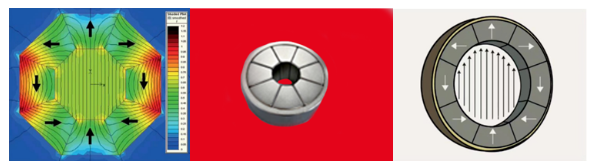
Under traditional manufacturing processes, the application of various Halbach arrays typically involves a method of pre-magnetization followed by assembly. However, due to the complex and variable directional forces acting between individual magnets within a Halbach permanent magnet array—coupled with the requirement for high assembly precision—the assembly of pre-magnetized magnets often necessitates the use of specialized molds. In contrast, "integral magnetization" technology adopts an "assemble-first, magnetize-later" approach; since the permanent magnets remain unmagnetized during assembly, Halbach arrays can be assembled without the need for custom-made molds. Furthermore, integral magnetization technology enhances magnetization efficiency, reduces energy costs, and mitigates assembly risks, thereby holding immense promise for future applications. Nevertheless, due to the significant technical challenges involved, this technology currently remains in an exploratory phase, and the prevailing market standard continues to rely on the traditional method of pre-magnetization followed by assembly.
The primary application scenarios for toroidal Halbach magnets include the following areas:
1. **Medical Imaging:** Toroidal Halbach magnets are frequently utilized in medical imaging equipment, such as Magnetic Resonance Imaging (MRI) systems. These magnets generate stable magnetic fields used to align and excite atomic nuclei within the subject being scanned, thereby enabling the acquisition of high-resolution image data.
2. **Particle Accelerators:** Toroidal Halbach magnets also find application in particle accelerators, where they serve to guide and control the trajectories of high-energy particles. By generating powerful magnetic fields, these magnets can alter the orbits and velocities of particles, thereby facilitating particle acceleration and focusing.
3. **Toroidal Motors:** Toroidal Halbach magnets are also incorporated into motor designs to generate driving torque. By modulating the direction and magnitude of the electric current, these magnets create varying magnetic fields that drive the rotation of the motor.
4. **Laboratory Research:** Toroidal Halbach magnets are commonly employed in physics laboratories to generate stable and uniform magnetic fields for conducting research in fields such as magnetism and materials science.
When selecting a toroidal Halbach magnet, the following key factors require careful consideration:
1. **Magnetic Field Requirements:** Based on specific practical needs, determine the required magnetic field strength of the magnet to ensure it meets the application's performance criteria. This determination will dictate the appropriate choice regarding the magnet's size, material composition, and design.
2. **Dimensional Constraints:** Account for the spatial limitations of the magnet's installation environment to determine the appropriate outer diameter, inner diameter, and height, thereby ensuring that the selected magnet is a suitable fit for the intended application. 3. Temperature Requirements: Determine the maximum operating temperature limit for the magnet to facilitate the selection of appropriate materials and cooling measures.
4. Corrosion Resistance: Assess the magnet's resistance to corrosion in specific environments, and select suitable materials and coatings to ensure its protection.
5. Stability Requirements: For applications requiring a stable magnetic field, select magnets characterized by high magnetic field stability and a low rate of magnetic field drift.
6. Magnet Weight: Based on the requirements of the specific application scenario, consider the weight constraints of both the magnet and its outer assembly to facilitate ease of installation and transportation.
7. Cost-Effectiveness: Evaluate the magnet's performance in relation to its price to select the most cost-effective option that optimally fulfills the application's requirements.
It should be noted that the points listed above represent only the general considerations for selecting a ring-shaped Halbach array magnet; specific model selection requires a precise analysis and decision-making process tailored to the unique requirements and circumstances of the intended application.