No products in the cart.
The application scenarios for NdFeB permanent magnets can be broadly categorized into attraction, repulsion, sensing, and electromagnetic conversion; however, the specific requirements for magnetic fields vary significantly across different applications.
🔹 In 3C products, internal space is extremely limited, yet high magnetic attraction strength is often required. Since the spatial constraints preclude increasing the physical size of the magnets, magnetic field strength must be enhanced through optimized magnetic circuit design.
🔹 In applications requiring magnetic field sensing, excessively divergent magnetic flux lines can trigger false readings in Hall sensors; therefore, magnetic circuit design is essential to precisely control and confine the magnetic field's spatial range.
🔹 In scenarios where one side of a magnet requires high attraction strength while the other side requires magnetic shielding—to prevent interference with adjacent electronic components—magnetic circuit design is again indispensable for resolving this issue and ensuring that the magnetic field on the shielded side remains within acceptable limits.
🔹 Other scenarios include those requiring precise positioning capabilities, uniform magnetic fields, and various other specific functional requirements.
In all the aforementioned situations, relying solely on a single, monolithic magnet makes it difficult to fully satisfy operational requirements. Furthermore, particularly when the market prices for rare earth elements are high, the physical volume and quantity of magnets used can significantly impact a product's overall manufacturing cost. Consequently, by strategically modifying the magnetic circuit structure—while still ensuring adequate attraction strength and normal functionality—we can effectively adapt the magnets to suit diverse application scenarios while simultaneously reducing the volume of magnetic material required, thereby lowering costs.
Common magnetic circuit configurations generally fall into categories such as Halbach Arrays, multipolar circuits, focusing circuits, designs incorporating flux-conducting materials, flexible transmission systems, single-sided magnets, and flux-concentrating structures. We will now introduce each of these concepts in turn:
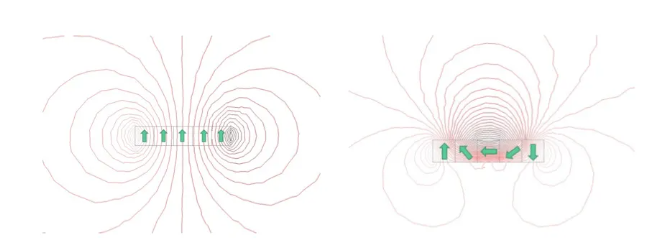
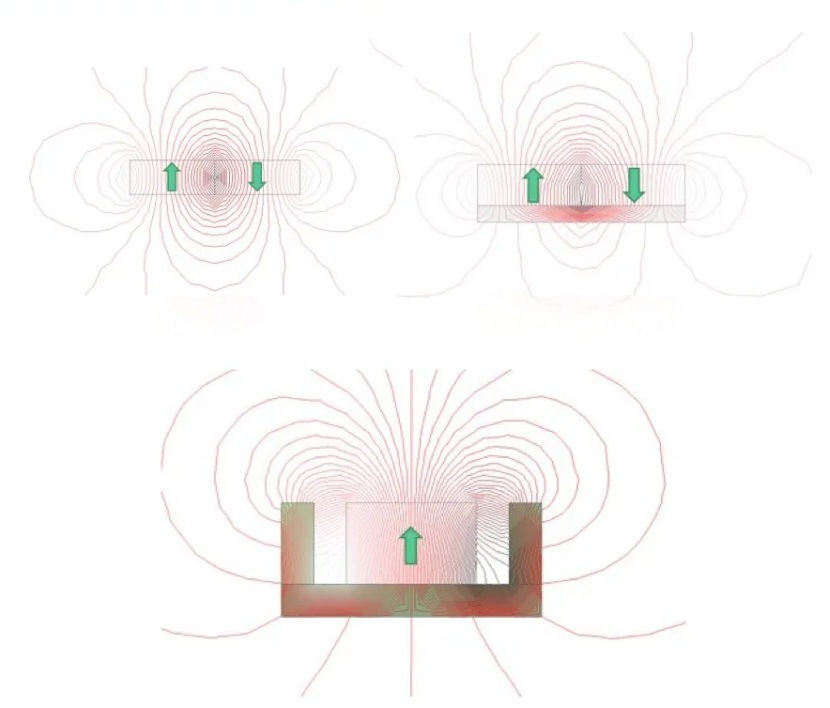
This represents a structure that is considered nearly ideal from an engineering perspective, with the primary objective of generating the strongest possible magnetic field using the minimum amount of magnetic material. Due to the unique configuration of the Halbach Array's magnetic circuit, the majority of the magnetic flux lines circulate internally within the magnetic assembly itself. This internal circulation minimizes magnetic leakage, thereby achieving flux concentration and creating a "self-shielding" effect in the non-working regions. Through optimized ring-shaped Halbach circuit designs, it is possible to achieve up to 100% magnetic shielding in the non-working areas. As illustrated in the accompanying figure, the flux lines in conventional magnetic circuits typically diverge symmetrically; in contrast, the flux lines within a Halbach Array are predominantly concentrated within the designated working region, resulting in significantly enhanced magnetic attraction force.
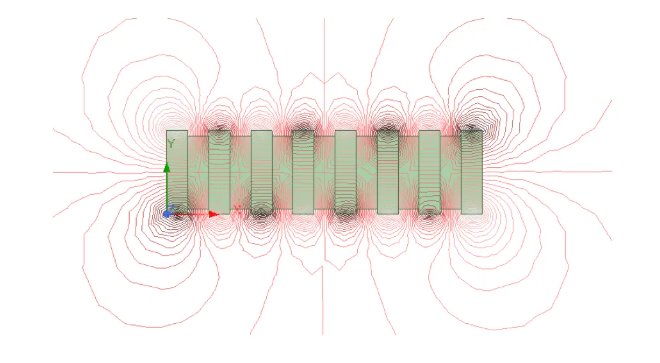
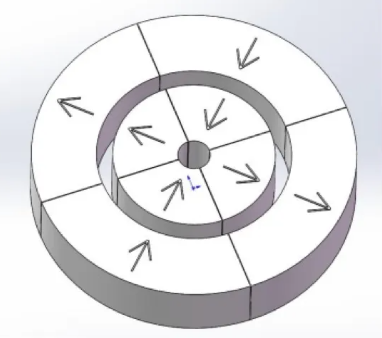
Multipole magnetic circuits primarily leverage the characteristic tendency of magnetic flux lines to preferentially seek the nearest opposing pole to form a closed magnetic loop. Compared to standard unipolar magnets, the magnetic flux lines (and thus the magnetic field) in multipole circuits are significantly more concentrated at the surface—a phenomenon that becomes increasingly pronounced as the number of poles increases. Multipole magnetic circuits generally fall into two categories: those created by applying a multipole magnetization pattern to a single magnet, and those formed by assembling an array of individual unipolar magnets. The distinction between these two methods lies primarily in their manufacturing cost; functionally, however, they are identical. Multipole magnetic circuits demonstrate a particularly distinct advantage in applications involving short-distance attraction.
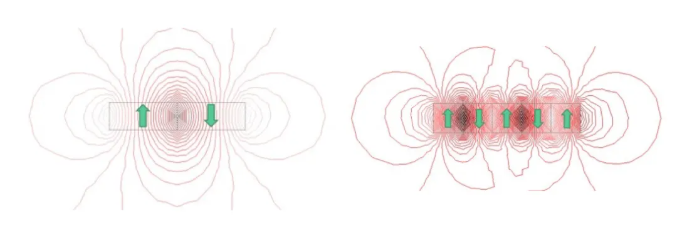
A focusing magnetic circuit utilizes a specialized magnetic path configuration to concentrate the magnetic field within a small region. This results in an intensely strong magnetic field—potentially reaching up to 1 Tesla—which significantly facilitates precise positioning and localized sensing.
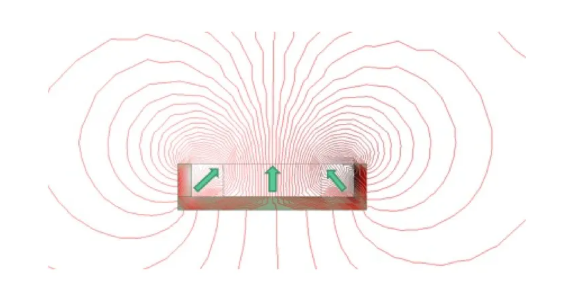
Magnetically conductive materials leverage the principle that magnetic field circuits preferentially follow the path of least magnetic resistance. By utilizing highly permeable materials—such as SUS430, SPCC, and DT4—within a magnetic circuit, the direction of the magnetic field can be effectively guided, thereby achieving localized magnetic concentration and magnetic shielding effects.
The defining characteristics of flexible transmission are its non-contact nature—achieved through the magnetic forces of attraction and repulsion—its compact size, and its simple structure. Furthermore, the torque can be varied by adjusting the size of the magnets and the air gap, offering a wide range of adjustability.
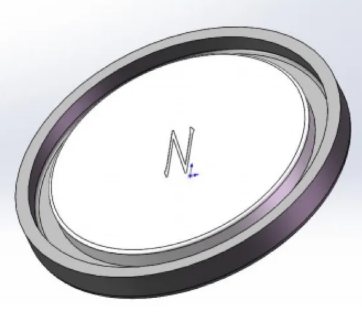
Single-sided magnets are characterized by their ability to shield the magnetic polarity on one side while retaining it on the other. They exert a strong attractive force when in direct contact; however, their magnetic strength attenuates significantly as the distance increases.
Characterized by an arrangement in which magnets and yokes are positioned relative to one another according to their polarity, this structure exhibits reduced magnetic flux divergence as the ratio of magnet thickness to yoke thickness increases—specifically, the thicker the yoke, the less the flux diverges. The magnetic flux concentration structure can be flexibly designed to suit specific air-gap dimensions, thereby achieving optimal performance; it effectively conserves magnet material and ensures a uniform distribution of the magnetic field along the yoke. However, its primary drawback is the relatively high cost of assembly.