
No products in the cart.
Do you know that magnets can suffer permanent demagnetization when exposed to temperatures beyond a certain limit? Different magnets have different maximum operating temperatures. So, what temperature-related parameters should be considered? And how do you select the right magnet based on operating temperature? This article can address these questions.
Curie Temperature
When discussing the relationship between temperature and magnetism, we first need to understand the concept of the Curie temperature. The term may sound familiar—it is indeed related to Pierre Curie.
Over 200 years ago, a renowned physicist discovered that when a magnet is heated to a certain temperature, it loses its magnetism. This scientist was Pierre Curie, the husband of Marie Curie. This critical temperature was later named the Curie point or Curie temperature (Tc), also known as the magnetic transition temperature.
Definition:
The Curie temperature is the temperature at which a magnetic material transitions between ferromagnetic and paramagnetic states. Below the Curie temperature, the material is ferromagnetic; above it, the material becomes paramagnetic. The Curie temperature depends on the material’s composition and crystal structure.
Above the Curie Temperature:
Thermal motion within the material becomes intense, destroying magnetic domains. As a result, ferromagnetic properties—such as high permeability, hysteresis behavior, and magnetostriction—disappear. The magnet undergoes irreversible demagnetization. Although it can be re-magnetized, a significantly higher magnetizing voltage is required, and the restored magnetic performance may not reach the original level.
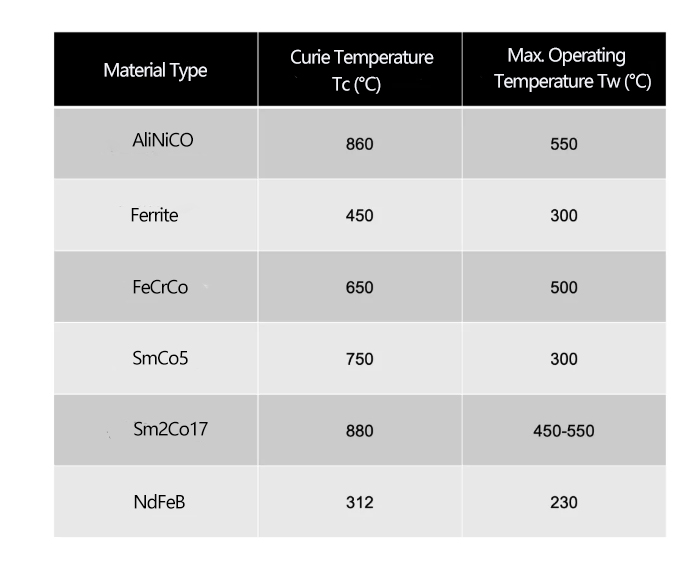
The Curie temperature is of significant importance in practical applications. In the selection of magnetic materials—especially soft magnetic materials—for devices that must retain ferromagnetism at specific temperatures, choosing a material with an appropriate Curie temperature can enhance stability and reliability.
Operating Temperature
Operating temperature (Tw) refers to the temperature range a magnet can withstand in actual applications. Due to differences in thermal stability, different materials have different operating temperatures. The maximum operating temperature of a magnet is much lower than its Curie temperature. Within the operating range, magnetic strength decreases as temperature rises, but most of it recovers after cooling.
Relationship between Operating Temperature and Curie Temperature:
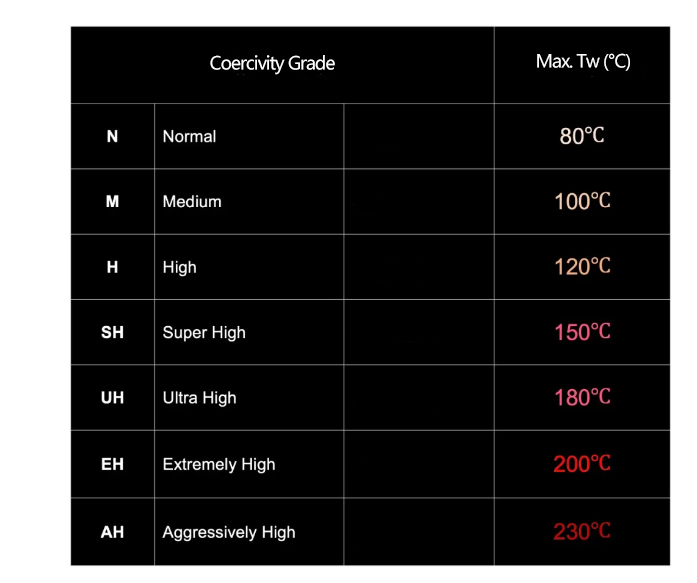
A higher Curie temperature generally corresponds to a higher operating temperature and better thermal stability. For sintered NdFeB magnets, adding elements such as cobalt (Co), terbium (Tb), and dysprosium (Dy) can increase the Curie temperature. Therefore, high-coercivity grades (e.g., H, SH, etc.) typically contain added Dy.
For the same type of magnet, different grades may have different temperature resistance due to variations in composition and structure. For example, NdFeB magnets have maximum operating temperatures ranging from 80°C to 230°C depending on the grade.
Factors Affecting the Actual Operating Temperature of Magnets
1.Shape and Dimensions (Permeance Coefficient, Pc):
The geometry of the magnet, particularly its length-to-diameter ratio (Pc), has a significant impact on the actual maximum operating temperature. Not all H-grade NdFeB magnets can operate at 120°C without demagnetization. Some geometries may even experience demagnetization at room temperature. In such cases, a higher coercivity grade is required to increase the effective maximum operating temperature.
2.Magnetic Circuit Design (Degree of Closure):
The degree of magnetic circuit closure also affects the actual maximum operating temperature. For the same magnet, a more closed magnetic circuit results in a higher allowable operating temperature and more stable performance. Therefore, the maximum operating temperature is not a fixed value but varies with the magnetic circuit conditions.