No products in the cart.
As is widely known, the key parameters used to measure the performance of NdFeB magnets include residual induction (Br), normal coercivity (HcB), intrinsic coercivity (HcJ), and maximum energy product ((BH)max). In addition to these, the squareness of the intrinsic curve and the parameter Hk are two other metrics of significant interest to magnetic application engineers. Today, we will explore the meaning of these two indicators and the factors that influence them.
First, let us review the definition of the intrinsic curve—also known as the J-H demagnetization curve.
The full name of the intrinsic curve is the *intrinsic demagnetization curve*. When a permanent magnet material is magnetized under the influence of an external magnetic field, the resulting internal magnetic induction is termed the *intrinsic magnetic induction* (Bi), also referred to as *magnetic polarization* (J). The curve illustrating the relationship between the magnet's magnetic polarization (J) and the external magnetic field strength (H) reflects the changes in the permanent magnet material's intrinsic magnetic properties; this is known as the intrinsic demagnetization curve—or simply the *intrinsic curve*—and is also referred to as the *J-H demagnetization curve*. (Hereafter, this will be referred to collectively as the "demagnetization curve.")
On the demagnetization curve, the corresponding magnetic field strength at the point where the magnetic polarization (J) equals zero is defined as the *intrinsic coercivity* (HcJ). The value of the intrinsic coercivity serves as an indicator of the permanent magnet material's resistance to demagnetization.
**Knee Point (Hk)**
As is evident from the diagram, when the external magnetic field is gradually increased, the magnetic induction (or magnetic polarization) of the magnet decreases very slowly. However, once the external magnetic field exceeds a certain threshold, the magnet's magnetic induction begins to drop rapidly. Typically, the point on the demagnetization curve where Ji equals 0.9Br or 0.8Br is referred to as the "bending point" or "knee point" of the curve. The magnetic field strength corresponding to this point is denoted as Hk—also known as the *knee-point coercivity*. When the external magnetic field exceeds Hk, the magnet suffers irreversible performance degradation; this is precisely why the value of Hk is a subject of significant interest.
**Debate Regarding the Position of the Knee Point**
There has been considerable discussion, both domestically and internationally, regarding whether the bending point of the demagnetization curve should be defined at Ji = 0.9Br or Ji = 0.8Br. The IEC has adopted the definition of Hk proposed by M. Katter; however, this definition applies exclusively to NdFeB magnets with an intrinsic coercivity (HcJ) greater than 400 kA/m (5000 Oe). Under this standard, the value of Hk is designated as HDx, where *x* represents the percentage reduction along the B-axis. For instance, HD10 denotes the point where the HD value lies 10% below Br—that is, at the 0.9Br mark.
**Squareness (Q)**
We utilize the ratio of Hk to HcJ (i.e., Hk/HcJ) to quantify the "squareness" (Q) of the demagnetization curve. The value of Q falls within the range of 0 to 1; the closer Q is to 1, the more closely the demagnetization curve approximates a perfect square. Generally, a product is considered to meet quality standards only if its squareness value (Q) exceeds 0.9.
**The Relationship Between Squareness, Maximum Energy Product, and Recoil Permeability**
The relationship is expressed by the formula: Q = 4μ₀(BH)max / Jr². This equation demonstrates a positive correlation between the squareness (Q) and the maximum energy product [(BH)max] of NdFeB permanent magnet materials. In other words, assuming a constant residual induction (Br), a higher Q value corresponds to a higher maximum energy product; thus, the magnitude of the Q value ultimately determines the magnitude of the magnet's maximum energy product. Q = 1/μrec; the squareness factor Q is inversely proportional to the magnet's recoil permeability (μrec). The higher the value of Q, the closer the recoil permeability μrec approaches 1; this indicates that the material possesses a greater capacity to resist interference from external factors—such as external magnetic fields and ambient temperature fluctuations—and consequently exhibits superior stability.
Factors Influencing Magnet Squareness
Factors such as raw material purity, powder particle uniformity, and the specific processes employed in sintering and compaction all influence the squareness of NdFeB magnets. Specifically, abnormal grain growth or irregular grain morphology can lead to a reduction in the magnet's squareness. Researchers have investigated the impact of rare earth and oxygen content on the squareness of the demagnetization curves of sintered NdFeB magnets. They discovered that, under identical processing conditions, as the content of rare earth elements was progressively increased, the residual induction (Br) decreased, the intrinsic coercivity (Hcj) increased, and the maximum energy product ((BH)max) remained essentially unchanged; however, the squareness factor demonstrated a significant increase, rising from 92.72% to 98.80%.
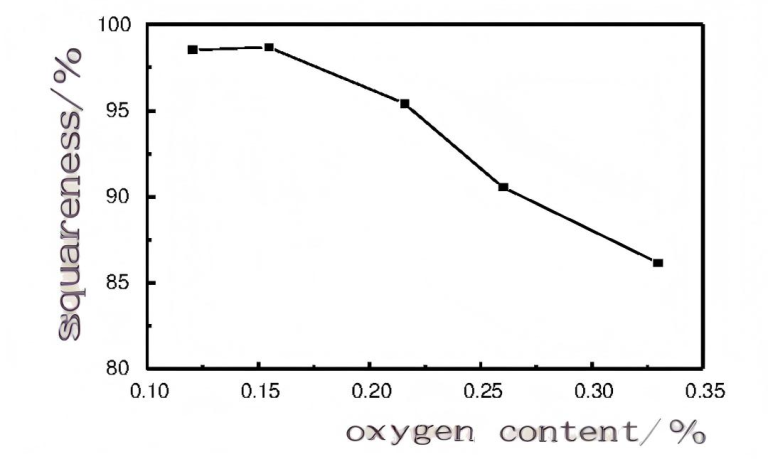
The samples were subjected to repeated trials; during the jet milling process, the system oxygen content was maintained at 0.01%, 0.02%, 0.03%, 0.04%, and 0.05%, respectively. The corresponding squareness values obtained were 98.53%, 98.68%, 95.41%, 90.55%, and 86.17%. These samples were designated as 3-1#, 3-2#, 3-3#, 3-4#, and 3-5#, respectively; the relationship between squareness and the oxygen content of the magnets is illustrated in the figure.