
No products in the cart.
Many of you may have a common question: do magnets of identical performance and volume exert the same attractive force? Claims circulating online suggest that the pulling force of a Neodymium-Iron-Boron (NdFeB) magnet is 640 times its own weight—is this credible?
This inquiry can actually be broadened to address a more fundamental question: what factors determine a magnet's attractive force? First, it is essential to clarify that magnets exert an attractive force only upon ferromagnetic substances. At room temperature, there are only three such materials—iron, cobalt, and nickel—along with their respective alloys; magnets exert no attractive force on non-ferromagnetic materials.
One can find various formulas online for calculating magnetic attraction:
F = k * B² * S / 2
F = 0.577 * S * B²
Are these formulas accurate? The answer is no—they are not precise. However, the underlying trend they illustrate is correct: the magnitude of a magnet's attractive force is directly correlated with both its magnetic field strength and the surface area of contact. The stronger the magnetic field and the larger the contact area, the greater the attractive force.
This leads to the next question: if we have magnets of equal volume—but varying shapes (e.g., flat, cylindrical, or slender)—will their attractive forces be identical? If not, which shape generates the strongest attraction?
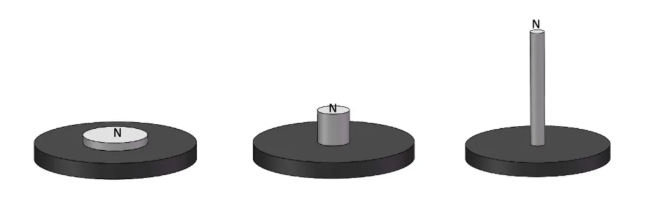
First and foremost, it is certain that not all magnets possess the same level of suction force. To determine which type of magnet exerts the greatest suction, we must refer to the definition of the "maximum energy product." A magnet possesses its maximum capacity for performing work—its maximum working energy—when its operating point is situated near this maximum energy product. Since a magnet's attractive force is a manifestation of this capacity to perform work, the corresponding suction force is likewise at its maximum. It is crucial to note here that the object being attracted must be sufficiently large—specifically, large enough to completely cover the magnet's pole face—so that the suction force remains unaffected by factors such as the object's material composition, dimensions, or shape.
How, then, can we determine whether a magnet's operating point is situated at or near the point of maximum energy product? When a magnet is in direct contact with the material it is attracting, its suction force is determined by the magnitude of the magnetic field within the air gap and the surface area of contact. Taking a cylindrical magnet as an example: when the ratio of height to diameter (H/D) is approximately 0.6, the magnet's permeance coefficient (Pc) at its center approaches 1; under these conditions—where the operating point lies near the maximum energy product—the suction force is maximized. This observation aligns with the general design principle for magnets intended for use as fasteners or attractors, which are typically engineered with a relatively flat profile. Consider, for instance, an N35-grade cylindrical magnet with dimensions of D10 × 6 mm. Through Finite Element Analysis (FEA) simulation, the suction force exerted on a steel plate can be calculated at approximately 27 N—a value that approaches the theoretical maximum for a magnet of this specific volume and is equivalent to 780 times the magnet's own weight.
Rectangular magnets behave similarly to their cylindrical counterparts: when in direct contact with the material being attracted, the central permeance coefficient (Pc) approaches 1. This signifies that the operating point is situated near the maximum energy product, allowing the suction force to reach the theoretical maximum for a magnet of that specific volume—as exemplified by dimensions such as 10 × 10 × 6.5 mm or 15 × 10 × 8 mm.
Of course, the above describes only the attraction state of a single-pole magnetized magnet; in the case of multi-pole magnetization, the attractive force differs significantly. The attraction generated by multi-pole magnetization is far greater than that of single-pole magnetization (provided there is a minimal gap between the magnet and the object being attracted).
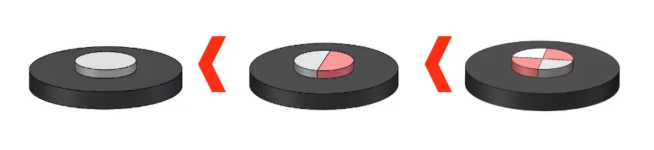
Why does the attractive force of a magnet of a given volume change so drastically when subjected to multi-pole magnetization? The reason lies in the fact that while the contact surface area (S) remains constant, the magnetic flux density (B) passing through the object being attracted increases significantly. As illustrated by the accompanying magnetic field line diagrams, the density of the field lines passing through the iron plate is markedly higher in a multi-pole magnetized magnet. Taking the N35 D10×6 magnet as an example once again: when configured with bi-polar magnetization, FEA simulations indicate that the attractive force exerted on an iron plate is approximately 1,100 times the magnet's own weight.
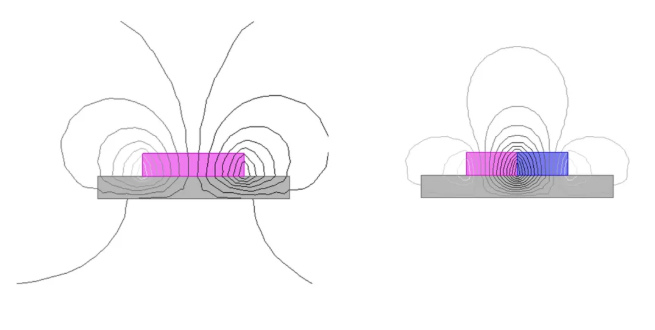
Since a magnet subjected to multipolar magnetization effectively functions as an array of more slender individual magnets—resulting in an altered Pc value that can no longer be calculated based on the magnet's overall dimensions—its optimal geometry shifts away from the standard H/D ≈ 0.6 ratio. Instead, the optimal form becomes flatter; the specific dimensions depend on the particular multipolar magnetization pattern and the number of poles.