
No products in the cart.
Both Samarium-Cobalt and Neodymium-Iron-Boron are metallic materials. Due to the excellent electrical conductivity inherent to metals, their electrical resistivity is very low. This characteristic is not ideal for rotating machinery—such as electric motors—as it leads to eddy current losses within the machinery, causing components (including the magnets themselves) to overheat. Consequently, the issue of eddy current losses in magnets within rotating machinery is a critical factor that must be carefully considered by both magnet manufacturers and motor designers. Today, we will guide you through an explanation of what constitutes magnetic eddy current loss and how to prevent it.
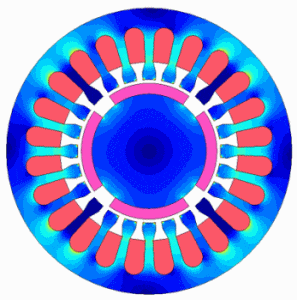
To understand and mitigate eddy current losses, we must first understand how they are generated. This requires introducing a specific concept: the skin effect.
The Skin Effect
When an alternating current flows through a conductor, the distribution of current density across the conductor's cross-section is non-uniform. As the frequency of the current increases, the current becomes increasingly concentrated near the conductive surface, while the current flowing through the interior of the conductor diminishes; this phenomenon is known as the skin effect. The higher the frequency, the more pronounced the skin effect becomes.
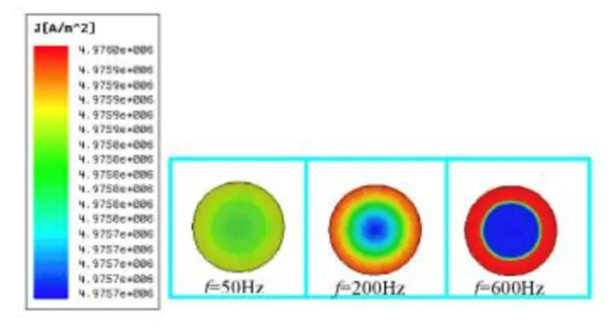
The cause of the skin effect is eddy currents. According to the laws of electromagnetic induction, an alternating magnetic field is generated around an alternating electric field. When an alternating current flows through a conductor, it creates an alternating magnetic field both within and surrounding the conductor; this, in turn, induces swirling currents within the conductor—known as eddy currents.
The closer one gets to the center of the conductor, the greater the induced electromotive force (EMF) generated by the alternating magnetic field within it. Consequently, the eddy currents are stronger, and their opposing effect on the primary current is more pronounced. This results in a lower current density near the center of the conductor and a higher current density closer to its surface.
Since the induced EMF increases with rising frequency, the skin effect becomes increasingly significant as the frequency increases. When a very high-frequency current flows through a wire, the current can be considered to flow exclusively within a very thin layer near the wire's surface. This phenomenon is equivalent to a reduction in the wire's effective cross-sectional area, thereby significantly lowering the utilization efficiency of the conductor material.
**Eddy Current Losses**
Because the electrical resistivity of samarium-cobalt (SmCo) and neodymium-iron-boron (NdFeB) permanent magnets is relatively low, the eddy currents generated within them when exposed to alternating magnetic fields are typically quite substantial. Due to the thermal effects of electric currents, these eddy currents cause the magnets to heat up; if the temperature becomes excessively high, thermal demagnetization may occur.
The magnitude of eddy current losses depends on various factors, including the nature of the magnetic field's variation, the motion of the conductor, the conductor's geometry, and its magnetic permeability and electrical conductivity. In rotating machinery, higher rotational speeds (which correspond to higher frequencies) and higher magnetic permeability—combined with lower electrical resistivity—result in a shallower skin depth and, consequently, greater losses. In applications such as electric vehicles and elevators, permanent magnet motors are often controlled by inverter power sources to facilitate speed regulation. However, the presence of higher-order harmonics within the carrier frequency of these inverters can exacerbate eddy current losses within the magnets, potentially leading to thermal demagnetization.
**Reducing Eddy Current Losses in Sintered NdFeB Magnets by Increasing Resistivity**
From the perspective of motor design, several technical methods have been proposed to mitigate eddy current losses in the permanent magnets used in rotating machinery. These methods include, for instance, the use of shielding pillars surrounding the magnets, the segmentation of the magnets, and the implementation of lateral insulation techniques. From the perspective of the magnet itself, one of the most effective methods for reducing eddy current losses in electric motors is the use of bonded magnets. This is because the presence of a binder—combined with a sufficiently high volume fraction—results in a resistivity for bonded magnets that is 10² to 10⁴ times higher than that of sintered magnets. However, this approach places significant limitations on the motor's power output and maximum operating temperature; consequently, the most direct solution is to enhance the intrinsic resistivity of the sintered magnets themselves.
There are various methods for increasing the resistivity of sintered magnets, such as incorporating high-resistivity powders (e.g., Al₂O₃) or applying SiO₂coatings. Nevertheless, these methods inevitably compromise the magnetic properties of the sintered magnets to some extent; therefore, during the research and development phase, it is essential to strike a balance between resistivity and magnetic performance.