
No products in the cart.
• Why do sintered NdFeB magnets require coating?
• How should coating materials be selected—zinc, nickel, or others? What are the differences?
This article explains key considerations for NdFeB magnet coatings.
Sintered NdFeB magnets are produced by powder metallurgy and are highly chemically active. Their internal micro-porosity makes them prone to corrosion and oxidation in air. Once corroded or structurally degraded, magnetic performance may deteriorate or even be lost over time, affecting the performance and service life of the final product. Therefore, proper anti-corrosion treatment is essential before use.
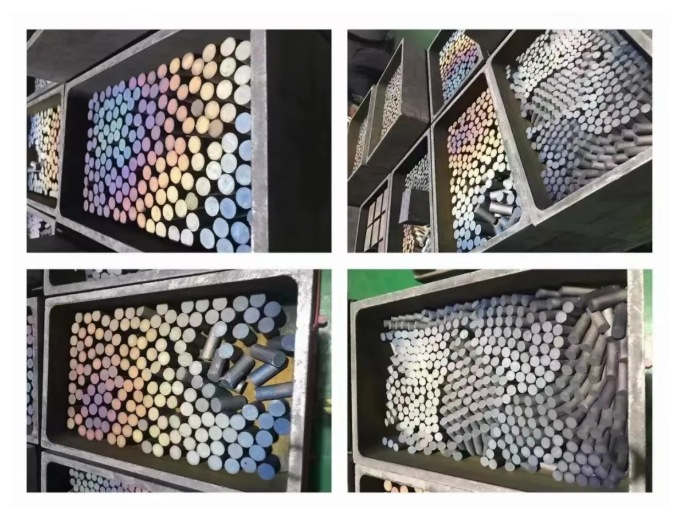
At present, corrosion protection for NdFeB magnets mainly includes electroplating, electroless plating, electrophoretic coating, and phosphating. Among these, electroplating is the most widely used due to its maturity as a metal surface treatment process.
The electroplating process for NdFeB magnets consists of two stages: pre-treatment and plating. The final coating quality is highly dependent on the pre-treatment.
Typical pre-treatment steps include abrasive grinding and chamfering, chemical degreasing, acid pickling to remove oxides, and mild acid activation, often combined with ultrasonic cleaning. These processes ensure a clean and suitable surface for plating. Any insufficient cleaning during pre-treatment may lead to latent defects such as blistering or peeling of the coating.
Compared to conventional steel parts, pre-treatment of NdFeB is more challenging due to its rough, porous structure, which easily traps contaminants. If not thoroughly removed, these impurities can significantly reduce coating adhesion. Multi-stage ultrasonic cleaning is commonly used, as cavitation helps remove oil, acids, and other residues from micro-pores. It also aids in removing boron-rich residues formed during pickling, further improving coating adhesion.
Types and Characteristics of Coatings for NdFeB Magnets
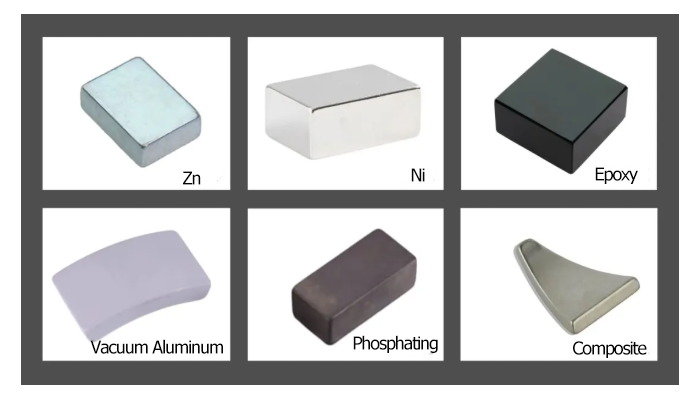
Electroplating processes for NdFeB magnets vary depending on the application environment, resulting in different coating systems such as zinc, nickel, copper, tin, and precious metals. The most common processes are zinc plating, Ni–Cu–Ni, and Ni–Cu–electroless Ni.
Only zinc and nickel can be directly plated onto NdFeB surfaces, so multilayer coatings are typically applied after an initial nickel layer. Recently, direct copper plating on NdFeB has become feasible. The Cu + Ni approach is an emerging trend, as it better supports thermal demagnetization performance to meet customer requirements.
| Characteristics and Application of Different Coatings for NdFeB Magnets | |||
| Types | Characteristics and Application | ||
| Nickel (Ni) Coating: | Magnetic; may cause magnetic shielding effects. Moderate resistance to humidity, heat, and pressure aging. Suitable for applications requiring stable appearance and performance over time. | ||
| Zinc (Zn) Coating: | Zn. L | Non-magnetic; good heat resistance but prone to white rust over time, affecting appearance. Suitable for mildly corrosive environments with basic protection needs. | |
| Zn. C | Improved corrosion resistance compared to blue/white Zn; suitable for more demanding atmospheric environments (e.g., organic corrosive conditions). | ||
| Ni–Cu–Ni Coating: | Better corrosion resistance than single-layer Ni; widely used, though the process is more complex. | ||
| Ni–Sn Coating: | Good appearance and solderability; suitable for applications requiring electrical contact and soldering. | ||
| Ni–Ag Coating: | Good appearance and solderability, low contact resistance, but relatively poor tarnish resistance. Suitable for electrical contact applications. | ||
| Ni–Au Coating: | Excellent decorative finish, stable surface, low contact resistance, but higher cost. Suitable for high-end applications requiring both electrical contact and premium appearance. | ||
There are differences in corrosion resistance among various coatings, as outlined below:
| Corrosion Resistance of Common Coatings | |||||
| Coating Type | Thickness (μm) | Salt Spray (hrs) | Humidity Test (hrs) | PCT / Pressure Test (hrs) | |
| Ni (Barrel Plating) | 5-20 | 48 | 168 | 48 | |
| Ni (Rack Plating) | 5-20 | 16 | 168 | 48 | |
| NiCuNi (Barrel Plating) | 5-20 | 48 | 168 | 48 | |
| NiCuNi (Rack Plating) | 5-20 | 16 | 168 | 48 | |
| Zn | Zn. L | 4-15 | 24 | / | / |
| Zn. C | 4-15 | 48 | / | / | |
| NiSn | 5-20 | 72 | 168 | 96 | |
| NiAg | 5-20 | 72 | 168 | 96 | |
| NiAu | 5-20 | 72 | 168 | 96 | |
| NiCuNiSn | 5-20 | 72 | 168 | 96 | |
| Ni+AP. Ni (Rack Plating) | 3-20 | 24 | 168 | 48 | |
| Ni+AP. Ni (Barrel Plating) | 3-20 | 72 | 168 | 48 | |
| PVD. AI | 2-15 | 24 | 168 | 24 | |
The most commonly used coatings for NdFeB magnets are zinc (Zn) and nickel (Ni). They differ significantly in the following aspects:
• Appearance:
Nickel plating offers superior polishability and a brighter finish. It is preferred for applications with high aesthetic requirements. Zinc plating is typically used where appearance is less critical or the magnet is not visible.
• Corrosion Resistance:
Zinc is a reactive metal and more susceptible to corrosion, especially in acidic environments. Nickel plating provides better corrosion resistance.
• Service Life:
Due to its lower corrosion resistance, zinc-plated magnets generally have a shorter lifespan. Over time, the coating may degrade, leading to oxidation and reduced magnetic performance. Nickel-plated magnets last longer.
• Hardness:
Nickel plating is harder than zinc, providing better resistance to chipping and cracking caused by impact.
• Cost:
Zinc plating is more cost-effective. In general, coating costs rank as: Zn < Ni < Epoxy.
When choosing a coating for NdFeB magnets, factors such as operating temperature, environmental conditions, corrosion resistance, appearance requirements, coating adhesion, and bonding performance should be considered comprehensively.