
No products in the cart.
Magnetic Moment and Magnetic Flux: Convertible via the Coil Constant
Magnetic moment is a crucial parameter used to characterize the magnetic strength of ferromagnetic materials, particularly permanent magnets. The open-circuit magnetic moment serves as one of the key acceptance criteria for finished permanent magnets upon factory release. Within China's permanent magnet industry, the "pull-coil method" is widely employed for measuring magnetic moment. Another significant application of this method is the sampling inspection of large-scale permanent magnets to assess their uniformity; this specific test is essentially a mandatory requirement for permanent magnets used in wind power generation and electric vehicles. my country has already established the standard GB3217-2013 for measuring the magnetic properties of permanent magnet materials under closed-circuit conditions; however, a corresponding methodological standard specifically addressing the open-circuit magnetic moment measurements described above has yet to be promulgated. Internationally, the existing standard relevant to this field is IEC 60404-14 ("Methods for the determination of the magnetic dipole moment of ferromagnetic materials by the pull-coil or rotating-coil methods"); my country is currently in the process of formulating a similar standard.
By conducting measurements on an open-circuit sample placed within a Helmholtz coil—which has been rigorously calibrated to possess a coil constant of *k*—one can obtain a magnetic flux value (Φ). Using this flux value, the magnetic moment (*M*) of the material can then be calculated.
The formula used to calculate a magnet's magnetic moment via measurements utilizing a fluxmeter and a Helmholtz coil is as follows:
M = k * Φ, where:
*M* represents the magnetic moment of the magnet, expressed in units of Wb·cm⁻¹;
*k* represents the coil constant, expressed in units of cm⁻¹ (note: a change in the unit of the coil constant will result in a corresponding change in the unit of the magnetic moment);
*Φ* represents the magnetic flux value, expressed in units of Wb.
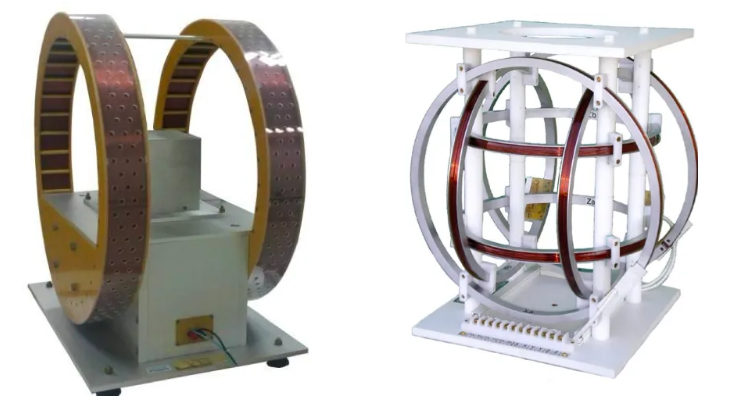
It is worth noting that during the production and trading processes, it is a common practice to measure the magnetic moment of finished permanent magnets—particularly those with irregular shapes—using the "pull-coil" method under open-circuit conditions. However, when individual enterprises construct their own measurement setups, the reproducibility of results often suffers due to various influencing factors, such as coil calibration and operational technique.
Calibrating a test coil requires introducing a steady current within a zero-magnetic-field environment to measure the resulting field strength, thereby determining the coil's specific constant. Yet, truly zero-magnetic-field laboratories are few and far between globally; consequently, the standardized calibration of test coils remains difficult to implement widely across the industry. The absence of such calibration directly compromises the accuracy and reliability of test results, which may, in turn, lead to trade disputes.
Magnetic Moment vs. Remanence: A Functional Relationship Closely Tied to Magnet Dimensions
If the magnetic flux or magnetic moment of a magnet is known—and provided the magnet's shape and dimensions are also established—one can calculate the permanent magnet material's permeance coefficient (Pc) to subsequently derive the magnet's Br, HcB, and (BH)max values. Conversely, if the shape, dimensions, and remanence are known, the magnet's magnetic moment can be calculated.
Permeance Coefficient (Pc)
Permanent magnets typically operate in an open-circuit state. Since a magnet in an open-circuit state is subject to the influence of a demagnetizing field, its magnetic flux density during operation does not correspond to the *Br* point (remanence) associated with a closed-circuit state; instead, it lies at a specific point on the demagnetization curve situated below *Br*. This specific location is referred to as the magnet's *operating point*—represented.
The position of the operating point is contingent upon both the shape of the demagnetization curve and the magnitude of the demagnetizing field acting on the magnet during operation. The straight line connecting the operating point D to the origin O is known as the *load line*; its slope is directly related to the magnet's *demagnetizing factor*. The slope of this load line is also referred to as the *permeance coefficient*, denoted by the symbol Pc.
Pc = BD / HD = μ0 (1 - 1/N) or Pc = 1 - 4π/N
The demagnetizing factor is intimately linked to the magnet's geometric configuration; consequently, the value of Pc is closely dependent on the magnet's specific shape and dimensions. Magnets that are more elongated in the direction of magnetization possess a smaller demagnetizing factor, whereas magnets that are flatter (more disc-like) in the direction of magnetization possess a larger demagnetizing factor. The demagnetizing factor *N* typically falls within the range 0 < N < 1 or 0 < N < 4π.
The figure below presents the estimated formulas for calculating the Pc values of various shapes of NdFeB permanent magnets, provided here for your reference. (Note: The calculation methods for Pc vary depending on the type of magnet; the formulas below are applicable only to sintered NdFeB magnets.)
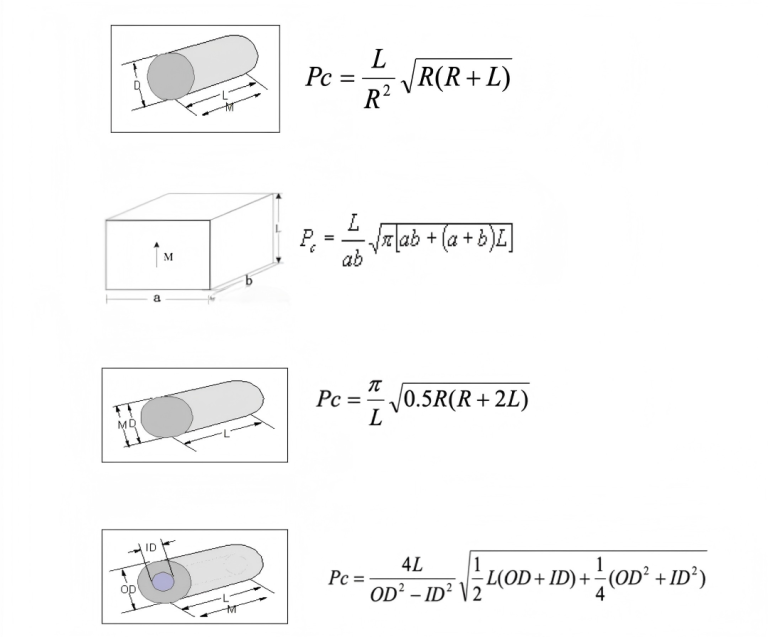
Having understood the concept of Pc and its calculation method, we can now perform mutual conversions between remanence and magnetic moment/magnetic flux.
Given the dimensions and remanence of a sintered NdFeB magnet, how does one calculate its magnetic moment and magnetic flux?
1.Calculate the magnet's volume and Pc value based on its shape and dimensions.
2.Calculate Bdi based on the relationship between Br and Bdi.
Note: Bdi refers to the intrinsic flux density. The recoil permeability is μrec = Br/HcB (for sintered NdFeB magnets, 1.05 is commonly used as an estimated value).
3.Calculate the magnet's magnetic moment by deriving it from the formula Bdi = Magnetic Moment / Volume.
Based on the relationship M = k * Ф, the magnetic flux (Ф) can be simulated and calculated once the coil constant (k) has been determined.