No products in the cart.
Magnetization is an essential process in magnet production. Without magnetization, a magnet has no magnetic properties and cannot function as a permanent magnet.
Since magnets vary in shape and size, how should they be magnetized? Do different magnetization directions produce the same effect? This article addresses these questions.
The magnetization direction is determined by the orientation direction. Only along the easy magnetization axis can the magnet reach saturation with minimal energy.
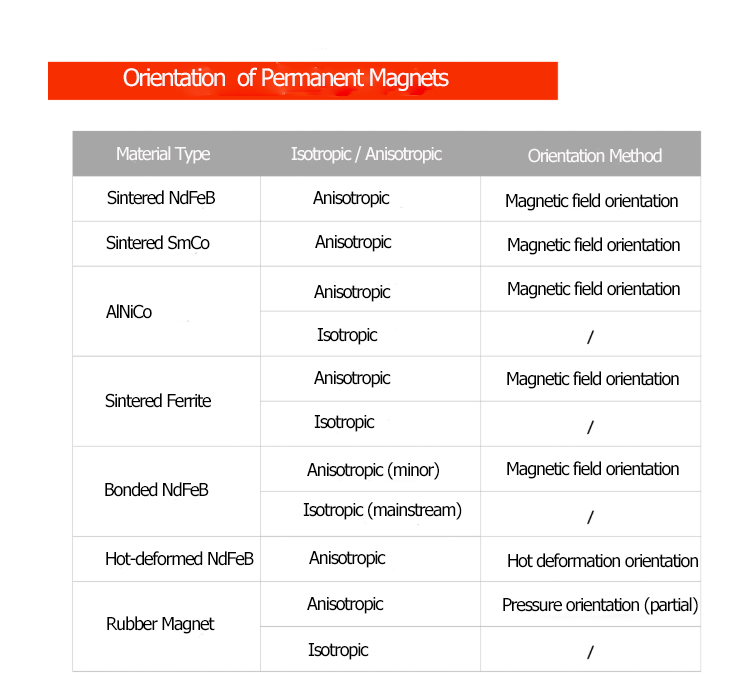
Orientation is essentially a pre-magnetization process during manufacturing. During forming or heat treatment, a strong magnetic field is applied to align magnetic domains as uniformly as possible. The higher the alignment, the better the orientation, and the higher the remanence of the final magnet.
Orientation can be simply understood as “building a path.” Like a north–south highway, movement is restricted to two directions. Similarly, oriented magnetic domains can only align bidirectionally along the same axis. For example, if the orientation is vertical, magnetization must also be vertical (N–S or S–N).
Based on whether orientation is involved, permanent magnets are classified into:
• Anisotropic magnets: higher magnetic performance
• Isotropic magnets: lower performance but magnetizable in any direction
For isotropic magnets:
• Remanence is up to ~50% of anisotropic magnets
• Maximum energy product is up to ~25% of anisotropic magnets
However, isotropic magnets typically have higher intrinsic coercivity, while anisotropic magnets exhibit better squareness of the demagnetization curve.
The most common method is magnetic field orientation, where a strong field (typically >1.5 T) aligns the crystal easy axis (C-axis). Other methods include hot deformation orientation and pressure-assisted orientation, utilizing shape anisotropy of magnetic domains.
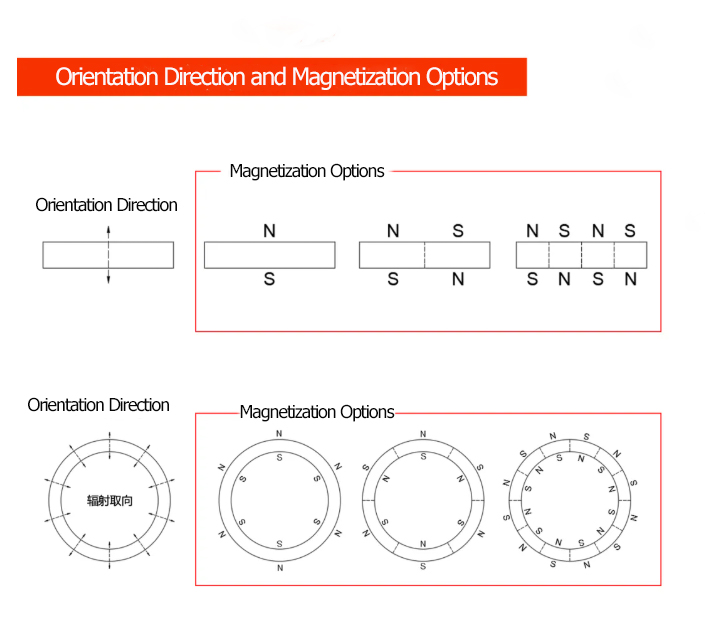
For anisotropic magnets, since the magnetic domains are already aligned after orientation, magnetization must be applied along the same axis (or dimension) as the orientation direction.
As shown, a highly oriented magnet can be magnetized as N–S or S–N, or in multiple pole combinations (e.g., repeated N–S and S–N patterns).
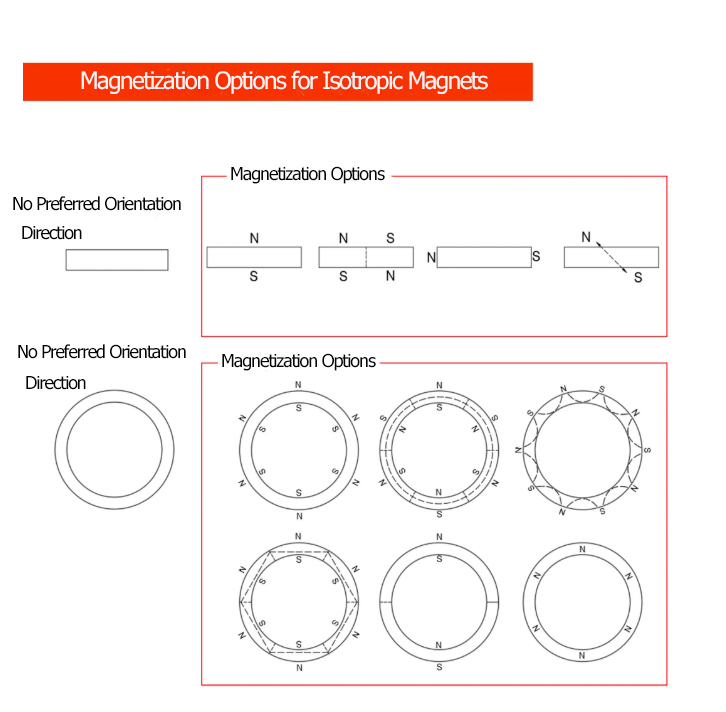
Isotropic magnets are not oriented, meaning their magnetic domains are randomly distributed. Although their performance is lower, they can be magnetized in any direction depending on the applied magnetic field.
For example, isotropic bonded NdFeB magnets are often made into radial multipole rings. As long as the magnetizing fixture can generate the required field pattern, the magnet can be magnetized accordingly.