
No products in the cart.
Magnetic materials are classified into isotropic and anisotropic magnets:
Isotropic magnets have identical magnetic properties in all directions and can be magnetized in any direction.
Anisotropic magnets exhibit different magnetic properties depending on the direction. The direction in which optimal magnetic performance is achieved is called the orientation direction.
Common anisotropic magnets include hard magnetic materials such as sintered NdFeB and sintered SmCo.
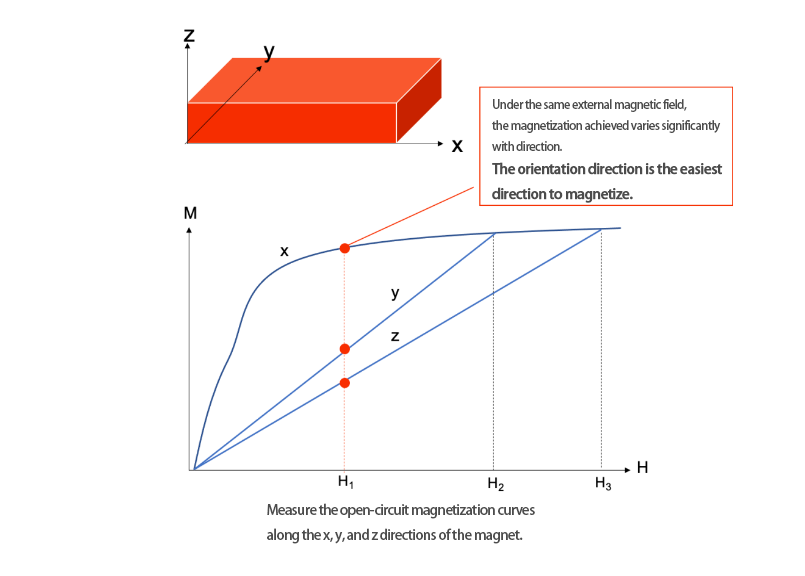
Orientation is a critical process in the production of sintered NdFeB magnets.
The magnetism of a magnet originates from magnetic ordering (i.e., aligning magnetic domains in a uniform direction). Sintered NdFeB magnets are formed by pressing magnetic powder in a mold. During this process, a strong magnetic field is applied (via an electromagnet) while mechanical pressure is exerted, aligning the easy magnetization axes of the powder particles.
After pressing, the compact is demagnetized and removed from the mold, resulting in a blank with well-defined orientation. It is then machined into the final dimensions as required.
Powder orientation is a key factor in producing high-performance NdFeB magnets. The quality of orientation at the blank stage is influenced by multiple factors, including magnetic field strength, particle shape and size, forming method, the relative direction between the orientation field and pressing force, and the apparent density of the oriented powder.
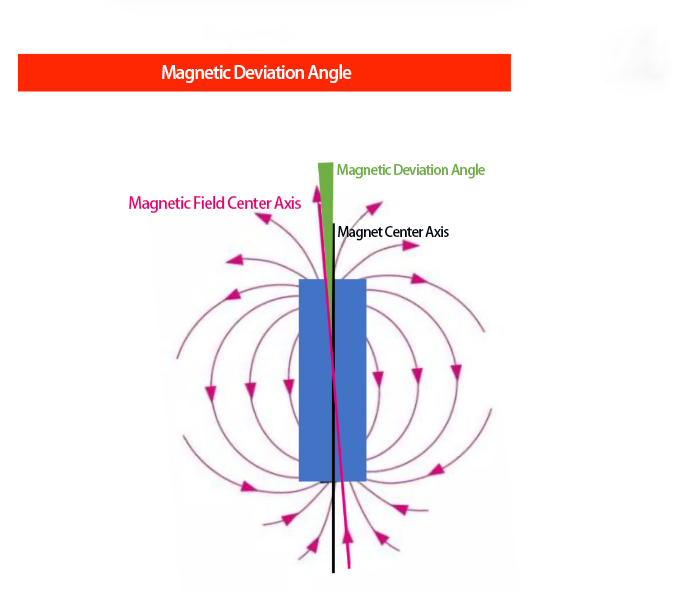
The angular deviation introduced during post-processing can affect the magnetic field distribution of the magnet.
Magnetic deviation angle refers to the angle between the direction of the magnetic flux lines and the magnet’s orientation plane. Ideally, this angle is perpendicular to the orientation plane. However, during post-processing—such as bonding and cutting—process variations may create a slight angle between the cutting direction and the pole surface. After magnetization, this can result in reduced magnetic field strength on the orientation surface compared to the expected level.
Magnetization is the final step for sintered NdFeB magnets to acquire magnetism.
After machining to the required dimensions and applying surface treatments such as plating, the magnet is still non-magnetic externally. Magnetization is required to “activate” its magnetic properties.
This process is performed using a magnetizing machine. The machine first charges a capacitor with high DC voltage (energy storage), then discharges it through a low-resistance coil (magnetizing fixture). The resulting pulse current can reach tens of thousands of amperes, generating a ძლიერი magnetic field that permanently magnetizes the magnet placed within the fixture.
Unexpected issues may occur during magnetization, such as incomplete magnetization, pole head damage, or magnet cracking.
• Incomplete magnetization is usually caused by insufficient voltage, where the magnetic field generated does not reach 1.5–2 times the saturation magnetization of the material.
• For multipole magnetization, magnets with large thickness along the orientation direction are difficult to fully magnetize. The large gap between the upper and lower poles results in insufficient field strength and an incomplete magnetic circuit, leading to weak or disordered magnetic poles.
• Pole head damage may occur when the applied voltage exceeds the safe limit of the magnetizing machine.
Magnets that are not fully magnetized or have been previously demagnetized are more difficult to saturate. In the initial state, magnetic domains are randomly oriented and require only domain rotation to achieve saturation. However, in partially magnetized or incompletely demagnetized magnets, reverse magnetic domains exist. During magnetization, these regions must be reversed, requiring additional energy to overcome intrinsic coercivity. As a result, a stronger magnetic field than the theoretical requirement is needed to achieve full saturation.