
No products in the cart.
Is "surface magnetism" simply the magnetic force of a magnet? Does a higher surface magnetism reading necessarily indicate a stronger magnet?
What are the differences and relationships between surface magnetism, residual induction, and magnetic flux?
Why do measurements taken on the same magnet yield different values when using a fluxmeter versus a gaussmeter?
**Concept:** Surface magnetism refers to the magnetic induction intensity at a specific point on the surface of a magnet (consequently, the surface magnetism at the center differs from that at the edges). It is a value measured by placing a Gaussmeter in contact with a specific surface of the magnet; it does not represent the overall magnetic properties of the magnet as a whole.
**Measurement:** Surface magnetism is typically measured using a Gaussmeter, also known as a Teslameter. Since different manufacturers utilize different Hall sensor elements in their Gaussmeters, the surface magnetism values measured for the same magnet may vary. Furthermore, it is important to note that different countries adhere to different metrological standards for Gaussmeters.
Surface magnetism is correlated with the magnet's height-to-diameter ratio (the ratio of the magnet's height to its diameter). Generally, the higher this ratio, the stronger the surface magnetism. Conversely, the larger the surface area perpendicular to the direction of magnetization, the lower the surface magnetism; conversely, the greater the dimension along the direction of magnetization, the higher the surface magnetism.
Concept: Consider a plane of area *S* situated within a uniform magnetic field of magnetic induction *B*, such that the plane is perpendicular to the direction of the magnetic field. The product of the magnetic induction *B* and the area *S* is defined as the magnetic flux passing through this plane; it is often referred to simply as "magnetic flux," denoted by the symbol "Φ," and measured in units of Webers (Wb). Magnetic flux is a physical quantity used to characterize the distribution of a magnetic field; it is a scalar quantity, though it can take on positive or negative values, where the sign serves merely to indicate direction. The formula is Φ = B·S; however, when the plane of area *S* forms an angle *θ* with the direction of *B*, the formula becomes Φ = B·S·cosθ.
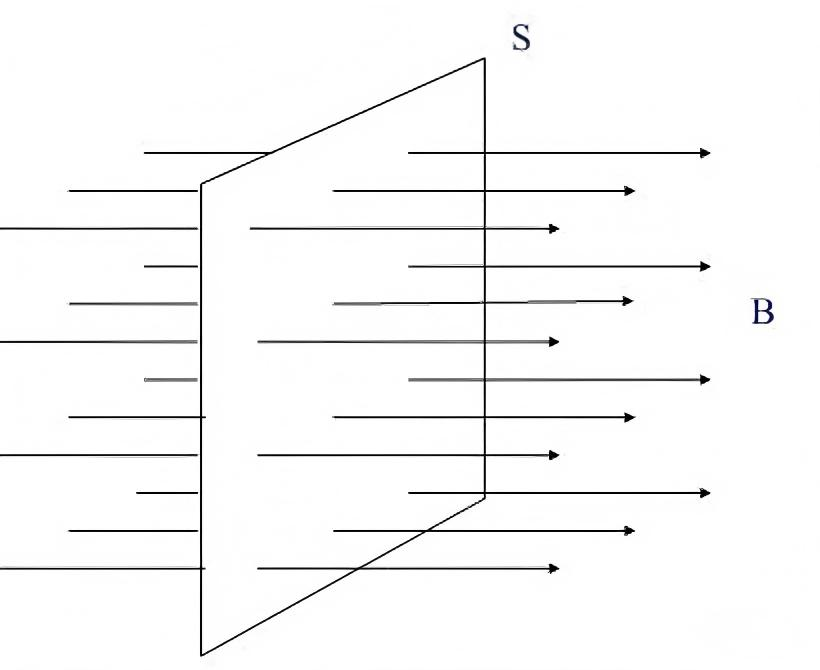
The magnitude of the magnetic flux passing through a specific plane can be vividly illustrated by the number of magnetic field lines traversing that plane. Within the same magnetic field, the density of magnetic field lines is directly proportional to the magnetic induction strength; that is, the greater the magnetic induction strength, the denser the lines. Consequently, as the magnetic induction strength (B) or the surface area (S) increases, the magnetic flux increases—signifying that a greater number of magnetic field lines pass through the surface in question. If a plane is simultaneously traversed by two magnetic fluxes of opposing directions, the net magnetic flux is calculated as the algebraic sum of these opposing fluxes.
Measurement: A fluxmeter is the instrument used to measure magnetic flux; it must be utilized in conjunction with a measurement coil (typically constructed from copper wire with a diameter of 0.1 to 0.5 mm). In recent years, domestic manufacturers of permanent magnets have widely adopted Helmholtz coils for the quality inspection of batch-produced products. (A Helmholtz coil is a device designed to generate a uniform magnetic field within a localized region. Due to its open configuration, other instruments can be easily inserted into or removed from the coil's interior, and direct visual observation is readily facilitated; for these reasons, it is a device frequently employed in physics experiments. It is named after the German physicist Hermann von Helmholtz.)
**Concept:** Remanence refers to the magnetic flux density retained within a ferromagnetic material after it has been magnetized to saturation by an external magnetic field, and that external field is subsequently reduced to zero. Its full technical name is *residual magnetic flux density* (denoted as Br). Remanence is determined by the intrinsic properties of the magnet itself; for a given magnet under specific conditions, its remanence remains constant and possesses a unique, single value.
**Relationship between Remanence and Surface Magnetism:** Both quantities are measured in units of Gauss; however, there is no direct, one-to-one correlation between surface magnetism and remanence. That is to say, two magnets with identical remanence values may not necessarily exhibit the same magnitude of surface magnetism, as surface magnetism is influenced by the magnet's shape, size, and method of magnetization.
1) For two magnets of identical shape, performance characteristics, and dimensions, the magnet exhibiting higher surface magnetism will possess stronger remanence.
2) For two magnets differing in shape, performance, or dimensions, one cannot simply determine the relative magnitude of their remanence based solely on the comparative levels of their surface magnetism.
**Relationship between Remanence and Magnetic Flux:** When the magnetic circuit of a magnet is closed, a fluxmeter can be utilized to measure the magnetic flux, thereby allowing for the calculation of the remanence. The formula is: Br = φ / (n × s), where: φ represents the magnetic flux, n represents the number of turns in the coil, and s represents the cross-sectional area of the magnet.