
No products in the cart.
Permanent magnets typically serve as magnetic field sources, providing a constant magnetic field within a specific spatial region. For precision instruments and magnetic devices, the stability of the magnet's magnetic field is of paramount importance, as it directly impacts the accuracy and reliability of the equipment.
However, under changing external conditions—such as variations in temperature, time, electromagnetic fields, mechanical vibration or shock, radiation, or chemical exposure—the performance of a magnet may undergo alteration. Changes in magnetic properties induced by shifting environmental conditions primarily manifest in two ways:
Changes in magnetic properties resulting from alterations in the magnetic domain structure (also known as *magnetic aging*). This type of change is reversible; when the magnet is subsequently remagnetized or recharged, the majority of its original performance can be restored.
Changes in magnetic properties resulting from alterations in the magnet's microstructure (also known as *structural aging*). This type of change is irreversible; when the magnet is subsequently remagnetized or recharged, its performance cannot be restored.
Any alteration in a magnet's magnetic properties caused by changes in environmental conditions involves a combination of both magnetic aging and structural aging.
A magnet's overall stability encompasses various aspects, including temperature stability, temporal stability, stability against vibration and shock, stability within electromagnetic fields, and chemical stability. This stability is typically quantified by measuring the magnitude of change in the magnet's performance parameters (for instance, the percentage change in residual induction per degree Celsius rise in temperature, or the annual decay rate of residual induction under ambient room-temperature conditions).
The specific stability requirements for a magnet vary depending on its intended operating environment. For example, magnets utilized in spacecraft applications typically prioritize stability under conditions of vibration and shock, while simultaneously requiring stability in the presence of radiation, temperature fluctuations, and the passage of time. Magnets destined for operation in acidic or alkaline environments—or in highly humid conditions (such as hot-humid climates or salt-spray environments)—generally require robust chemical stability. Conversely, in applications where the ambient operating temperature is subject to variation, the primary focus lies on ensuring the magnet possesses adequate temperature stability.
**Temperature Stability of Permanent Magnets**
Instruments and devices constructed using permanent magnetic materials rarely operate under strictly constant temperature conditions. Since changes in ambient temperature exert a direct influence on a magnet's magnetic properties, it is essential—during the design phase of the magnetic circuit—to accurately characterize how the magnet's performance parameters vary with temperature, thereby ensuring that the equipment functions correctly even when subjected to thermal fluctuations. To quantitatively characterize the extent to which temperature affects magnet performance, various temperature stability parameters—specifically related to ambient temperature—have been defined. These include the temperature coefficient of remanence (αBr), the temperature coefficient of intrinsic coercivity (αHcJ), the reversible loss (Lrev) and irreversible loss (Lirr) of open-circuit flux density, the reversible temperature coefficient of open-circuit flux density, and the maximum operating temperature (Tm). Among these, the temperature coefficient of remanence (αBr) and the temperature coefficient of intrinsic coercivity (αHcJ) are two key performance specifications that must be provided for commercial permanent magnets.
Temperature Coefficient of Remanence and Temperature Coefficient of Intrinsic Coercivity
As the name implies, a temperature coefficient represents the relative rate of change of a physical quantity with respect to temperature. Within a temperature range extending from a reference temperature T0 to a specific elevated temperature T, the temperature coefficient of remanence and the temperature coefficient of intrinsic coercivity are defined as follows; their unit of measurement is %/°C.
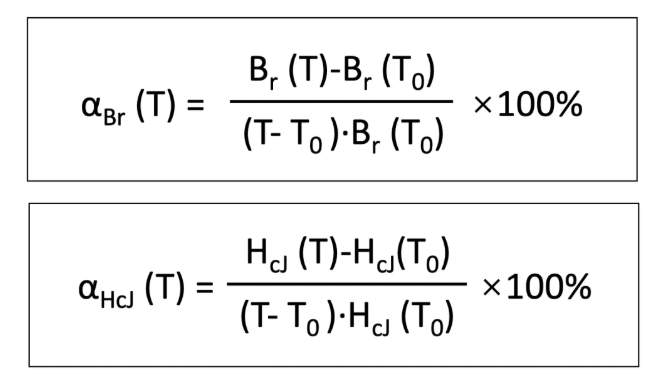
Here, Br(T) and Br(T0) represent the remanence at temperature T and the reference temperature T0, respectively (the same applies to HcJ). Room temperature—typically 20°C—is usually selected as T0, while the value for the elevated temperature T is determined jointly by the supplier and the customer based on the specific operating environment. If αBr is positive, it indicates that the remanence increases as the temperature rises; conversely, if it is negative, it indicates that the remanence decreases as the temperature rises.
Reversible Temperature Coefficient
Magnets typically operate in an open-circuit state involving an air gap; consequently, the characteristics of how open-circuit remanence (or open-circuit flux) varies with temperature hold greater practical significance. When the ambient temperature rises from room temperature T0 to a specific temperature T1, the open-circuit flux decreases from B(T0) to B(T1). If the temperature subsequently returns to room temperature T0, the open-circuit flux generally recovers to a value B'(T0) that is slightly lower than B(T0), as illustrated in the figure below. Experimental evidence demonstrates that when the temperature fluctuates repeatedly between T0 and T1—provided that the temperature difference ΔT is not excessively large—the variation in B is linear and reversible, corresponding to the line PB'(T0) in the figure below.
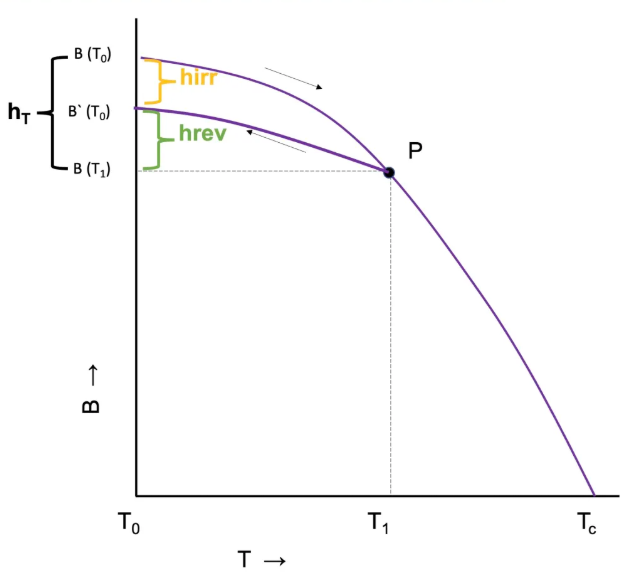
Throughout the entire heating process, the total magnetic flux loss from room temperature to high temperature is given by:
hT = (B(T1) - B(T0)) / B(T0) × 100%
This can be decomposed into two components:
Reversible magnetic flux loss: hrev = (B(T1) - B'(T0)) / B'(T0) × 100%
Irreversible magnetic flux loss: hirr = (B'(T0) - B(T0)) / B(T0) × 100%
As indicated by the B-T curve, when the temperature varies within the range of T0 to T1, the change in B is linear. The average reversible loss of the open-circuit magnetic flux is expressed in terms of the reversible temperature coefficient α.
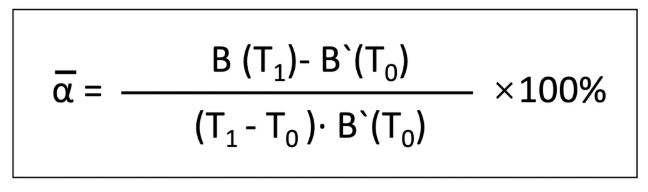
Within the broad concept of the "temperature coefficient," it is particularly important to distinguish between the specific sub-concepts of the general temperature coefficient, the reversible temperature coefficient, and the irreversible temperature coefficient.
Aging treatment can significantly reduce hT, hirr, hrev, and α. Subjecting permanent magnets to an aging treatment—typically involving heating them at a specific temperature for a certain duration—prior to use or testing helps eliminate structural instabilities within the magnet. The specific temperature and duration of the aging treatment must be determined based on factors such as the type of magnet and its intended application.
The reversible temperature coefficient αB(T)—or the temperature coefficient of remanence, αBr(T)—is intrinsically dependent on the material's inherent magnetic properties. By introducing specific alloying elements, one can alter the relationship between the saturation magnetization of the primary magnetic phase and temperature, thereby modifying the magnet's overall temperature coefficient. For instance, in Neodymium-Iron-Boron (NdFeB) magnets, partially substituting Iron (Fe) with Cobalt (Co) can significantly elevate the Curie temperature of the primary phase; similarly, partially substituting Neodymium (Nd) with Dysprosium (Dy) also leads to an improvement in αB(T).