No products in the cart.
When purchasing NdFeB magnets, selecting the appropriate grade is a common question faced by procurement professionals.
N35, N38H, N40SH…
What do these complex grade designations actually represent?
What are the differences between various grades?
How can you choose the right NdFeB magnet based on its grade?
This article provides clear answers to these questions.
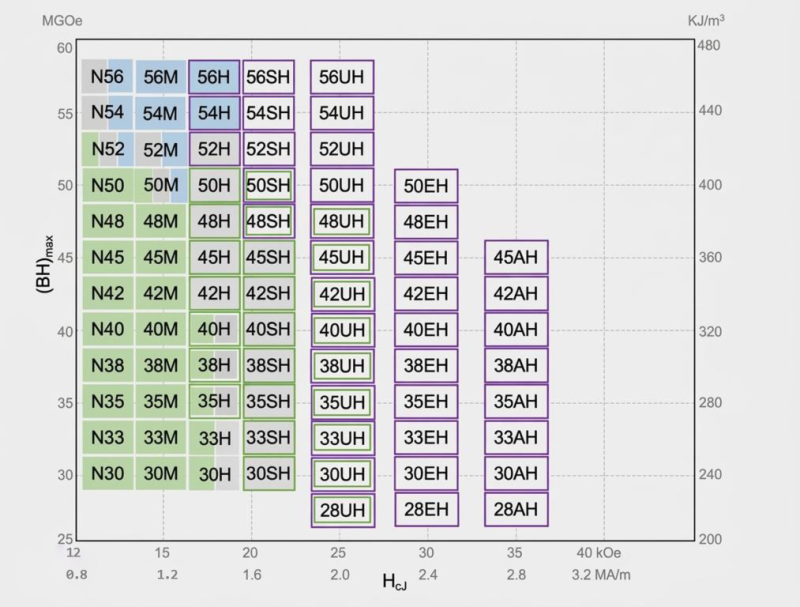
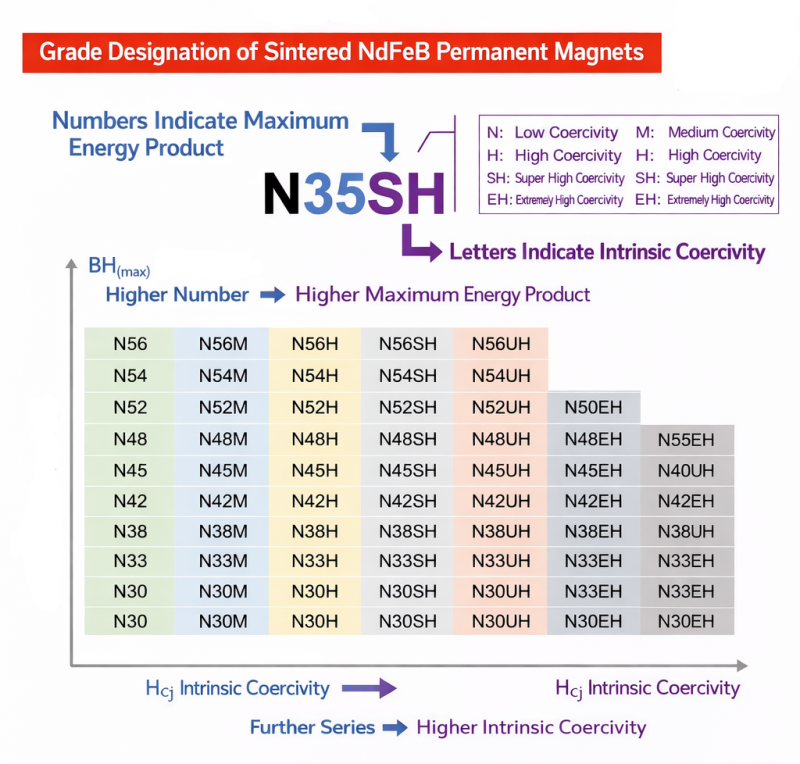
Sintered NdFeB permanent magnets can be classified into seven series based on intrinsic coercivity (HcJ): N, M, H, SH, UH, EH, and AH (TH). Within each series, grades are further subdivided according to remanence (Br) and maximum energy product (BH)max.
• The number indicates the maximum energy product (BH)max; the higher the number, the greater the magnetic performance.
• The letter indicates the intrinsic coercivity class; series further along in the sequence correspond to higher intrinsic coercivity.
The magnetic performance of sintered NdFeB magnets is primarily evaluated by four key parameters: remanence (Br), coercivity (Hcb), intrinsic coercivity (Hcj), and maximum energy product ((BH)max). For a more detailed understanding of these concepts, please refer to the article Remanence, Coercivity, and Maximum Energy Product.
To illustrate with a simple analogy: if a magnet is like a cup of water, magnetization is equivalent to heating the water. Remanence (Br) is the heat retained after the heating stops, so it can be understood as the “magnetic content” of the magnet. For magnets of the same size, higher remanence generally means stronger magnetic force.
Demagnetization is similar to cooling the water. Coercivity (Hcb) represents the temperature at which the surrounding environment offsets the water’s heat, resulting in no external heat being observed. Intrinsic coercivity (Hcj) is the temperature required to completely remove all the heat from the water.
Both coercivity and intrinsic coercivity are indicators of a magnet’s resistance to demagnetization. The higher these values, the better the magnet’s stability and temperature resistance.
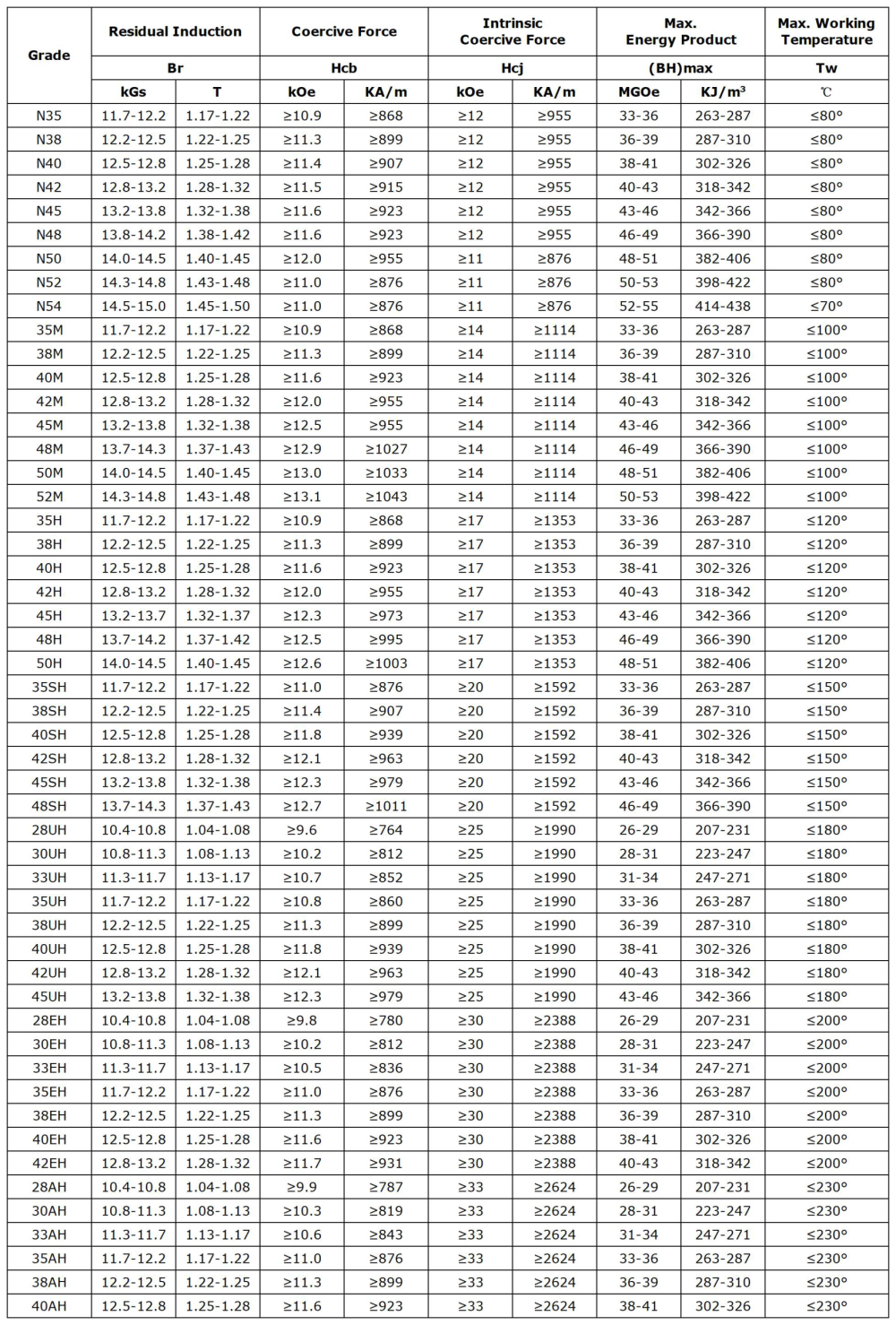
The properties of sintered NdFeB magnets under each grade are not single fixed values, but rather fall within a certain range. These performance ranges may vary among different manufacturers, so it is important to ensure that the supplier’s specifications meet your requirements when making a selection.
The figure below shows the typical magnetic performance parameters for various grades from mainstream domestic manufacturers. The data are measured at room temperature (20°C) and are for reference only. Actual working performance is also influenced by factors such as magnet size and coating.
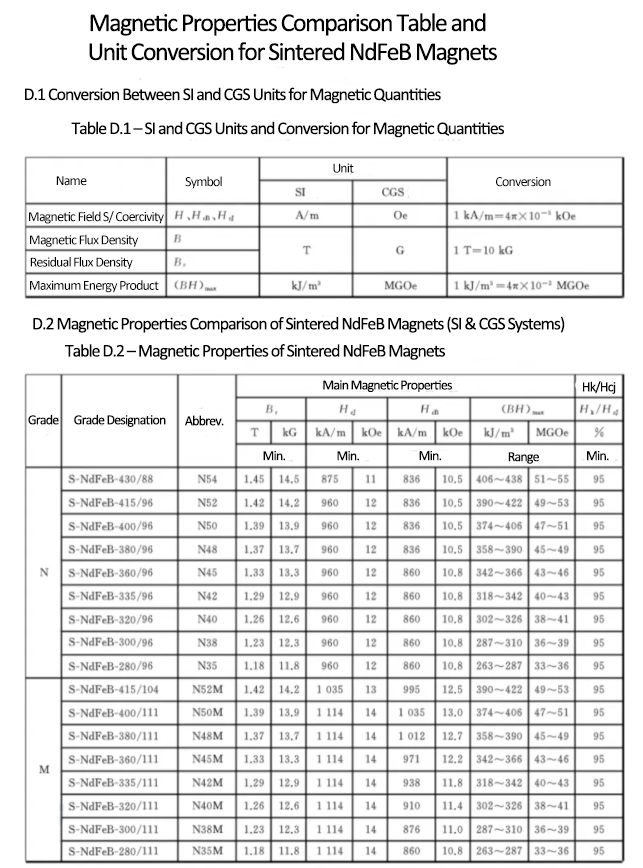
The latest national standard for sintered NdFeB magnets (GB/T 13560-2017), jointly issued by the General Administration of Quality Supervision, Inspection and Quarantine and the Standardization Administration of China, came into effect in May 2018. It specifies the minimum values or ranges of performance parameters for different grades of sintered NdFeB magnets, as shown in the figure below.
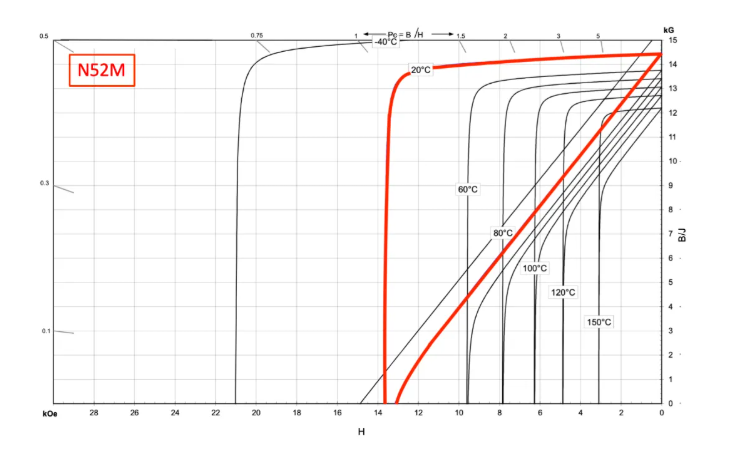
The demagnetization curve provides a comprehensive representation of a magnet’s magnetic properties, as well as how these properties vary under different temperature conditions.
In recent years, mainstream manufacturers of sintered NdFeB magnets have continuously optimized and innovated their production processes. Technologies including heavy rare earth-free magnets, grain boundary diffusion, and cerium magnets have been widely applied and developed, leading to a continuous reduction in production costs and more stable performance of the magnets.