
No products in the cart.
A Hall element is a magnetic sensor based on the Hall effect; it is used to detect magnetic fields and their fluctuations, making it suitable for use in a wide variety of magnetic-field-related applications. Hall elements offer numerous advantages: they feature a robust structure, compact size, and light weight; they boast a long service life and are easy to install; furthermore, they consume minimal power, support high operating frequencies (up to 1 MHz), are resistant to vibration, and remain unaffected by contamination or corrosion caused by dust, oil, moisture, or salt spray.
The scope of applications for Hall elements is extremely broad, encompassing uses such as signal sensors in automotive distributors, speed sensors in ABS systems, automotive speedometers and odometers, detectors for physical properties of fluids, current detection and operational status diagnostics for various electrical loads, engine speed and crankshaft angle sensors, and various types of switches, among others.
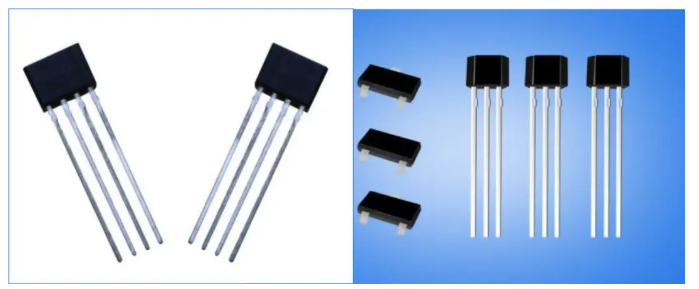
To understand the operating principles of Hall elements, let us begin by examining the Hall effect.
The Hall effect is a type of electromagnetic phenomenon; it was discovered in 1879 by the American physicist Edwin Hall while he was investigating the mechanisms of electrical conduction in metals. When an electric current flows through a semiconductor perpendicular to an external magnetic field, the charge carriers undergo deflection. This deflection generates an additional electric field—oriented perpendicularly to both the current and the magnetic field—which, in turn, creates a potential difference across the semiconductor. This phenomenon is known as the Hall effect, and the resulting potential difference is referred to as the Hall voltage.
Hall devices, designed based on the Hall effect, utilize a magnetic field as their operating medium to convert the motion parameters of an object into a digital voltage output, thereby enabling them to perform both sensing and switching functions. Based on their functionality, Hall elements can be categorized into two types: linear Hall elements and Hall switch elements; the former produces an analog output, while the latter produces a digital output.
The internal structure of a linear Hall element primarily consists of three main components: a voltage regulator circuit, the linear Hall element itself, and an operational amplifier. Its input is the magnetic flux density, and its output is a voltage directly proportional to this input quantity. This type of circuit features high sensitivity and excellent linearity, making it suitable for various magnetic field detection applications. Linear Hall elements respond to the strength of a magnetic field by generating a parabolic-like output response. For instance, the throttle grip on an electric vehicle utilizes a linear Hall element; it allows the vehicle's speed to increase from zero to its maximum limit in response to changes in the magnetic field, yet once the magnetic field intensity exceeds a specific upper threshold within its operating range, the speed remains constant.
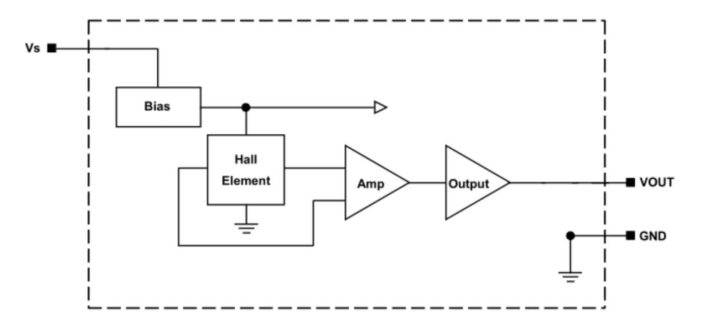
A switching-type Hall sensor consists of a voltage regulator, a Hall element, an amplifier, a Schmitt trigger, and an output stage.
When a magnetic object approaches a Hall switch, the Hall element located on the switch's sensing face generates a Hall effect, causing a change in the state of the switch's internal circuitry. This enables the switch to detect the presence of a nearby magnetic object and subsequently control its switching state (on or off). The object detected by this type of proximity switch must be magnetic.