
No products in the cart.
Neodymium-iron-boron (NdFeB) permanent magnet products can be categorized based on their manufacturing processes into sintered, bonded, and hot-pressed types. Due to these distinct production methods, these categories exhibit significant differences in their magnetic properties, post-processing requirements, and applications. Having previously provided a comprehensive overview of sintered NdFeB, we will now proudly introduce bonded and hot-pressed NdFeB, along with a comparative analysis of the performance and applications of these three distinct types of NdFeB products.
Bonded Neodymium-Iron-Boron Magnets
Bonded magnets first emerged around the 1970s. At that time, SmCo magnets had already reached commercial maturity, and the market for sintered Nd-Fe-B permanent magnets was robust. However, sintered magnets presented significant challenges regarding precision machining into complex or specialized shapes; furthermore, the manufacturing process was prone to issues such as cracking, breakage, and chipping of edges and corners. Additionally, their assembly proved difficult, thereby limiting their scope of application. To address these issues, a solution was devised wherein permanent magnet powder was pulverized, mixed with a plastic binder, and then compression-molded within a magnetic field—marking what was likely the earliest method for manufacturing bonded magnets. Bonded Nd-Fe-B magnets have since gained widespread application due to their numerous advantages, including low cost, high dimensional precision, exceptional design flexibility regarding shape, good mechanical strength, and light weight.
I. Production Process:
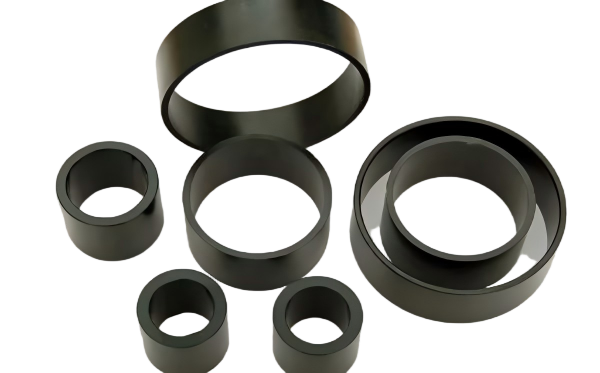
Bonded Nd-Fe-B magnets are produced by mixing permanent magnet powder with a binding material—such as rubber or a lightweight, rigid plastic—and then directly molding the mixture into various permanent magnet components that meet specific user requirements.
The preparation of magnetic powder is a critical step in the processing of Nd-Fe-B permanent magnets; the quality of the magnetic powder directly determines the magnetic properties of the final permanent magnet. Methods for preparing Nd-Fe-B magnetic powder include mechanical crushing, melt spinning (rapid quenching), the HDDR process, gas atomization, and mechanical alloying, among others. Currently, the HDDR process is the mainstream technique employed to produce high-performance rare-earth permanent magnet powder. This process involves a sequence of hydrogenation, decomposition, dehydrogenation, and recombination: first, the alloy is crushed into coarse powder and loaded into a vacuum furnace, where it undergoes crystallization treatment at a specific temperature; the alloy absorbs hydrogen and undergoes a disproportionation reaction; subsequently, the hydrogen is evacuated, allowing the material to recombine into a rare-earth permanent magnet powder characterized by extremely fine grains. This method yields fine grains with an average particle size of 0.3 μm, thereby producing magnetic powder with high coercivity.
Currently, there are four primary processes for the compaction and molding of bonded Nd-Fe-B magnets: calendering, injection molding, extrusion molding, and compression molding. Among these, calendering and injection molding are the most widely adopted.
Calendering involves uniformly mixing magnetic powder with a binder at a specific volume ratio, rolling the mixture to the desired thickness, and then subjecting it to a curing process to produce the finished product. Typically, vinyl resins and nitrile rubber are utilized as binders, and the surface of the finished product generally requires a protective coating.
Injection molding entails mixing magnetic powder with a binder (specifically, a thermoplastic resin). The mixture undergoes heating, kneading, granulation, and drying; it is then conveyed via a screw mechanism into a heating chamber, where it is heated and subsequently injected into a mold cavity at a specific velocity to take shape. Upon cooling, the finished product is obtained. Due to the high resin content, a protective film forms on the surface of the magnet; consequently, additional surface anti-corrosion treatment is generally unnecessary, unless the application demands exceptionally high resistance to corrosion.
Extrusion molding is fundamentally identical to injection molding; the sole distinction lies in the method of forming, wherein the heated granules are continuously extruded through a die orifice into the mold.
Compression molding involves mixing magnetic powder and a binder according to a specific ratio. The mixture is granulated—often with the addition of a coupling agent—and then compacted within a mold. Finally, the material is cured at a temperature between 120°C and 150°C to yield the finished product.
II. Product Performance
Due to the addition of a binder, magnetic properties are lower than those of sintered NdFeB: Bonded NdFeB magnets are produced by binding magnetic powder into solid blocks using an adhesive; consequently, their density typically reaches only 80% of the theoretical maximum. In contrast, sintered NdFeB magnets are formed through a complex process involving high-temperature heating. Therefore, in terms of magnetic strength, bonded NdFeB is weaker than sintered NdFeB.
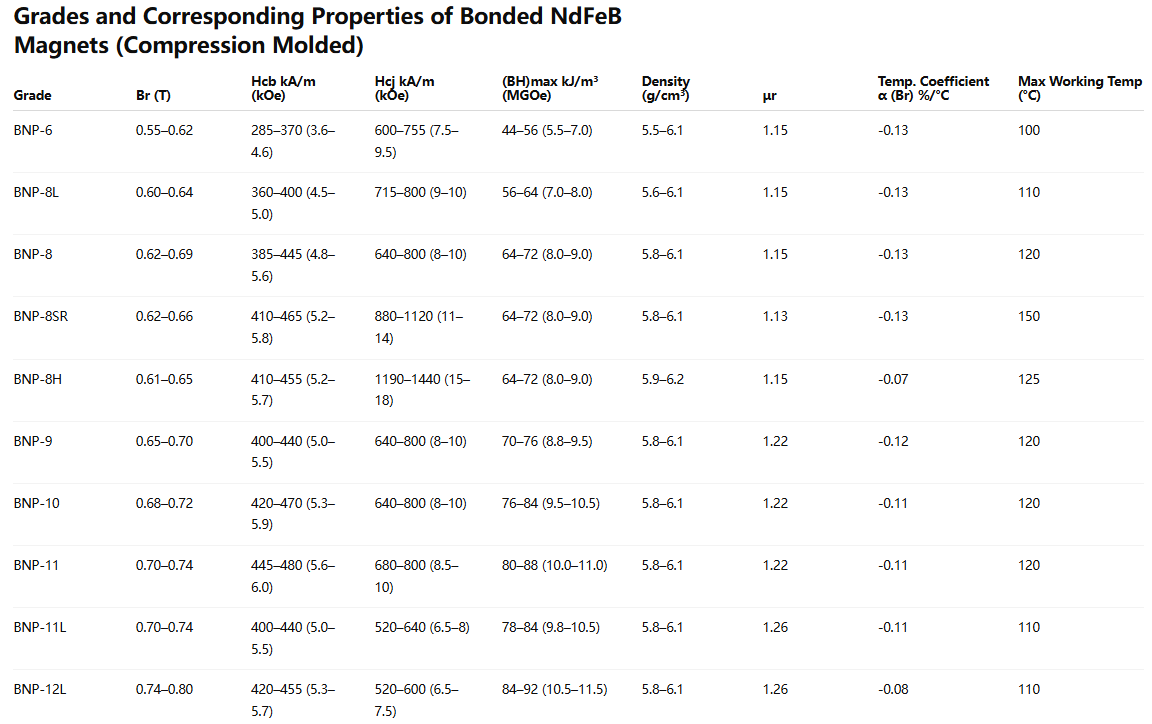
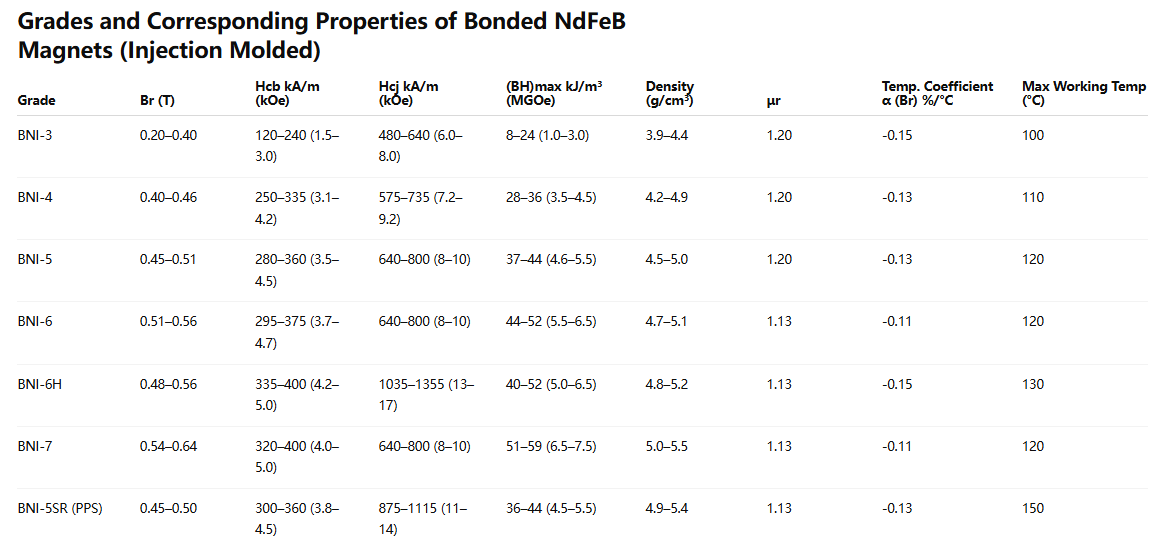
**High Product Precision and High Design Flexibility:** Sintered NdFeB magnets are produced via a powder sintering method; typically, the sintering process yields only a rough blank, which then requires subsequent mechanical processing (such as wire cutting, slicing, grinding, etc.) to be shaped into finished magnets of various forms. In contrast, the manufacturing process for bonded NdFeB permanent magnets is simpler, requiring no secondary processing; consequently, the finished products exhibit high dimensional precision and are free from deformation. Furthermore, they offer significant design flexibility, allowing for the creation of various shapes—such as rods, sheets, tubes, rings, or other complex geometries—tailored to specific application requirements. This facilitates large-scale automated production and results in products with high mechanical strength.
**Isotropic Magnets, Facilitating Magnetization in Any Direction:** Bonded NdFeB magnets are isotropic; that is, their magnetic properties are uniform across all directions. This makes it easy to manufacture monolithic magnets with multiple poles—or even an infinite number of poles—a feat that is typically difficult to achieve with sintered magnets.
**III. Product Applications**
Although the magnetic properties of bonded NdFeB magnets are not as strong as those of sintered NdFeB magnets, they are widely utilized in various micro-motors and sensor systems. This widespread adoption is driven by several key advantages: their ease of manufacture into multi-pole magnetized rings; their excellent consistency and uniformity in performance; their ability to be easily integrated and co-molded with other metal or plastic components; and their magnetic performance, which is significantly superior to that of bonded ferrite magnets. Specific applications for bonded NdFeB magnets can be categorized as follows:
**Digital Products:** Hard Disk Drive (HDD) magnets—currently the largest application sector for bonded NdFeB magnets.
**Office Automation (OA) Products:** Drive motors for printers, motors for scanners, stepper motors (STP) for photocopiers, magnetic rollers for laser printers, etc.
**Automotive Motors and Magnetic Sensors:** Including magnets for Electric Power Steering (EPS) sensors, windshield wiper motors, power window motors, seat adjustment motors, etc.
**Other Industrial and Household Motors:** Primarily encompassing various servo motors, motors for power tools, motors for air conditioning and refrigeration systems, etc.