
No products in the cart.
Neodymium-iron-boron (NdFeB) permanent magnet products can be categorized based on their manufacturing processes into sintered, bonded, and hot-pressed types. Due to these distinct production methods, they exhibit significant differences in terms of magnetic properties, post-processing requirements, and applications. We have previously provided a comprehensive overview of sintered NdFeB; today, we are pleased to introduce the niche—yet significant—hot-pressed NdFeB, alongside a comparative analysis of the performance and applications of these three distinct types of NdFeB products.
Hot-Pressed NdFeB
Hot-pressed NdFeB magnets can achieve magnetic properties comparable to those of sintered NdFeB magnets without the addition of heavy rare earth elements. They boast several advantages, including high density, high degree of orientation, excellent corrosion resistance, and high coercivity. However, they suffer from poor mechanical properties, and—due to patent monopolies—their processing costs are relatively high. Currently, only three companies worldwide possess the necessary production technology: General Electric (USA), Daido Steel (Japan), and Delta (Europe); furthermore, only Daido Steel has successfully achieved mass production of hot-pressed NdFeB products. In February 2018, Galaxy Magnets completed the construction of China's first hot-pressed NdFeB production line, with an annual capacity of 300 tons; mass production is expected to commence shortly.
Hot-pressed NdFeB permanent magnet materials are fabricated using either hot-pressing or hot-deformation processes. The process begins by preparing a rapidly quenched NdFeB ribbon using the melt-spinning method, based on a specific compositional ratio. This ribbon is then crushed into a powder of a specific particle size. Subsequently, within an inert gas or vacuum environment and at a specific temperature, the powder is densified and pressed into a compact billet; at this stage, the product exists as an isotropic magnet billet. Next, within an inert gas or vacuum environment—and following a mold change or adjustment—the temperature is raised and pressure is reapplied; this subjects the isotropic billet to hot deformation, inducing anisotropy and yielding an anisotropic magnet billet. Finally, either the isotropic or anisotropic billet undergoes mechanical machining and magnetization to produce the final isotropic or anisotropic hot-pressed NdFeB permanent magnet material.
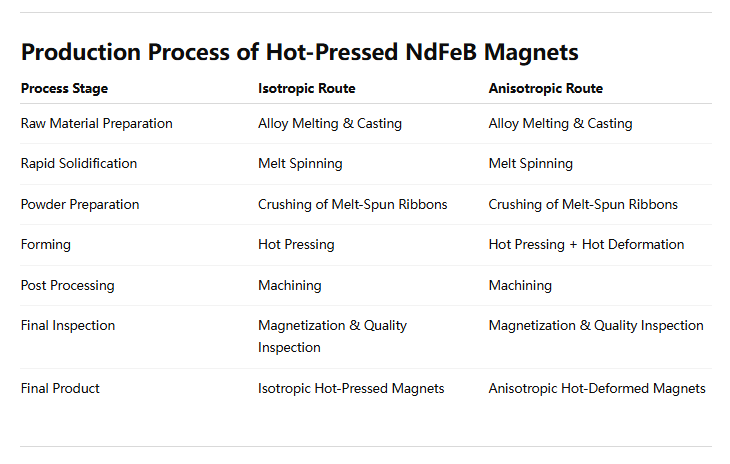
Due to limitations in molding technology, hot-pressed NdFeB magnets are currently restricted to ring shapes, which somewhat limits their scope of application. They are currently utilized primarily in fields such as automotive Electric Power Steering (EPS) motors. Hot-pressed NdFeB magnets possess superior magnetic properties; the magnetic rings feature radial orientation and uniform radial magnetic performance, enabling motors to operate quietly and deliver smooth torque output.
The displacement of sintered NdFeB by hot-pressed variants is concentrated primarily in the high-performance sector—specifically, low-dysprosium, high-coercivity NdFeB magnets. As this represents the most profitable segment for sintered NdFeB manufacturers, these companies face a race against time to implement technological upgrades, adopting new processes typified by techniques such as grain boundary diffusion (e.g., Dy diffusion) and PLP.
**Sintered, Bonded, and Hot-Pressed NdFeB: Each Has Its Merits**
**Sintered NdFeB**
**Advantages:** Possesses extremely high magnetic properties; it is currently the magnetic material with the highest magnetic performance, boasting a maximum energy product of up to 55 MGOe (N54).
**Disadvantages:** To withstand high-temperature operating environments, certain grades of sintered NdFeB require the addition of medium-to-heavy rare earth elements (such as dysprosium and terbium) to enhance the magnet's intrinsic coercivity and maximum operating temperature; however, this results in a higher unit cost for the product. Furthermore, the preparation process is complex (involving initial sintering into a rough billet followed by machining), leading to significant material loss during processing and a consequent impact on yield rates.
**Bonded NdFeB**
**Advantages:** Offers high dimensional precision and flexible shaping capabilities; contains no medium-to-heavy rare earth elements, resulting in a lower unit cost; utilizes a direct molding process, which minimizes material loss during manufacturing.
**Disadvantages:** Exhibits lower magnetic properties compared to other types; currently, the maximum energy product for bonded NdFeB products is approximately 12 MGOe. Additionally, both its intrinsic coercivity and maximum operating temperature are relatively low.
**Hot-Pressed NdFeB**
**Advantages:** Capable of achieving extremely high magnetic properties with virtually no reliance on medium-to-heavy rare earth elements; current products can reach a maximum energy product of up to 43 MGOe. The manufacturing process also entails low material loss.
**Disadvantages:** Currently restricted to ring shapes, which significantly limits the scope of its application. Furthermore, due to the high technological barriers associated with hot-pressed NdFeB production, only one company globally—Japan's Daido Electronics—has successfully achieved mass production; this monopolistic landscape results in a high market price for the material.
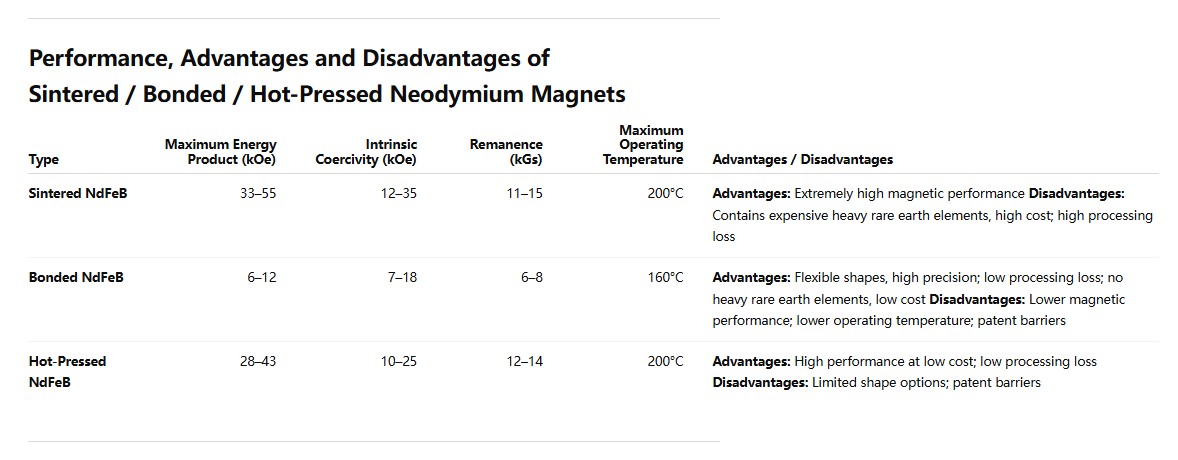
Currently, there is minimal overlap in the practical applications of these three types of magnets.
Hot-pressed NdFeB magnets can only be manufactured in a ring shape, which places certain limitations on their scope of application; currently, they are primarily utilized in motors for automotive Electric Power Steering (EPS) systems. Even when taking into account the rapid growth of hot-pressed NdFeB within the automotive EPS market—and the extent to which it displaces sintered NdFeB—its overall market size remains extremely small compared to that of sintered NdFeB. Consequently, the impact on the growth rate of demand for sintered NdFeB is relatively minor.
Due to significant differences in both magnetic properties and molding characteristics, the areas of application for bonded and sintered NdFeB magnets do not overlap significantly. Bonded NdFeB magnets are predominantly used in applications such as spindle motors for hard disk drives and optical drives, as well as in low-power micro-motors; conversely, sintered NdFeB magnets are more frequently employed in applications involving higher-power drive motors.