No products in the cart.
Permanent magnets operate under open-circuit conditions. Since a magnet in an open-circuit state is subject to the influence of a demagnetizing field, the magnetic flux density of the permanent magnet during operation does not correspond to the B_r point associated with closed-circuit conditions; rather, it lies at a specific point on the demagnetization curve situated below B_r. This specific point is referred to as the permanent magnet's operating point.
The operating point is related to the shape of the demagnetization curve and the magnitude of the demagnetizing field acting on the magnet under operating conditions. The straight line connecting the operating point D to the origin O is known as the load line; its slope is related to the magnet's demagnetization factor. The slope of the load line is also referred to as the Permeance Coefficient, denoted by Pc.
Pc = BD / HD = μ0(1 - 1/N) [where μ0 is the permeability of free space]
or Pc = 1 - 4π/N
The demagnetization factor N is closely tied to the magnet's geometry; consequently, the value of Pc depends on the magnet's shape and dimensions. For magnets that are more elongated in the direction of magnetization, the demagnetization factor is smaller; conversely, for magnets that are flatter in the direction of magnetization, the demagnetization factor is larger. The value of N falls within the range 0 < N < 1 or 0 < N < 4π.
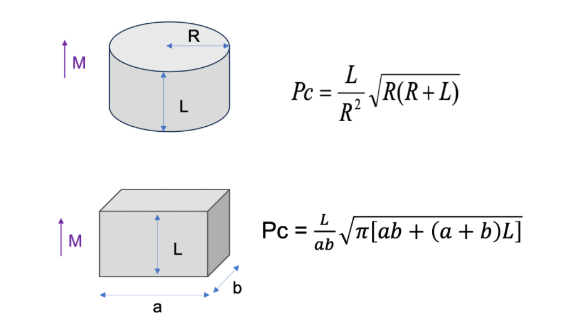
The figure below presents the formulas for calculating Pc for various shapes of NdFeB permanent magnets, provided here for your reference.
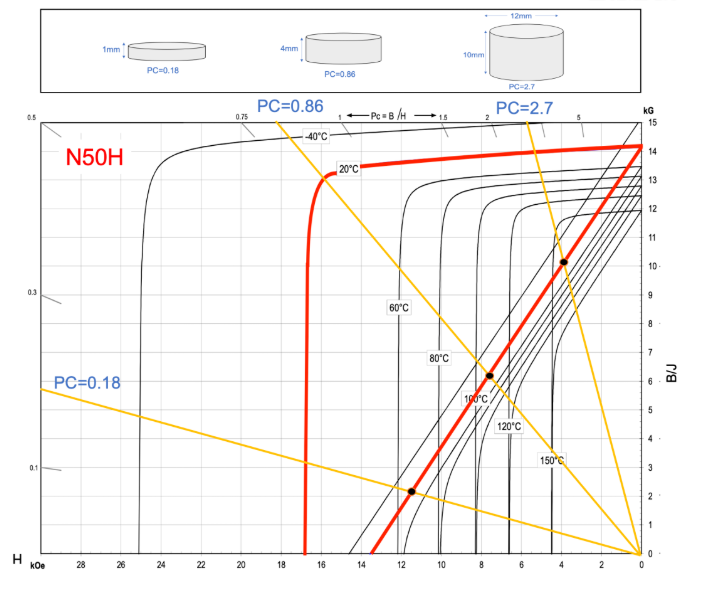
For magnets of the same grade, variations in shape and dimensions result in differing Pc values and distinct operating points; consequently, the actual performance exhibited by the magnets will vary. When a magnet's Pc value is relatively low, it is prone to significant demagnetization at high temperatures, which can compromise the normal operation of the entire assembly. Therefore, in practical engineering calculations, it is essential to determine the magnet's permeance coefficient (Pc) in order to assess the safe operating temperature and thermal demagnetization characteristics under the assembly's working conditions, thereby ensuring the proper functioning of the complete system.
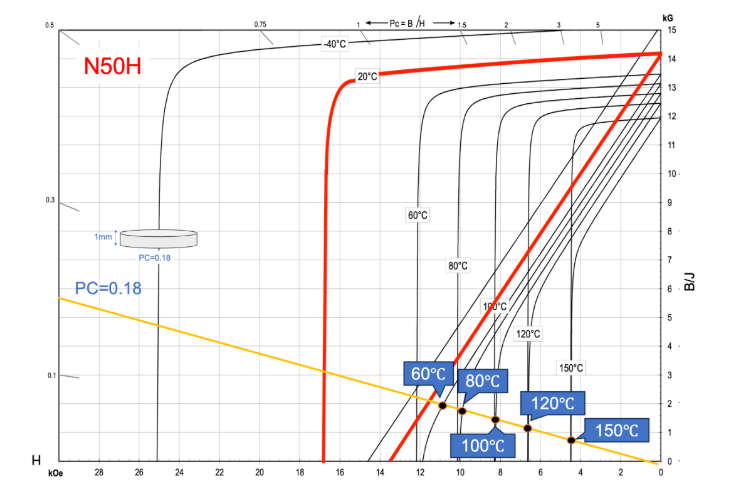
If a magnet's Pc value is low—meaning its operating point falls below the knee of the demagnetization curve—the magnet cannot function normally at the corresponding temperature. As illustrated in the figure below, an N50H-grade magnet (D12 × 1 mm) operating in an environment exceeding 60°C will experience severe, irreversible demagnetization; consequently, it is necessary to either adjust the magnet's dimensions or upgrade to a higher coercivity grade.