No products in the cart.
Based on the characteristics they exhibit within an external magnetic field, materials can be classified into five categories: paramagnetic, diamagnetic, ferromagnetic, ferrimagnetic, and antiferromagnetic. Ferromagnetic materials are substances that, once magnetized by an external magnetic field, retain their magnetized state—and thus their magnetic properties—even after the external field is removed. The fundamental characteristics of ferromagnetic materials are the presence of spontaneous magnetization and a magnetic domain structure within their interior.
Magnetic domain theory serves as the foundation of modern magnetization theory. Almost all applications in magnetism treat the magnetic domain—rather than the individual electron spin—as the fundamental unit of analysis; consequently, all discussions regarding magnetic moments in the field of magnetism are framed around these domains. However, since magnetic domains are invisible to the naked eye, grasping and visualizing them can present certain difficulties. Today, we will explore exactly what magnetic domains are.
1.Formation of Magnetic Domains
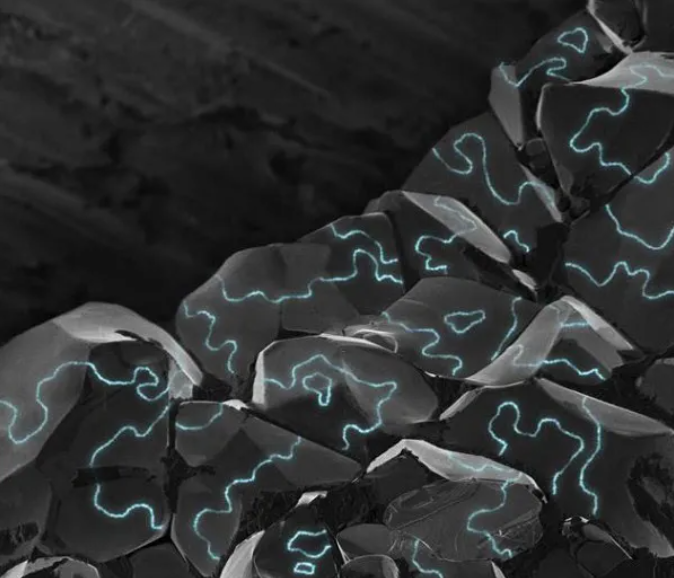
As is well known, ferromagnetic materials do not exhibit external magnetism prior to being magnetized. This is because, below the Curie temperature, a magnetic domain structure forms within bulk ferromagnetic crystals. While the spontaneous magnetization within each individual magnetic domain is uniform and consistent, the directions of spontaneous magnetization differ between distinct domains; consequently, the magnetic moments cancel one another out—resulting in a vector sum of zero—and thus, on a macroscopic level, the ferromagnetic material displays no net magnetism.
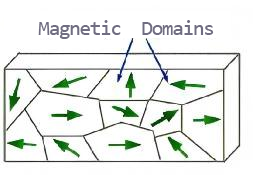
Magnetic domains are small, distinct regions within a ferromagnetic material that emerge during the process of spontaneous magnetization to minimize magnetostatic energy; within each region, a vast number of atoms are contained, and their magnetic moments align neatly—much like tiny magnets—though the orientation of these atomic magnetic moments differs between adjacent regions. The interface separating individual magnetic domains is known as a magnetic domain wall.
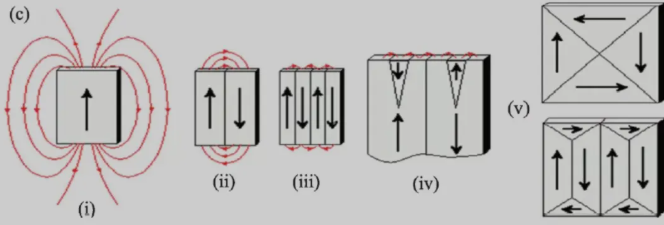
The formation of magnetic domains can be simply understood as a mechanism to reduce the magnetic dipole energy—specifically, the demagnetization energy—associated with the stray fields that permeate the surrounding external space. Figure c-i illustrates a single-domain magnet, characterized by a widely distributed stray field; to attenuate this field, the magnetic moments within the material spontaneously undergo a redistribution, thereby forming magnetic domains. The most intuitive form of this redistribution is depicted in Figure c-ii, where two distinct domains—an upper and a lower one—are formed, resulting in a substantial reduction of the stray field. If this process continues to form four domains—as shown in Figure c-iii—the stray field is attenuated even further. However, this process simultaneously leads to an increase in magnetostatic exchange energy, which can be broadly conceptualized as domain wall energy. The final morphology and scale of the magnetic domains represent the outcome of a competition between the magnetic dipole energy and the exchange energy. Furthermore, if the size or external geometry of the ferromagnetic sample is altered, the resulting magnetic domain structures can exhibit a rich variety of forms—such as the domain configuration illustrated in Figure c-v.
2.Magnetic Domain Walls
The boundary between adjacent magnetic domains is known as a magnetic domain wall. A domain wall in which the atomic magnetic moments of the neighboring domains are oppositely directed (forming an angle of 180°) is termed a 180° domain wall; conversely, a domain wall in which the atomic magnetic moments of the neighboring domains are mutually perpendicular is termed a 90° domain wall. Magnetic domain walls possess a thickness spanning several atoms, and the specific thickness varies depending on the material.
A magnetic domain wall constitutes a transition zone of finite thickness. Within the domain wall, the direction of magnetization does not undergo an abrupt, large-angle rotation; rather, it rotates gradually across the specific thickness of the wall—meaning that, within this transition zone, the orientation of the atomic magnetic moments changes incrementally. The energy density within a domain wall is invariably higher than that within the interior of the magnetic domains themselves.
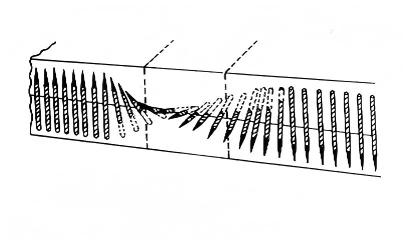
3.The Process of Technical Magnetization
To distinguish it from the spontaneous magnetization occurring within magnetic domains in ferromagnetic or ferrimagnetic materials, we refer to the magnetization of such materials when placed in a magnetic field as technical magnetization.
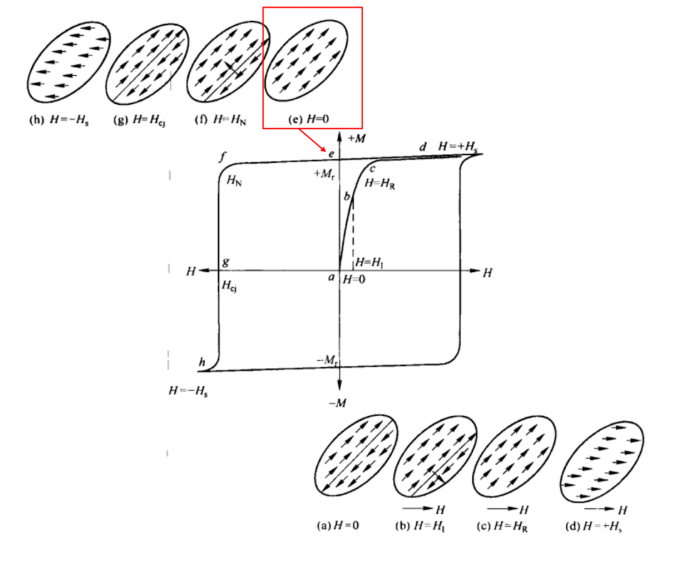
As is well known, the technical magnetization curve (M–H curve) of ferromagnetic or ferrimagnetic materials is nonlinear; the vertical axis represents magnetization (*M*), while the horizontal axis represents magnetic field strength (*H*). Let us assume that the magnet consists of two magnetic domains:
When the magnetic field is zero, the number of atomic magnetic moments in the upper domain is equal to that in the lower domain, and their directions are opposed; consequently, the vector sum of the atomic magnetic moments is zero, and the magnetization of the material is zero. This is illustrated in Figure (a).
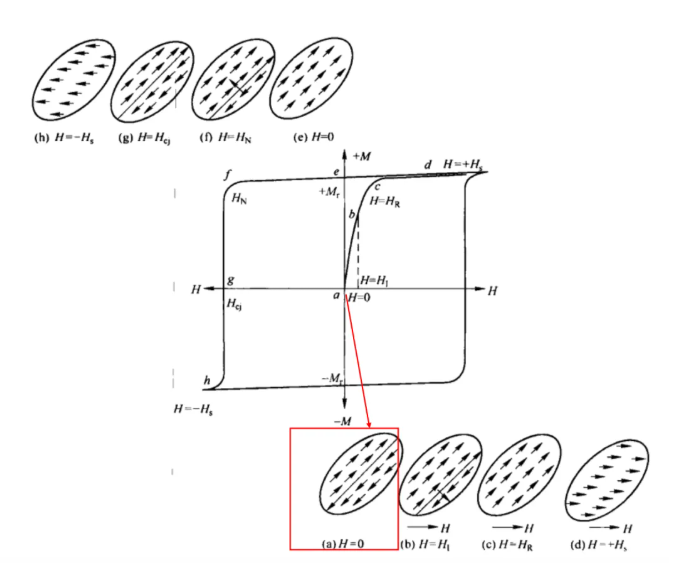
When a magnetic field H1 is applied in the positive direction of the x-axis, the angle θ between the magnetic moment M of the upper magnetic domain and the external field is less than 90°; consequently, its magnetostatic energy is relatively low, rendering it comparatively stable. Conversely, for the lower magnetic domain, the angle θ between its magnetic moment M and the external field exceeds 90°; as a result, its magnetostatic energy is relatively high, making it comparatively unstable. Therefore, under the influence of the external magnetic field H1, the upper magnetic domain expands while the lower magnetic domain contracts. This process entails the displacement of the 180° domain wall—as illustrated by the arrow in Figure (b)—leading to an increase in magnetization along the direction of the magnetic field. Furthermore, the velocity of this 180° domain wall displacement can be quite rapid, causing segment *ab* of the M–H magnetization curve to become very steep.
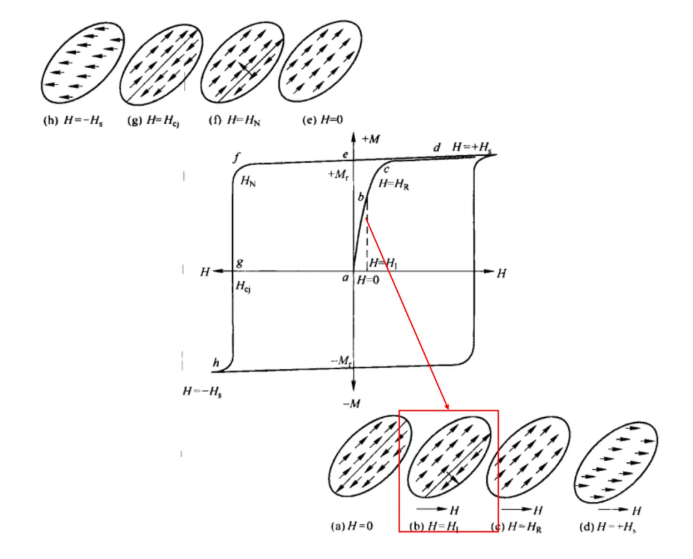
When the external magnetic field increases to *H*<sub>R</sub>—specifically point *c* in the figure—domain wall displacement has ceased; the 180° domain walls have been expelled from the magnet, and the entire body has become a single domain. The atomic magnetic moments remain aligned with the direction of the original magnetic moments of the previous domain, as shown in Figure (c). The transition from point *a* to point *c* constitutes the technical magnetization process, which is characterized by domain wall displacement.
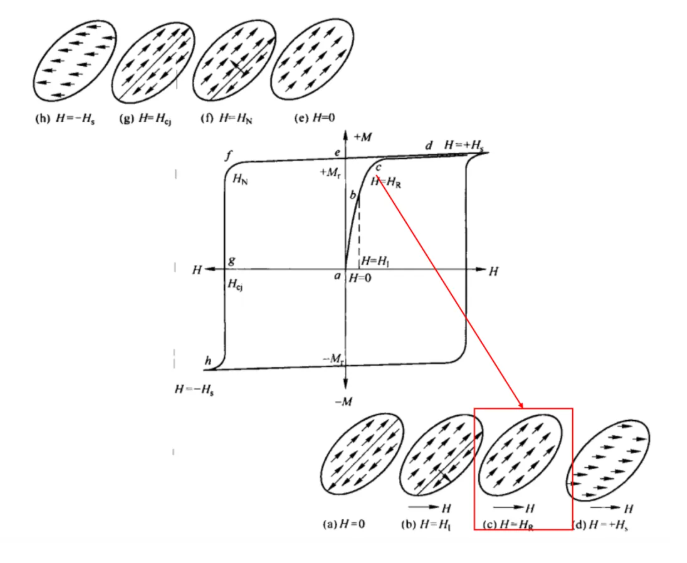
As the external magnetic field gradually increases from point HR to point HS—that is, from point c to point d—the atomic magnetic moments progressively rotate to align with the direction of the external field, as illustrated in Figure (d). When the external magnetic field reaches point HS, virtually all atomic magnetic moments have rotated to a direction parallel to the field; at this juncture, the magnetic material has attained a state of technical magnetization saturation, and the corresponding magnetization intensity is termed the saturation magnetization. The process of technical magnetization is fundamentally realized through two mechanisms: domain wall displacement and the rotation of magnetic moments.
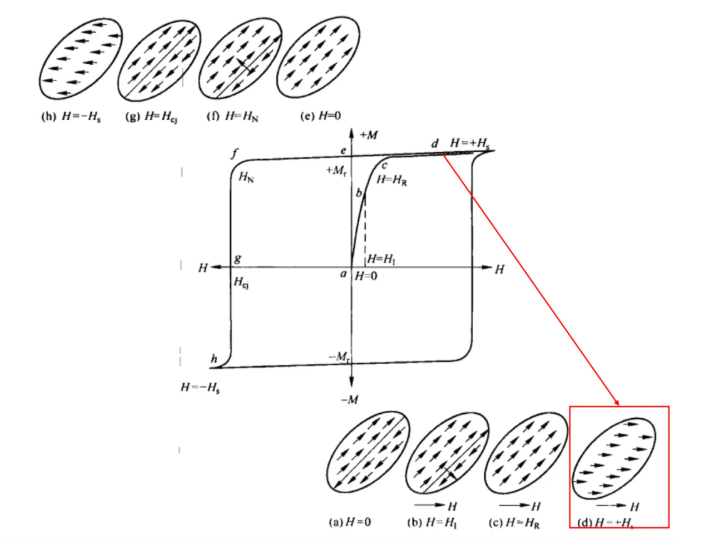
If the external magnetic field is reduced to zero, the atomic magnetic moments will gradually align themselves along the direction of the major axis, as shown in Figure (e); this process constitutes the rotation of the magnetic moments. It is evident that, even after the external magnetic field is removed, the magnetization does not decrease to zero; rather, a value of *M*r is retained in the positive direction of the magnetic field—a quantity known as the *residual magnetization*.