
No products in the cart.
The magnetism of matter originates from the magnetic moments of electrons within atoms.
Matter is composed of atoms, and atoms, in turn, consist of an atomic nucleus and electrons. Within an atom, electrons possess an orbital magnetic moment due to their motion around the nucleus, as well as a spin magnetic moment resulting from their intrinsic spin. The magnetic moment of an atom is primarily derived from these electron magnetic moments; this constitutes the fundamental source of magnetism in all forms of matter.
A magnetic moment is a directional vector. Within an atom, electron spins are classified into two orientations: "up" and "down." In most substances, the number of electrons with upward spins is equal to the number with downward spins; consequently, the magnetic moments generated by these electrons cancel each other out, rendering the atom as a whole magnetically neutral. Only in a minority of substances do the numbers of electrons with different spin orientations within an atom differ. In such cases, after the magnetic moments of oppositely spinning electrons have canceled each other out, a residual portion of the electron spin magnetic moments remains uncompensated, resulting in the atom possessing a net magnetic moment. The magnetic moment of a single atom is determined by its atomic structure; indeed, the atoms of every element in the periodic table possess their own characteristic magnetic moments.
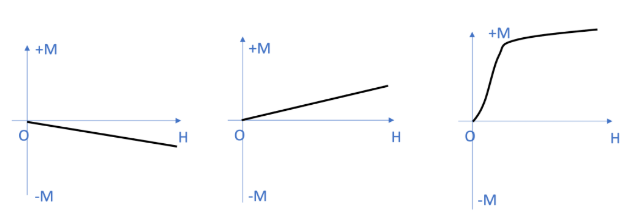
Because different atoms possess distinct magnetic moments, interactions occur between the atomic magnetic moments within macroscopic matter, leading to varying arrangements of these moments at room temperature. Based on the differences in their magnetization intensity and magnetic susceptibility when subjected to an external magnetic field, macroscopic substances are classified into five categories: paramagnetic, diamagnetic, ferromagnetic, ferrimagnetic, and antiferromagnetic substances.
Magnetic Moment and Magnetic Flux: Interconversion via the Coil Constant
Magnetic moment and magnetic flux are both critical parameters used to characterize the magnetic strength of permanent magnet materials; while they share a certain correlation, they represent distinct physical quantities with different meanings.
The standard method for measuring magnetic moment is conducted in accordance with International Electrotechnical Commission (IEC) standard IEC 60404-14 ("Methods for the determination of the magnetic dipole moment of ferromagnetic materials using a withdrawal or rotating coil method"). In practice, the magnetic moment is determined indirectly by first measuring the open-circuit magnetic flux and subsequently performing a calculation. By measuring an open-circuit sample within a one-dimensional Helmholtz coil—which has been rigorously calibrated to possess a specific coil constant *k*—one can obtain a magnetic flux value (Φ); this flux value is then used to calculate the material's magnetic moment (*M*). The calculation formula is as follows:
*M* = k×Φ
*M* represents the magnetic moment of the magnet, expressed in units of Wb·cm⁻¹.
*k* represents the coil constant, expressed in units of cm⁻¹ (a change in the unit of the coil constant will result in a corresponding change in the unit of the magnetic moment).
Φ represents the magnetic flux value, expressed in units of Wb.
For a given magnet, the measured magnetic flux values will vary depending on the specific coil constant used; however, the calculated magnetic moment remains constant. Consequently, basing discussions between buyers and sellers on the magnetic moment ensures a more accurate and efficient exchange of information.