
No products in the cart.
Choosing the right neodymium magnet grade is critical for product performance, cost control, and long-term reliability. Among the most common grades, N35, N42, and N52 neodymium magnets are widely used in industrial, commercial, and consumer applications.If you’ve ever shopped for neodymium magnets for a project, you’ve almost certainly run across labels like N35, N42, and N52. These seemingly simple alphanumeric codes are far more than arbitrary product identifiers: they define the fundamental magnetic performance, physical limits, and real-world suitability of the magnet you are about to install. For engineers, product designers, DIY builders, and industrial procurement teams, choosing the wrong grade does not just mean wasting money—it can lead to underperforming motors, failing sensor systems, unexpected safety hazards, or even costly redesigns late in the product development cycle. This guide breaks down exactly what these three popular neodymium magnet grades represent, how they compare across the most critical performance metrics, and how to confidently select the correct one for your unique application.
Neodymium magnets, also known as NdFeB or rare-earth magnets, are the strongest commercially available permanent magnets. Our high-performance neodymium magnets are available in various grades, shapes, and custom configurations for industrial and commercial applications.Their grade system is a standardized classification developed by magnet manufacturers to communicate core performance characteristics at a glance, eliminating the confusion that would come from unregulated, brand-specific naming conventions. The “N” at the start of every grade label stands for “neodymium,” and the number that follows directly corresponds to the maximum energy product of the magnet, measured in units of Mega-Gauss Oersted (MGOe).
To put that in simple terms, the number tells you roughly how much total magnetic “power” the material can deliver per unit of volume. N35, as the name suggests, has a rated maximum energy product of 35 MGOe, N42 comes in at 42 MGOe, and N52 sits at the top of this common range with 52 MGOe. It is important to understand that these numbers are not arbitrary marketing claims: they are certified values that manufacturers are required to meet during quality control testing. A N52 magnet will always deliver significantly more magnetic output than a same-sized N35, all other factors like coating, shape, and manufacturing process being equal.
It is also critical to note that the base “N” series grades we are discussing here—N35, N42, N52—are the standard temperature variants of neodymium magnets, designed for continuous operation at typical room to moderately elevated temperatures, rather than the high-temperature “SH” or “EH” grades built for extreme industrial heat environments. This makes them the most widely used, cost-effective, and accessible grades for 90% of consumer, commercial, and general industrial magnet applications.
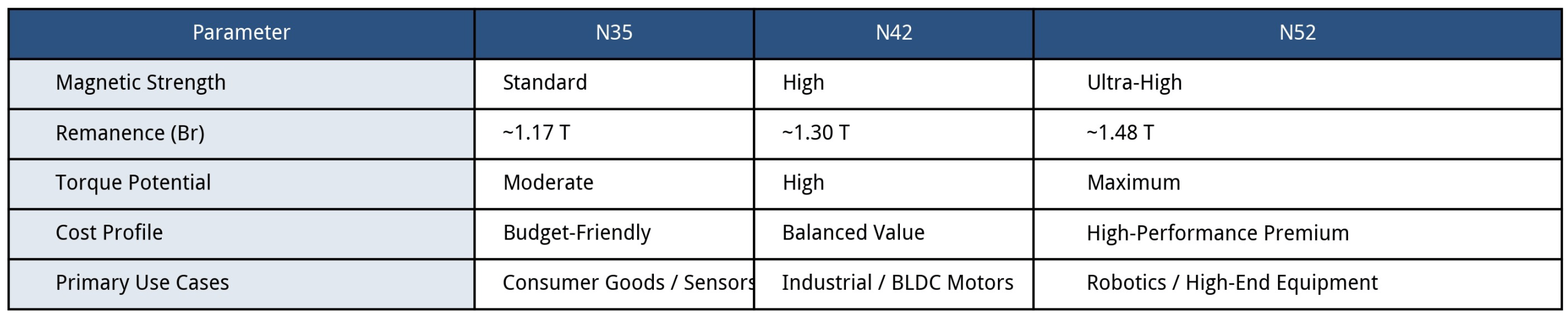
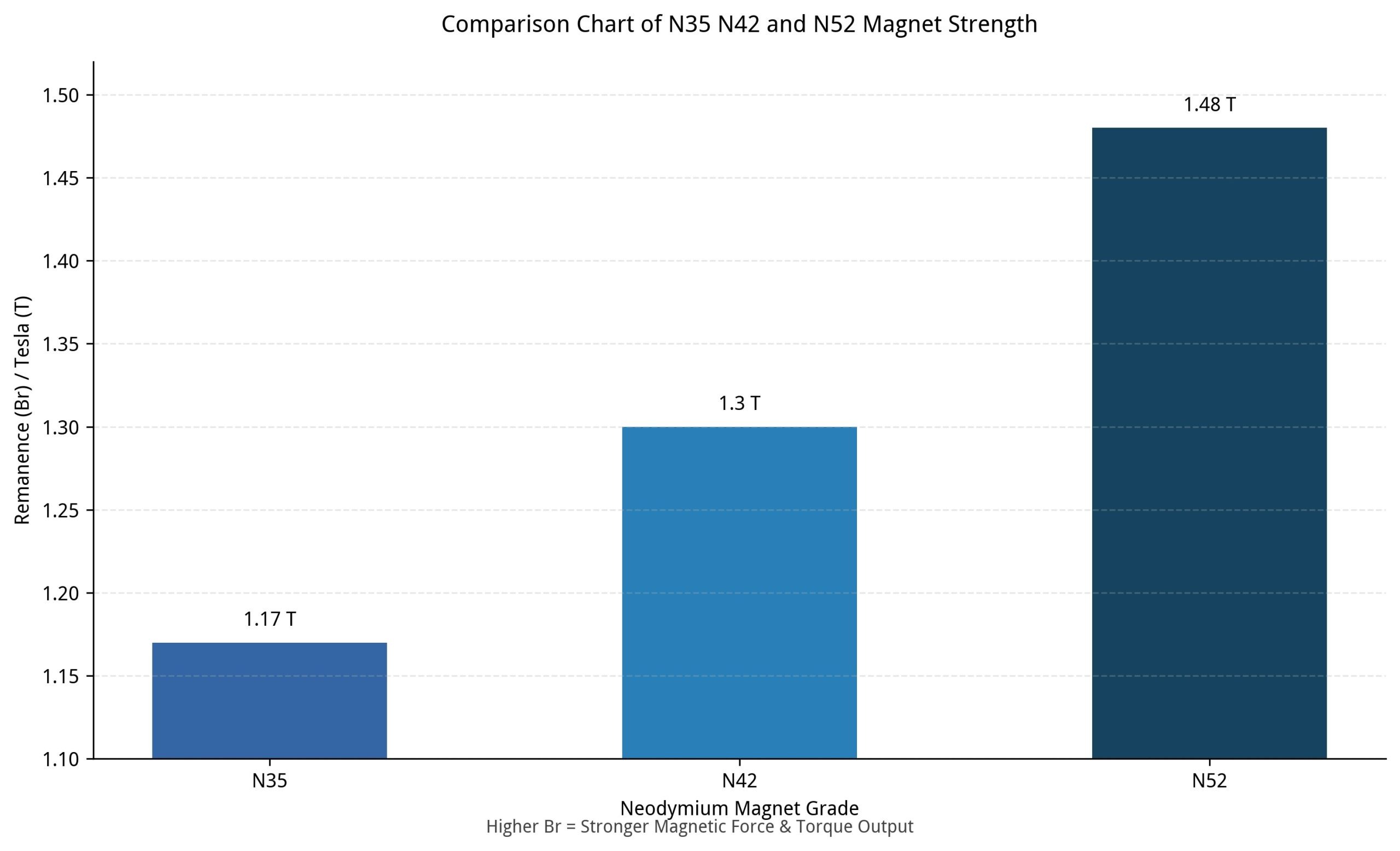
Remanence, universally abbreviated as Br, is one of the most fundamental properties of any permanent magnet. It describes the residual magnetic flux density that remains in the magnet material after it has been fully magnetized and the external applied magnetic field used to charge it has been completely removed. In practical terms, Br tells you how strong the magnetic field the magnet can sustain on its own, and it is measured in Tesla (T) or Gauss, where 1 Tesla equals 10,000 Gauss.
When we compare the Br values of our three target grades, the difference in raw performance becomes immediately clear. N35 has a typical remanence rating of approximately 1.17 Tesla, which translates to 11,700 Gauss at the surface of the magnet material itself. This is the standard baseline strength for general-purpose neodymium magnets, more than 3 times stronger than the strongest ceramic ferrite magnets, but far from the upper limits of rare-earth performance. N42 steps this up to roughly 1.30 Tesla, or 13,000 Gauss, delivering about 11% more residual magnetic flux than N35 in the exact same physical dimensions. That 11% difference might sound small on paper, but in real-world use, it translates to noticeably stronger holding force, higher torque output in motors, and more sensitive magnetic field actuation. N52 pushes remanence even further, reaching approximately 1.48 Tesla, or 14,800 Gauss. That is a staggering 26% increase in residual magnetic strength over N35, meaning a N52 magnet of identical size can generate nearly a third more magnetic field output than its N35 counterpart.
This difference in Br has very tangible, everyday consequences. If you are designing a magnetic holding fixture, a 20mm diameter N35 disc magnet might lift 5kg, while the exact same size N42 will lift closer to 6kg, and the N52 version can lift over 6.3kg. For designers working on projects with strict size constraints, this means you can often use a smaller, lighter N52 magnet to achieve the exact same holding force as a much larger N35, saving critical space and reducing overall system weight.
While remanence tells you the peak magnetic flux the material can hold, the maximum energy product, abbreviated as BHmax, is a more holistic metric that describes the total usable magnetic energy stored within the magnet material. Measured in Mega-Gauss Oersted (MGOe), this value represents the maximum point on the magnet’s demagnetization curve where the product of magnetic flux density (B) and magnetic field strength (H) reaches its highest possible value.
Think of BHmax like the “battery capacity” of the magnet: a higher BHmax means the material can pack more total magnetic energy into a smaller physical volume. For N35, the BHmax sits at a certified 35 MGOe, which is the industry standard for entry-level high-performance neodymium. This grade delivers reliable, consistent magnetic energy without requiring the tight, expensive manufacturing tolerances needed for higher grades. N42 has a BHmax of 42 MGOe, which is a 20% increase in total stored magnetic energy over N35. This is why N42 is often described as the “balanced” workhorse grade in industrial settings: it delivers significantly more energy density without the steep price premium of ultra-high-performance grades. N52, with a BHmax of 52 MGOe, offers nearly 49% more total magnetic energy than N35. This extreme energy density is the reason N52 is the go-to grade for engineers who need to maximize magnetic performance while minimizing the physical footprint of their magnet components.
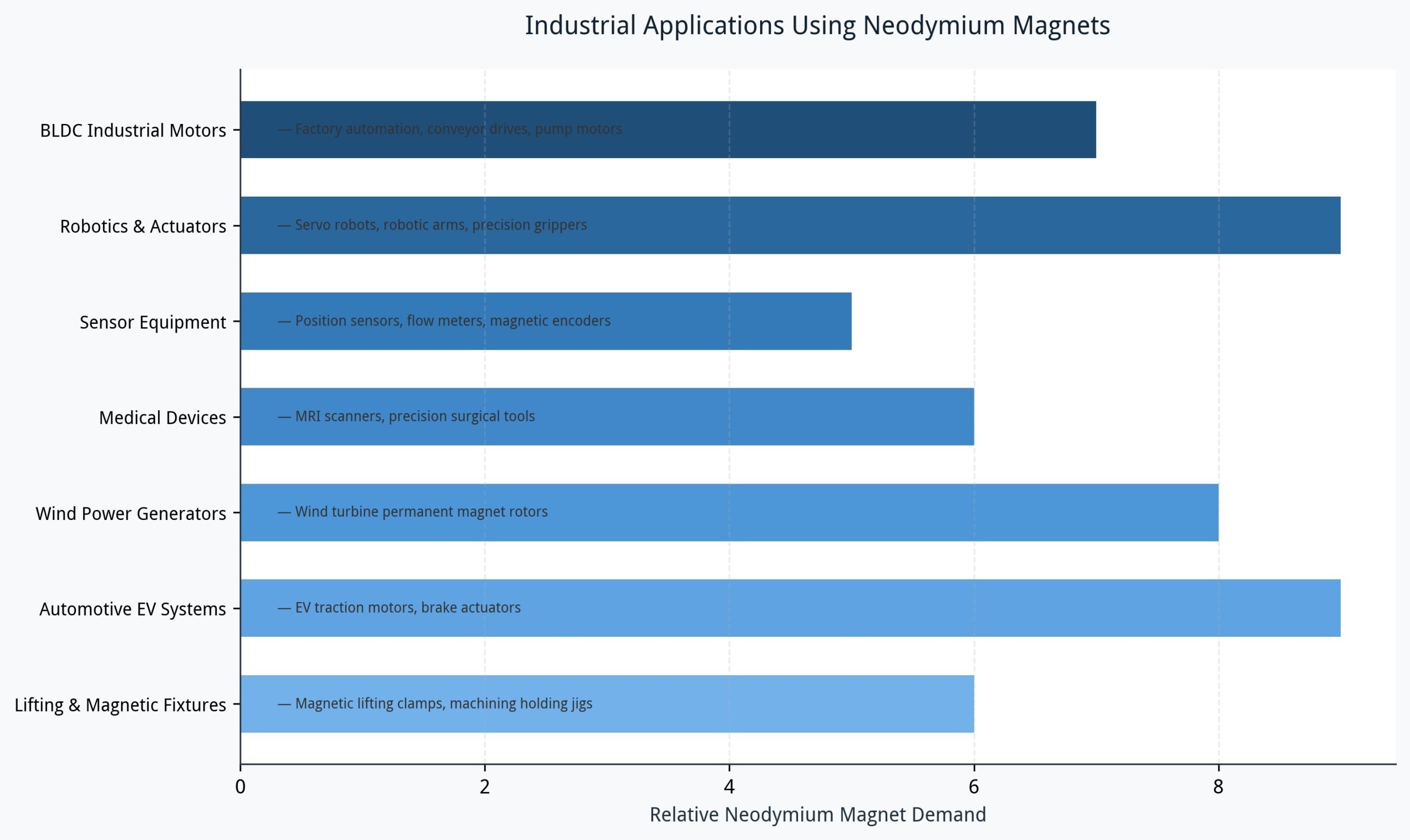
The practical impact of BHmax is most obvious in dynamic applications like electric motors. In a brushless DC (BLDC) motor, higher BHmax magnets allow the designer to generate the same level of rotational torque with a smaller rotor assembly. This is why upgrading from N35 to N52 magnets in a motor of the same physical size can deliver a 20-30% increase in peak torque output, or alternatively, allow you to shrink the entire motor housing by 25% while maintaining the exact same torque performance. This is a game-changer for industries like consumer electronics, aerospace, and robotics, where every cubic centimeter of space and every gram of weight counts towards the final product’s functionality and market competitiveness.
No magnet performs perfectly under all temperature conditions, and even the strongest neodymium magnets will lose some of their magnetic output as temperatures rise. For the standard N-series grades we are covering here, temperature behavior is one of the most overlooked, yet most critical, factors that can make or break an application.
N35, N42, and N52 all share the same maximum recommended continuous operating temperature of 80°C to 85°C for most standard formulations. If you expose these magnets to temperatures above this threshold, they will begin to experience reversible magnetic loss: their magnetic strength will drop while they are hot, but they will return to their full rated strength once they cool back down to room temperature. However, if you push them far beyond their thermal limits, typically above 150°C for standard N grades, they will suffer irreversible demagnetization, meaning they will permanently lose a portion of their magnetic strength even after cooling, rendering them useless for their original purpose.
It is a common misconception that higher grade N-series magnets handle heat better than lower grades. In reality, the opposite is often true. N52, which pushes the limits of neodymium material science to achieve maximum energy density, is actually more sensitive to elevated temperatures than N35. The ultra-high alignment of magnetic domains that gives N52 its incredible strength makes it slightly easier for heat to disrupt those domains, leading to a slightly higher rate of temporary flux loss at temperatures above 60°C compared to N35. For example, at 80°C, a N35 magnet might retain 90% of its room-temperature Br value, while a N52 magnet of the same size could retain closer to 86% of its room-temperature strength. This does not mean N52 is unusable at higher temperatures—it just means designers need to account for that extra thermal derating when calculating performance for high-heat environments.
For applications that regularly operate above 80°C, such as high-power industrial motors, engine bay sensors, or outdoor equipment exposed to direct summer sun in hot climates, none of these standard N grades are ideal, and you would need to step up to specialized high-temperature neodymium grades like N35SH or N42SH that are engineered to maintain performance at temperatures up to 150°C or higher. But for all indoor, consumer, and general industrial applications that stay below 70°C, the standard N35, N42, and N52 grades perform reliably and predictably.
Each of these three magnet grades has carved out a distinct niche in the market, based on their unique balance of performance, cost, and reliability. Understanding where each grade excels in real products will help you map your own project requirements to the right choice.
For standard applications, our disc neodymium magnets and other common magnet shapes provide reliable performance and cost efficiency.Its low cost and consistent, reliable performance make it the default choice for mass-market consumer products. You will find N35 magnets in everyday items like refrigerator magnets, magnetic photo holders, basic craft supplies, and low-cost consumer electronics accessories. It is also extremely common in low-precision sensor systems, basic magnetic switches, and simple educational lab equipment. Many budget 3D printer build plates use N35 magnets to hold the flexible print surface in place, as the strength is more than enough for that task and keeps the overall printer cost low. N35 is also the top choice for simple magnetic retrieval tools, basic office organization products, and hobbyist projects where maximum strength is not a priority, but low cost and ready availability are.
N42 is the balanced industrial workhorse that bridges the gap between budget performance and premium strength. It is the most widely used grade in modern industrial automation and motion control systems. N42 magnets are the standard choice for most mid-range brushless DC motors used in power tools, electric bicycles, HVAC blower motors, and industrial conveyor systems. They are also extremely common in magnetic coupling assemblies, high-performance holding fixtures for manufacturing lines, and professional-grade magnetic separation equipment used in food processing and recycling facilities. Many high-end speaker drivers use N42 magnets, as the extra magnetic strength improves audio clarity and efficiency without driving the cost of the speaker unit up prohibitively. For most engineers designing industrial equipment, N42 is the “safe default” choice that delivers more than enough performance for 80% of use cases, while keeping the bill of materials cost under control.
N52 is the premium high-performance grade reserved for applications where space, weight, and maximum magnetic output are non-negotiable priorities. You will find N52 magnets in the joints and actuators of modern industrial robotic arms, where every gram of reduced component weight directly improves the robot’s payload capacity and movement speed. It is also the go-to grade for high-performance drone motors, where maximizing thrust in the smallest possible motor size is critical to extending flight time. N52 is widely used in medical devices like MRI auxiliary components, surgical tool actuators, and wearable medical sensors, where strict size constraints demand the highest possible magnetic energy density. Many high-end consumer products, including premium wireless earbud charging cases, compact magnetic phone mounts, and lightweight portable power tools, use N52 magnets to deliver strong magnetic performance in ultra-thin, compact form factors that would be impossible to achieve with lower strength grades.
Selecting between N35, N42, and N52 does not have to be a guessing game. By working through these simple, structured steps, you can make a fully informed decision that balances performance, cost, and long-term reliability.
First, start by defining your minimum required magnetic performance. Calculate or test exactly how much holding force, torque, or magnetic field strength your application needs to function correctly. If a N35 magnet of your target size already meets or exceeds that requirement, there is no practical benefit to paying extra for a higher grade. For example, if you are designing a simple magnetic wall mount that only needs to hold 2kg, a N35 magnet will do the job perfectly, and upgrading to N52 will add unnecessary cost with zero functional gain.
Second, evaluate your size and weight constraints. If your design has strict limits on how large or heavy the magnet component can be, that is where higher grades deliver massive value. If you can only fit a 10mm diameter magnet in your product, but you need the holding force that a 15mm N35 magnet would deliver, a 10mm N52 magnet can often meet that requirement, eliminating the need to completely redesign your product housing to make extra space. This is the single most common reason engineers choose N52: it lets them hit performance targets that would be physically impossible with lower strength grades in the allocated space.
Third, build your budget and total cost of ownership calculation. N35 is typically 20-30% cheaper per kilogram than N42, and N52 can cost 30-40% more than N42, depending on raw rare-earth material market prices. For high-volume production runs of 100,000 units or more, even a $0.10 difference in the cost per magnet adds up to tens of thousands of dollars in extra material costs. If you are manufacturing a mass-market consumer product with tight profit margins, choosing N35 when it meets your performance requirements can be the difference between a profitable product and one that loses money at scale.
Fourth, map your operating environment. If your application will regularly see temperatures above 60°C, or will be exposed to sustained heat from nearby motors or electronics, avoid over-specifying to N52 unless you have accounted for its slightly higher thermal flux loss. In these scenarios, N42 often delivers the best balance of strength and thermal stability, and N35 will perform more predictably at elevated temperatures than the ultra-high-strength N52. If your product will operate outdoors in direct sun, or in a factory environment with high ambient heat, you should also verify that none of the standard N grades will exceed their thermal limits, and consider a high-temperature variant if needed.
If you need a specific magnet grade, size, coating, or tolerance, our engineering team can provide custom neodymium magnet solutions based on your application requirements. No datasheet can perfectly predict how a magnet will perform in your exact assembly, with your specific steel components, air gaps, and mechanical constraints. Order sample batches of all two or three candidate grades, test them under your actual operating conditions, and measure their real performance before committing to a full production order. This small upfront investment in testing will save you from the costly mistake of discovering your chosen magnet grade underperforms after you have already ordered thousands of units.
There is no universal “best” magnet grade between N35, N42, and N52—there is only the best grade for your specific application. N35 is the perfect choice for cost-sensitive, low-demand applications where basic reliable magnetic strength is all you need. N42 is the versatile, balanced workhorse that will meet the performance requirements of the vast majority of industrial and commercial projects, delivering excellent strength without unnecessary cost. N52 is the premium high-performance option that unlocks new possibilities for compact, lightweight, high-efficiency designs where every bit of magnetic energy density counts. By understanding the core differences in remanence, maximum energy product, temperature behavior, and real-world use cases, you can make a confident, informed choice that optimizes your product for performance, cost, and long-term reliability.
N52 magnets provide the highest magnetic strength, followed by N42 and N35. Higher grades offer more magnetic energy density but usually come with higher cost and slightly lower temperature tolerance.
Yes. An N52 magnet has a higher maximum energy product and can generate more magnetic force than an N42 magnet of the same size.
N42 is often the preferred choice for industrial applications because it provides a good balance between magnetic performance, cost, and reliability.
Standard N52 magnets are not designed for extreme heat environments. For high-temperature applications, SH or EH grade magnets are recommended.