Put the two most common magnets on an engineer's desk — a nickel-plated neodymium disc and a dark grey ferrite disc of the same size — and the comparison looks one-sided: the neodymium magnet pulls roughly ten times harder. Yet ferrite still accounts for the majority of magnet tonnage shipped worldwide, because the neodymium vs ferrite magnets decision was never about strength alone. It is about the six factors below: strength, temperature, corrosion, cost, size and demagnetization. This guide puts numbers on each factor and ends with a decision table you can apply to your own application.
Both materials are permanent magnets, and both can hold their force for decades. Where they differ is in what you pay — in money, in size, or in operating limits — to get the hold your design needs, and every neodymium vs ferrite magnets trade-off below comes back to those three currencies. Let's walk the six factors.
The table below sums up the neodymium vs ferrite magnets comparison on the six properties that decide most projects — each factor gets its own section after it:
| Property | Neodymium (NdFeB) | Ferrite (Ceramic) |
|---|---|---|
| Strength (energy product) | 35–55 kJ/m³ — the strongest commercial magnet | 3–4.5 kJ/m³ — roughly a tenth of neodymium |
| Max operating temp | 80 °C standard; up to 230 °C with high-temp grades | ~250 °C standard grades, no special alloy needed |
| Corrosion | Rusts — needs Ni, epoxy or rubber coating | Essentially immune — no coating required |
| Cost per unit of hold | Higher per magnet, far less material needed | Cheap material, but 8–10× the volume for the same hold |
| Size and weight | Compact and light | Large and heavy for the same force |
| Demagnetization | High coercivity; risks at heat, not at rest | Robust in the operating point; watch very cold service |
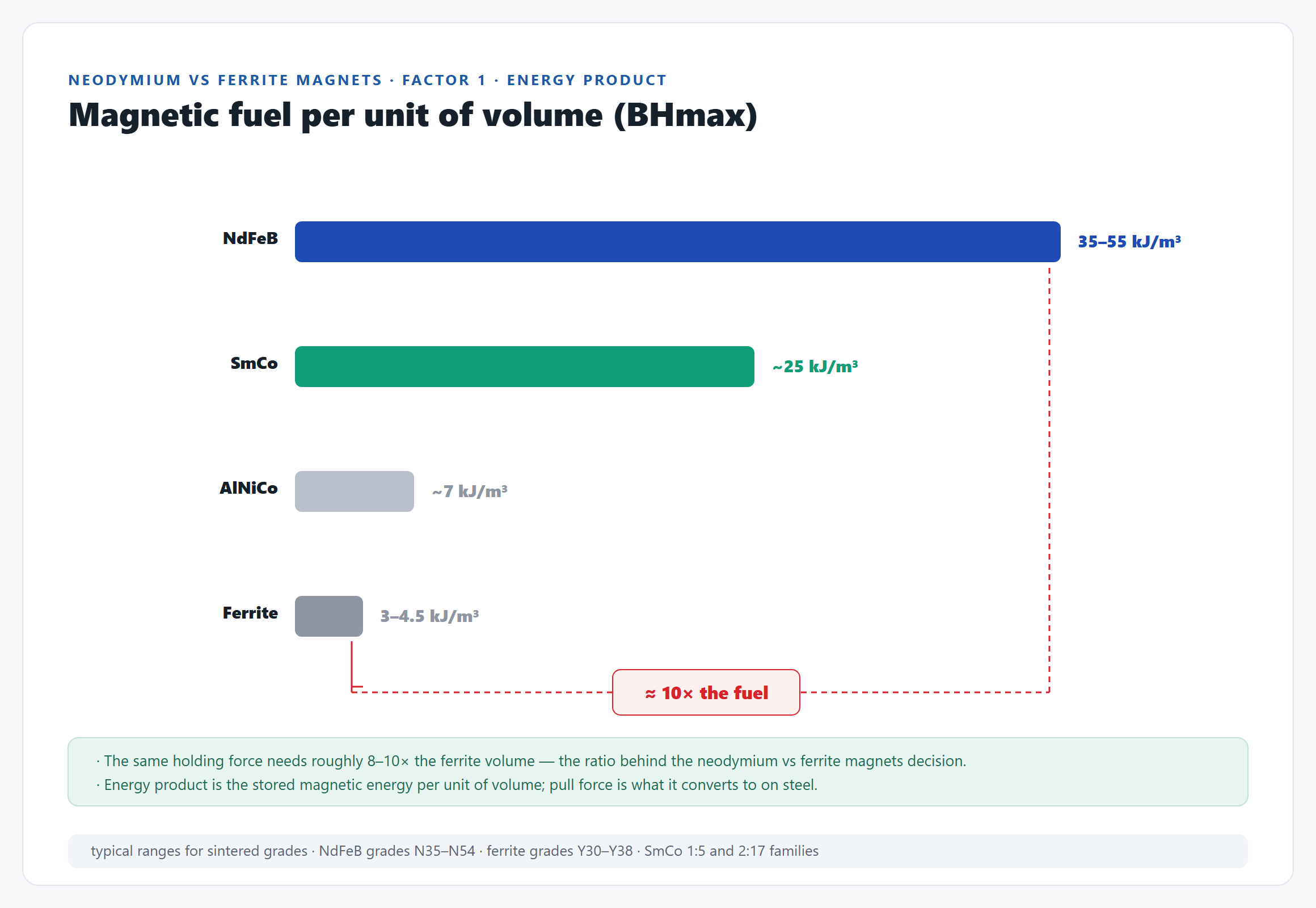
The headline difference in the neodymium vs ferrite magnets comparison is energy product — the magnetic "fuel" stored per unit volume. Sintered neodymium reaches 35–55 kJ/m³ depending on grade; ferrite manages 3–4.5 kJ/m³. In practical terms, a ferrite magnet needs roughly eight to ten times the volume of a neodymium magnet to deliver the same holding force. A Ø25 × 7 mm neodymium cup hook from our catalogue holds 24.25 lb; the equivalent ferrite assembly would be closer to fist-sized.
If your design is volume-constrained — a sensor, a coupling, a fixture, anything that mounts inside other hardware — that ratio usually ends the argument by itself, and it is the reason most neodymium vs ferrite magnets searches end at the same answer. The full logic of how that stored energy converts into pull is explained on our pull force page.
This is the one factor where the neodymium vs ferrite magnets comparison flips outright: ferrite wins. Standard N-grade neodymium keeps its rating only up to 80 °C continuous; beyond that you step up through M, H, SH, UH, EH and TH grades — at rising cost — to reach 230 °C. Ferrite grades run at up to about 250 °C as standard, with no premium alloy required.
The honest nuance: ferrite loses some force at low temperature too. Below roughly −20 °C, short ferrite magnets can suffer a small, permanent drop in output (low-temperature demagnetization), while neodymium actually gets slightly stronger as it cools. Hot application → ferrite or a high-temp neodymium grade; deep-cold application → check the ferrite grade's spec sheet. Our temperature ratings guide covers every neodymium grade in detail.
Ferrite is a ceramic — iron oxide and strontium or barium carbonate fired into a hard, chemically inert body. It does not rust, and it ships with no coating at all. Neodymium is roughly two-thirds iron by weight; uncoated, it corrodes fast enough to crumble, so every neodymium magnet carries a plating — nickel-copper-nickel as standard, epoxy or rubber for wet and salt environments.
Two consequences worth designing around. First, a neodymium magnet's finish is its armour: chip it and rust follows, so coated or rubber-jacketed parts earn their keep outdoors. Second, ferrite's bare surface is slightly rougher and its hold on painted or galvanized steel is less consistent. In maintenance terms this is where the neodymium vs ferrite magnets gap is widest — a ferrite part is finished the day it is fired, while a neodymium part is only as good as its plating. Our coatings guide compares Ni-Cu-Ni, zinc, epoxy and Parylene by environment and cost.
Raw ferrite is cheap — its feedstock is iron oxide, literally an industrial by-product — and per magnet, a ferrite part typically costs a fraction of an equivalent-size neodymium one. But the honest way to run this leg of the neodymium vs ferrite magnets debate is cost per unit of hold: ferrite needs 8–10× the volume, so its advantage narrows the moment space, weight or assembly size carries a price. For a big, roomy, low-value application (a door seal, a loudspeaker ring, a craft magnet), ferrite's low cost wins. For anything compact, the material you don't have to buy is the cheaper one.
Same force, ten times the volume — which also means roughly seven to eight times the mass. In a fixture or enclosure where grams don't matter, ferrite's bulk is free. In a moving assembly, a handheld tool, a drone, or a hook on a cabinet door, the weight penalty compounds: bigger magnet, bigger housing, more steel to hold it. This is the factor that most often flips the neodymium vs ferrite magnets decision back to neodymium even when ferrite passes every electrical requirement.
Ferrite magnets sit on a nearly straight demagnetization curve, which makes them stubborn in their working point: external fields rarely disturb a properly designed ferrite circuit, and they carry no keeper requirements. Neodymium's coercivity is far higher still — a standard N-grade resists fields that would erase an alnico — but it has its own two weak points: heat above the grade's limit, and physical shock. Neither material "runs down" in use; a magnet does not spend force by holding things. Age is a non-issue for both — under 1% flux loss per decade indoors for a properly coated magnet.
One honest cross-material caveat: a strong neodymium magnet pressed against a ferrite magnet can partially demagnetize the ferrite, especially in heat. Keep dissimilar magnets separated in storage — and treat the neodymium vs ferrite magnets pair as neighbours that should never share a toolbox drawer.
Six factors, one decision. Most neodymium vs ferrite magnets choices reduce to the table below — find the row that matches your constraint and read the winner:
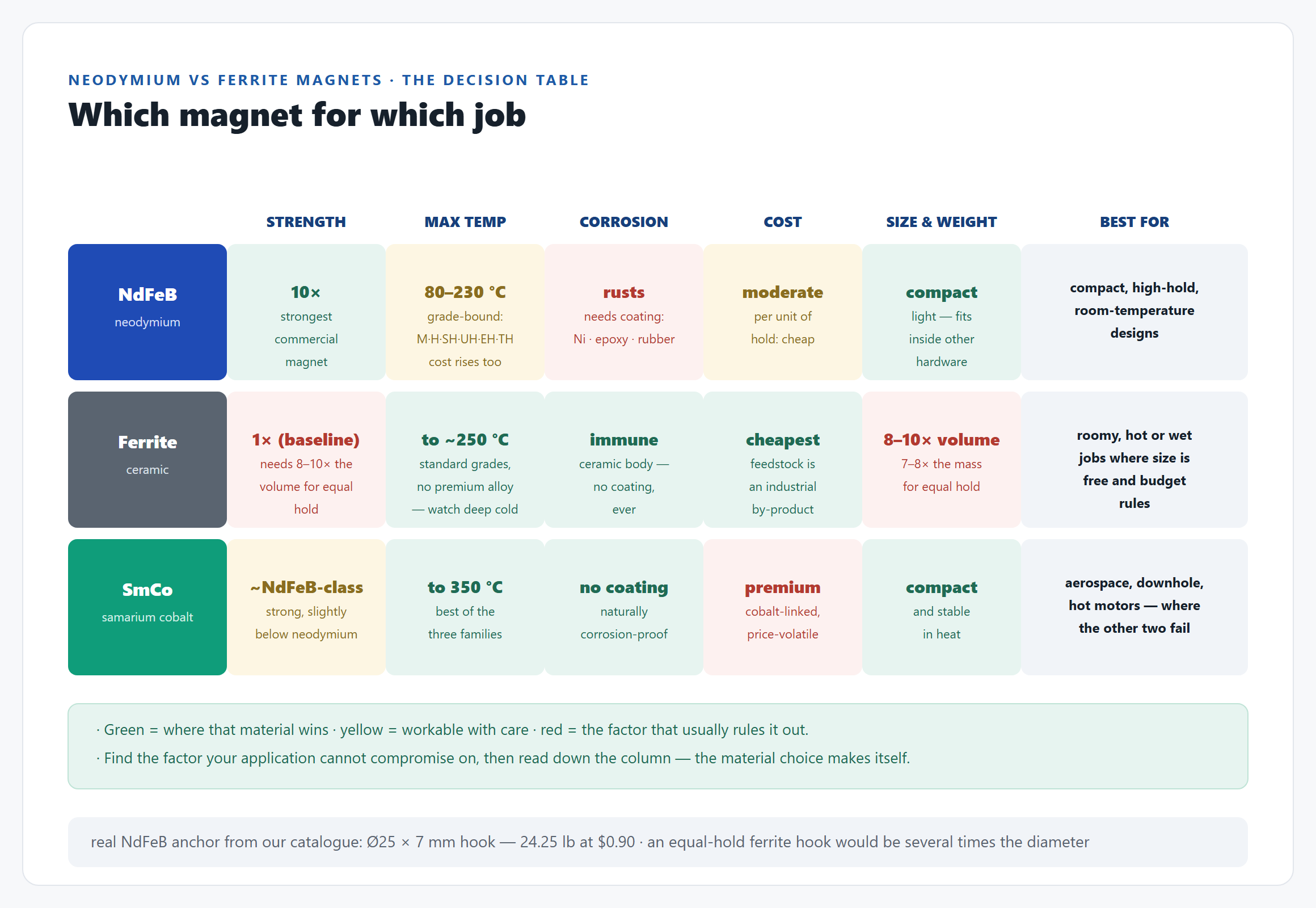
| If your application needs… | Choose |
|---|---|
| Maximum hold in minimum space, room temperature | Neodymium, any standard grade |
| Hold through 150–250 °C without exotic alloys | Ferrite — or a UH/EH neodymium grade |
| Outdoor or wet service with no coating to maintain | Ferrite (or rubber-coated neodymium) |
| Lowest material cost where space is free | Ferrite |
| Light moving assemblies, couplings, sensors | Neodymium |
| Operation beyond 250 °C, or corrosive + hot | SmCo — see below |
Our NdFeB magnetic hooks show the strength side of the neodymium vs ferrite magnets trade with real, in-stock numbers: Ø10 × 5 mm holds 4.19 lb at $0.20; Ø12 × 5 mm holds 7.28 lb at $0.25; Ø25 × 7 mm holds 24.25 lb at $0.90. To match that last figure, a ferrite hook would need several times the diameter — it would fit the job only if the cabinet door had the room and the budget ruled out neodymium anyway. That is the whole comparison in one shelf of products: ferrite wins when volume and weight are free and temperature is high; neodymium wins everywhere else.
Between the two sits samarium cobalt: strength close to neodymium, temperature to 350 °C, and corrosion resistance that needs no coating — at a cobalt-linked premium. It is the answer for aerospace, downhole and high-temperature motor work where neither the neodymium vs ferrite magnets pair survives the environment. We build SmCo pot magnets alongside our NdFeB range.
Q1: Which is stronger, neodymium or ferrite? A: Neodymium — by roughly ten times per unit of volume. The same size ferrite magnet delivers about a tenth of the holding force; equal force needs 8–10× the ferrite volume.
Q2: Why is ferrite still so widely used? A: Cost, temperature and corrosion — the three rows of the neodymium vs ferrite magnets comparison where neodymium does not win. Ferrite is the cheapest magnet material, runs at up to ~250 °C as standard, and needs no coating. When space and weight are free, it is the economical choice.
Q3: Can ferrite replace neodymium in my design? A: Only if you have the room. The replacement magnet needs roughly 8–10× the volume for the same hold — measure your assembly before assuming it fits. That single check settles most neodymium vs ferrite magnets questions in practice.
Q4: Which lasts longer, neodymium or ferrite? A: Both last decades. The neodymium magnet's real lifespan limiter is its coating; ferrite's ceramic body is nearly immune but can chip. Under 1% magnetic loss per decade for either, used within limits — lifespan is rarely the deciding factor in the neodymium vs ferrite magnets choice.
Q5: Do ferrite magnets work outdoors? A: Yes — that is one of their best cases. They neither rust nor need plating, and they shrug off sun-driven surface temperatures that would push standard neodymium past 80 °C.
Q6: Which handles heat better? A: Ferrite, as standard. Neodymium needs progressively more expensive grades (M, H, SH, UH, EH, TH) to climb from 80 °C to 230 °C, while standard ferrite grades run to ~250 °C.
Q7: Can a neodymium magnet demagnetize a ferrite magnet? A: A strong neodymium magnet pressed against a ferrite one — especially in heat — can partially demagnetize it. Store dissimilar magnets apart, with unlike poles facing where practical.
Q8: Is the neodymium vs ferrite magnets choice also a safety question? A: Indirectly, yes. Neodymium's higher force means harder pinch hazards and more violent snap-together at small sizes; ferrite's weaker grip is more forgiving. Either way, keep strong magnets from children and pacemaker wearers.
Q9: What about SmCo — where does it beat both? A: Above 250 °C and in corrosive service. SmCo reaches 350 °C with no coating, at a cobalt-linked price premium that only harsh environments justify.
Q10: Can you supply both materials? A: Yes — our range is neodymium-first (10 million magnets in stock), with ferrite and SmCo options for the applications where they are the right call. Tell us the application and we will quote the honest material, not just ours.
The neodymium vs ferrite magnets decision is an engineering trade, not a brand loyalty question — and we manufacture the neodymium side of it honestly: if ferrite is the right material for your job, our engineers will tell you before they quote. Browse the neodymium magnets explained basics or contact us with your application's force, temperature and environment — you get a material recommendation the same day.