Magnetic push pins do everything a traditional push pin does — hold papers, photos, notes and reminders where you can see them — without punching a single hole. A neodymium magnet inside an easy-to-grip plastic housing snaps onto any ferromagnetic surface, repositions in a second, and comes off without leaving marks, adhesive residue or a board full of punctures. One pin outlasts hundreds of box-store push pins, which is why offices, classrooms and kitchens keep switching.
This page covers the GM-T1 family of magnetic push pins in three strengths: the standard 11 mm pin at 0.99 lb hold (eight colours, $0.11), and two glassboard-specialised sizes at 3.75 lb and 4.85 lb (four colours, $0.299 and $0.599). The three strengths exist for a reason that most sellers never explain: a glass whiteboard steals holding force, because the steel the magnet grips sits behind a layer of glass. Below the spec table you will find that physics in plain numbers, an honest guide to which pin holds what on which surface, and a four-step chooser.
If you are fitting out a whole office, the same magnets are also sold under the glassboard magnets family alongside board-scale sizes — and every pin on this page is a stock item, shipped from 10-million-magnet inventory.
Every one of our magnetic push pins is built from three parts:
Because the housing covers the magnet completely, magnetic push pins are safe to slide across a board, stack in a drawer, and hand around a classroom — the magnet's full strength is always working for you, never against your fingers.
Pull figures for these magnetic push pins are vertical pull-off on thick clean steel, measured the same way as every magnet in our catalogue:
| Model | Diameter | Height | Weight | Pull | Colours | Price |
|---|---|---|---|---|---|---|
| Standard pin | 0.433 in / 11 mm | 0.67 in / 17 mm | 0.071 oz / 2 g | 0.99 lb / 450 g | 8 | $0.110 |
| Glassboard pin, small | 0.748 in / 19 mm | 0.984 in / 25 mm | 0.194 oz / 5.5 g | 3.75 lb / 1.7 kgf | 4 | $0.299 |
| Glassboard pin, large | 1.14 in / 29 mm | 1.5 in / 38 mm | 0.564 oz / 16 g | 4.85 lb / 2.2 kgf | 4 | $0.599 |
Reading notes: the standard pin comes in black, blue, clear, green, orange, pink, purple and yellow — a full colour-coding palette at eleven cents. The glassboard sizes come in black, blue, gray and green, the tones offices actually specify for board-scale work. All three strengths of magnetic push pins are stock items; mixed-strength, mixed-colour sets ship as easily as single-SKU cartons.
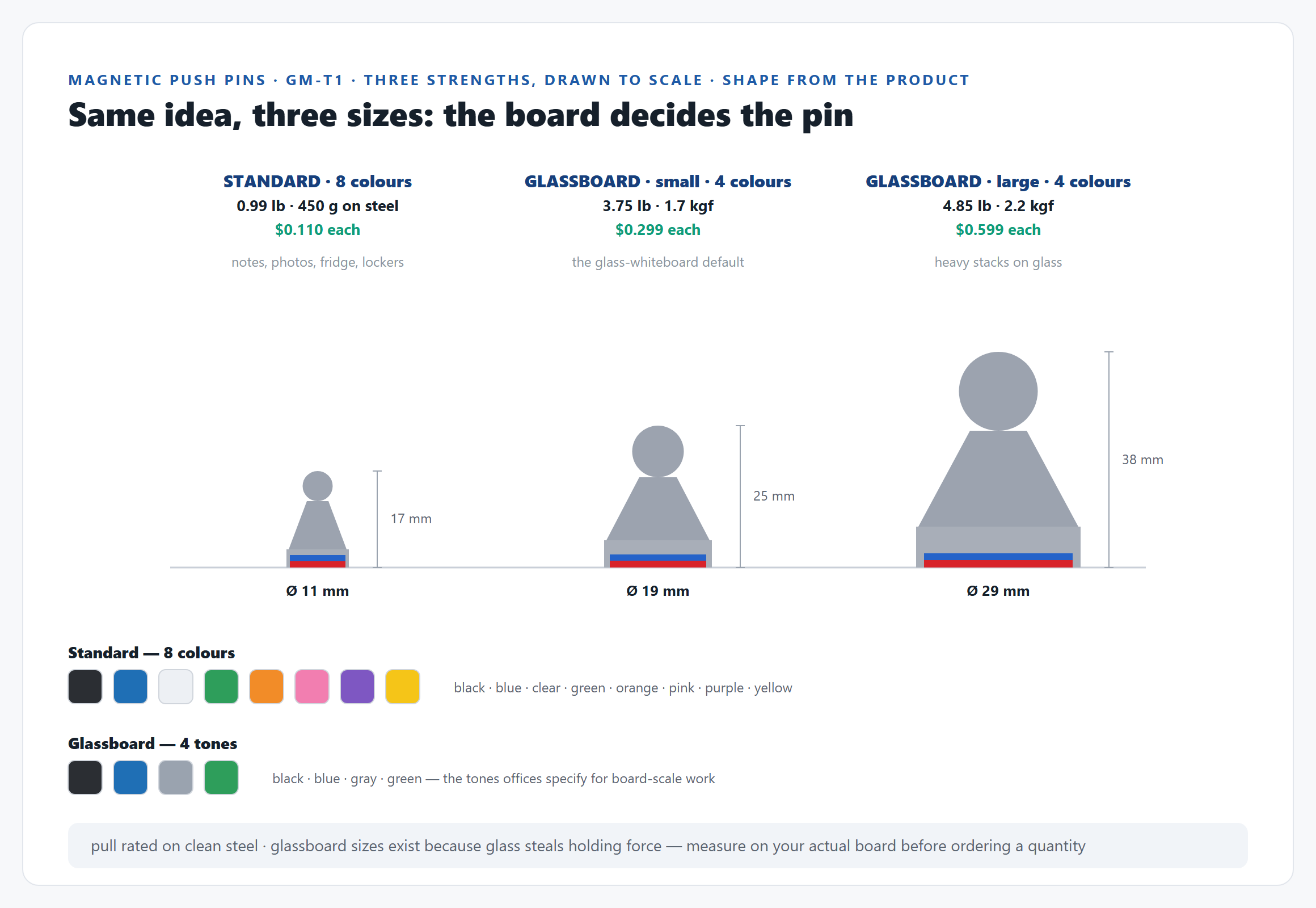
The counter-intuitive row is the first one: the standard pin is rated 0.99 lb — plenty for a stack of papers on steel — yet it disappoints on a glass whiteboard. The reason is distance, not strength. A glass board is a sheet of glass in front of the steel the magnet actually grips, and pull force falls off steeply with every millimetre of air or material gap — the same pull force physics that governs coatings and paint. Typical board glass sits several millimetres thick, and magnetic push pins that grip the steel directly lose a large share of their rating by the time they reach the glass surface.
So the glassboard sizes exist to compensate: the 19 mm pin triples the magnet volume, and the 29 mm pin goes further again, so that hold at the glass surface stays useful. The honest caveat: exactly how much hold survives the glass depends on your board's glass thickness and backing — we do not publish a single through-glass number, because a 3 mm board and a 6 mm board do not behave the same. Tell us your board (or send one) and engineering will measure the hold on the actual surface before you commit to a quantity. On plain steel — fridges, filing cabinets, lockers, rack uprights — magnetic push pins perform at their rated figures, every row of the table.
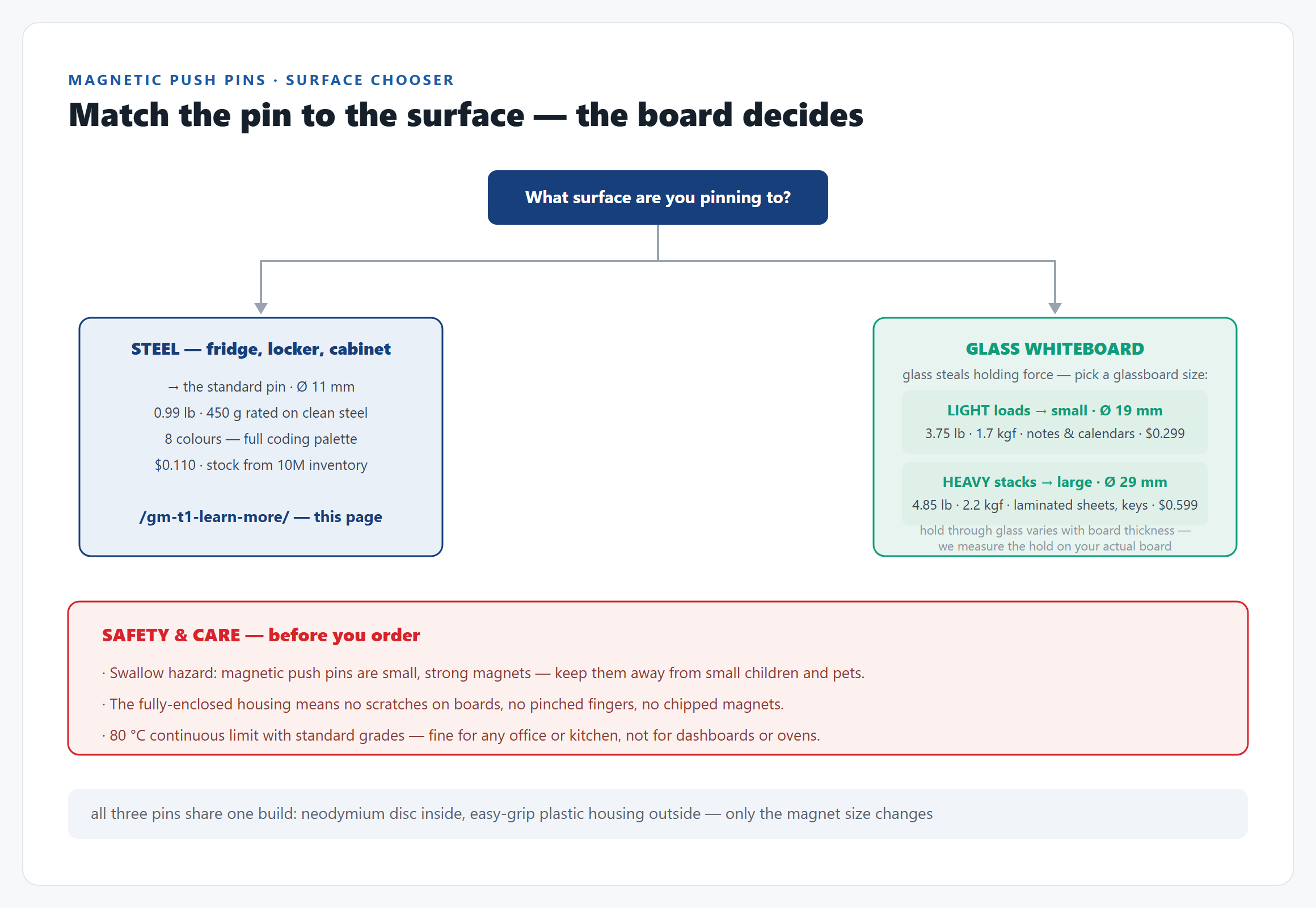
Magnetic push pins earn their keep in different places — match the pin to the surface:
| Standard pin (11 mm) | Glassboard pin, small (19 mm) | Glassboard pin, large (29 mm) | |
|---|---|---|---|
| Best surface | steel: fridges, lockers, cabinets, rack uprights | glass whiteboards, steel boards | glass whiteboards with heavy stacks |
| Hold on clean steel | 0.99 lb / 450 g | 3.75 lb / 1.7 kgf | 4.85 lb / 2.2 kgf |
| Through glass | not recommended | the glassboard default | when stacks are heavy |
| What it holds | notes, photos, reminders, a few sheets | multi-page documents, calendars, plans | laminated sheets, small tools, keys |
| Colours | 8 — full coding palette | 4 office tones | 4 office tones |
| Price | $0.110 | $0.299 | $0.599 |
One more decision rule that saves money: colour-coding is a standard pin's superpower. Teams that mark workflows by colour — red for urgent, green for done — buy the eight-colour standard pin for steel surfaces and the four-tone glassboard pins only where a glass board forces it. Matching the pin to the surface, not the colour, keeps the per-pin cost of magnetic push pins near a dime.
Beyond the three stock strengths we build OEM programmes for office-supply brands and education distributors: custom housing colours and materials, private-label packaging, mixed colour-and-strength assortment tins, and special pull ratings for particular board constructions. Because the magnets and housings are produced in-house, a custom pin is a drawing and a quantity — start at custom magnets or contact us directly.
Q1: Will magnetic push pins work on a glass whiteboard? A: Yes, but only the glassboard sizes — the 19 mm and 29 mm pins carry magnets large enough to keep a useful hold at the glass surface. The standard 11 mm pin is rated for steel and loses too much hold through typical board glass.
Q2: Why do glassboard magnetic push pins need to be bigger? A: Pull force falls with distance from the steel. Glass sits between the pin and the steel backing, so a bigger magnet is the only way to restore hold at the surface — the same physics that makes painted steel weaker than bare steel.
Q3: How much can the standard pin hold? A: 0.99 lb (450 g) vertical pull on clean steel — comfortably a stack of papers, photos and notes. It is the most economical magnetic push pin in the range at $0.11.
Q4: Will the pins scratch my fridge or whiteboard? A: No — the magnet is fully enclosed in the plastic housing, so nothing metal touches the surface. Wipe dust off the face occasionally so grit never gets trapped under it.
Q5: What colours are available? A: The standard pin comes in eight colours: black, blue, clear, green, orange, pink, purple and yellow. The glassboard sizes come in black, blue, gray and green.
Q6: Can I mix colours and strengths in one order? A: Yes — all three strengths and every colour are stock items, and mixed cartons ship as easily as single-SKU ones. Assortment tins for retail are a standard OEM option.
Q7: Are magnetic push pins safe around children? A: Treat them like any small strong magnet: keep them away from small children and pets. Swallowed magnets are a medical emergency. The fully-enclosed housing removes pinch and chip risks in normal use.
Q8: What temperature can they take? A: Standard neodymium grades inside magnetic push pins hold their rating in any normal office or kitchen environment; keep continuous service under 80 °C. Higher-temperature grades are a custom order.
Q9: Do the pins lose strength over time? A: No — neodymium magnets keep their pull for the life of the product. What ages is nothing here: the housing is the only wearing part, and it is plastic.
Q10: Can we order custom colours or private-label packaging? A: Yes — housing colours, materials, pull ratings and retail packaging are all standard OEM options for magnetic push pins; see the custom section above or contact us with your brand book.
Three strengths, eight-plus colours, from $0.11 a pin — every pull figure measured the same way as the rest of the catalogue, so the comparison across magnetic push pins is honest. Browse the glassboard magnets category for stock, or contact us with the board you use and the load you need to hold. Engineering answers the same day — including the measurement of hold on your actual glassboard before you commit to a quantity.