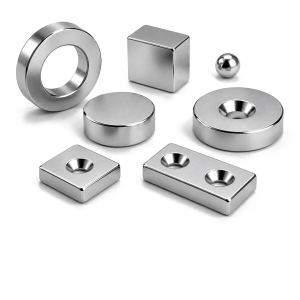
Neodymium magnets, also known as NdFeB magnets, are rare-earth permanent magnets valued for their high magnetic energy density and compact size. They are widely used in industrial equipment, electronics, automation systems, magnetic fixtures and custom assemblies.
NEOMAG supplies standard neodymium magnets in a range of shapes, dimensions, grades, coatings and magnetization configurations. With more than 20 years of experience and over 10 million magnets in stock, we support OEMs, distributors and industrial buyers with standard products and customized magnetic solutions.
Whether you need magnets for an existing product or are developing a new assembly, choosing the right magnet starts with understanding the shape, magnetic properties and operating environment.
Browse Neodymium Magnet Products or explore Custom Magnets & Magnetic Assemblies.
Neodymium magnets are available in different geometries to accommodate installation space, mounting methods and magnetic circuit requirements. The following are common shapes available in our product range.
Disc magnets are cylindrical magnets with a diameter greater than their thickness. They are commonly used in sensors, electronic devices, magnetic holders and compact industrial assemblies.
Explore our Neodymium Disc Magnets.
Block magnets have rectangular or square geometries that provide versatile mounting surfaces. They are used in industrial fixtures, motors, automation equipment and magnetic assemblies.
Explore our Neodymium Block Magnets.
Ring magnets feature a central hole for mounting around shafts, fasteners or other mechanical components. They are commonly used in motors, speakers, sensors and magnetic couplings.
Explore our Neodymium Ring Magnets.
Countersunk magnets feature a tapered mounting hole designed to accommodate a compatible countersunk screw. They are useful in magnetic fixtures, mounting systems, displays and closures.
Explore our Neodymium Countersunk Magnets.
Sphere magnets have a rounded geometry for specialized assemblies, scientific applications and other designs requiring spherical magnetic components.
Explore our Neodymium Sphere Magnets.
Neodymium magnets are used across industries where compact size and high magnetic performance are important. Typical applications include:
The appropriate magnet depends on the complete application, including required force, working distance, operating temperature, mounting arrangement and surrounding materials.
Choosing a neodymium magnet for an industrial application requires more than comparing grades. Engineers should consider the required holding force, available installation space, air gap, operating temperature, mounting method and surrounding materials. For OEM projects, evaluating these factors together helps identify a magnet configuration that meets the functional requirements of the finished product.
Selecting a neodymium magnet involves more than choosing a grade number. Dimensions, magnetic properties, operating temperature, coating and magnetization direction all influence suitability for the intended application.
Common neodymium magnet grades include N35, N38, N42, N45 and N52. The grade number primarily describes the material's maximum energy product, not the finished magnet's actual holding force.
A higher grade can provide greater magnetic energy density, but actual performance also depends on magnet dimensions, geometry, air gap and the surrounding magnetic circuit.
For a more detailed comparison, read our Neodymium Magnet Grades Guide.
Operating temperature depends on the specific grade, coercivity, magnet geometry, magnetic circuit and working conditions. High-temperature grades may be suitable for applications exposed to elevated temperatures, but the appropriate material should be selected against the actual operating requirements.
Common coating options may include nickel-based finishes, zinc and epoxy, depending on product availability and application requirements. Coating selection should consider moisture, corrosion exposure, handling and the intended operating environment.
No coating should be assumed to provide complete corrosion protection under every condition.
Magnetization direction determines the orientation of the magnetic poles. Depending on the magnet geometry and application, axial, diametrical or specialized multipole magnetization may be considered.
For custom designs, a drawing showing the required dimensions and pole orientation can help clarify the specifications.
For projects requiring non-standard dimensions, specific magnetic properties, special coatings or particular magnetization configurations, NEOMAG can review drawings, samples and application requirements.
Explore our Custom Magnets & Magnetic Assemblies to learn more about available customization options.
NEOMAG supports standard magnet supply and customized magnetic solutions for OEMs, distributors and industrial buyers.
For current availability, technical specifications and order requirements, contact our team before placing an order.
Neodymium magnets are rare-earth permanent magnets made primarily from neodymium, iron and boron. They are commonly referred to as NdFeB magnets.
The choice depends on available installation space, mounting method, required magnetic performance and the surrounding magnetic circuit. Disc, block, ring and countersunk magnets each offer different geometric and mounting characteristics.
There is no single best grade for every application. The appropriate grade depends on required magnetic performance, dimensions, operating temperature, resistance to demagnetization and cost.
There is no single maximum temperature for all neodymium magnets. The suitable operating temperature depends on the specific grade and application conditions. Confirm the relevant material data and operating requirements before selecting a magnet for a high-temperature environment.
Common options include nickel-based coatings, zinc and epoxy, depending on product availability. The appropriate coating depends on moisture exposure, corrosion risk, handling and other environmental conditions.
Standard nickel-plated magnets may corrode under prolonged exposure to moisture or harsh environments. The appropriate coating or protective assembly should be selected according to the actual conditions. For demanding outdoor applications, evaluate corrosion protection and service-life requirements before use.
Neodymium magnets generally offer much higher magnetic energy density than ferrite magnets, allowing strong magnetic performance in a compact volume. Actual holding force depends on magnet dimensions, geometry, contact conditions and the magnetic circuit.
NEOMAG reviews custom requirements for dimensions, grades, coatings, magnetization directions and magnetic assemblies. Drawings, samples or detailed application information can help our team evaluate a suitable solution.
Whether you need standard magnets, bulk supply or a customized magnetic assembly, NEOMAG can review your product requirements and help identify suitable options.