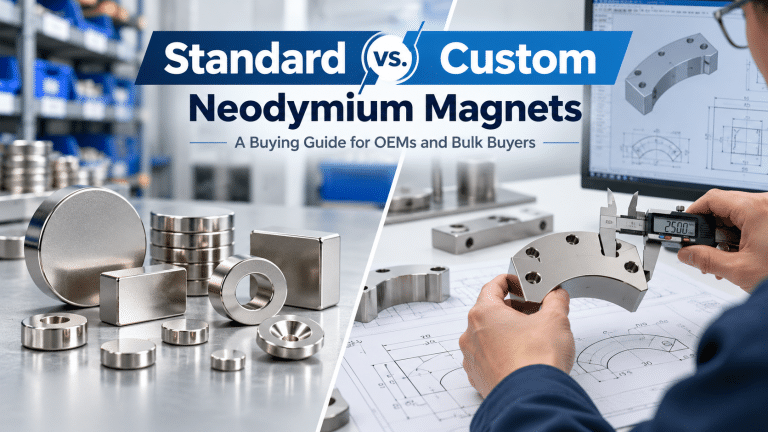
When sourcing neodymium magnets for industrial production, distribution, or OEM applications, buyers face an important decision: Should you purchase standard neodymium magnets in bulk or choose custom-manufactured magnets designed specifically for your application?
Both options offer advantages, but the right choice depends on your required specifications, order volume, budget, and production schedule.
Standard magnets can be a practical option when readily available dimensions and magnetic properties meet your requirements. Custom neodymium magnets, on the other hand, offer greater design flexibility for products that require specific dimensions, magnetic performance, coatings, or magnetization patterns.
For purchasing managers, product engineers, and wholesale distributors, understanding these differences can help reduce sourcing risks, control costs, and avoid unnecessary production delays.
In this guide, we'll compare standard and custom NdFeB magnets, explain the factors affecting pricing and lead times, and help you determine the most suitable sourcing strategy for your business.
Standard neodymium magnets are commercially available NdFeB magnets manufactured in commonly requested shapes, dimensions, and specifications.
They are widely used in industrial equipment, commercial products, magnetic fixtures, displays, and various manufacturing applications.
Common standard magnet shapes include:
At NEOMAG, buyers can explore a range of standard neodymium magnets in different shapes and specifications.
Faster availability
When the required size and specification are already in stock, buyers may be able to avoid the additional production time associated with custom manufacturing.
Lower initial development requirements
Standard products generally do not require new dimensional designs or application-specific manufacturing arrangements.
Convenient bulk purchasing
For wholesalers, distributors, and manufacturers using established specifications, standard magnets can simplify repeat orders.
Easier product comparison
Buyers can compare existing product dimensions, available specifications, and pricing before requesting a larger order.
Standard magnets may not meet every application requirement.
A commercially available magnet could have the wrong thickness, magnetization direction, operating-temperature capability, or surface finish for a particular design.
Choosing an unsuitable standard magnet simply because it is available can introduce assembly problems, performance inconsistencies, or unnecessary redesign costs.
Standard magnets are usually the best starting point when the available specifications already satisfy your application.
Custom neodymium magnets are manufactured according to specific customer requirements rather than selected exclusively from an existing product catalog.
These requirements may include:
For example, an OEM producing a compact electronic device may require a magnet with a particular thickness and magnetization direction that cannot be found among standard catalog products.
Similarly, an industrial equipment manufacturer may need a magnetic assembly designed to fit an existing housing or mounting configuration.
In these situations, customized manufacturing can provide a more appropriate solution.
NEOMAG supports custom neodymium magnets and magnetic assemblies for OEM and industrial applications, including engineering consultation, prototype development, and production.
Application-specific fit
Custom dimensions and configurations help magnets integrate into products with particular mechanical constraints.
Controlled magnetic performance
Engineers can define the required magnetic properties and magnetization configuration rather than relying solely on standard catalog options.
Greater material and coating flexibility
Magnet grades and protective coatings can be selected according to the operating environment and project requirements.
Improved design integration
A custom magnet or magnetic assembly may eliminate the need for additional adapters, modifications, or compromises elsewhere in the product design.
Custom magnets may involve additional engineering review, sample development, manufacturing setup, or minimum-order requirements.
They can also require longer lead times than available stock products.
Therefore, custom manufacturing is most valuable when the technical or commercial benefits justify the additional development effort.
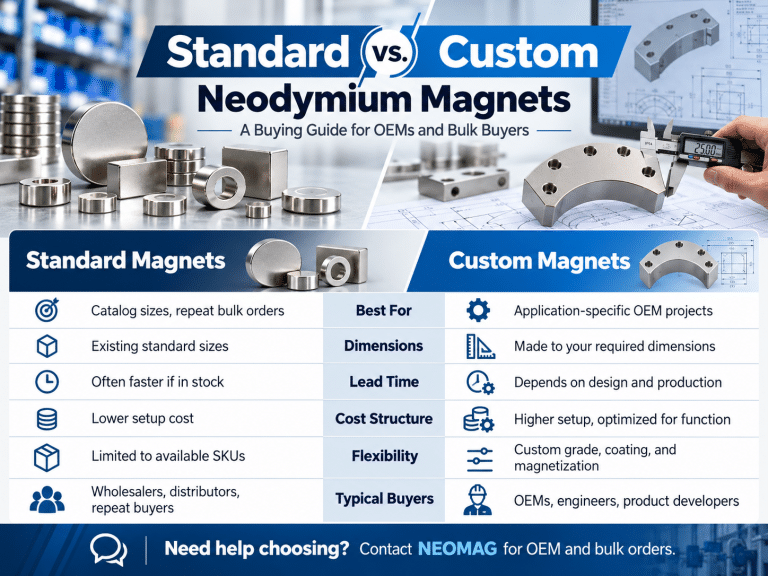
The following comparison helps OEM buyers and purchasing managers evaluate both options.
| Factor | Standard Neodymium Magnets | Custom Neodymium Magnets |
|---|---|---|
| Dimensions | Existing catalog sizes | Designed around project specifications |
| Magnet grades | Available stocked options | Grades selected for application requirements |
| Magnetization | Existing product configurations | Custom directions or patterns where feasible |
| Coatings | Existing product finishes | Application-specific coating options |
| Initial setup | Generally minimal | May require engineering and manufacturing setup |
| Lead time | Potentially faster for in-stock products | Depends on design and production requirements |
| Upfront cost | Often lower without customization | May include development or setup costs |
| Bulk purchasing | Suitable for repeat orders of standard SKUs | Suitable for repeat OEM production |
| Best suited for | Distributors and buyers using established specifications | OEMs requiring specific functional or dimensional characteristics |
The important distinction is that standard does not automatically mean better value, and custom does not automatically mean better performance.
A standard magnet is often more economical when its specifications match the application.
A custom magnet may provide greater overall value when it improves product integration, eliminates unnecessary components, or satisfies requirements that standard products cannot meet.
Price is a major consideration for both wholesale buyers and OEM manufacturers.
However, comparing magnets based only on unit price can be misleading.
The total cost of purchasing and using magnets may include:
Standard neodymium magnets are often cost-effective when:
For example, a distributor purchasing standard disc magnets for resale may benefit from established stock specifications and volume-based pricing.
In this case, choosing custom manufacturing would not necessarily provide additional value.
Custom magnets can be economically attractive when they eliminate other manufacturing or assembly costs.
Consider an OEM whose product requires a specific magnetic component.
A standard magnet might need an additional bracket, spacer, or modification to fit the assembly.
A custom magnet manufactured to the correct specifications could potentially reduce those additional steps.
For recurring production orders, these savings may help offset initial custom manufacturing expenses.
The final comparison depends on actual quotations, engineering requirements, and annual purchasing volume.
Procurement tip: Request quotations using the same performance requirements, target quantities, quality expectations, and delivery terms. This makes the comparison between standard and custom solutions more meaningful.
Lead time is another important factor in magnet procurement.
A delayed component can affect an entire assembly or manufacturing schedule.
For stocked products, lead time primarily depends on:
A supplier with local inventory may offer advantages to buyers who require shorter fulfillment times.
NEOMAG maintains a U.S. fulfillment warehouse in Redlands, California, supporting selected in-stock magnet orders for customers across the United States.
Buyers should confirm the current stock quantity and estimated dispatch date before placing a time-sensitive order.
Custom magnet production may include additional stages:
The schedule varies with magnet complexity, material availability, production quantity, and inspection requirements.
For OEM projects, sharing complete drawings and specifications early can help the supplier evaluate feasibility and develop a more realistic production schedule.
Yes. For some projects, a combined sourcing strategy is worth evaluating.
For example, an engineering team may begin prototype testing with an available standard magnet before ordering a custom component for the finalized product.
However, a standard magnet should not be treated as functionally equivalent to a custom design without appropriate testing.
The magnetic field, dimensions, temperature rating, and assembly performance must still satisfy the project's requirements.
Whether purchasing standard magnets or developing custom components, buyers should evaluate more than magnet size.
Neodymium magnets are available in different grades, such as N35, N42, N45, and N52.
These designations indicate different maximum energy product ranges, but they do not independently determine the holding force of a finished magnet.
The actual magnetic performance also depends on geometry, magnetization, air gap, and surrounding materials.
A higher grade is not always necessary for every application.
Common shapes include discs, blocks, rings, and countersunk magnets.
Shape influences magnetic field distribution, mounting methods, and integration into the finished product.
Buyers should specify dimensions clearly, including applicable tolerances.
Browse NEOMAG's disc magnets or block magnets to explore standard product options.
Sintered NdFeB magnets are susceptible to corrosion when inadequately protected.
Common coating options include nickel-based plating, epoxy, and other application-dependent protective finishes.
Coating selection should consider humidity, chemical exposure, abrasion, and the intended operating environment.
Axial and diametrical magnetization are common configurations for appropriate magnet geometries.
More specialized applications may require different magnetic pole patterns.
The correct magnetization direction is critical because an otherwise suitable magnet may perform incorrectly if its poles do not align with the intended assembly.
Temperature can affect magnetic performance.
The maximum recommended operating temperature depends on the material grade, magnet geometry, magnetic circuit, and operating conditions.
For high-temperature environments, buyers should specify the expected temperature range and discuss suitable materials with the supplier.
Published pull-force values generally reflect specific test arrangements.
Real-world holding force can differ due to air gaps, steel thickness, contact area, surface condition, loading direction, and other factors.
Where holding performance is important, evaluate the magnet in its actual assembly rather than relying exclusively on catalog pull-force figures.
Choosing a magnet supplier should involve more than comparing quoted prices.
For recurring industrial or wholesale purchasing, buyers should evaluate the supplier's ability to provide consistent products and dependable support.
Can the supplier provide standard magnets as well as custom dimensions, grades, coatings, and magnetization configurations?
A supplier that supports both options may help buyers manage projects as their requirements evolve.
For wholesale distributors and repeat industrial customers, inventory availability is especially important.
Ask whether the supplier can support your anticipated order quantities and replenishment schedule.
Depending on the application, important inspection factors may include:
For critical applications, communicate inspection methods, acceptance criteria, and documentation requirements before placing the order.
A supplier should be able to review project requirements and discuss potential manufacturing or performance concerns.
This is particularly valuable for custom magnets, where missing technical details may lead to quotation delays or incorrect specifications.
Packaging requirements can vary substantially between retail distribution and industrial assembly.
Buyers may need bulk cartons, separated components, labeled bags, or application-specific packaging.
Shipment planning should also consider the requirements applicable to magnetized materials.
A reliable sourcing plan accounts for both product performance and the practical requirements of receiving, storing, and using the magnets.
NEOMAG supports wholesale distributors, industrial buyers, and OEM manufacturers with standard magnet products and custom magnetic solutions.
With more than 20 years of experience in magnet manufacturing and supply, NEOMAG offers several advantages for business customers.
NEOMAG reports an inventory of more than 10 million magnets across its product offerings, supporting buyers who require established products and repeat purchasing.
Inventory availability for a specific SKU or quantity should be confirmed before ordering.
Selected stocked products are fulfilled through NEOMAG's warehouse in Redlands, California.
This provides an additional fulfillment option for U.S. customers purchasing available standard products.
NEOMAG supports customization of dimensions, magnet grades, coatings, magnetization directions, and magnetic assemblies according to project requirements.
Customers can discuss design requirements and prototype-to-production needs with the technical team.
NEOMAG describes inspection processes covering dimensions, magnetic performance, coating quality, and product consistency.
Customers with specific testing or documentation requirements should include them in their request for quotation.
Whether you need standard magnets in large quantities or application-specific components for an OEM project, NEOMAG can review your requirements and discuss available supply options.
Explore Bulk Neodymium Magnets
Explore Custom Magnet Solutions
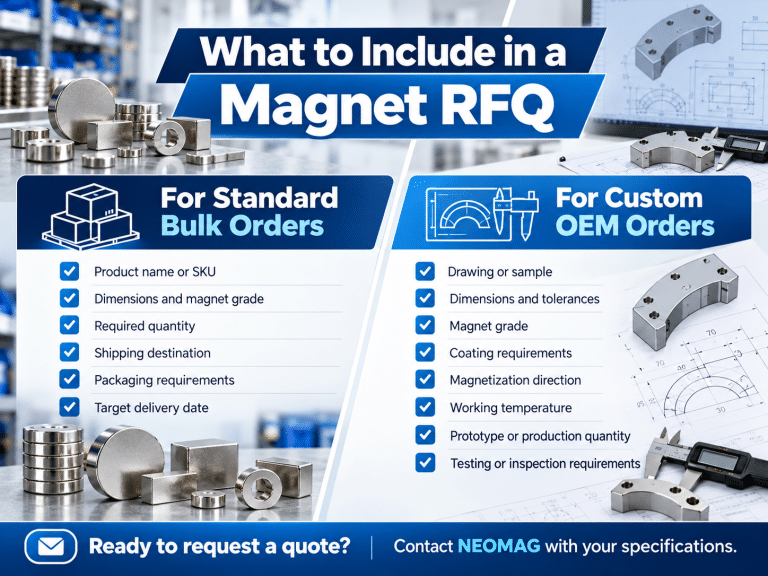
A complete RFQ helps suppliers understand the project and prepare a more relevant quotation.
For standard neodymium magnet bulk orders, provide:
For custom OEM magnet orders, include:
If you are unsure about a particular specification, describe the application and identify which requirements remain open for discussion.
You can submit these details through NEOMAG's contact and quotation page.
Bulk purchasing may reduce the unit price compared with smaller orders, depending on product specifications, quantity, packaging, and supplier pricing.
However, buyers should compare the complete quotation, including shipping and any additional charges, rather than unit price alone.
Yes. Custom NdFeB magnets can be manufactured for recurring OEM production and larger industrial orders.
Production feasibility, minimum order quantity, lead time, and pricing depend on the specifications and supplier capabilities.
There is no universal minimum order quantity for all custom magnets.
MOQ depends on geometry, material, manufacturing requirements, and other factors. Buyers should submit their specifications to obtain a project-specific assessment.
Not necessarily.
Custom manufacturing allows the magnetic properties and geometry to be selected for a particular application, but customization alone does not guarantee higher magnetic strength.
The magnet's actual performance depends on material properties, dimensions, magnetization, and operating conditions.
Often, yes, provided the available magnet is suitable for the intended tests.
Standard magnets may help engineers explore initial concepts before committing to a final design.
However, results obtained using standard magnets should not automatically be assumed to represent the performance of a different custom design.
Choose standard magnets when their available dimensions, magnetic properties, and other specifications meet your requirements.
Consider custom manufacturing when your application requires dimensions, magnetization patterns, coatings, tolerances, or configurations unavailable in standard catalog products.
Yes. NEOMAG offers standard neodymium magnet products for bulk purchasing and custom magnetic solutions for OEM and industrial projects.
Contact the team with your product requirements, quantity, and expected delivery schedule to discuss the appropriate option.
Both standard and custom neodymium magnets play important roles in industrial manufacturing and wholesale distribution.
Standard neodymium magnets are often the practical choice when established product specifications meet your requirements, particularly for recurring bulk orders.
Custom neodymium magnets are more suitable when a project requires specialized dimensions, magnetic properties, coatings, or assembly configurations.
The best sourcing decision balances technical performance, purchase cost, manufacturing requirements, inventory availability, and long-term supply planning.
By evaluating these factors early, purchasing managers and engineers can make better-informed decisions and reduce avoidable procurement risks.
Looking for a reliable neodymium magnet supplier for your next order or OEM project?
NEOMAG supports businesses purchasing standard neodymium magnets in bulk as well as manufacturers requiring customized NdFeB magnetic solutions.
Buying standard magnets in bulk?
Browse our product catalog and send us the specifications, quantity, and delivery requirements for your order.
Browse Wholesale Neodymium Magnets →
Developing an OEM product?
Share your drawing, application requirements, and estimated production volume so our team can review your custom magnet needs.
Explore Custom Neodymium Magnets →
Ready to discuss your requirements?
Contact NEOMAG — Request a Quote →
Tell us what you need, and we'll help you evaluate a suitable magnet sourcing solution.