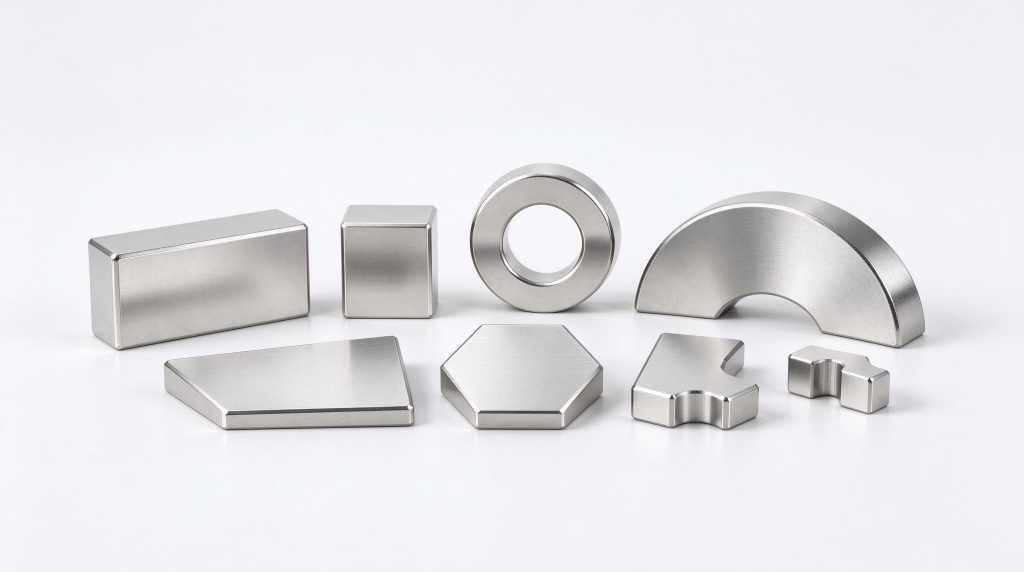
A custom magnet project usually starts with a simple request: "We need a magnet that fits this part and delivers this performance." The difficult part is turning that request into a specification a manufacturer can actually evaluate. Size matters, but so do grade, temperature, coating, magnetization direction, tolerance, the working air gap, and the surrounding steel or mechanical structure.
For OEM and industrial projects, the best results usually come from defining the application first and the magnet second. A well-prepared specification reduces back-and-forth, makes prototype testing more meaningful, and helps buyers compare quotations on the same technical basis. If an off-the-shelf part will not meet the design, custom neodymium magnets can be developed around the mechanical, magnetic, thermal, and environmental requirements of the application.
The eight decisions below are a practical starting point for engineers, product designers, sourcing teams, and buyers preparing a custom NdFeB magnet request.
|
Design item |
What to define |
Why it matters |
|
Application |
What the magnet must do in the finished product |
Defines the real performance target instead of relying on grade alone. |
|
Shape and dimensions |
OD/ID, length, width, thickness, holes, countersinks, radii |
Controls fit, available magnetic volume, and manufacturability. |
|
Grade |
N-series grade and temperature suffix when required |
Affects magnetic energy density and resistance to demagnetization. |
|
Temperature |
Continuous and peak temperature |
Helps determine suitable material and design margin. |
|
Coating |
Nickel, zinc, epoxy, or another specified finish |
Protects the magnet and must match the operating environment. |
|
Magnetization |
Axial, diametrical, radial, multipole, or special pattern |
Determines field orientation in the assembly. |
|
Tolerance |
Critical dimensions and acceptable variation |
Balances assembly fit, function, and manufacturing cost. |
|
Quantity and validation |
Prototype quantity, annual volume, test method |
Helps plan sampling, production, inspection, and commercial evaluation. |
The most useful custom-magnet request explains what the component needs to do. "N52 disc magnet" sounds specific, but it does not tell a supplier the required holding force, sensing distance, torque contribution, working air gap, temperature, mounting method, or available space.
A better starting point is the function. For example: the magnet must trigger a sensor across a defined air gap, hold a removable cover against a steel frame, fit inside a compact rotor, or remain stable near a heat source. Those details influence material selection and geometry far more than an isolated grade number.
When possible, provide the assembly drawing, mating material, target performance, and how the part will be tested. If the requirement is a pull force, specify the direction of load and the test condition. A direct pull from thick, clean steel is not the same as a sliding load, a painted surface, or a magnet separated from steel by plastic or adhesive.
Common custom shapes include discs, blocks, rings, cylinders, arcs, countersunk parts, and special profiles. Standard disc magnets are often a useful starting point when the design is simple. Ring magnets add an inner diameter that may be used for a shaft, fastener, alignment feature, or other mechanical requirement.
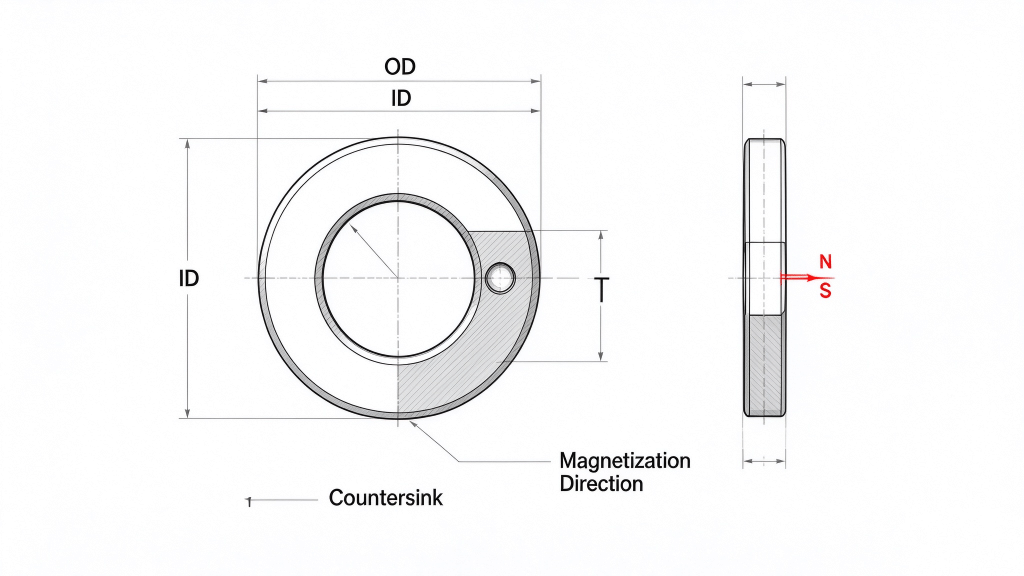
For a custom drawing, identify every dimension that affects fit or magnetic performance. On a ring magnet, that may include outer diameter, inner diameter, thickness, chamfers, and flatness. On a countersunk part, hole diameter, countersink angle, and the relationship between the hole and the outside geometry may be critical.
Avoid tightening every dimension by default. Instead, identify which features are critical to function and which can accept normal manufacturing variation. Tighter tolerances may be justified for automated assembly or a controlled air gap, but unnecessary precision can add cost without improving the finished product.
For US-based teams, it is fine to dimension a drawing in inches. If the original engineering drawing is metric, however, keep the original units rather than introducing rounding through unnecessary conversions. A dimension such as 12.7 mm converts cleanly to 0.500 in; many others do not.
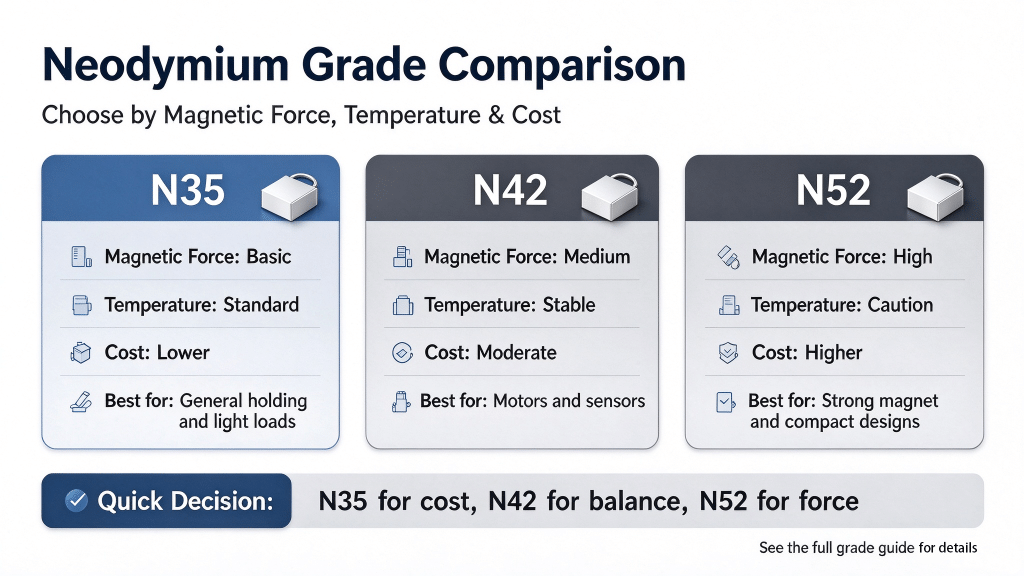
Neodymium magnet grades such as N35, N42, and N52 describe magnetic material performance, but they do not directly tell you the finished pull force of a component. Geometry, air gap, target steel, temperature, and magnetization all affect the field available in the real assembly. Our detailed N35 vs N42 vs N52 comparison explains why a higher grade is not automatically the best value for every design.
If the design has enough space, a slightly larger magnet in a lower grade may meet the performance target. If the envelope is fixed and very compact, a higher-energy grade may be useful. The decision should be based on the complete magnetic circuit and verified by calculation or prototype testing where performance is critical.
Also separate the N-number from temperature capability. The grade number alone does not define the maximum operating temperature. High-coercivity variants and temperature suffixes may be required in warmer environments, and the suitable choice depends on geometry and operating conditions as well as the material designation.
Temperature should be defined early because a magnet can lose magnetic output as temperature rises, and excessive heat can cause irreversible loss. A useful specification separates normal continuous temperature from occasional peak temperature. For example, a part may operate most of the time at 140 degrees F (60 degrees C) but see short peaks above that level during a process cycle.
Also describe how long the peak lasts, whether the magnet repeatedly cycles between hot and cold conditions, and whether a nearby motor, coil, heater, or enclosure raises the magnet temperature above ambient.
Do not select material only from a catalog maximum-temperature number. Magnet geometry and the magnetic circuit affect resistance to demagnetization. For a critical application, the material choice should be reviewed together with the actual dimensions and operating condition.
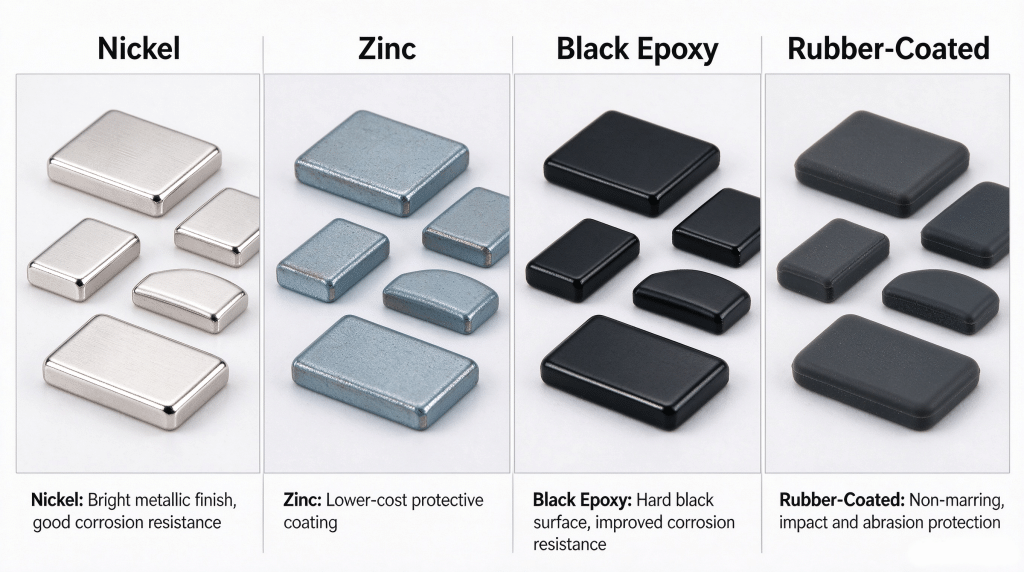
Sintered NdFeB magnets are normally supplied with a protective finish. The best coating depends on exposure conditions, appearance, assembly method, and handling. A dry indoor product has different needs from a component exposed to condensation, outdoor moisture, cleaning chemicals, or repeated mechanical contact.
Coating thickness also matters when the magnet sits in a close-tolerance pocket or when adhesive is applied to the coated surface. If bonding is part of the assembly process, tell the supplier what adhesive or joining method you plan to use so the coating choice can be evaluated as part of the complete process.
|
Coating/finish |
Typical reason to consider it |
Questions to confirm |
|
Nickel-based finish |
Common general-purpose finish with a clean metallic appearance |
Will the part see moisture, impact, or an adhesive-bonding step? |
|
Zinc finish |
Alternative protective finish for selected applications |
Is appearance important and what environment will the part see? |
|
Epoxy-type finish |
Often considered when added corrosion protection is needed |
What chemicals, humidity, temperature, and wear conditions are expected? |
|
Rubber-coated assembly |
Useful when grip, surface protection, or impact isolation is part of the product design |
Is the requirement a coated magnet or a complete magnetic assembly? |
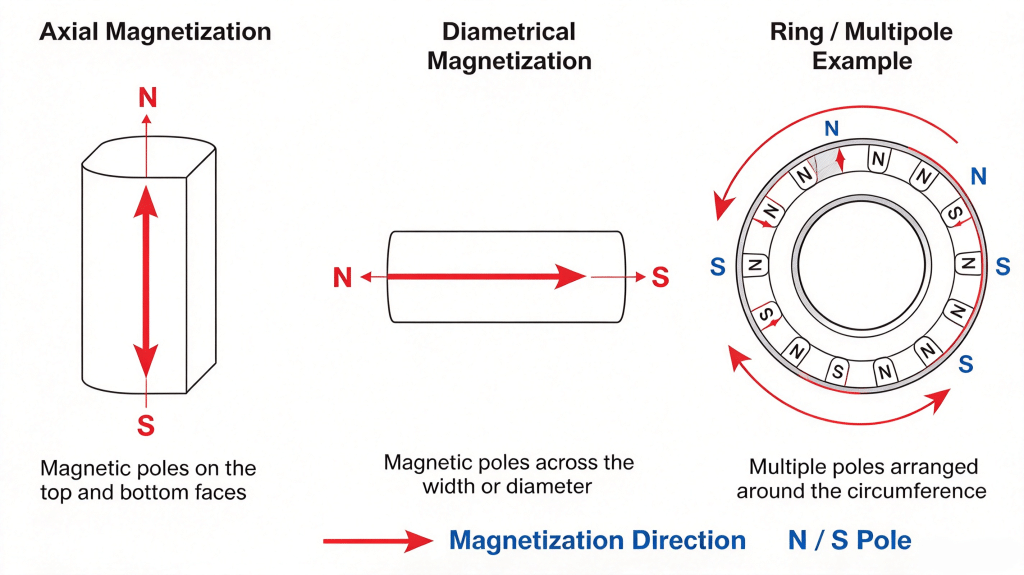
Magnetization direction determines where the north and south poles appear on the finished part. A disc magnet can be magnetized through its thickness or across its diameter. Rings may use axial, diametrical, radial, or multipole patterns depending on the application and manufacturing feasibility.
This detail is especially important in sensors, motors, encoders, couplings, and assemblies where the magnetic field must align with another component. Two magnets with the same material and dimensions can behave very differently in a product if their pole orientation is different.
Mark the intended pole direction directly on the drawing when possible. If the requirement is based on a field profile rather than a simple two-pole direction, share the target field, pole count, sensor location, or mating component so the magnetization pattern can be reviewed.
A custom magnet drawing should distinguish between dimensions that control function and dimensions that simply define the general shape. Critical dimensions may include a press-fit diameter, the location of a mounting hole, total thickness where an air gap is controlled, or an ID that must fit over a shaft.
Tolerance should also reflect how the magnet will be assembled. Brittle magnetic materials should not be treated like ductile machined steel parts. Press fits, impact loading, edge contact, and fastener stress can create problems if the surrounding design does not account for the material behavior.
If the magnet is bonded into a pocket, specify the intended adhesive gap and assembly method. If it will be overmolded, captured by a housing, or integrated into a steel cup, provide the surrounding component details because the final assembly may be more important than the standalone magnet dimension.
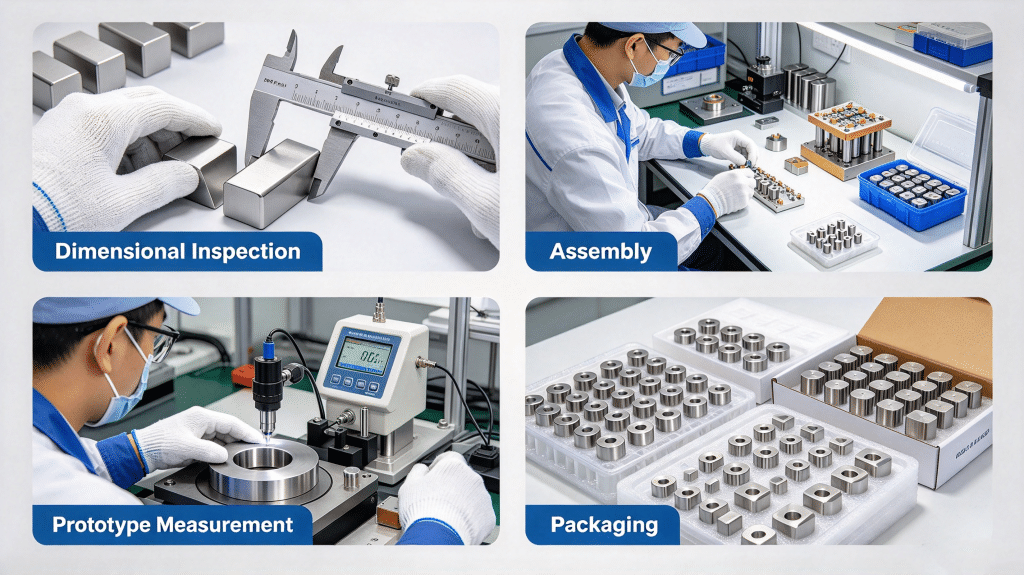
A good custom specification includes an acceptance method. Depending on the project, that may be dimensional inspection, magnetic flux measurement at a defined point, pull-force testing under controlled conditions, polarity verification, visual coating inspection, or functional testing in the actual assembly.
The test condition must be repeatable. For pull force, define the steel target, surface condition, contact area, pull direction, and whether there is an air gap. For field measurements, define the measurement location and sensor orientation. Without a consistent test setup, two valid parts can appear different simply because they were measured differently.
Prototype samples are especially useful when the final result depends on several interacting variables. Testing a prototype in the real product can reveal whether a change in grade, thickness, air gap, coating, or magnetization pattern is actually necessary before production is released.
A useful RFQ does not need to be complicated. If available, include:
If several of these items are still unknown, that is normal during early product development. Start with the application, available space, temperature, and target performance. A supplier can evaluate the missing items more effectively when the design intent is clear. NEOMAG currently lists customization for shape and dimensions, grade, temperature requirements, coatings, magnetization, packaging, and magnetic assemblies on its custom magnet capabilities page.
Vague request: "We need a strong round magnet for a sensor."
More useful request: "We need a round NdFeB magnet for a position sensor. Maximum envelope is 0.500 in diameter by 0.125 in thick. The sensor is separated from the magnet by a 0.080 in plastic wall. Continuous temperature is about 140 degrees F (60 degrees C), with short peaks near 176 degrees F (80 degrees C). The magnet will be bonded into a molded pocket. Please recommend a suitable grade, coating, and axial magnetization for prototype testing."
The second request gives the supplier enough information to discuss the complete application instead of simply quoting the highest-grade magnet that fits the dimensions.
At minimum, provide the application, shape, dimensions, quantity, operating temperature, and target performance. A drawing is strongly preferred. Coating, magnetization direction, tolerances, and test requirements should also be included when they are known.
No. N52 offers high magnetic energy density, but the best grade depends on size constraints, operating temperature, air gap, magnetic circuit, cost, and the required performance. A lower grade can be the better engineering choice when the design has enough magnetic volume.
Yes, depending on magnet geometry, material, tooling, and project requirements. Axial and diametrical magnetization are common, while some ring, motor, encoder, and sensor applications may require radial or multipole patterns.
There is no single best coating for every application. The correct choice depends on moisture, corrosion exposure, temperature, appearance, mechanical wear, and the assembly or bonding process.
For applications with tight mechanical fit, critical magnetic performance, unusual temperature conditions, or a custom pole pattern, prototype testing can reduce risk. The prototype should be tested using the same conditions that will be used to judge the production part.
A successful custom magnet specification is not a list of isolated material properties. It is a description of how the magnet must work inside the finished product.
Start with the application. Then define the geometry, magnetic performance, temperature, coating, magnetization, tolerance, and acceptance method that matter to that application. This approach gives engineering and sourcing teams a clearer basis for prototype evaluation, supplier comparison, and production approval.
The goal is not to specify the strongest or most complicated magnet. It is to specify the simplest magnetic solution that reliably meets the real requirement.