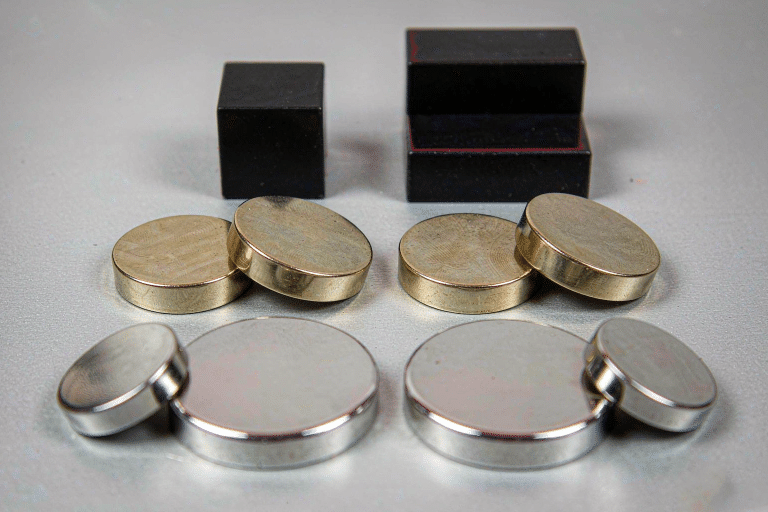
Choosing the right neodymium magnet coating is essential for protecting NdFeB magnets against corrosion and maintaining reliable performance in different operating environments. Common coating options include nickel-copper-nickel (Ni-Cu-Ni), zinc, epoxy and Parylene, each offering different advantages in surface protection, coating thickness, appearance and cost.
In this guide, we compare four widely used neodymium magnet coatings, explain their key differences and help engineers, manufacturers and buyers choose suitable surface treatments based on environmental exposure, dimensional requirements and application needs.
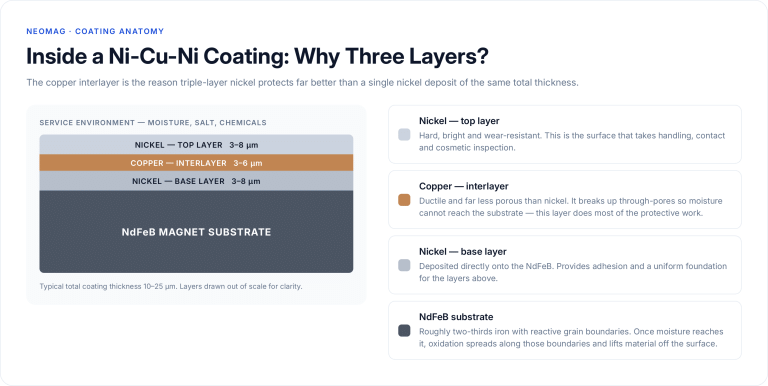
Neodymium magnets are the strongest permanent magnets available, but they are also the most corrosion-prone. A sintered NdFeB magnet is roughly two-thirds iron, and its microstructure contains a highly reactive neodymium-rich grain boundary phase. Left unprotected in humid air, it will oxidize, spall and eventually lose magnetic mass.
That is why, for OEM and bulk buyers, the coating is not a cosmetic option. It is part of the engineering specification — and choosing the wrong one is one of the most common causes of early field failure. This guide compares the coating options you will actually be quoted on, explains what the test data means, and shows how to specify coating correctly on an RFQ.
Sintered neodymium magnets are produced by pressing and sintering fine alloy powder. Three characteristics of the finished part make corrosion a real risk:
In practice, an uncoated magnet left in a humid environment can show rust within days. A good coating turns a lab-grade material into a component that survives years in service.
If your application is genuinely wet, submerged or salt-exposed, treat coating selection as a design decision — not a line item to default to "nickel."
The industry default. Three layers are electroplated in sequence — nickel, then copper, then nickel. The copper interlayer is the key: it is more ductile and less porous than nickel alone, so it interrupts the through-pores that would otherwise let moisture reach the magnet.
A lower-cost alternative to nickel. Zinc protects sacrificially: it corrodes in preference to the magnet substrate, which is useful while the layer lasts.
Epoxy is applied by spraying or dipping and then cured, producing a much thicker, non-metallic barrier. Black epoxy is the standard colour; grey is used when a less conspicuous finish is needed.
An electroplated Ni-Cu-Ni base with an epoxy topcoat. It combines the hard, wear-resistant metallic layer with the moisture barrier of the polymer, and it is the usual answer when a single layer cannot meet the test requirement.
Applied by chemical vapour deposition in a vacuum chamber, Parylene forms a truly conformal, pinhole-free film — it coats edges, corners and recesses at uniform thickness, which electroplating cannot do.
Gold is applied as a thin flash over a nickel underlayer. It is chosen for biocompatibility, corrosion resistance in specific chemical environments, solderability and appearance — not for heavy mechanical duty.
Not a plating process — the magnet is encapsulated in an elastomer. It is the right choice when impact, abrasion or grip matters more than minimum thickness.
← Swipe horizontally to compare all coating options →
| Coating | Typical thickness | Salt spray (ASTM B117) | Practical temp limit | Relative cost | Best environment |
|---|---|---|---|---|---|
| Ni-Cu-Ni | 10–25 µm | 24–72 h | Limited by magnet grade | $$ | Dry indoor, general industrial |
| Zinc | 5–15 µm | 12–48 h | Limited by magnet grade | $ | Dry indoor, cost-driven |
| Epoxy | 15–30 µm | 100–500 h | ~120–150 °C | $$ | Wet, humid, chemical, outdoor |
| Ni + Epoxy | 25–45 µm | 200–500+ h | ~120–150 °C | $$$ | Automotive, marine, condensation |
| Parylene C | 5–25 µm | Very good for thickness | ~100 °C in air | $$$$ | Medical, precision electronics |
| Gold over Ni | 0.1–1 µm Au + Ni base | Similar to Ni-Cu-Ni | Limited by magnet grade | $$$$ | Medical, jewellery, contacts |
| Rubber / TPE | 0.3–1.5 mm | Excellent (encapsulated) | Depends on elastomer | $$$ | Impact, wet grip, mounting |
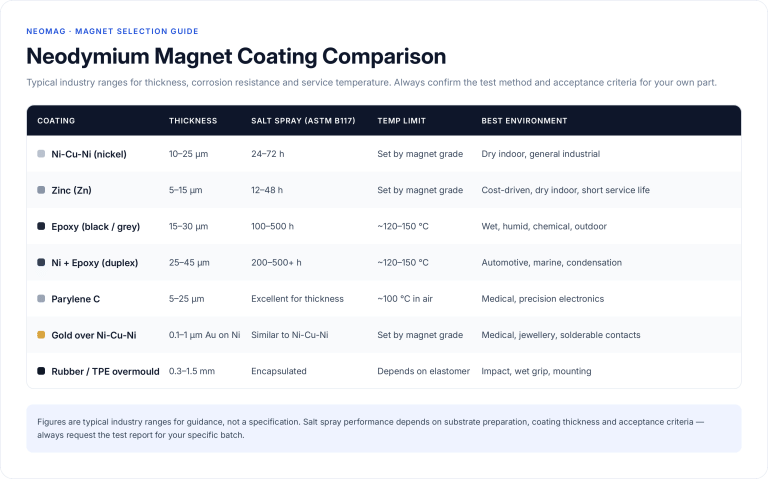
Figures are typical industry ranges for guidance. Actual performance depends on process control, magnet geometry and the acceptance criteria you specify. Confirm the test report for your specific part.
This is where most RFQs go wrong. A coating adds material to every surface, so:
How to avoid it: state explicitly on the drawing whether dimensions are before coating or after coating, give a coating thickness range per surface, and flag any features that must be masked (bores, threads, bonding faces, countersinks).
Coating materials are non-magnetic, so every micron is an air gap. In a typical holding application the effect is small — but consider:
If pull force is marginal in your design, specify the thinnest coating that meets the corrosion requirement, and validate with a pull test on coated samples rather than bare ones.
Ask for the test method, not just the hours. Common evaluations include:
A supplier quoting "500 hours salt spray" without naming the standard, the substrate preparation and the acceptance criterion is not giving you a comparable number.
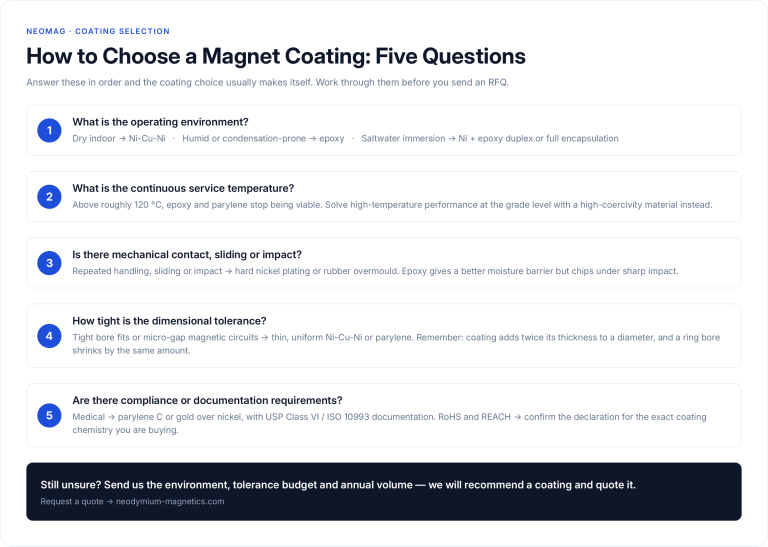
Work through these questions in order:
| Application | Common coating | Why |
|---|---|---|
| EV traction motor rotor | Epoxy or Ni-Cu-Ni | Humidity plus thermal cycling |
| Industrial servo motor | Ni-Cu-Ni | Dry, controlled environment |
| Sensors and encoders | Ni-Cu-Ni or parylene | Dimensional precision |
| Marine and fishing magnets | Rubber overmould or epoxy | Saltwater plus impact |
| Medical and dental devices | Parylene C or gold over Ni | Biocompatibility documentation |
| Consumer electronics | Ni-Cu-Ni | Appearance, cost, adequate barrier |
| Outdoor signage and fixtures | Ni + epoxy duplex | Condensation and UV exposure |
Include coating in the specification from the first enquiry, not as an afterthought:
Bringing this information together at RFQ stage shortens the quotation cycle and prevents the most common source of rework.
What is the most common coating for neodymium magnets?
Nickel-copper-nickel (Ni-Cu-Ni) is a common coating for neodymium magnets. It provides a smooth metallic finish and corrosion protection for many general-purpose applications, provided the coating remains intact.
Which is better for neodymium magnets: nickel or zinc coating?
The choice depends on the application. Ni-Cu-Ni is commonly selected for its appearance and multilayer protective structure, while zinc can be a more economical option. Actual corrosion performance depends on the complete coating specification and environmental conditions.
Are epoxy-coated neodymium magnets waterproof?
An epoxy coating can improve moisture protection, but it should not automatically be considered waterproof. Coating integrity, adhesion, edge coverage and exposure conditions must be evaluated for the intended application.
What are the advantages of Parylene-coated magnets?
Parylene is a conformal polymer coating that can cover small or complex-shaped components with a relatively thin protective film. It can be useful where coating uniformity and dimensional control are important.
Does coating thickness affect magnet dimensions?
Yes. Coating adds material to the magnet surface and can affect finished dimensions, hole sizes and assembly clearances. Precision applications should specify whether dimensions apply before or after coating.
How should I choose the right coating for an NdFeB magnet?
Consider operating temperature, moisture exposure, chemical contact, corrosion resistance, coating thickness, handling conditions and budget. For demanding applications, define appropriate testing and acceptance criteria before production.
Coating selection sits at the intersection of environment, tolerance, temperature and cost — and it is one of the specification decisions most likely to be overlooked until something fails in the field. If you share your operating conditions, dimensions and volume, our team can review the options and recommend a coating that meets both your corrosion requirement and your tolerance budget.
Request a quote with your magnet shape, dimensions, grade, coating requirement, quantity and application, and we will come back with recommendations and lead time.