Flexible magnets are lightweight magnetic materials that trade raw strength for something rigid magnets cannot offer: they cut with scissors, bend around curves, take printing, and install without tools. Made by bonding ferrite magnetic powder into flexible polymer binders, they can be rolled, laminated, die-cut or supplied with adhesive backing — the answer whenever a job needs custom shapes, large surface coverage or easy, tool-free installation.
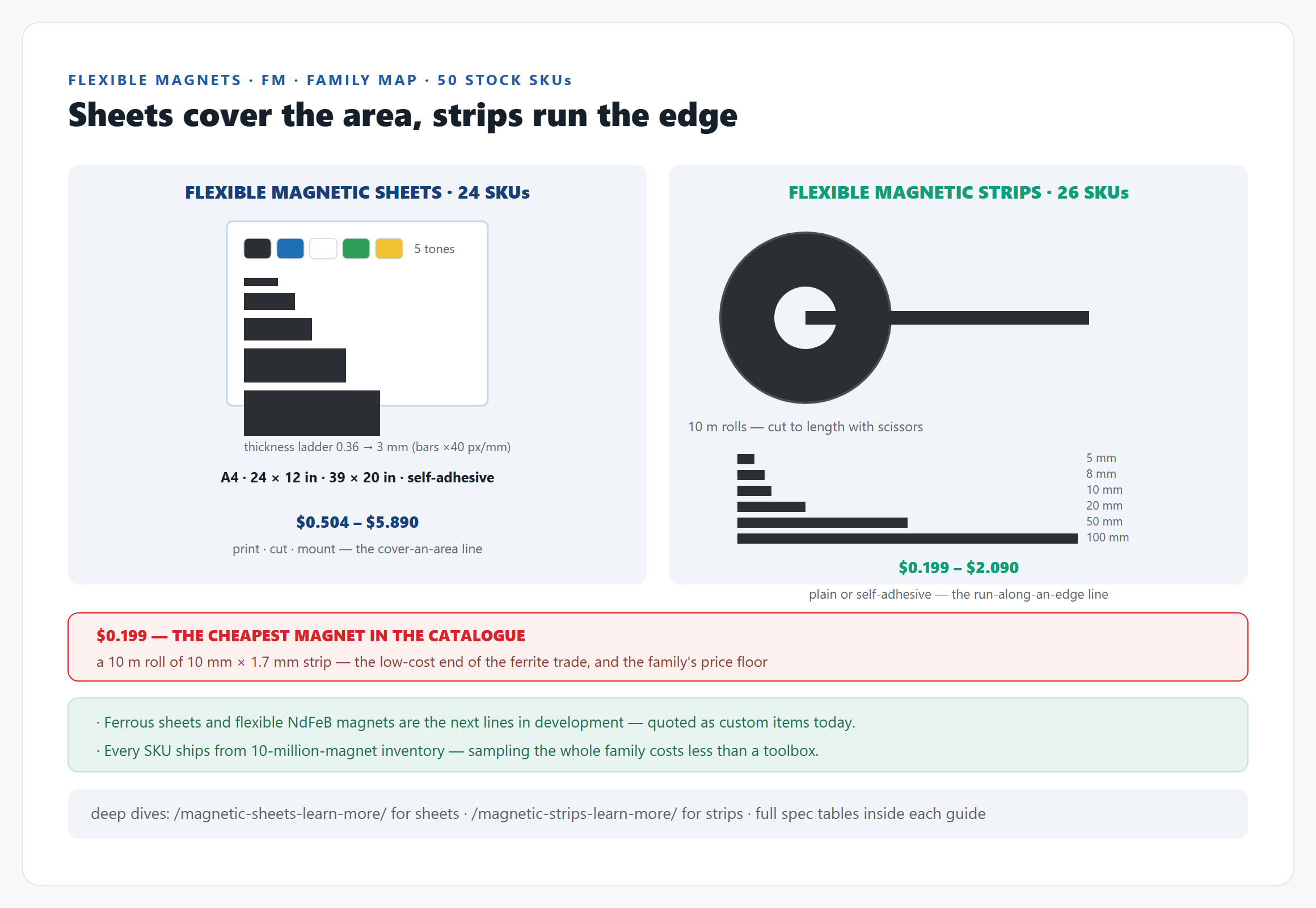
The NEOMAG range of flexible magnets covers two live product lines: flexible magnetic sheets — 24 stock SKUs from A4 colour film to 3 mm heavy-duty panels — and flexible magnetic strips — 26 stock SKUs in 10-metre rolls from 5 to 100 mm wide. Together that is 50 SKUs from $0.199, serving signage, labeling, advertising displays, vehicle graphics, education, retail merchandising, packaging and industrial identification.
With over 20 years of manufacturing experience and more than 10 million magnets in stock, we supply both standard flexible magnets and customized solutions — printed graphics, adhesive backing, die-cut shapes and OEM production. Our engineering team supports the project from material selection and prototyping to mass production.
Every SKU below is a stock item — the whole family ships from the same inventory at wholesale pricing:
| Line | Formats | Sizes | Price range |
|---|---|---|---|
| Flexible magnetic sheets | A4 sheets, 24 × 12 in and 39 × 20 in panels, self-adhesive | 7 thicknesses, 0.36–3 mm, 5 colour tones | $0.504 – $5.890 |
| Flexible magnetic strips | 10 m rolls, round-profile and flat, plain and self-adhesive | widths 5–100 mm, thicknesses 1–5 mm | $0.199 – $2.090 |
Reading the table honestly: these two lines are siblings, not duplicates — sheets answer "cover an area", strips answer "run along an edge". Ferrous sheets and flexible NdFeB magnets appear in the family menu as the next lines in development; they are quoted as custom items today. And the family's price floor is worth knowing: a 10 mm flexible magnetic strip at $0.199 is the cheapest magnet in our entire catalogue — the low-cost end of the neodymium-vs-ferrite trade explained on our materials comparison page.
Flexible magnets win on four things rigid magnets cannot do: they cut to any length or shape without losing magnetism, bend around curved and irregular surfaces, print directly on white and coloured faces, and mount without drilling — plain against steel, or self-adhesive onto wood, plastic and acrylic. For signage, labeling and display work, those four abilities are the whole specification.
The honest boundary: ferrite-in-rubber holds a fraction of what a rigid ferrite or neodymium magnet of the same footprint holds. Flexible magnets are for paper, cards, signage, labels and light closures — not for tools or structural loads. The pull force physics behind that trade is identical across the catalogue, and inside the family, hold rises with thickness (sheets) and width (strips). Neither material ages measurably: under 1% flux loss per decade in normal service.
The material choice is deliberate, not a compromise. The ferrite filler is the same iron-oxide ceramic that makes rigid ferrite magnets cheap and weatherproof: it does not rust, needs no coating, survives vehicle cabin heat, and costs a fraction of neodymium per unit of grip. What the rubber binder adds is the geometry freedom — and what it costs is flux density, which is exactly why the family prices from $0.199 while a neodymium hook of equal hold would cost several times more.
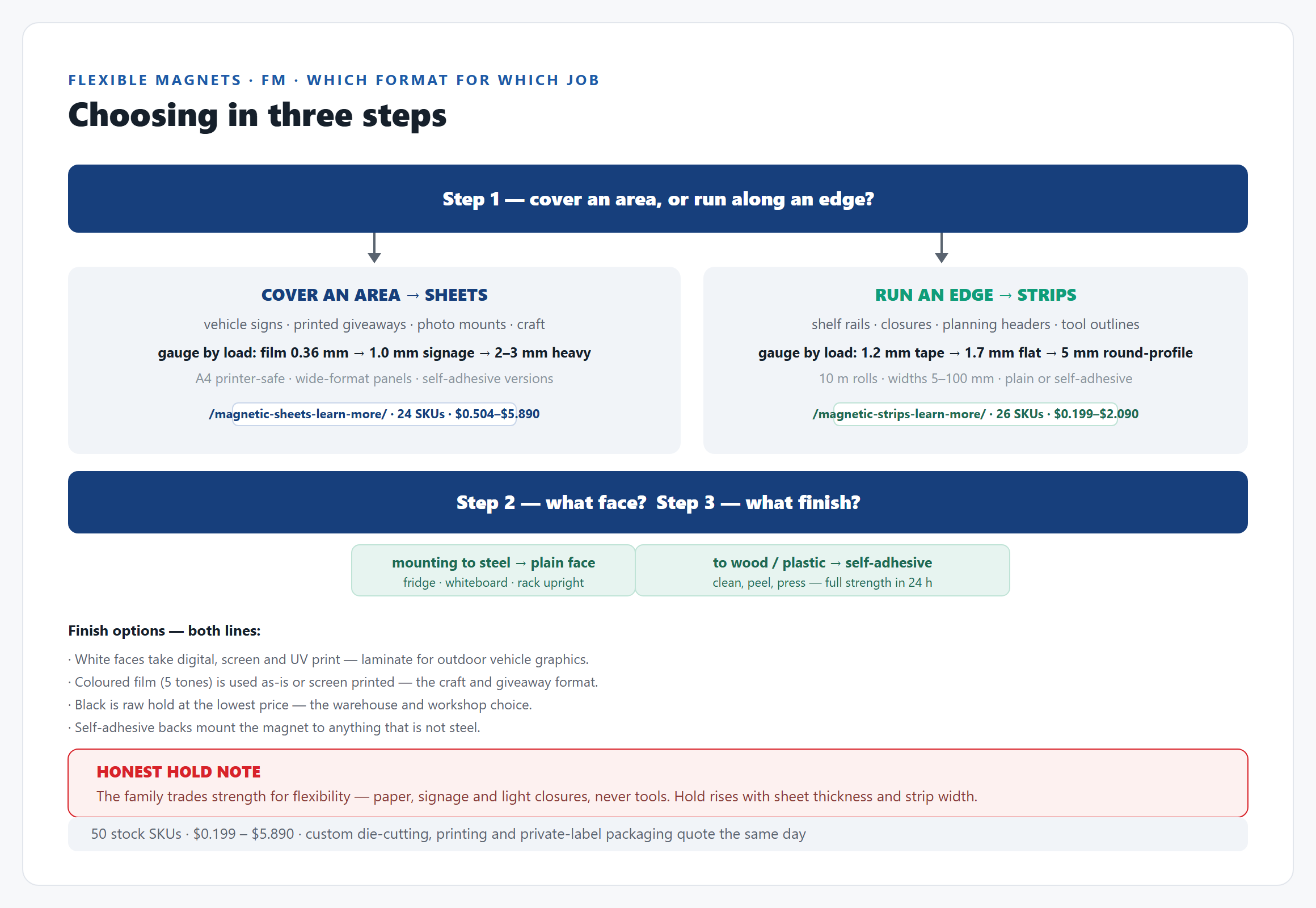
Because every product in the family starts from the same ferrite-in-rubber compound, the working rules are shared — learn them once and they apply to all 50 SKUs:
For vehicle graphics specifically, the working combo is a thin white panel, printed and laminated, held by its own flexible grip on the steel panel — no drilling, no residue, removable at season's end.
Beyond the 50 stock SKUs, we convert in-house: custom die-cut shapes from your artwork, kiss-cut label stock, roll slitting to your width, UV and screen printing, laminated and adhesive-backed constructions, and private-label packaging for retail programmes. Because converting starts from stock material, a custom flexible magnet order is a drawing and a quantity — start at custom magnets or contact us directly.
Q1: What are flexible magnets? A: Magnetic materials made by combining ferrite magnetic powder with flexible polymer binders — they bend, roll, cut and fabricate into almost any shape while keeping a reliable hold.
Q2: Are flexible magnets made from neodymium? A: Mostly no — the family is ferrite-based, which is why it is cheap, corrosion-proof and safe in heat. Flexible NdFeB exists as a specialty line; the full trade-off is explained in our neodymium vs ferrite comparison.
Q3: Can flexible magnets be cut to size? A: Yes — scissors and utility knives handle the thin gauges, die-cutting and laser cutting handle volume production, and the cut edge loses no magnetism.
Q4: Can flexible magnets be printed? A: Yes — white vinyl and PVC faces accept digital, screen and UV printing, from A4 sheets to 1000 × 500 mm panels on wide-format machines.
Q5: Are adhesive-backed flexible magnets available? A: Yes — self-adhesive sheets and strips with pressure-sensitive backing, for mounting onto plastic, wood, glass, paper, cardboard and acrylic.
Q6: Can flexible magnets be used outdoors? A: Yes — the ferrite filler is fully weatherproof and UV-stable, which is why vehicle signs are a flagship use. Laminated prints extend the graphic's outdoor life.
Q7: What thicknesses are available? A: Sheets run 0.36 mm to 3 mm across seven gauges; strips run 1 mm to 5 mm across widths from 5 to 100 mm. Custom dimensions are a converting job, not a new tool.
Q8: Can flexible magnets damage painted surfaces? A: Not in normal use — the rubber-faced material is gentle on paint. Keep both faces clean, because trapped grit is what scratches, on any magnet format.
Q9: Can flexible magnets be customized? A: Yes — dimensions, magnetic loading, printable surfaces, adhesive types, laminates, die-cut shapes and OEM branding all convert from stock material.
Q10: What industries use flexible magnets? A: Advertising, printing, retail, logistics, education, automotive, packaging, warehousing, manufacturing and promotional products — anywhere these materials cut, print or bend their way into a design.
Q11: Do flexible magnets lose their magnetism over time? A: Under 1% flux loss per decade in normal service — the ferrite filler is thermally stable. Store sheets and rolls flat or in their original form; sharp creases can weaken a line.
Q12: How do I choose the right flexible magnet? A: Format first (sheet covers an area, strip runs an edge), then gauge by load, then surface by finish. The three-step chooser above covers the stock family — our engineering team recommends beyond it.
Two product lines, 50 stock SKUs, $0.199 to $5.890 — every one of the flexible magnets in the family listed with the same honest spec sheet, and every one of them cuttable, printable and convertible. Browse the flexible magnets category for stock, or contact us with your shape, length and quantity — converting quotes the same day.