Fishing magnets are recovery tools built around one question: what is between the magnet and the steel when it grabs? A neodymium magnet inside a steel housing, an eyebolt for the rope, and whatever the water puts in the way — silt, paint, rust, structure. Get those four things right and a 20-dollar magnet outperforms a 200-dollar one; get them wrong and no catalogue number will save the trip. This page is the entry point to our whole fishing magnets range: two families, 23 stock sizes, 4.5 to 700 kgf of measured pull, $2.65 to $341.73. It is written to be read once, before your first order, and then used as the map for the two deeper guides it links to.
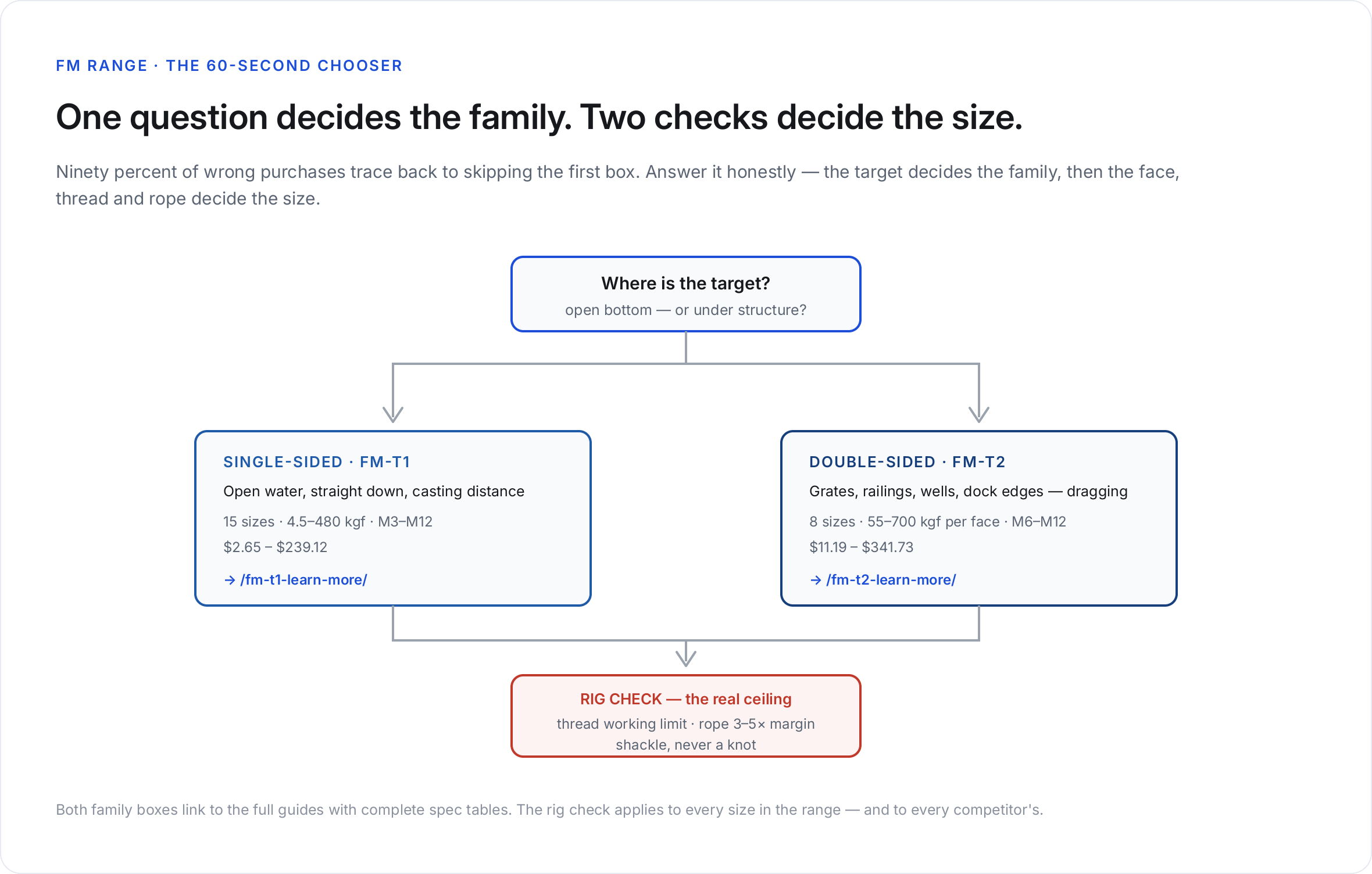
The two families divide by geometry, and the difference decides everything downstream. Single-sided housings concentrate all the flux in one face — maximum force per gram for straight-down recovery onto open bottom. Double-sided housings carry a working face on both sides of the block — they are the only tools that can search through a grate, along a railing, or inside a well, because they grab from either side. Both are made on our own line, both are measured the same way, and both are covered by a dedicated guide with the full size tables.
Start here for the decision, then go deep: the single-sided range (15 sizes, Ø16–120 mm) and the double-sided range (8 sizes, Ø42–135 mm) each carry their complete spec tables, rigging data and technique sections. For the physics behind every number — pull versus shear, air gaps, the thread ceiling — our pull force guide is the reference this page builds on.
All 23 fishing magnets in this range share the same four-part anatomy — and only one of the parts is the magnet:
The housing styles differ visibly — a round cup for the single-sided family, a rectangular block for the double-sided — but the job is identical: turn one magnet's flux into a working face.
| Single-sided (FM-T1) | Double-sided (FM-T2) | |
|---|---|---|
| Working faces | 1 | 2 |
| Sizes | 15 (Ø16–120 mm) | 8 (Ø42–135 mm) |
| Pull per face | 4.5–480 kgf | 55–700 kgf |
| Total weight | 9 g–1.6 kg | 191 g–4 kg |
| Threads | M3–M12 | M6–M12 |
| Grabs through a grate or railing | no | yes — the main reason it exists |
| Weight efficiency per face | good | 11–40 % better (shared steel body) |
| Best for | open water, straight down, casting distance | structure, wells, dock edges, dragging |
The counter-intuitive result from our own catalogue: at matched diameter the double-sided face is never weaker than the single-sided one (55 vs 36 kgf at 42 mm; 592 vs 480 at 120 mm), because the block carries more magnet material and shares the return steel. The bill arrives as weight — 1.4–1.8× — not as force. The full comparison, with the weight-per-face table, is in the double-sided guide.
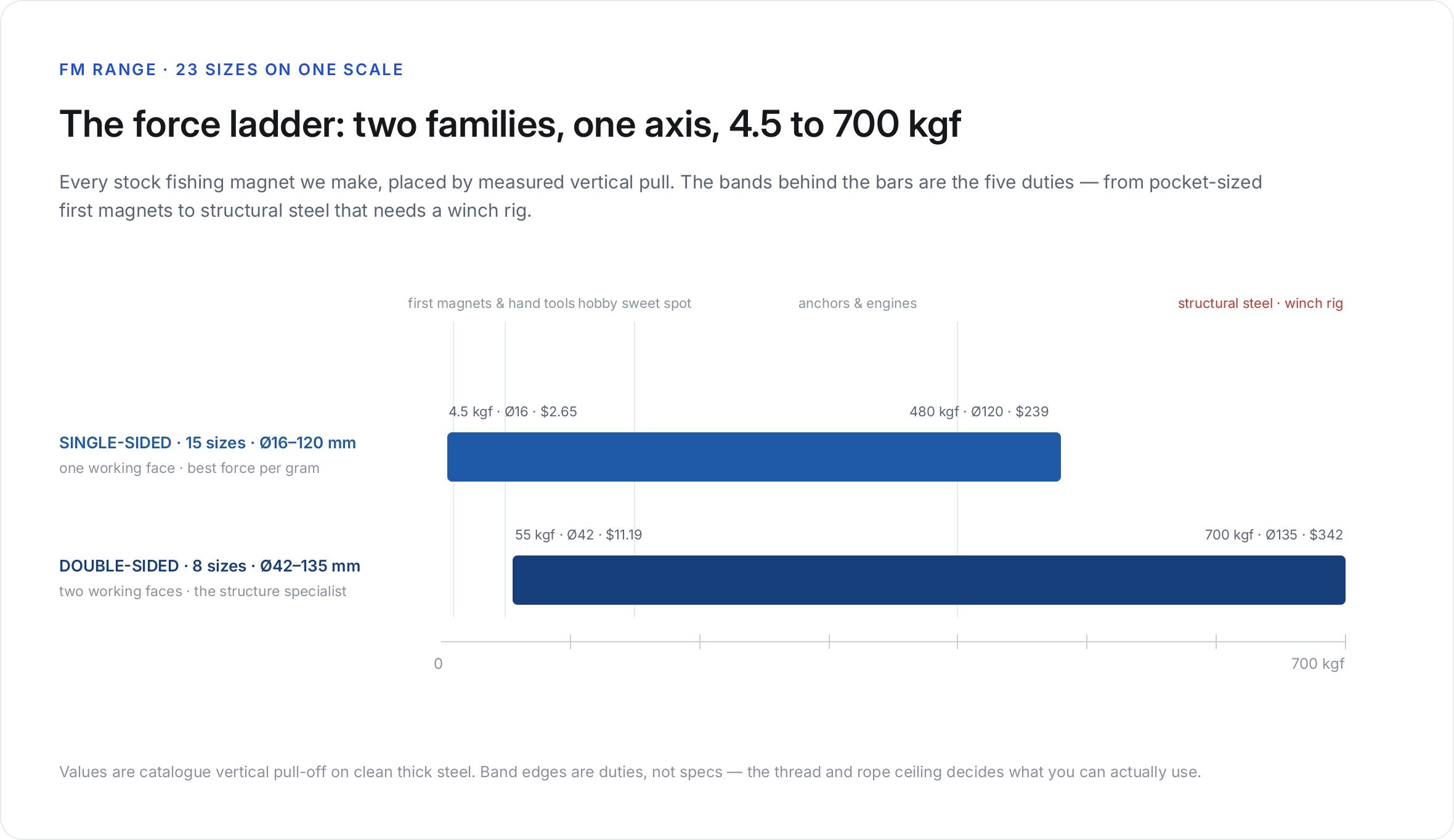
Reading the two catalogues side by side on one scale makes the ranges' characters obvious — and lets you place any fishing magnet on the market against ours:
| Pull band | Single-sided option | Double-sided option | What lives here |
|---|---|---|---|
| under 10 kgf | Ø16 · 4.5 kgf · M3 · $2.65 | — | keys, cutlery, first magnet for kids |
| 10–50 kgf | Ø20–42 · 7–36 kgf · M4–M6 | Ø42 · 55 kgf · M6 · $11.19 | hand tools, chains, hobby starter |
| 50–150 kgf | Ø48–67 · 75–175 kgf · M8 | Ø48–60 · 73–145 kgf · M8 | the hobby sweet spot — bolts, padlocks, bike parts |
| 150–400 kgf | Ø75–100 · 235–400 kgf · M10 | Ø75–100 · 250–470 kgf · M10 | engines, anchors, safes — rope and shackle required |
| 400–700 kgf | Ø120 · 480 kgf · M12 | Ø120–135 · 592–700 kgf · M12 | structural steel — and a rig rated for it |
Two warnings travel with this ladder wherever fishing magnets are sold. First, the top bands exceed their threads: a 470 kgf single face on an M10 bolt and 700 kgf on M12 mean the bolt, shackle and rope set the real ceiling — see the rigging rules below. Second, every number is a vertical pull-off on clean thick steel; the four rules in the next section are what convert it into a field figure.
These apply to every fishing magnet in the range, both families, all 23 sizes — and to every competitor's, because none of them are marketing opinions. They are physics:
All four are derived and worked through with numbers in the pull force and shear force guide — the single most-linked page in this chapter for a reason.
Fifteen sizes from a 9 g pocket magnet to a 1.6 kg, 480 kgf monster. The steel cup puts every flux line through one face, which makes these the most force-efficient fishing magnets per gram and per dollar — and the ones that cast farthest. Straight-down recovery from a bank, a dock or a boat is their native job. Full table and technique: the single-sided guide.
Eight block-style bodies from 191 g to 4 kg, each with live faces on both sides. These are the fishing magnets you buy when the target is under a grate, along a pier edge, inside a well, or under a dock — surfaces a one-face tool cannot touch at all. They reward slow dragging and punish casting, and they have no dead face to rest a hand on. Full table, the shared-yoke weight data and drag technique: the double-sided guide.
Face area should match the ferrous area of the target — a huge face on a small object wastes its field in air:
Between two sizes, take the smaller. Technique recovers more than the last 50 kgf ever does.
Every stock size ships nickel-copper-nickel plated: hard, conductive, right for fresh water and occasional salt. Epoxy is the repeated-immersion and marina choice; zinc for budget dry-duty. The full comparison — and why rubber jacketing is deliberately absent from this range — is in the coatings guide. Rinse in fresh water and dry after every salt session; chloride in a scratch, not the water, is what kills plating. Buyers who keep their fishing magnets for a decade all share one habit: they never put a wet magnet away in a closed box.
The original use is hobby magnet fishing, and it remains the biggest volume — but the same fishing magnets are bought for paid work:
Beyond the 23 stock sizes we build OEM programmes for outdoor brands, retailers and industrial buyers: custom pull targets, alternative coatings, different eyebolt and shackle interfaces, laser marking, retail packaging and mixed kits. Because magnets, housings and machining are all in-house, a custom retrieval tool is a drawing and a quantity — the same line that runs the stock fishing magnets runs the private-label ones. Start at custom magnets or contact us directly.
Q1: What is a fishing magnet? A: A high-strength retrieval tool: a neodymium magnet in a steel housing with an eyebolt for the rope. The housing is not just protection — it closes the magnetic circuit and multiplies the bare magnet's pull several times over.
Q2: What is the difference between single-sided and double-sided fishing magnets? A: Single-sided puts all the flux through one face for maximum force per gram — best for open water and casting. Double-sided carries a live face on both sides of the block, which is the only way to search through a grate, along a railing or inside a well. At matched diameter the double-sided face is never weaker; it weighs 1.4–1.8× more.
Q3: How is pull force measured? A: Vertical pull-off from thick, clean, flat steel at breakaway — a lab figure. Real performance depends on surface condition, target size, pull angle and temperature; our pull force guide gives the conversion rules.
Q4: What materials can fishing magnets attract? A: Ferromagnetic metals: iron, carbon steel, cast iron, some steel alloys. Not aluminium, copper, brass, or most stainless grades.
Q5: What can I find with a fishing magnet? A: Tools, chains, bolts, bicycles, anchors, knives, safes, machinery parts — anything ferrous lost in rivers, lakes, canals, docks or construction sites. The objects set the size more than the depth does: match the face to the find, not the water to the wish.
Q6: Can fishing magnets be used in saltwater? A: Yes, with care: Ni-Cu-Ni as standard, epoxy for repeated immersion, and a fresh-water rinse after every session. Salt attacks the plating in scratches, not the magnet.
Q7: Are fishing magnets dangerous? A: They can be, at the top of the range: a 480–700 kgf break-free event through a glove is a hospital visit. Gloves, no fingers between magnet and steel, 30 cm from pacemakers and electronics, and never let the rope run through your hands under tension. Treated like dive gear, fishing magnets are safe; treated like toys, they are not.
Q8: Can fishing magnets lose their strength? A: Not in normal use — neodymium loses nothing to time. Heat past the grade limit, severe impact, or contact with strong reverse fields can demagnetize part of the magnet permanently.
Q9: Can fishing magnets be customized? A: Yes — pull targets, housing styles, eyebolt configurations, coatings, branding and kits. See the custom section above.
Q10: What size fishing magnet should I choose? A: Decide the family first (open water vs structure), then match the face to the target and the rig to the thread ceiling. The five-step chooser above covers it; when two sizes tie, take the smaller.
Twenty-three sizes on one production line, one measurement convention, $2.65 to $341.73 — that is what a factory that makes its own magnets, housings and threads can do. Browse the fishing magnets category for stock and pricing, or contact us with the objects you need to recover and the water you fish. Engineering answers the same day — and will tell you honestly when a smaller magnet is the better buy, because the fishing magnets we sell twice are the ones that matched the job the first time.