Double-sided fishing magnets are recovery tools with a working face on both ends: a neodymium magnet stack inside a steel housing, a pole piece at each face, a threaded bore running through the middle, and an eyebolt for the rope. One face grabs the bottom; the other grabs whatever is above it — a grate, a railing, a hull, the underside of a dock. That second face is not a gimmick. It changes which retrievals are physically possible, because it lets you search by dragging through structure instead of only lowering onto open bottom.
This page covers our FM-T2 range in full: eight stock sizes from Ø42 mm to Ø135 mm, 55 to 700 kgf per face, M6 to M12 threads, nickel-copper-nickel plating as standard, $11.19 to $341.73. It also does something most catalogue pages avoid — it compares these double-sided fishing magnets honestly against the single-sided range at matching diameters, because the numbers do not behave the way most buyers expect, and the reason turns out to be the most interesting thing about the design. If you have been told that a two-face magnet gives half the pull per face, this page is the correction.
If you are still deciding between one face and two, read the single-sided range first, or start from the magnet fishing overview that covers the whole chapter. Either way, come back to this page before you buy double-sided fishing magnets — the comparison tables below are the ones that decide it.
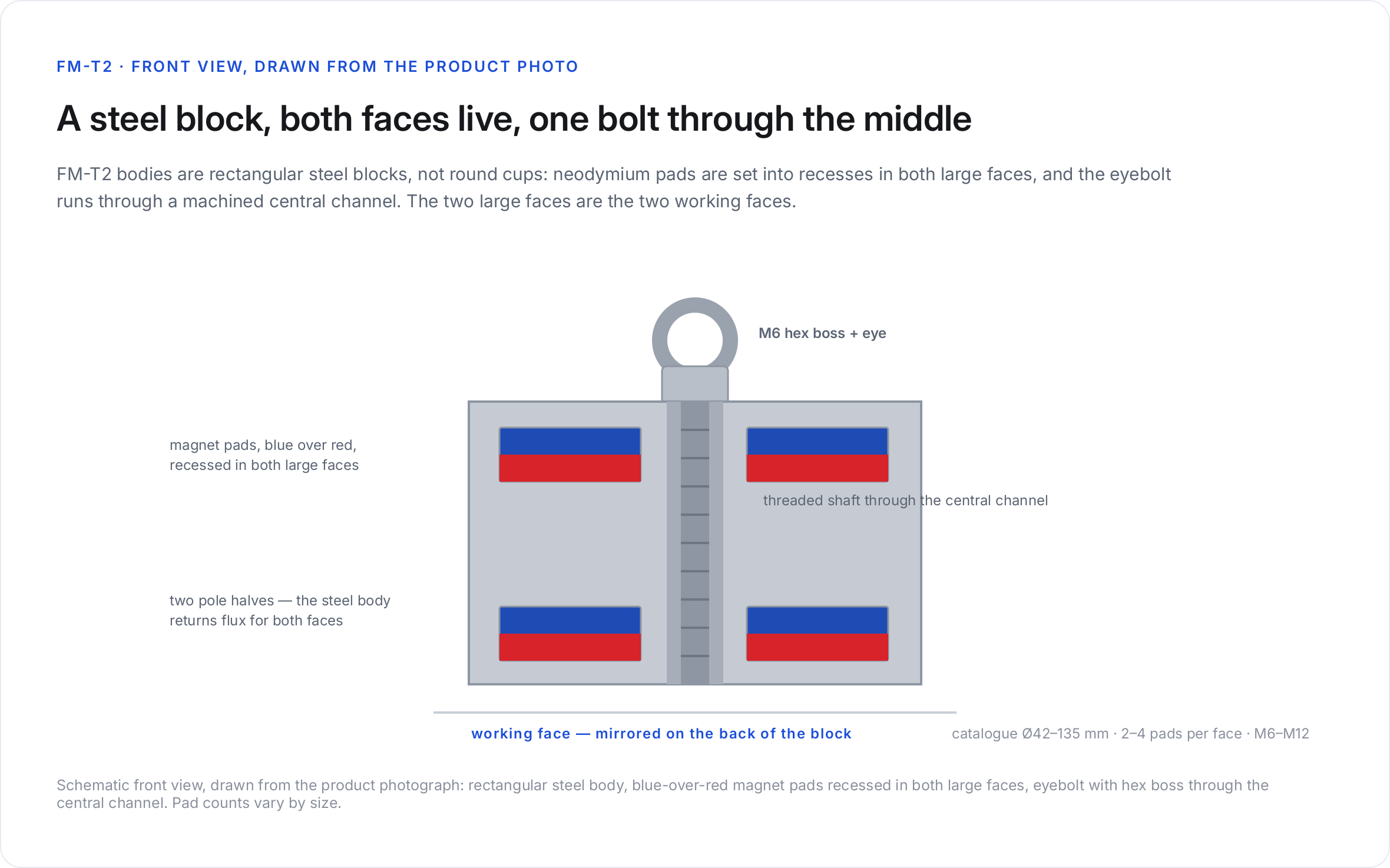
Every double-sided fishing magnet in this range is assembled from the same four elements:
The practical consequence of that shared yoke is worth stating early: the two faces do not each get half of one magnet's force. The assembly carries more magnet material than a single-sided unit of the same diameter, and the steel is shared — which is why the per-face pull of these double-sided fishing magnets is equal to, and usually higher than, the single-sided size at the same diameter. The detailed comparison is further down; the point here is that "double-sided" does not mean "half as strong per side". Because both faces are live, a double-sided fishing magnet has no safe back to rest a hand on. Handle these the way you would handle two magnets at once: gloves, and never between a face and steel.
A single-sided magnet can only ever grab what is beneath it. Double-sided fishing magnets can grab from either side of the housing, and that opens four retrieval geometries that are otherwise closed:
In all four cases the gain is coverage, not peak force. You are not going to out-pull a single-sided magnet of the same diameter by much; you are going to sweep a surface a single face cannot reach at all. Buyers who understand that distinction choose double-sided fishing magnets for structure and single-sided for open water — and the ones who do not, buy the wrong one and blame the magnet.
All eight SKUs are nickel-copper-nickel plated, rated for 80 °C service, and supplied with a through bore for the eyebolt. Pull figures are per face, measured as vertical pull-off on thick clean steel — the standard way double-sided fishing magnets are rated, and the only way the two ranges can be compared fairly.
| Diameter | Thickness | Overall height | Overall length | Thread | Weight | Pull per face | Price |
|---|---|---|---|---|---|---|---|
| 1.654 in / 42 mm | 0.63 in / 16 mm | 1.46 in / 37.1 mm | 2.99 in / 75.9 mm | M6 | 6.75 oz / 191 g | 121.25 lb / 55 kgf | $11.19 |
| 1.89 in / 48 mm | 0.709 in / 18 mm | 2.13 in / 54.1 mm | 3.31 in / 84.1 mm | M8 | 10.9 oz / 309 g | 160.94 lb / 73 kgf | $24.88 |
| 2.362 in / 60 mm | 0.866 in / 22 mm | 2.28 in / 57.9 mm | 3.78 in / 96.0 mm | M8 | 18.87 oz / 535 g | 319.67 lb / 145 kgf | $41.39 |
| 2.953 in / 75 mm | 0.984 in / 25 mm | 2.64 in / 67.1 mm | 4.61 in / 117.1 mm | M10 | 32.52 oz / 922 g | 551.16 lb / 250 kgf | $78.72 |
| 3.543 in / 90 mm | 1.1 in / 27.9 mm | 2.76 in / 70.1 mm | 5.2 in / 132.1 mm | M10 | 54.96 oz / 1,558 g | 815.71 lb / 370 kgf | $107.30 |
| 3.937 in / 100 mm | 1.181 in / 30 mm | 2.83 in / 71.9 mm | 5.59 in / 142.0 mm | M10 | 65.4 oz / 1,854 g | 1,036.17 lb / 470 kgf | $163.98 |
| 4.724 in / 120 mm | 1.26 in / 32 mm | 3.23 in / 82.0 mm | 6.69 in / 169.9 mm | M12 | 95.59 oz / 2,710 g | 1,305.14 lb / 592 kgf | $239.82 |
| 5.315 in / 135 mm | 1.34 in / 34 mm | 3.31 in / 84.1 mm | 7.32 in / 185.9 mm | M12 | 141.1 oz / 4,000 g | 1,543.24 lb / 700 kgf | $341.73 |
Two columns deserve a note. The overall length is the number that decides whether the magnet fits through your gap — it includes the eyebolt and is consistently 1.8× the diameter on this range, so a 135 mm head is a 186 mm object once rigged. That single ratio is the most common reason double-sided fishing magnets get returned: the buyer measured the face, not the tool. And weight crosses into serious territory at the top: at 4 kg the Ø135 is no longer a cast-and-drag tool, it is a winch-and-lower tool.
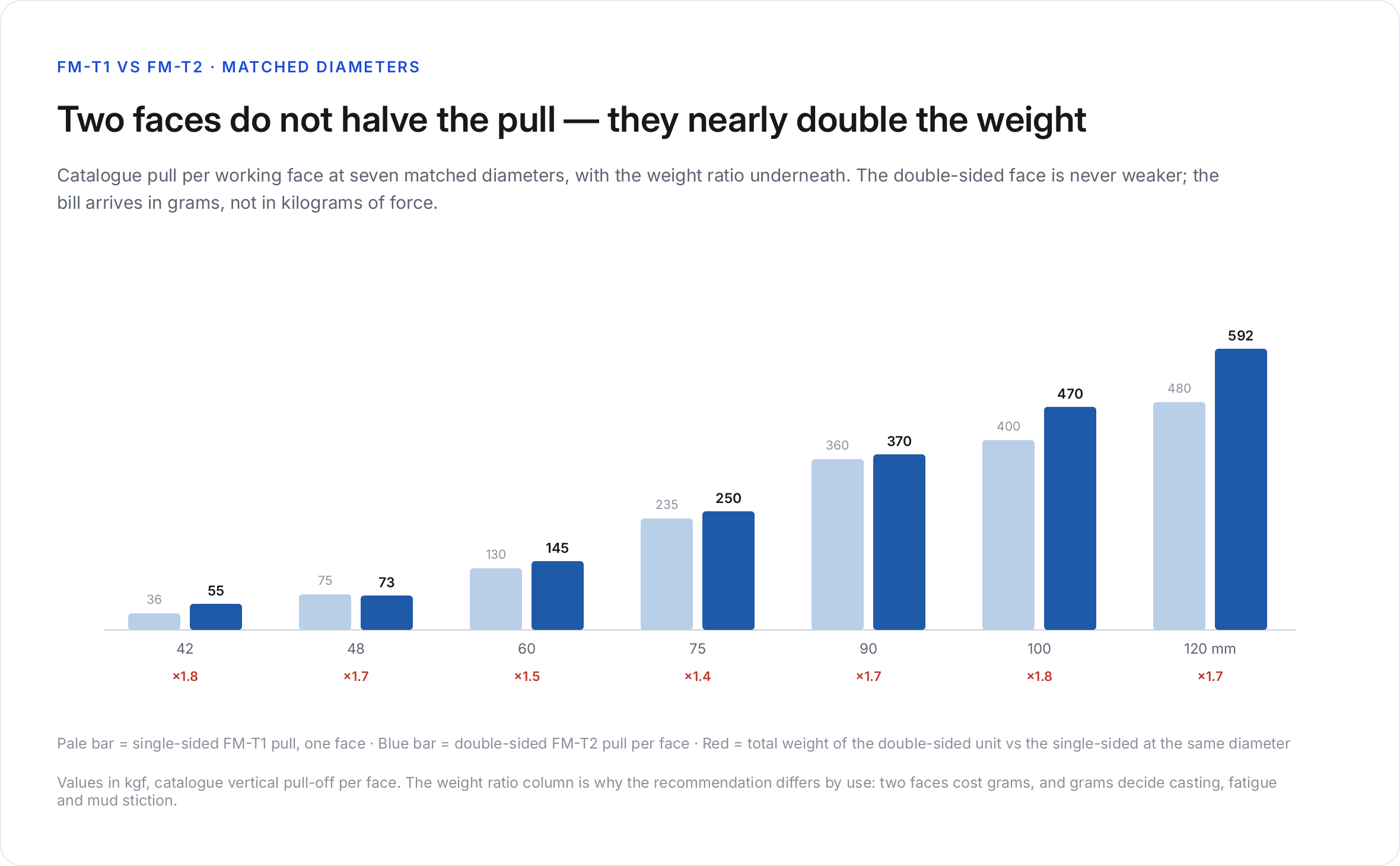
Here is where double-sided fishing magnets get mis-sold. The common assumption is that a two-face magnet gives each face half the pull of a one-face magnet. Checked against our own catalogue, that assumption is wrong — and the honest table is more useful than the convenient one:
| Diameter | FM-T1 pull (one face) | FM-T2 pull per face (two faces) | FM-T2 total weight vs FM-T1 |
|---|---|---|---|
| 42 mm | 36 kgf (79 lb) | 55 kgf (121 lb) | 1.84× |
| 48 mm | 75 kgf (165 lb) | 73 kgf (161 lb) | 1.73× |
| 60 mm | 130 kgf (287 lb) | 145 kgf (320 lb) | 1.53× |
| 75 mm | 235 kgf (518 lb) | 250 kgf (551 lb) | 1.42× |
| 90 mm | 360 kgf (794 lb) | 370 kgf (816 lb) | 1.68× |
| 100 mm | 400 kgf (882 lb) | 470 kgf (1,036 lb) | 1.81× |
| 120 mm | 480 kgf (1,058 lb) | 592 kgf (1,305 lb) | 1.68× |
Read down the middle column: at matching diameter, the double-sided face is never weaker — it is level at 48 mm and up to 50 % stronger at 42 mm. The reason is that the FM-T2 housing carries more magnet material than the FM-T1 unit of the same diameter (compare thickness: 16 mm against 8 mm at 42 mm), and the second pole gets its return path through steel it shares. Anyone who has been told that double-sided fishing magnets sacrifice per-face strength has been told a half-truth that only holds if you assume both builds use the same magnet.
So the real trade is not force. It is weight and bulk: you carry 1.4–1.8× the mass and 1.5–2× the thickness to gain a second face. For a rope-borne tool that matters — the Ø135 at 4 kg is nearly twice the weight of the Ø120 single-sided, and casting distance, mud stiction and fatigue all scale with it. When a buyer says double-sided fishing magnets "feel heavy", this table is the reason, and it is a design trade rather than a defect.
The same data read a different way explains why the double-sided format is not simply "more magnet for more money" — and it is the strongest technical argument for buying double-sided fishing magnets when you genuinely need two faces. Divide weight by the number of working faces, then divide again by the force each face delivers:
| Diameter | FM-T1: grams per kgf | FM-T2: grams per working face per kgf | Winner |
|---|---|---|---|
| 42 mm | 2.89 | 1.74 | double-sided, by 40 % |
| 48 mm | 2.39 | 2.12 | double-sided, by 11 % |
| 60 mm | 2.68 | 1.84 | double-sided, by 31 % |
| 75 mm | 2.76 | 1.84 | double-sided, by 33 % |
| 90 mm | 2.58 | 2.11 | double-sided, by 18 % |
| 100 mm | 2.56 | 1.97 | double-sided, by 23 % |
| 120 mm | 3.36 | 2.29 | double-sided, by 32 % |
That is the shared yoke dividend: one steel housing serves both circuits, so the second working face costs less weight than a second magnet would. Per face, these double-sided fishing magnets are 11–40 % more weight-efficient than the single-sided range. If your application genuinely needs two faces, you are buying the right shape. If it needs one, you are paying 1.4–1.8× the weight for a face you will never use — which is the real argument for the single-sided range and the reason both exist.
Being explicit about both sides is more useful than a feature list:
Wins
Loses
If your retrieval is straight down onto an open bottom, the extra face is dead weight — the single-sided guide covers that case with the same level of detail, and it is the honest recommendation for most first purchases. Double-sided fishing magnets earn their keep from the second surface, not from a bigger number.
The eyebolt passes through the yoke, so the load path is face → housing → bore → eyebolt → shackle → rope. On double-sided fishing magnets the thread is once again the practical ceiling, and the top two sizes make the point sharply:
That last line is not a defect; it is physics that every buyer should know before ordering the biggest size. If you hang 700 kgf of magnet on an M12 bolt and a shackle rated for 500, the magnet becomes the strongest link in a chain that fails somewhere else. Size the rig for the bolt, use a rated shackle rather than a knot, and apply the same 3× static / 5× dynamic margin covered in our pull force and shear force guide — the one-third shear rule applies to these faces exactly as it does to any other.
Two faces change how you fish, not just what you catch. The technique that experienced users converge on:
All eight SKUs ship nickel-copper-nickel plated — hard, conductive, and adequate for fresh water, mud and occasional salt. On a double-sided assembly the coating matters twice as much, because there are two faces to scratch and two pole-piece edges to chip — and the plating on double-sided fishing magnets is the first thing salt water attacks. The coatings guide covers the alternatives; in short:
Fresh-water rinse and a dry cloth after every salt session adds years. Chloride sitting in a chip is what kills plating, not the water itself.
The original use case is hobby magnet fishing, and it remains the biggest volume — but the same double-sided fishing magnets are bought for paid work:
Between two sizes, take the smaller one unless the gap requires the larger face. Double-sided fishing magnets are easiest to use when the assembly is comfortably inside your rope's rating — technique recovers more than the last 50 kgf does.
Beyond the eight stock sizes we build OEM programmes for distributors, outdoor brands and retailers: custom pull targets at a given diameter, alternative coatings, different eyebolt and shackle interfaces, laser marking, retail packaging, and mixed kits boxed for a market. Because the magnets, the yoke and the machining are all in-house, a custom assembly is a drawing and a quantity rather than a new supply chain — which is why double-sided fishing magnets under our own brand and a dozen private labels come off the same line. Tell us the structure you are searching and the gap you have to pass, and engineering will propose the diameter, the coating and the rigging — start at custom magnets or contact us directly.
What does double-sided mean on a fishing magnet? Both ends of the housing carry a live working face, with a shared steel yoke between them. You can grab from either side, which is what makes grates, railings, wells and dock undersides searchable at all. It is the definition that separates double-sided fishing magnets from every one-face tool on the market.
Are double-sided fishing magnets stronger than single-sided ones? Per face, at matching diameter, yes or level — 55 kgf against 36 at 42 mm, 592 against 480 at 120 mm. They are not "half per side": the housing carries more magnet material and shares the return steel. The cost is 1.4–1.8× the weight, which is the trade every buyer of double-sided fishing magnets is actually making.
Which is better for magnet fishing, single or double-sided? Open water and straight-down retrievals: single-sided, for weight and casting distance. Grates, structure, shafts and dock edges: double-sided fishing magnets, because a single face physically cannot reach those surfaces.
How much can the largest size lift? The Ø135 is rated 700 kgf per face (1,543 lb). That is well beyond the ~400–500 kgf working limit of its M12 eyebolt, so in practice the rig — bolt, shackle, rope — sets your ceiling, not the magnet. It is the same weak-link arithmetic that governs every double-sided fishing magnet above Ø100.
Can I use one under a grate? That is the primary reason to buy one. Lower it through the bars, let it lie flat, and drag; both faces work the surface.
Will the second face grab the boat or the dock? Yes — that is the known handling risk. Both faces are live, and the upper face will grab steel structure on the way up. Keep the assembly clear of the hull and lift vertically; this is the one habit that separates confident users of double-sided fishing magnets from bruised ones.
What rope should I use? One rated above the assembly's pull with a 5× margin on the working load, terminated with a shackle rather than a knot. On the top two sizes, the bolt limit binds before the rope does.
Will it work in salt water? Yes, with care: Ni-Cu-Ni as standard, epoxy for repeated immersion, and a fresh-water rinse after every session. Two faces mean twice the area to inspect for scratches — the single biggest cause of premature failure on double-sided fishing magnets used in marinas.
What is the maximum temperature? 80 °C for the standard neodymium grades; higher-temperature grades are available through the custom route — relevant for plant and tank work rather than for double-sided fishing magnets used in open water.
Do you supply retail packaging and custom kits? Yes — OEM programmes include retail boxing, laser marking, mixed-size kits and alternative coatings; see the custom section above. Most private-label double-sided fishing magnets we ship are kitted, not loose.
Eight sizes, one production line, $11.19 to $341.73 — that price spread is what in-house magnet, yoke and machining buys you. Browse the double-sided fishing magnet category for stock and current pricing, or contact us with the structure you need to search and the gap you have to pass. Engineering answers the same day, and will tell you honestly if a single-sided tool would serve you better than the double-sided fishing magnets you asked about.