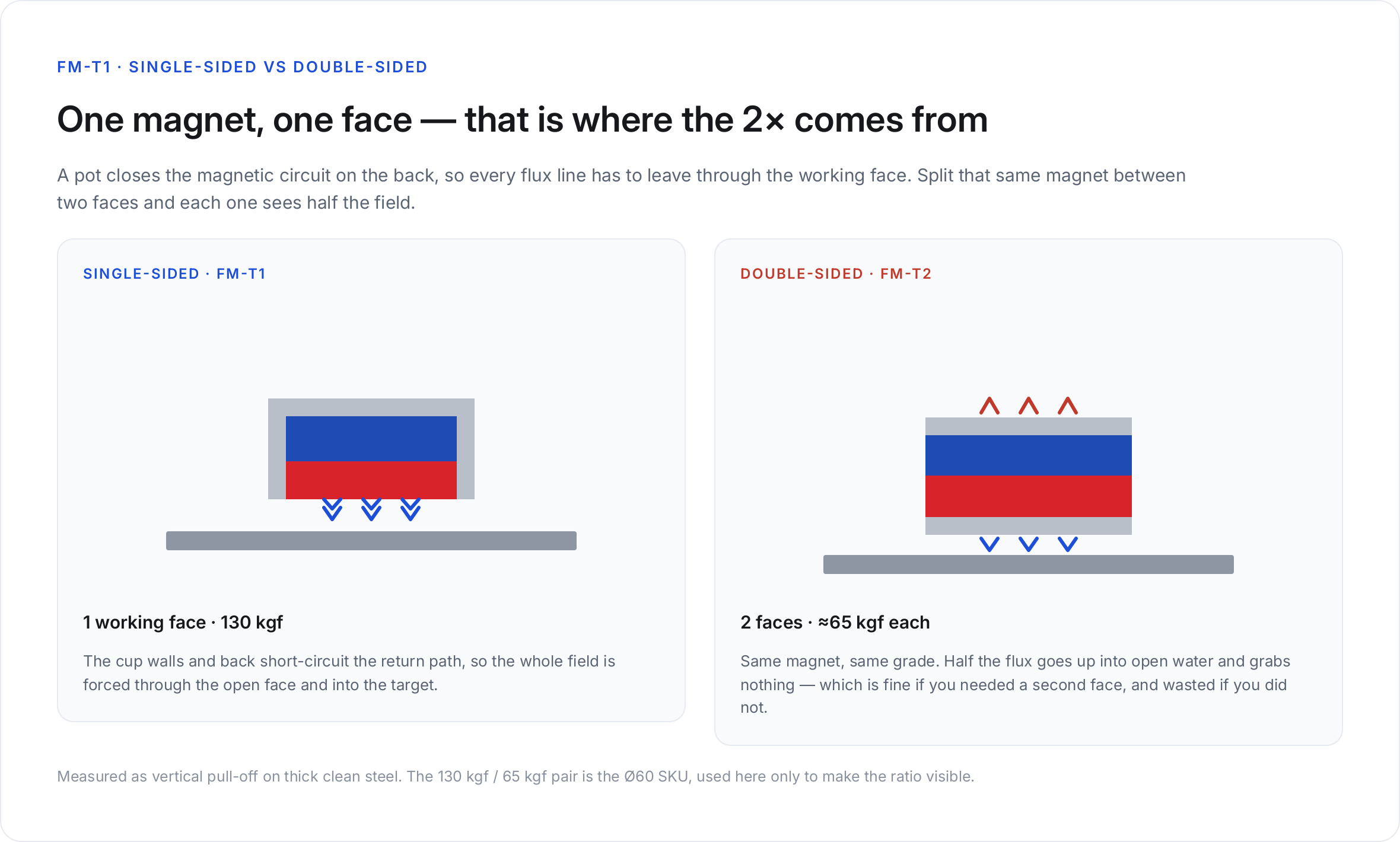
Single-sided fishing magnets are recovery tools with all their magnetic force concentrated on one working face: a neodymium disc inside a steel cup, a threaded bore on the back, and an eyebolt for the rope. One face grabs, the other face grabs nothing — and that is exactly why the grab is stronger. Put the same magnet and the same steel in a double-sided housing and the flux splits between two faces; concentrate it on one and the pull roughly doubles. That is the design decision behind every single-sided fishing magnet in the range, and it drives every number on the rest of this page.
This page covers our FM-T1 range in full: 15 stock sizes from Ø16 mm to Ø120 mm, 4.5 to 480 kgf measured pull, M3 to M12 threads, nickel-copper-nickel plating as standard. Below the spec table you will find the four things that actually decide whether the magnet comes back up with the object attached: the thread, the target's size, the shock of retrieval, and what sits between the two faces. Every one of those four limits bites hardest on single-sided fishing magnets, because there is no second face to fall back on.
If you are new to the hobby, start with the magnet fishing overview; if you are choosing between one face and two, the double-sided range is the other half of this chapter.
Every single-sided fishing magnet on this page is built from the same four parts, and only one of them is glamorous:
Because the cup closes the circuit on the back, the rear face is magnetically dead. You can lay these single-sided fishing magnets flat on a steel bench without them sticking, you can stack them in a crate, and — the practical point — you can put your hand on the back while the front is stuck to something. Anyone who has handled a bare double-sided assembly knows why that matters. It is also why the range is safe to handle in a shop, a tank or a classroom in a way that a live two-face magnet never is.
The "single-sided" name is a description of the field, not of the build quality: single-sided fishing magnets are neodymium magnet assemblies with a plated steel housing, not toys with a magnet glued into a plastic shell.
Two faces share one magnet. Take a Ø60 disc that pulls 130 kgf through one face in an open cup, and house it double-sided: each face now sees roughly half the flux, so each face pulls roughly 65 kgf. Nothing is lost — you gained a second working face — but if you only ever grab from one direction, half your magnet is doing nothing. This is the single trade-off that separates single-sided fishing magnets from every other recovery assembly on the market, so it is worth ten seconds of thought before you buy.
| Single-sided (FM-T1) | Double-sided (FM-T2) | |
|---|---|---|
| Working faces | 1 | 2 |
| Pull per face at equal size and grade | ≈2× | ≈1× (reference) |
| Grabs through a gap, grate or railing | no — one face only | yes — drop it through and pull |
| Rear face safe to handle | yes, dead face | no, live face |
| Best for | straight-down vertical recovery, one known face | grating, storm drains, structure, blind drops |
The decision rule is simple: if your target is under open water and you will lower the magnet onto it, single-sided fishing magnets give you the most force per gram and per dollar. If the target sits under a grate, inside a channel, or behind structure where only a drop-through approach works, the double-sided assembly reaches it and the single-sided one cannot. The double-sided page carries its own table, and the magnet fishing overview explains where both fit in a kit.
All fifteen SKUs are nickel-copper-nickel plated, all rated for 80 °C service, all with a countersunk bore in the cup back. Pull figures are vertical pull-off on thick clean steel — the standard way single-sided fishing magnets are rated, and the number every supplier quotes.
| Diameter | Thickness | Overall height | Thread | Weight | Pull | Price |
|---|---|---|---|---|---|---|
| 0.63 in / 16 mm | 5.0 mm | 18.7 mm | M3 | 9 g | 4.5 kgf (9.9 lb) | $2.65 |
| 0.787 in / 20 mm | 6.0 mm | 25.0 mm | M4 | 16 g | 7.0 kgf (15.4 lb) | $3.90 |
| 0.984 in / 25 mm | 7.0 mm | 30.0 mm | M5 | 29 g | 10.0 kgf (22.1 lb) | $4.57 |
| 1.26 in / 32 mm | 7.0 mm | 30.0 mm | M5 | 46 g | 24.0 kgf (52.9 lb) | $6.32 |
| 1.417 in / 36 mm | 7.0 mm | 35.0 mm | M6 | 64 g | 26.0 kgf (57.3 lb) | $9.59 |
| 1.654 in / 42 mm | 8.0 mm | 37.1 mm | M6 | 104 g | 36.0 kgf (79.4 lb) | $11.47 |
| 1.89 in / 48 mm | 11.0 mm | 43.9 mm | M8 | 179 g | 75.0 kgf (165 lb) | $24.78 |
| 2.165 in / 55 mm | 12.0 mm | 46.0 mm | M8 | 243 g | 100 kgf (220 lb) | $27.41 |
| 2.362 in / 60 mm | 15.0 mm | 48.0 mm | M8 | 349 g | 130 kgf (287 lb) | $41.19 |
| 2.638 in / 67 mm | 15.0 mm | 56.9 mm | M8 | 432 g | 175 kgf (386 lb) | $59.70 |
| 2.953 in / 75 mm | 18.0 mm | 59.9 mm | M10 | 649 g | 235 kgf (518 lb) | $78.02 |
| 3.15 in / 80 mm | 18.0 mm | 57.9 mm | M10 | 738 g | 280 kgf (617 lb) | $89.95 |
| 3.543 in / 90 mm | 18.0 mm | 59.9 mm | M10 | 927 g | 360 kgf (794 lb) | $107.10 |
| 3.937 in / 100 mm | 18.0 mm | 74.9 mm | M10 | 1,023 g | 400 kgf (882 lb) | $162.98 |
| 4.724 in / 120 mm | 18.0 mm | 74.9 mm | M12 | 1,614 g | 480 kgf (1,058 lb) | $239.12 |
Two features of this table are worth pointing out because they are not accidents. First, pull rises far faster than diameter: 16 mm → 48 mm is a 3× increase in diameter and a 16× increase in pull. Second, the thickness steps in groups — 5/6/7 mm on the small sizes, 11/12/15/18 mm on the large — which lets us use taller (higher-grade) magnet blocks as the diameter grows without making the assembly absurdly thin and fragile. Read together, those two columns are the whole design story of this range: single-sided fishing magnets are a diameter-and-thickness problem long before they are a grade problem.
Six columns, four of which matter for selection. Here is what each one is actually telling you about a single-sided fishing magnet:
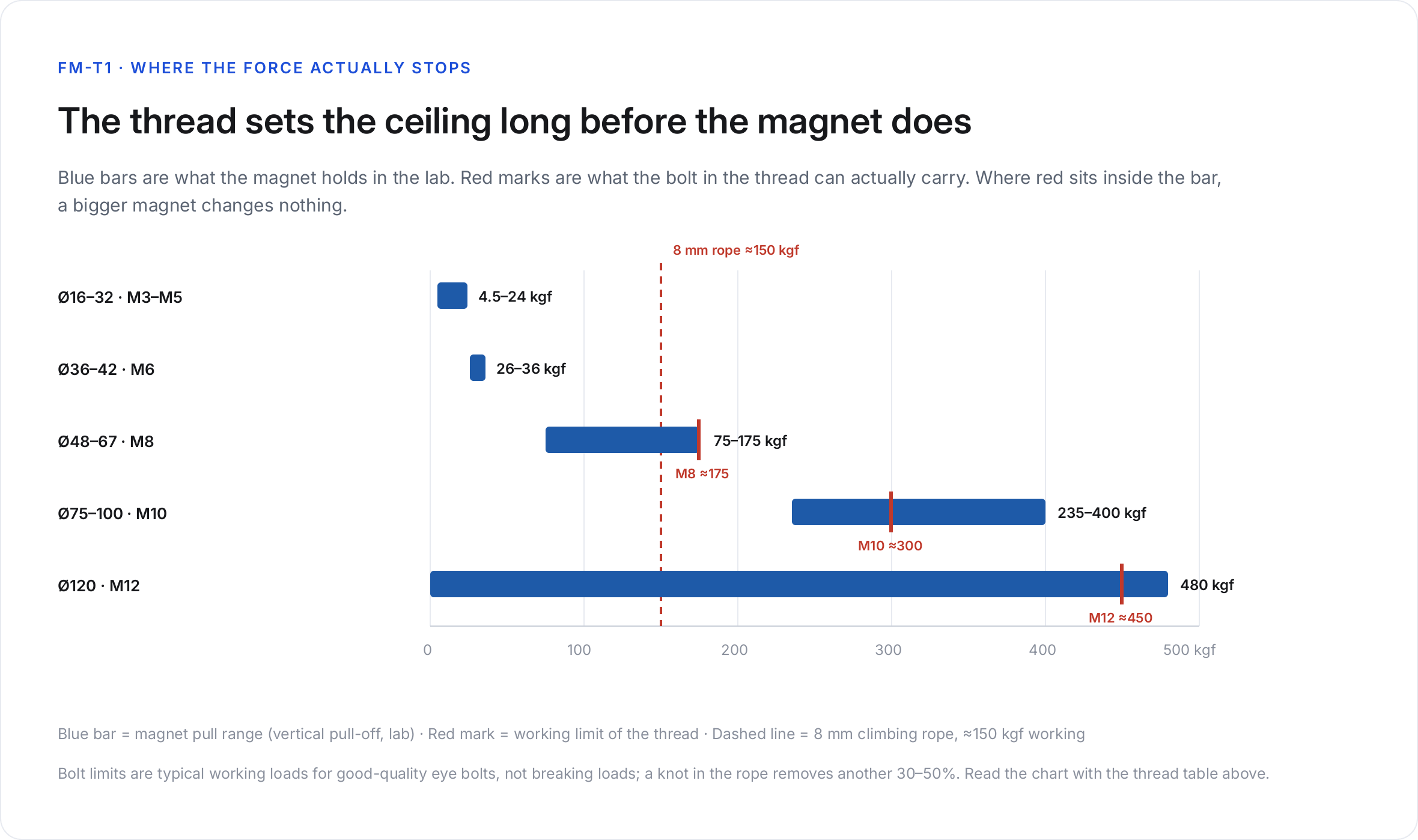
This is where most buyers of single-sided fishing magnets get caught out. A Ø120 pulls 480 kgf. The M12 eye bolt screwed into it does not carry 480 kgf — nothing in your rig does. The chain of load is magnet → thread → eye bolt → shackle → rope → you, and the working load is the weakest link, which is almost never the magnet:
| Item | Typical limit | What it means |
|---|---|---|
| M8 eye bolt (steel, good quality) | ~150–200 kgf working | the ceiling for Ø48–67 magnets in practice |
| M10 eye bolt | ~250–350 kgf working | Ø75–100 assemblies |
| M12 eye bolt | ~400–500 kgf working | Ø120, and only with a rated bolt |
| 8 mm climbing-grade rope | ~150 kgf working | often the real limit on a hobby rig |
| Knot in that rope | 50–70% of rope strength | the weakest point most people forget |
Three rules follow. Use a threaded eye bolt rated for the assembly, not a bent nail or a hook. Terminate with a shackle or a spliced eye rather than a knot where the load will be high. And never let the rope go through your hand under tension — a 480 kgf break-free event through a glove is a hospital visit, which is why every serious rigger uses a bank stick or a cleat.
This is the counter-intuitive rule of single-sided fishing magnets: the working face should roughly match the ferrous area of the target. Magnetic pull is generated by flux completing a circuit through steel. A 120 mm face landing on a 40 mm bottle cap closes a small circuit and wastes most of its field in air; the same object picked up by a Ø48 with a thicker magnet can actually hold better relative to its weight and is far easier to control in the water.
Practically, four bands cover almost every purchase of single-sided fishing magnets:
A big magnet also brings a big liability: on a steel plate or a rock with steel in it, a Ø120 at 480 kgf can be genuinely hard to remove. Many experienced anglers carry two magnets — a 48 mm for searching and a big one for confirmed heavy targets. It is the cheapest way to get more out of single-sided fishing magnets without buying a bigger one.
Every number in the table is a slow, perpendicular pull-off. Retrieval is nothing like that, and this is the second place where single-sided fishing magnets get over-specified:
Design for it: pick the magnet for the target, pick the rope for the magnet's pull, and keep a safety factor of 5× on any overhead or hand-adjacent load and 10× if the magnet could land on something you cannot see. This is the same discipline as any rigging — see factor of safety. Applied honestly to single-sided fishing magnets, that rule alone pushes most buyers from the Ø90 they wanted down to the Ø55 they can actually control.
Water is not the problem. A film of water between magnet and steel costs almost nothing, which is why these assemblies work as well at 20 m as at the surface — and why the depth rating on single-sided fishing magnets is a rope question, not a magnet question. The real losses are the things the water carries:
| Between magnet and target | Effect on pull |
|---|---|
| Clean water film | negligible |
| Silt, mud, sand | 20–60% depending on thickness |
| Rust scale or barnacles on the target | 30–50% |
| Paint or epoxy on the target | 20–50% |
| Algae mat or weed trapped between | can drop it to near zero |
Which produces the retrieval technique that experienced anglers converge on: drag, don't stab. Lower the magnet slowly, let it settle, drag it across the bottom rather than pressing it into silt, and lift vertically once it takes. A magnet pressed into 10 mm of silt is holding silt, not steel — and of the four limits in this section, silt is the one that most often explains why single-sided fishing magnets "stop working" on a lake that is simply muddier than it looks.
All fifteen SKUs ship nickel-copper-nickel plated, which is the right default: hard, conductive, and adequate for fresh water, mud and occasional salt exposure. It is also the finish that keeps single-sided fishing magnets working after a season of gravel and grit, because nickel resists the abrasion that strips softer coatings. Where the environment is harsher, the coatings guide covers the alternatives:
Whatever the coating, fresh water rinse and a dry cloth after every salt-water session adds years. The enemy is not the water — it is chloride sitting in a scratch. Treat single-sided fishing magnets like dive gear rather than like tools and they will outlast the rope.
Six habits separate people who keep their single-sided fishing magnets for years from people who lose one in the first month:
The original use case is hobby magnet fishing, and it remains the biggest volume — but the same single-sided fishing magnets are bought for paid work:
Four points that the catalogue never covers but that decide whether single-sided fishing magnets survive a season:
If you only read one section, read this one. Five questions, in order, will land you on the right size of single-sided fishing magnet more reliably than any pull figure:
Between two sizes, take the smaller one. Single-sided fishing magnets are easiest to use when they are comfortably within the rope's rating, and the pull difference between Ø48 and Ø55 is rarely the difference between success and failure — technique is.
Beyond the fifteen stock sizes, we supply OEM programmes for distributors, outdoor brands and retailers: custom pull targets at a given diameter, alternative coatings (epoxy, zinc, rubber), different eye-bolt and shackle interfaces, laser marking and retail packaging, and mixed-size kits boxed for a specific market. Because the thread, the cup and the magnet are all made in-house, a custom assembly is a drawing and a quantity, not a new supply chain — which is why single-sided fishing magnets under our own brand and a dozen others come off the same line. Tell us the target objects and the water you fish, and engineering will propose the size and coating — start with the custom magnets page or contact us directly.
What does single-sided mean? All the magnetic force is concentrated on one working face by a steel cup; the back is magnetically dead. Same magnet and grade gives roughly twice the pull of a double-sided housing at the same size — the defining property of single-sided fishing magnets, and the reason the range exists at all.
How much can these magnets lift? 4.5 kgf on the Ø16 up to 480 kgf on the Ø120, measured as vertical pull-off on thick clean steel. In the water, on a real target, expect to work with 20–50% of that once silt, rust and off-axis pull are counted — the usual reason single-sided fishing magnets feel weaker in the field than on the box.
Can I use a single-sided magnet under a grate? No — it only grabs from one face. Use the double-sided range where a drop-through approach is needed; single-sided fishing magnets are the wrong tool for any target that has to be reached from below.
What rope should I use? One rated above the magnet's pull with a 5× margin on the working load, terminated with a shackle rather than a knot. An 8 mm climbing-grade rope at ~150 kgf working load is the practical limit of most hobby rigs — which caps you around the Ø48–55 sizes regardless of what the magnet can hold. Size the rope first and choose from the single-sided fishing magnets that fit it, not the other way round.
Will the magnet work in salt water? Yes, with care: Ni-Cu-Ni standard, epoxy for repeated immersion, rinse and dry after every session. Salt damages the plating in scratches, not the magnet — and single-sided fishing magnets recovered from salt water should be rinsed the same day, not the same week.
Does the thread really limit the pull? On the large sizes, yes. An M8 eye bolt carries roughly 150–200 kgf working, so the Ø48–67 assemblies are limited by their bolt long before their magnet. Any supplier quoting a 480 kgf pull for a single-sided fishing magnet without also quoting the bolt is quoting the magnet, not the rig.
Why did a bigger magnet perform worse than a smaller one? Target matching. A large face on a small ferrous target wastes its field in air; a smaller, thicker magnet often holds a small object better and is much easier to control. This is the single most common complaint we get about single-sided fishing magnets, and it is a selection error, not a defect.
Can these magnets damage a phone or a pacemaker? Yes. Keep 30 cm from implanted pacemakers and defibrillators, and away from phones, cards and mechanical watches. Single-sided fishing magnets are no safer here than bare discs — the dead face is on the back, not the front.
What is the maximum temperature? 80 °C for the standard neodymium grades. Higher-temperature grades are available through the custom route — relevant for factory and plant maintenance rather than for single-sided fishing magnets used in open water.
Do you supply retail packaging and custom colours? Yes — OEM programmes include retail boxing, laser marking, kit configurations and alternative coatings. Colour is not available on this range, though: single-sided fishing magnets are specified for pull and corrosion resistance, and a painted cup costs flux.
Every size in the table ships from our own production line, which is why a 480 kgf assembly can sit at $239 and a 4.5 kgf starter magnet at $2.65. Browse the single-sided fishing magnets category for stock sizes, or contact us with the objects you need to recover and the water you fish in — engineering answers the same day, and will tell you honestly if a smaller single-sided fishing magnet would serve you better than the one you asked for.