Rubber coated magnetic hooks trade a slice of raw holding force for three things a bare steel cup cannot give you: a scratch-free contact face, real friction against sliding, and a quiet, corrosion-resistant jacket for painted, glass and stainless-show surfaces.
Rubber coated magnetic hooks come in three fittings on the same rubber-jacketed pot — a J hook, a ring (eye bolt) and a swivel wire loop — in 13 stock sizes from Ø22 to Ø88 mm and 2 to 26 kgf. This page explains what the rubber changes, which fitting fits which job, and the two rows in the spec table you should check before you design in.
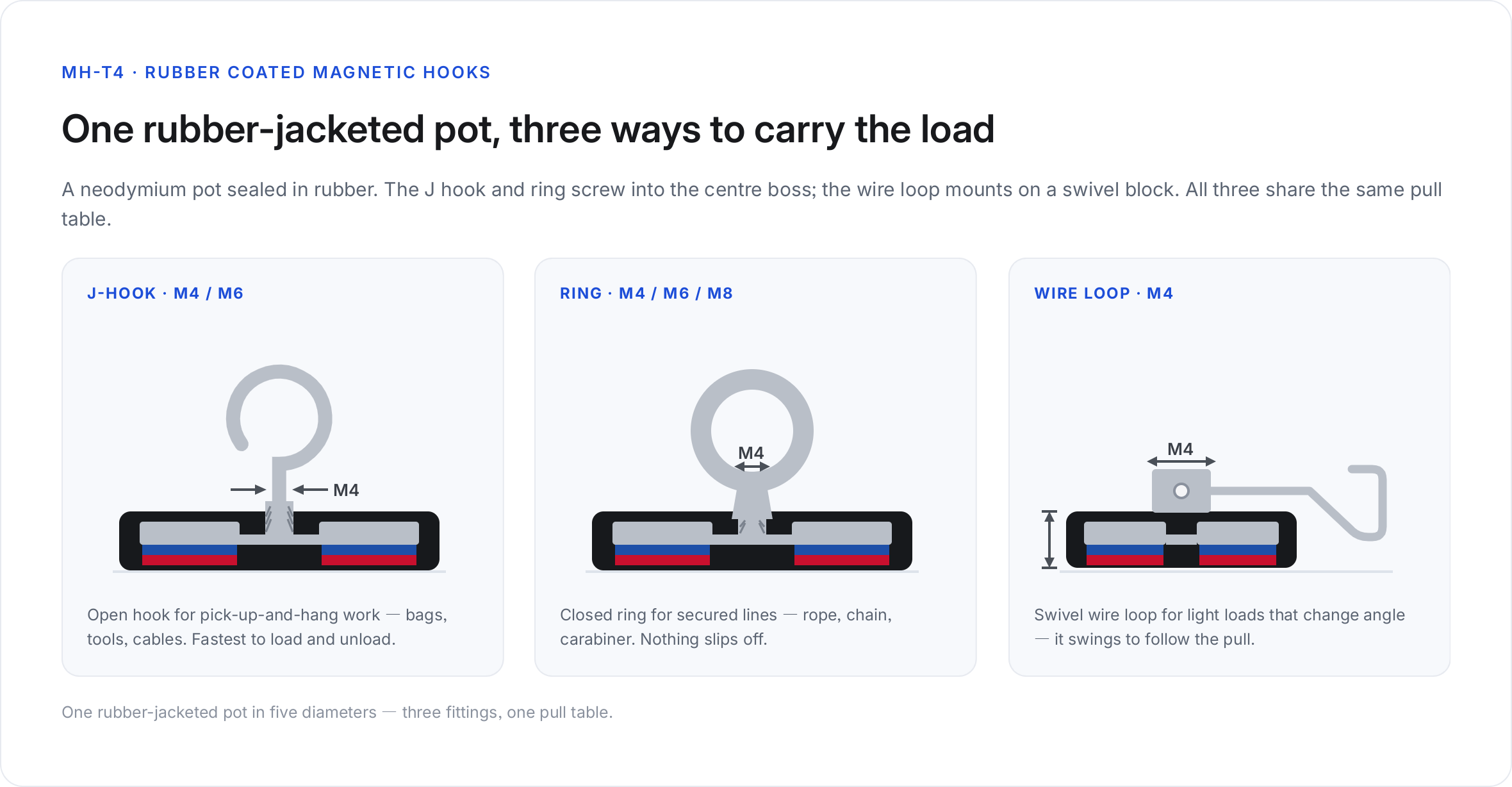
A rubber coated magnetic hook is a neodymium pot magnet completely enclosed in a soft rubber jacket, with a threaded boss through the centre that carries the fitting. The neodymium magnet inside is the same platform used across our magnetic hooks range; the rubber — a soft, grippy polymer a few millimetres thick — is the interface.
The jacket does four jobs at once:
The cost is pull force: the rubber sits between the magnet and the steel, and every millimetre of it is an air gap the flux has to cross. More on that below, with numbers.
All 13 rubber coated magnetic hooks share the same rubber-jacketed pot in five diameters. The fitting on top is what differs:
| J-Hook | Ring (eye bolt) | Wire loop (swivel) | |
|---|---|---|---|
| Connection | Open J hook, threaded boss | Closed ring nut, threaded boss | Bent wire loop on the boss |
| Load escapes? | Yes, if line goes slack | No | Swings to follow the load |
| Threads stocked | M4, M6 | M4, M6, M8 | M4 |
| Sizes | 5 (Ø22–88) | 5 (Ø22–88) | 3 (Ø22–43) |
| Best for | Bags, tools, quick hangs | Rope, cable, chain, carabiner | Light loads that change angle |
Choose the J hook for the everyday pick-up-and-hang work. Choose the ring when the line must not come off — tethered tools, Tarps, safety barriers. Choose the wire loop when the load swings and you want it to self-align, in the three smallest sizes.
The fitting choice mirrors our bare-cup families: the fixed hook (MH-T1), the eye bolt (MH-T2) and the swivel (MH-T3). If you need the same logic with maximum pull and no rubber, those are the pages.
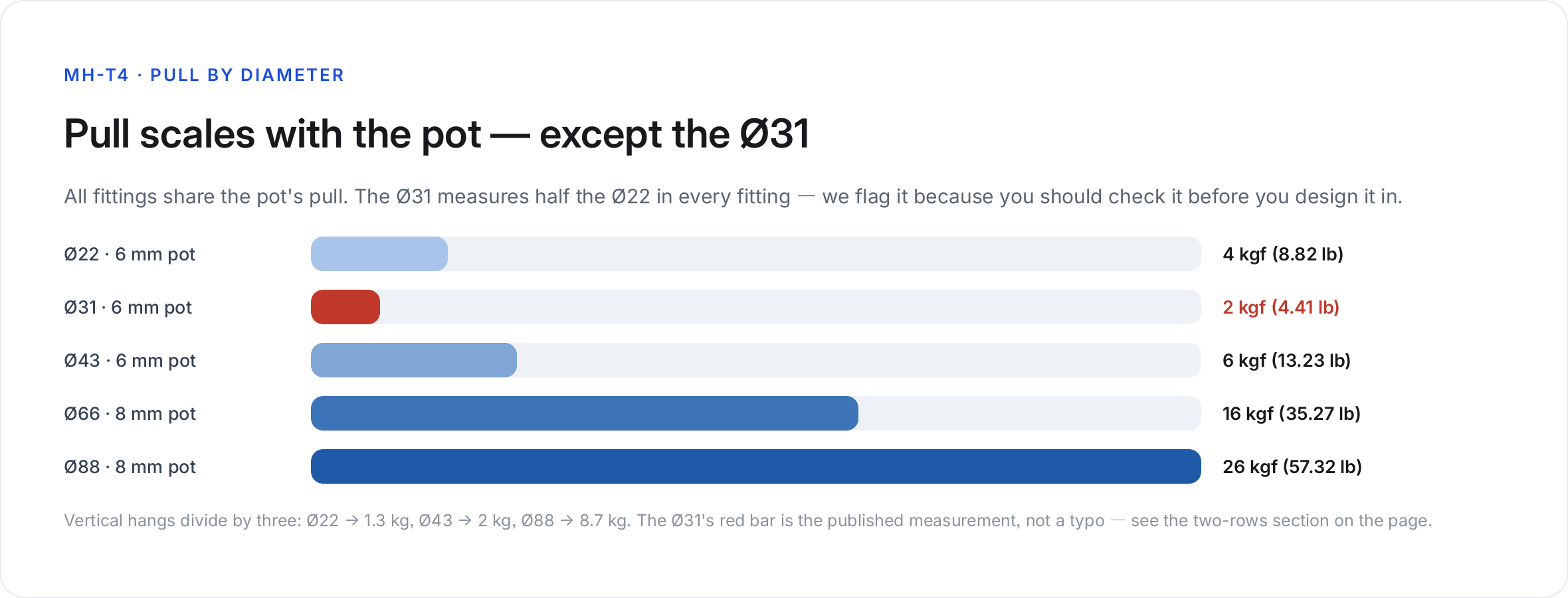
All sizes are nickel-plated under the rubber, rated to 80 °C, and measured on 3 mm mild steel, perpendicular to the face. Pot height is 6 mm up to Ø43 and 8 mm from Ø66 up.
J-Hook (M4 / M6)
| Ø mm | Pot height | Thread | Pull force | Weight | Unit price |
|---|---|---|---|---|---|
| 22 | 6 mm | M4 | 4 kgf (8.82 lb) | 13.1 g | $1.23 |
| 31 | 6 mm | M4 | 2 kgf (4.41 lb) | 19.1 g | $1.16 |
| 43 | 6 mm | M4 | 6 kgf (13.23 lb) | 35.2 g | $1.61 |
| 66 | 8 mm | M6 | 16 kgf (35.27 lb) | 112 g | $3.10 |
| 88 | 8 mm | M6 | 26 kgf (57.32 lb) | 208 g | $5.38 |
Ring / eye bolt (M4 / M6 / M8)
| Ø mm | Pot height | Thread | Pull force | Weight | Unit price |
|---|---|---|---|---|---|
| 22 | 6 mm | M4 | 2 kgf (4.41 lb) | 18.5 g | $1.68 |
| 31 | 6 mm | M4 | 2 kgf (4.41 lb) | 24 g | $1.58 |
| 43 | 6 mm | M6 | 6 kgf (13.23 lb) | 61 g | $2.13 |
| 66 | 8 mm | M8 | 16 kgf (35.27 lb) | 153 g | $3.75 |
| 88 | 8 mm | M8 | 26 kgf (57.32 lb) | 245 g | $5.63 |
Wire loop (M4)
| Ø mm | Pot height | Thread | Pull force | Weight | Unit price |
|---|---|---|---|---|---|
| 22 | 6 mm | M4 | 4 kgf (8.82 lb) | 11 g | $1.50 |
| 31 | 6 mm | M4 | 2 kgf (4.41 lb) | 17 g | $1.42 |
| 43 | 6 mm | M4 | 6 kgf (13.23 lb) | 32.9 g | $2.10 |
Always in stock for sampling — rubber coated magnetic hooks ship in 1–2 business days: the Ø22 J-hook, the Ø22 ring, the Ø22 wire loop, the Ø66 ring M8 and the Ø88 J-hook M6 — one of each fitting, so you can test the interface before you commit.
We publish the numbers as they measure, so two results in the table deserve a flag before you design in:
That is the whole list. Every other row scales the way you'd expect — and if a future lot of rubber coated magnetic hooks shifts, this page gets updated first: roughly double the diameter buys three to four times the pull.
The honest trade for rubber coated magnetic hooks, in one table:
| Bare steel cup (MH-T1/T2) | Rubber coated magnetic hooks (MH-T4) | |
|---|---|---|
| Pull force, same class | Higher — no gap in the flux path | Lower — rubber is an air gap |
| Sliding on smooth paint | Slides at ~1/3 of rating | Grips — friction carries part of the shear |
| Surface damage | Scratches glass and paint | Nothing to damage |
| Corrosion | Plating only | Rubber seals the whole pot |
| Noise | Clanks | Quiet |
| Fitting swap | Yes (threaded) | Yes (threaded) |
Two practical readings:
The pull force above is a perpendicular measurement on clean steel. For a vertical hang, start from the same rule as every family — the table below is for rubber coated magnetic hooks:
design working load ≈ one-third of the pull force
| Ø mm | Pull force | Realistic vertical hang |
|---|---|---|
| 22 (J / loop) | 4 kgf | ~1.3 kg |
| 31 (all) | 2 kgf | ~0.7 kg |
| 43 (all) | 6 kgf | ~2 kg |
| 66 (J / ring) | 16 kgf | ~5.3 kg |
| 88 (J / ring) | 26 kgf | ~8.7 kg |
Then adjust for reality: powder coat or glass costs 30–50%, thin steel below 1.5 mm costs half, and swinging loads cost another third. The difference is that with rubber, the failure you are least likely to see is the quiet sideways slide — the jacket grips while the magnet works.
On rubber coated magnetic hooks the boss is threaded and the fitting screws in, so all three families accept replacements and custom ends:
Thread callouts follow the ISO metric screw thread standard, so standard eyebolts, hooks and studs from any supplier thread in. Match the thread before the diameter: an M6 fixture cannot take an M8 ring, and there is no adapter worth owning.
Where rubber coated magnetic hooks get specified, week after week:/n/n- Hanging tools and cables on painted racking without a single scratch
Rubber coated magnetic hooks are usually picked by feel. Run the checklist instead:/n/n1. Pick the fitting by the load's behaviour — J for quick hangs, ring for secured lines, loop for swinging loads.
Rubber coated magnetic hooks open up program work the bare cups can't do:
Our custom magnet service quotes drawings in 48 hours; jacket tooling is the only long-lead item.
Rubber coated magnetic hooks need almost no maintenance — a short list keeps it that way:
Treated this way, rubber coated magnetic hooks run for years outdoors. The jacket is the wear part; the magnet is not.
Every lot of rubber coated magnetic hooks is pull-tested on 3 mm mild steel and sample-checked for jacket bond and boss thread gauging. Standard sizes ship from stock in Redlands, California — 3–7 day transit for North American buyers instead of a 30-day ocean leg. Custom assemblies typically quote in 48 hours and sample in 7–10 days.
Ten questions about rubber coated magnetic hooks that come in every week. we answer every week about rubber coated magnetic hooks.
Q1: How much weight can a rubber coated magnetic hook hold? A: Start from one-third of the rated pull for a vertical hang: the Ø22 J-hook (4 kgf) holds about 1.3 kg, the Ø88 (26 kgf) about 8.7 kg. Derate further for paint, thin steel and swinging loads.
Q2: Why is the pull force lower than bare magnets of the same size? A: The rubber jacket sits between the magnet and the steel and acts as an air gap in the flux path. That costs pull force — and buys surface protection, friction and a sealed pot.
Q3: Will the rubber leave marks on the surface? A: Normally no. On some powder coats, long static contact with soft rubber can leave a temporary imprint that recovers; on glass and stainless it wipes clean.
Q4: Why does the Ø31 measure less than the Ø22? A: That is how the current pots measure — 2 kgf against 4 kgf, in all three fittings. If you spec'd Ø31, check whether Ø22 or Ø43 does the job; our engineers will confirm the pot revision on request.
Q5: Do rubber coated magnetic hooks work on curved surfaces? A: Better than flat rubber would suggest — the jacket conforms slightly to cylinders and bends, which is one reason they are popular on vehicle panels and tubing.
Q6: What is the maximum temperature? A: 80 °C / 176 °F for the magnet, standard N-grade. The rubber tolerates more, but the magnet sets the limit; higher grades are available on request.
Q7: Are rubber coated magnetic hooks suitable for outdoor and marine use? A: Yes — the sealed jacket is the point. For permanent direct sunlight, ask about the EPDM jacket, which resists UV and ozone better than standard rubber.
Q8: Can I swap the hook for an eye bolt? A: Yes — the boss is threaded (M4, M6 or M8 by size), so standard fittings from any supplier thread in. See the thread table above for what ships on each size.
Q9: Do they hold on stainless steel? A: Only on ferritic grades. Austenitic 304 and 316 are effectively non-magnetic and will not hold — rubber does not change that.
Q10: What is the lead time for custom jackets or fittings? A: Existing pots with a new fitting sample in 7–10 days. New jacket colour or hardness tooling adds 2–3 weeks. Stock sizes ship in 1–2 business days from California.
Tell us the surface, the load and how the load moves — we will pick the fitting and the size, apply the derates with you, and confirm whether rubber coated magnetic hooks or bare steel is the cheaper way to hold it. Stock rubber coated magnetic hooks ship from California; custom jackets and fittings are quoted within 48 hours.
Contact our engineering team or browse the full magnetic hooks range to compare all seven sub-types side by side.