Eye bolt magnets hold a closed steel loop against a steel surface — rope, cable, chain or carabiner threads through the eye and cannot slip off. That single difference from a hook changes how you specify them: the load has to enter the eye in its plane, and the tall eye adds a lever arm that the magnet has to fight.
This page covers our MH-T2 eye bolt magnets in full: 11 stock sizes from Ø10 to Ø75 mm, 1.9 to 250 kgf measured pull, M3 to M10 threads, and the derating rules that turn a catalog number into a safe hanging load.
An eye bolt magnet is a neodymium pot magnet with a threaded boss and a steel eye bolt screwed into it. The magnet is the same platform used across our magnetic hooks range — a neodymium magnet disc inside a steel cup that concentrates flux onto the contact face — and the eye bolt is the interface.
Three things follow from the closed loop:
Buyers also search for eye bolt magnets as magnetic eye bolts, magnetic eyebolts, eyelet magnets or eye bolt mounting magnets — same assembly, same 11 sizes.
Every eye bolt magnet below is nickel-plated (Ni-Cu-Ni), axially magnetized, rated to 80 °C, and measured on 3 mm mild steel, perpendicular to the face.
| Model (Ø × thickness) | Ø mm | Overall height | Thread | Pull force | Weight | Surface gauss | Unit price |
|---|---|---|---|---|---|---|---|
| 0.394″ × 0.197″ | 10 | 30.0 mm | M3 × 7 | 1.9 kgf (4.19 lb) | 5 g | 3,300 Gs | $0.20 |
| 0.472″ × 0.197″ | 12 | 30.5 mm | M3 × 7.5 | 3.3 kgf (7.28 lb) | 6 g | 3,300 Gs | $0.25 |
| 0.630″ × 0.197″ | 16 | 36.1 mm | M4 × 8 | 4.2 kgf (9.26 lb) | 11.5 g | 3,300 Gs | $0.30 |
| 0.787″ × 0.236″ | 20 | 37.1 mm | M4 × 8 | 5 kgf (11.02 lb) | 17 g | 3,400 Gs | $0.50 |
| 0.984″ × 0.276″ | 25 | 43.9 mm | M5 × 9 | 11 kgf (24.25 lb) | 31.4 g | 2,500 Gs | $0.90 |
| 1.26″ × 0.276″ | 32 | 48.0 mm | M6 × 8 | 20 kgf (44.09 lb) | 50 g | 1,200 Gs | $1.10 |
| 1.42″ × 0.276″ | 36 | 48.0 mm | M6 × 8 | 22 kgf (48.5 lb) | 57 g | 1,000 Gs | $1.60 |
| 1.65″ × 0.315″ | 42 | 50.0 mm | M6 × 7 | 35 kgf (77.16 lb) | 96 g | 1,000 Gs | $1.99 |
| 1.89″ × 0.433″ | 48 | 58.9 mm | M8 × 13 | 75 kgf (165.35 lb) | 181 g | 900 Gs | $3.29 |
| 2.36″ × 0.591″ | 60 | 64.0 mm | M8 × 15 | 140 kgf (308.65 lb) | 353 g | 1,000 Gs | $6.09 |
| 2.95″ × 0.709″ | 75 | 73.9 mm | M10 × 16 | 250 kgf (551.16 lb) | 698 g | 1,000 Gs | $14.09 |
Always in stock for sampling: the Ø10 M3 starter size, the Ø25 M5 that suits most signage, the Ø48 M8 for barrier and cable work, and the Ø75 M10 for structural hanging.
Two rows to look at before you shop on price: the Ø32 and Ø36 pair costs 45% more for 2 kgf extra pull — the Ø32 is almost always the better buy — and the Ø25 to Ø32 step is the range's biggest jump, 11 to 20 kgf, because the thread moves from M5 to M6.
Price breaks start at 201 pieces; the Ø75 drops from $14.09 to $6.09, which is the largest volume saving in the family.
The three neodymium options differ only in the top fitting, so choosing between eye bolt magnets and their siblings is a mechanical decision, not a magnetic one.
| Magnetic hook (MH-T1) | Eye bolt magnet (MH-T2) | Swivel hook (MH-T3) | |
|---|---|---|---|
| Connection | Open hook | Closed eye | Rotating hook or eye |
| Load can slip off | Yes, if line goes slack | No | Only if the hook is open |
| Best for | Bags, tools, quick change | Rope, cable, chain, carabiner, tether | Loads that must spin under tension |
| Thread | M3–M10 | M3–M10 | M6–M10 |
| Extra height over cup | Smallest | Medium (30–74 mm) | Largest |
| Unit price at Ø25 | $0.90 | $0.90 | Higher |
Choose eye bolt magnets when the line must stay attached — safety barriers, tarps, boat covers, cable runs, hanging signage that moves in wind, anything with a knot, splice or shackle. Choose the hook when the load is picked up and put down a hundred times a shift. Choose the swivel when the load rotates — a hanging display that turns, or a cable that twists as it pays out.
For flat-clamping work rather than hanging, the pot magnet range covers the same cups without a fitting. Rubber-coated MH-T4 versions of the same cups exist for painted or curved steel; ferrite MH-T5 covers cost-sensitive jobs where 80 °C is not the limit.
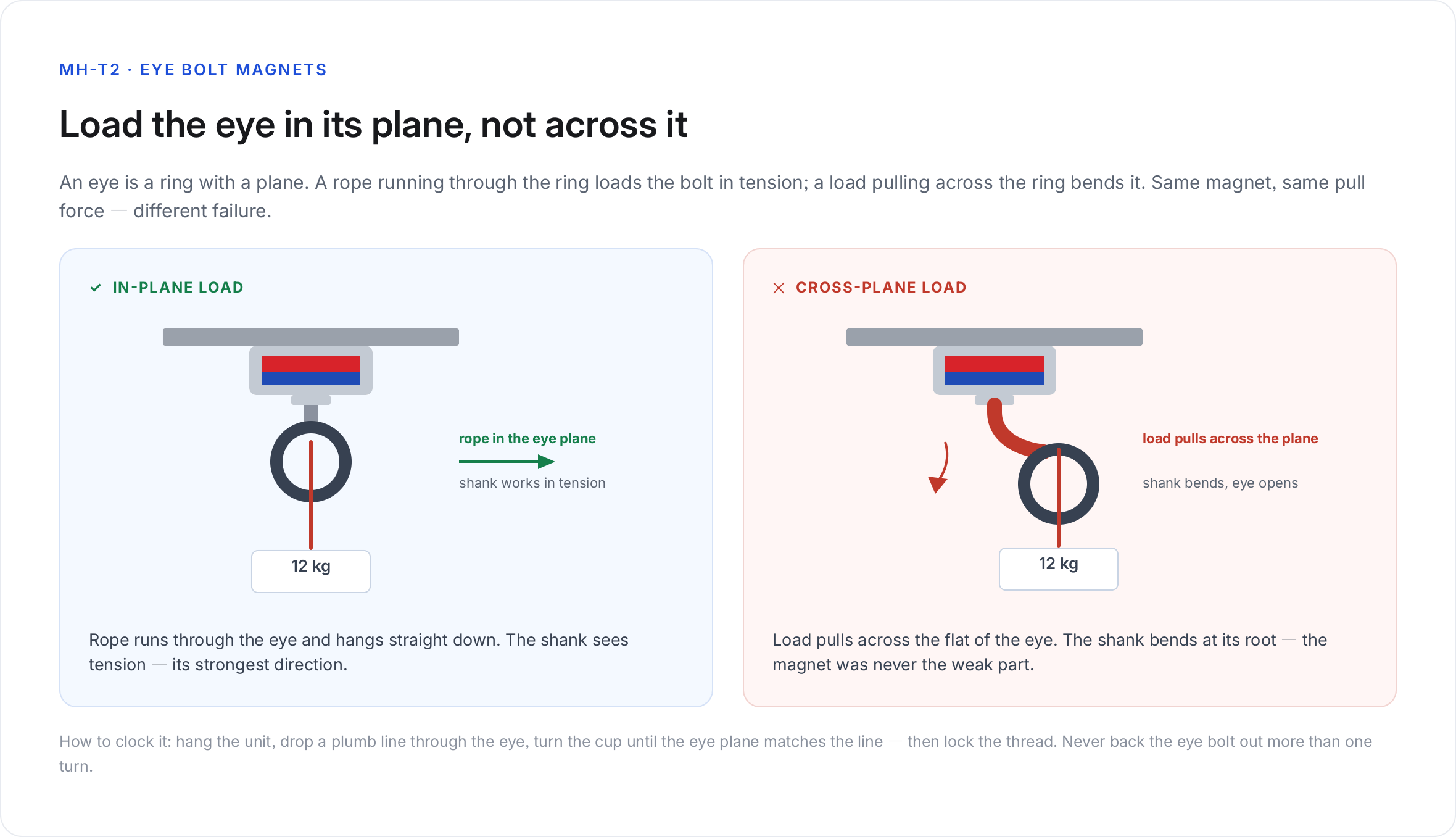
This is the failure that returns the most eye bolt magnets, and it has nothing to do with pull force.
An eye is a ring with a plane. A rope running through the ring loads the bolt shank in tension — the strong direction. A load pulling across the ring puts the bolt in bending, and a bent eye bolt either straightens or opens at the weld.
The fix takes ten seconds at installation: hang the assembly, tie a plumb line to the eye, then unscrew the magnet a half turn at a time until the eye plane lines up with the line. On MH-T2 eye bolt magnets the eye is fixed to the bolt, so clocking means rotating the whole cup — which is fine, because the cup is rotationally symmetric and the flux pattern does not care about its rotation.
Two rules for after you clock it:
On eye bolt magnets the eye is a lever. Take the Ø75: the eye sits 73.9 mm above the magnet face. Hang a 30 kg load that pulls sideways — a tarp in wind, a cable under tension — and the moment at the face is:
M = 30 kg × 9.81 × 0.074 m ≈ 21.8 N·m
Spread over a 75 mm cup, that moment shows up as roughly 580 N (59 kgf) of extra tension at one rim — nearly a quarter of the 250 kgf rating, spent purely on leverage, before the load itself is counted. The same load on the Ø25 (43.9 mm tall) is 12.9 N·m, and on the Ø10 it is negligible.
Practical consequences for eye bolt magnets:
On eye bolt magnets the eye bolt screws into a tapped boss. That joint — not the magnet — decides when the assembly fails, because a stripped M6 thread lets go at a fraction of the cup's rating.
| Thread | Engagement on stock lengths | Recommended hanging load per unit |
|---|---|---|
| M3 × 7 | 7 mm | 0.6–1.1 kg |
| M4 × 8 | 8 mm | 1.4–1.7 kg |
| M5 × 9 | 9 mm | ~3.7 kg |
| M6 × 7–8 | 7–8 mm | 6.7–11.7 kg |
| M8 × 13–15 | 13–15 mm | 25–47 kg |
| M10 × 16 | 16 mm | ~83 kg |
The engagement lengths follow the ISO metric screw thread convention of at least one nominal diameter in steel — M6 threads get 6 mm or more, M10 gets 10 mm or more. The loads in the right column are the 1/3 rule applied to the pull force; they are what the joint can carry continuously, not what the cup can hold for one second.
If a customer needs more, the answer is a longer custom shank or a bigger thread — not a bigger magnet on the same M6.
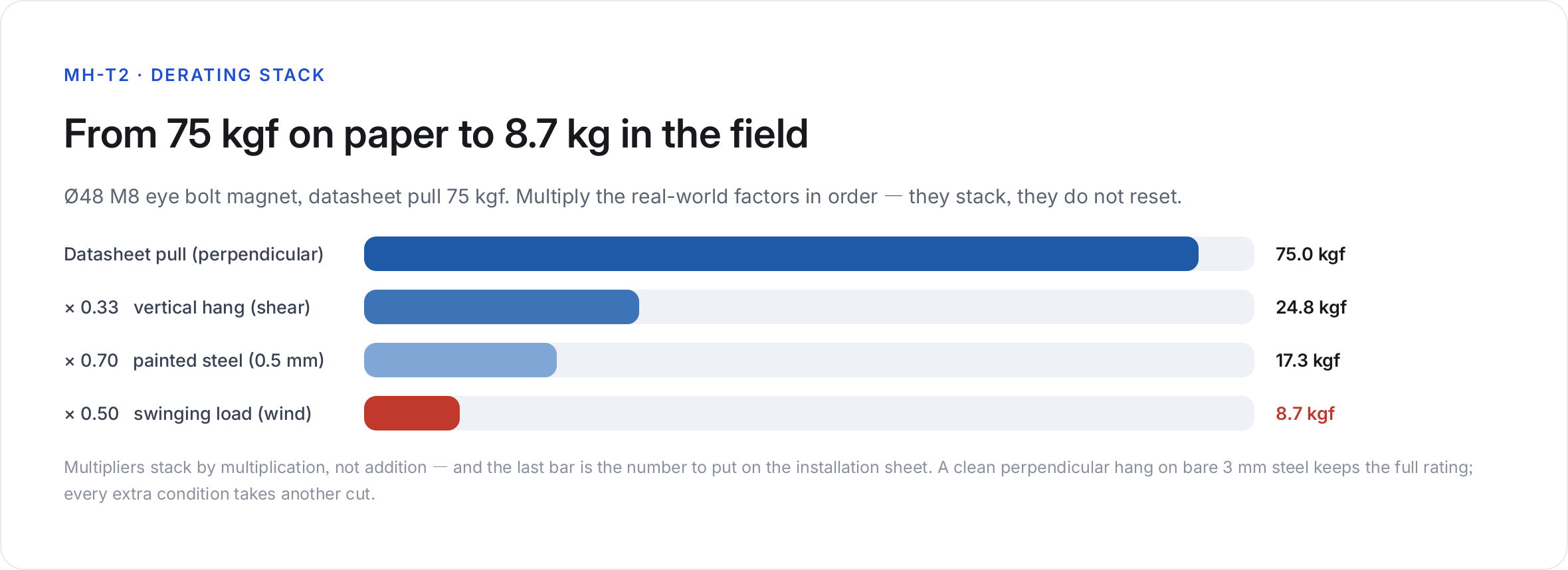
For eye bolt magnets the datasheet pull force assumes a perpendicular pull, a clean flat surface and a static load. Real installations break all three. Apply the factors in order:
| Condition | Multiply by |
|---|---|
| 0° (perpendicular pull) | 1.00 |
| 30° off perpendicular | 0.85 |
| 45° off perpendicular | 0.65 |
| 60° off perpendicular | 0.45 |
| 90° (pure shear, vertical hang) | 0.33 |
| Painted or powder-coated steel (0.5 mm film) | 0.50–0.70 |
| Thin steel under 1.5 mm | 0.50 |
| Swinging or wind-loaded | 0.50 |
| Shock or repeated impact | 0.33 |
For eye bolt magnets, multiply — do not pick one. A powder-coated, swinging installation at 90° is 0.33 × 0.6 × 0.5 ≈ 0.10 of the datasheet value — a Ø48 rated 75 kgf becomes a 7.5 kg holder. That is not a defect; it is the arithmetic that separates a product that stays up from one that falls on a customer.
Our magnet coatings guide explains which finishes survive salt spray, and the temperature ratings guide covers what happens above 80 °C.
A retail chain wants to hang an 8 kg fabric banner from a steel beam, outdoors, with wind sway. Walk the stack:
Cost at 20 anchors: 20 × $3.29 = $65.80, versus drilling 20 holes, 20 anchors and a lift rental. The same job with hooks would work until the first windy week, when the banner unhooks itself — which is exactly why the eye bolt exists.
Eye bolt magnets are hanging hardware, not certified lifting points.
We say this plainly because an eye bolt magnet that is sold as a lifting eye is a liability waiting for an incident report. If your application needs certification, tell us the standard and we will quote a different assembly.
The gut feel that bigger means more gauss is wrong across this range: the Ø10 reads 3,300 Gs, the Ø48 reads 900 Gs, and the Ø75 comes back up to 1,000 Gs. Peak surface field is a measure of how tightly flux is concentrated at the pole, not of how much force is available.
Holding force scales with pole area and flux density together. A Ø75 face has 56 times the area of a Ø10, which is why it holds 130 times the load despite a third of the gauss. Do not compare gauss across eye bolt magnets — compare pull force, then derate for your angle.
All MH-T2 eye bolt magnets are rated to 80 °C / 176 °F. Above that, the N-grade magnet starts to lose strength permanently; the fix is a higher grade (H, SH, UH), not a thicker coating.
Most eye bolt magnets are specified in the wrong order — size first, load later. Run it the other way round:/n/n1. Measure the steel. Under 1.5 mm, derate by half or move to a different fixing.
If two sizes both pass, step back to the smaller cup and add a second anchor — a pair of eye bolt magnets 600 mm apart beats one oversized unit on a swinging load.
Because the eye bolt is a separate part on these eye bolt magnets, the customization happens there rather than in the magnet:
Our custom magnet service covers drawing review, sample runs and production; most eye bolt variants need one drawing and one sample round to lock.
Every eye bolt magnet lot is pull-tested on 3 mm mild steel and checked for coating thickness and thread gauging before it ships. Standard sizes ship from stock in Redlands, California for North American buyers, with 3–7 day transit instead of a 30-day ocean leg. Custom assemblies typically quote in 48 hours and sample in 7–10 days.
Ten questions we answer every week about eye bolt magnets.
Q1: How much weight can an eye bolt magnet hold?
A: Use about one-third of the published pull force for a vertical hang, because the magnet is loaded in shear. A Ø25 rated 11 kgf holds roughly 3.7 kg; a Ø75 rated 250 kgf holds about 83 kg, thread permitting.
Q2: What is the difference between eye bolt magnets and magnetic hooks?
A: The magnet is identical; the top fitting differs. An eye bolt is a closed loop, so a rope, cable or carabiner cannot slip off. A hook is open, so it is faster to load and unload but releases if the line goes slack.
Q3: Can I rotate the eye to a different angle?
A: Yes — unscrew the cup, or the eye bolt, up to one turn to clock the eye plane. Keep full thread engagement and add threadlocker so it stays put.
Q4: Why did my eye bolt bend?
A: Almost always a cross-plane load. The line was pulling across the flat of the eye rather than through it, which bends the bolt instead of stretching it. Re-align the eye plane to the line.
Q5: Are these rated for overhead lifting?
A: No. Eye bolt magnets carry no WLL marking or lifting certification and must not be used over people. Use a certified anchor for overhead loads.
Q6: Do they work on stainless steel?
A: Only on ferritic grades. Austenitic 304 and 316 are effectively non-magnetic and will not hold; aluminium and plastics do not work either.
Q7: What is the maximum temperature?
A: 80 °C (176 °F) for all MH-T2 sizes. Above that, specify a higher grade such as H or SH; see the temperature ratings guide.
Q8: Can the eye bolt be replaced with a different fitting?
A: Yes, if the thread matches. M3 to M10 bosses accept standard eye bolts, hooks and studs, which is how the same cup becomes MH-T1 or MH-T3.
Q9: How thick must the steel be?
A: 1.5 mm minimum for full rating; 3 mm is the reference surface. Below 1.5 mm the steel saturates and holding force drops by half or more.
Q10: What is the lead time for custom eye bolt magnets?
A: Drawings quote in 48 hours, samples in 7–10 days, production in 3–4 weeks. Stock sizes ship in 1–2 business days from California.
Send us the load, the steel thickness and the angle the line leaves the surface — we will size the right eye bolt magnets and thread for you, and confirm whether one anchor or two is the cheaper answer. Stock eye bolt magnets ship from California; custom eyes are quoted within 48 hours.
Contact our engineering team or browse the full magnetic hooks range to compare eye bolt magnets with all seven sub-types side by side.