Pot magnets are engineered magnetic mounting systems: a neodymium (or ferrite, or samarium-cobalt) magnet sealed inside a steel cup. The steel housing concentrates the magnetic field onto the working face, protects the brittle magnet from chipping, and gives the assembly a built-in way to attach — with countersunk screws, threaded studs, tapped bosses, eyelets or adhesive. Unlike a bare magnet, a pot magnet installs with standard fasteners and can be removed without damaging either surface.
Because the mounting method — not raw magnet strength — decides which part fits your machine, NEOMAG builds the product line around nine mounting types. The family covers stock diameters from Ø10 mm to Ø88 mm with measured pull from 1.9 kgf to 250 kgf, and every type ships factory-direct from a 10-million-magnet inventory. This page is the hub for the whole pot magnets range: compare all nine types in one table, then follow the links into the per-type data pages for full size charts.
A pot magnet (also called a cup magnet, magnetic mounting pot or magnetic assembly) is a permanent magnet pressed into a shallow steel cup. The magnet's back and sides are wrapped by the steel shell, which closes the magnetic circuit and forces the flux to exit through the open working face. Two things follow from that geometry:
The steel cup also shields the sintered magnet itself. Neodymium is hard but brittle; a bare disc edge chips on the first knock, while a potted magnet survives workshop handling, vibration and repeated mounting cycles.
Every type below is a live product line with stock SKUs. Pull forces are manufacturer-measured direct-pull values on a clean, flat, thick steel plate with no air gap — the same test method across the family, so the numbers are comparable.
| Type | Mounting method | Stock range | Measured pull | Best for |
|---|---|---|---|---|
| T1 Countersunk | Countersunk screw, M3–M10, head flush | Ø16–75 × 5–18 mm, 11 SKUs | 4.5–235 kgf (9.92–518.09 lb) | Flush permanent fixing in wood, panels and fixtures |
| T2 Counterbore | Socket-head screw recessed below surface | Ø16–75 × 5–18 mm, 11 SKUs | 4.5–235 kgf (9.92–518.09 lb) | Hidden fastener in steel fixtures and jigs |
| T3 Male thread | External stud M4–M8 screws into hardware | Ø22–88 × 6–8 mm, 5 SKUs | 2–26 kgf (4.41–57.32 lb) | Screw-in hooks, brackets and eye bolts |
| T4 Female thread | Tapped boss M3–M10 receives a bolt | Ø10–75 × 5–18 mm, 11 SKUs | 1.9–250 kgf (4.19–551.16 lb) | Bolt-on attachments and adjustable mounts |
| T5 Flat thread | External stud on a flat housing | See category page | On request | Slim screw-in mounts |
| T6 Glue-in | Adhesive pocket, no fastener | See category page | On request | Drill-free fixing on plastic and wood |
| T7 Carabiner | Steel eyelet Ø5/Ø6 mm, no fastener | Ø25–42 mm, 4 SKUs | 10–40 kgf (22.05–88.18 lb) | Tool-free hanging on carabiners and hooks |
| T8 Channel | 2 × M3 countersunk screws | 1.5–4 in × 0.5 × 0.138 in, 5 SKUs | 23.2–31 kgf (51.15–68.34 lb) | Flat screw-down on wood; only 3.5 mm tall |
| T9 SmCo | Standard mounts with SmCo magnet core | See category page | On request | Ovens, curing lines and 250 °C+ process heat |
Three patterns worth reading out of the table:
Four mounting families cover every installation pot magnets are sold for — screw-through, threaded, clipped and glued:
When you can drive a screw, this group is the default. A countersunk pot magnet sits flush under a flat-head screw — the head never protrudes, so panels, rollers and doors slide over it. The counterbore version takes a socket-head screw recessed below the surface, which keeps the fastener hidden and gives the screw head more thread engagement. The channel magnet stretches the same screw-through idea into a 3.5 mm-tall strip with two M3 holes, made for long wooden surfaces where a round pot only grips at one point.
The male-thread pot magnet screws into what you want to hang — brackets, eye bolts, hooks — and unscrews just as fast. The female-thread pot magnet works the other way round: a tapped boss in the steel shell receives your bolt or threaded rod, so the magnet becomes a relocatable anchor point. Remember its geometry rule: total height = cup height + thread depth, and plan clearance for the bolt you will add. The flat-thread series keeps the stud but flattens the housing for tight builds.
The carabiner pot magnet needs no fastener at all: a steel eyelet with a Ø5 or Ø6 mm bore hangs on any standard carabiner gate. Load path is metal-on-metal — carabiner to eyelet to cup to steel surface — which is why it is the standard pick for warehouse banners, wire runs and anything you reposition daily.
The glue-in pot magnet carries an adhesive pocket so plastic housings, laminates and hollow panels can hold a magnet without a through-hole. The SmCo pot magnet swaps the neodymium core for samarium-cobalt, whose Curie point sits around 700–850 °C — these assemblies keep working where a neodymium pot magnet would permanently weaken, such as curing ovens and hot-forming jigs.
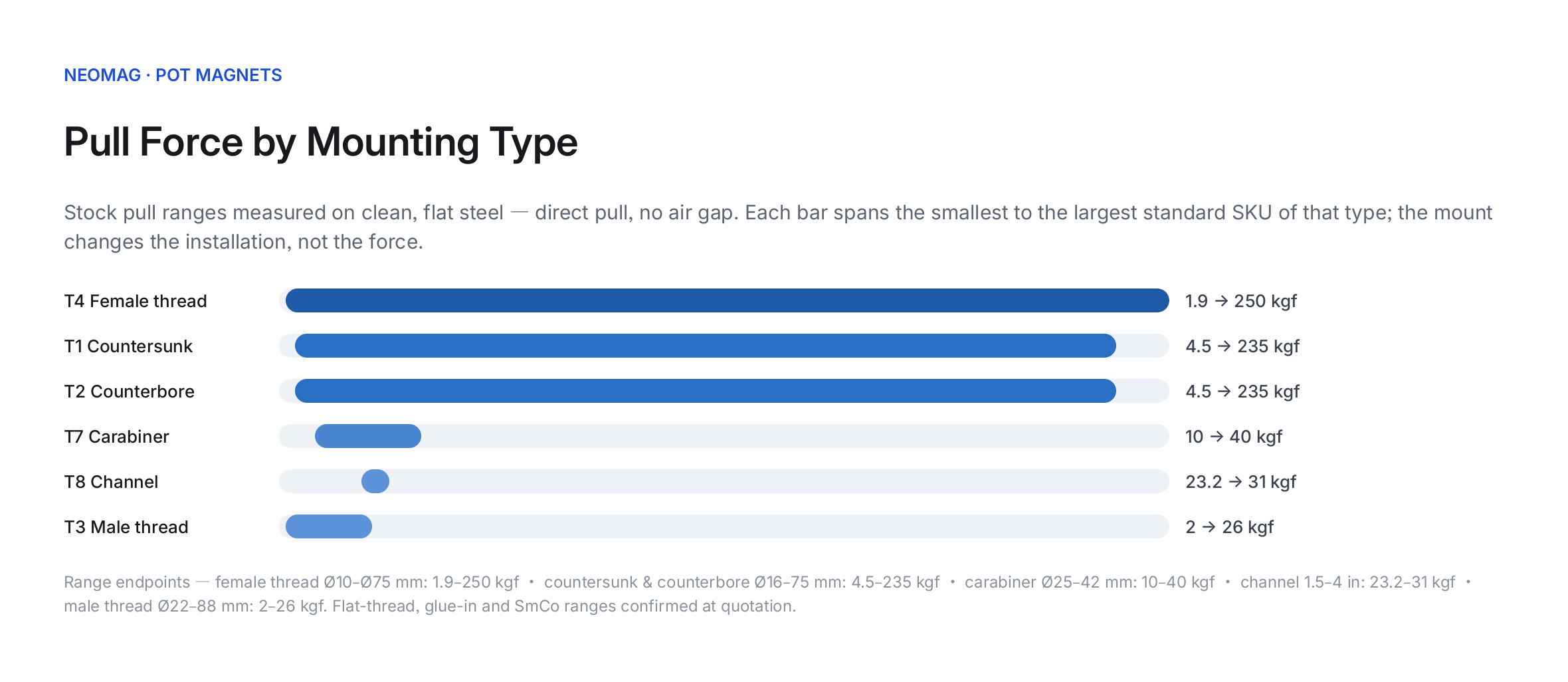
The chart below plots each type's stock pull range on one axis — from the Ø10 mm female-thread pot at 1.9 kgf up to the Ø75 × 18 mm female-thread pot at 250 kgf.
What actually moves the number:
Two field rules keep pot magnets performing at their rated numbers. Mount on bare, thick, flat steel — paint, mill scale and thin sheet each discount the force, and a 0.5 mm air gap can halve it. And respect the load direction: pot magnets are rated in direct pull, perpendicular to the surface, so a 100 kgf pot magnet supporting a sideways-sliding load delivers roughly a third of that figure. Where shear dominates your application, add a mechanical stop or step up one or two diameters.
At the extremes of the family: the smallest part is the Ø10 × 5 mm female-thread pot magnet at 3 g and 1.9 kgf, and the largest are the Ø75 × 18 mm screw-through and female-thread pots at around 585 g and 235–250 kgf. Between them sit roughly 40 stock SKUs across the nine types.
Per gram, the surprise is the channel: the 1.5 in channel magnet holds 23.2 kgf from just 11.2 g — about 2.1 kgf per gram, roughly four times any round pot in the family. The reason is geometry, not grade: the channel's steel walls are fractions of a millimeter thick, so almost no volume is spent on dead steel. If your mount is wood and space is tight, it is the efficiency pick of the whole range.
The clearest way to see how mounting types differ is to hold the steel cup constant and swap only the mount. At Ø25 × 7 mm — one of the most-ordered pot magnet sizes — three types ship the same force:
| Ø25 × 7 mm pot magnet | Mount | Fastener | Pull force | Pick it when |
|---|---|---|---|---|
| Countersunk (T1) | M5 flat-head screw, flush | M5 × countersink | 22.05 lb (10 kgf) | The surface must stay smooth — panels, rollers, sliding doors |
| Counterbore (T2) | M5 socket-head screw, recessed | M5 socket cap | 22.05 lb (10 kgf) | The fastener must stay hidden — jigs, machine tables |
| Carabiner (T7) | No fastener — Ø5 mm eyelet | Carabiner gate | 22.05 lb (10 kgf) | The load must come off daily — banners, cables, sample cards |
Same diameter, same neodymium core, same 10 kgf on steel — the mount changes the installation, not the physics. That is why our selection guide starts with "how will you attach it?" and only then asks how hard it must hold. If you need the same cup to receive a bolt instead, the female-thread series steps in at the next size up with a tapped boss.
Each product URL in this family encodes its geometry, which makes catalog navigation faster once you can read it. The code d0-984x0-276-m5 decodes as: d0-984 = diameter 0.984 in (Ø25 mm), x0-276 = height 0.276 in (7 mm), m5 = M5 countersink. Metric-first codes like d1-26x0-276 follow the same rule — Ø32 mm × 7 mm — and the channel line uses inch codes such as 1-5x0-5x0-138-2m3: 1.5 in long × 0.5 in wide × 0.138 in thick with two M3 holes.
When you request a quotation, quoting the code plus quantity is enough for us to price standard pot magnets the same day; for modified parts, add the change you need (thread, coating, magnetization direction) and engineering will come back with a drawing.
The standard family uses sintered neodymium magnets in grades N38–N52. Standard neodymium grades keep full force up to about 80 °C; higher-coercivity grades push the continuous limit toward 150–200 °C, and above that the samarium-cobalt core (T9) takes over — its Curie temperature of 700–850 °C makes 250–350 °C service realistic. Ferrite cores remain available where cost and corrosion resistance matter more than size.
Every steel-cup assembly ships with corrosion protection matched to its job: nickel-copper-nickel plating as the indoor standard, zinc for lower-cost volume parts, epoxy for damp workshops, and full rubber jackets where you need grip, quiet operation and surface protection — see the rubber-coated pot magnets line, which shares most mounting types with this family.
Pot magnets appear wherever strong, removable, non-destructive mounting beats drilling or welding:
Teams specify NEOMAG pot magnets because the supply chain is as predictable as the parts:
Standard parts cover most projects, but when the mount is unusual we engineer it. NEOMAG customizes pot magnets with different magnet materials, housing designs, thread standards, coatings, sizes and holding-force targets — from a modified stock design to a fully custom magnetic assembly. Our engineering team supports product design, optimization, prototyping and mass production; see custom magnets or send your drawing through the contact page for a fast quotation.
Q1: What is a pot magnet? A: A pot magnet is a magnetic assembly consisting of a magnet housed inside a steel cup or casing. The steel housing concentrates the magnetic field on the working surface, significantly increasing holding force while protecting the magnet from mechanical damage.
Q2: Why are pot magnets stronger than standard magnets? A: The steel cup redirects and concentrates the magnetic flux toward the contact surface, making pot magnets far more efficient for holding and mounting than an exposed magnet of similar size.
Q3: What is the difference between neodymium, ferrite and SmCo pot magnets? A: Neodymium pot magnets offer the highest holding force in the smallest size; ferrite pot magnets trade force for cost-effectiveness and inherent corrosion resistance; SmCo pot magnets (T9) keep their force in continuous heat up to 250–350 °C where neodymium would weaken.
Q4: What are countersunk pot magnets used for? A: Countersunk pot magnets let a flat-head screw sit flush with the magnet surface, making them ideal for permanent mounting on wood, cabinetry, signage, displays and industrial fixtures. Eleven stock sizes from Ø16 to Ø75 mm are listed on the countersunk series page.
Q5: What are threaded pot magnets? A: Threaded pot magnets feature either an external stud or an internal tapped connection, allowing easy attachment to bolts, brackets, hooks, eyelets and other mounting hardware. See the male-thread and female-thread pages for full size charts.
Q6: Can pot magnets be used outdoors? A: Yes. For outdoor use we recommend rubber-coated magnets, epoxy-coated magnets or stainless-steel magnetic assemblies for better durability and corrosion resistance.
Q7: How much weight can a pot magnet hold? A: Holding force depends on size, material, mounting orientation, air gap and surface condition. Under ideal direct-pull conditions our pot magnets range from 1.9 kgf (Ø10 mm female thread) to 250 kgf (Ø75 × 18 mm female thread). In shear the value drops to roughly a third, so apply a 3–5× safety factor.
Q8: Can pot magnets be customized? A: Yes. NEOMAG provides customized pot magnets with different magnet materials, housing designs, mounting options, coatings, sizes and holding-force requirements.
Q9: Are pot magnets suitable for industrial applications? A: Absolutely. Pot magnets are widely used in manufacturing, automation, material handling, machine building, inspection equipment and industrial tooling due to their strong holding force and durability.
Q10: How do I choose the right pot magnet? A: First fix the mounting method (screw-through, thread, clip-on or adhesive), then the required holding force, then environment: temperature, moisture and surface condition. The comparison table above maps all nine types; our engineering team can confirm the final selection against your working surface.