Channel magnets are the low-profile option in the pot magnet family — and the only one shaped for screw patterns instead of round footprints. Two neodymium blocks sit inside a steel channel just 3.5 mm thick, with two countersunk M3 holes running down the centerline. You screw the channel flat to a shelf, jig or cabinet, and it holds like a pot magnet twice its height.
This page covers our channel magnets in full: 5 stock lengths from 1.5 to 4 inches with real measured pull of 23–31 kgf, and the selection rule no listing states — every size shares the same cross-section, so length buys hole spacing, not holding power (the data is below, and the curve is nearly flat).
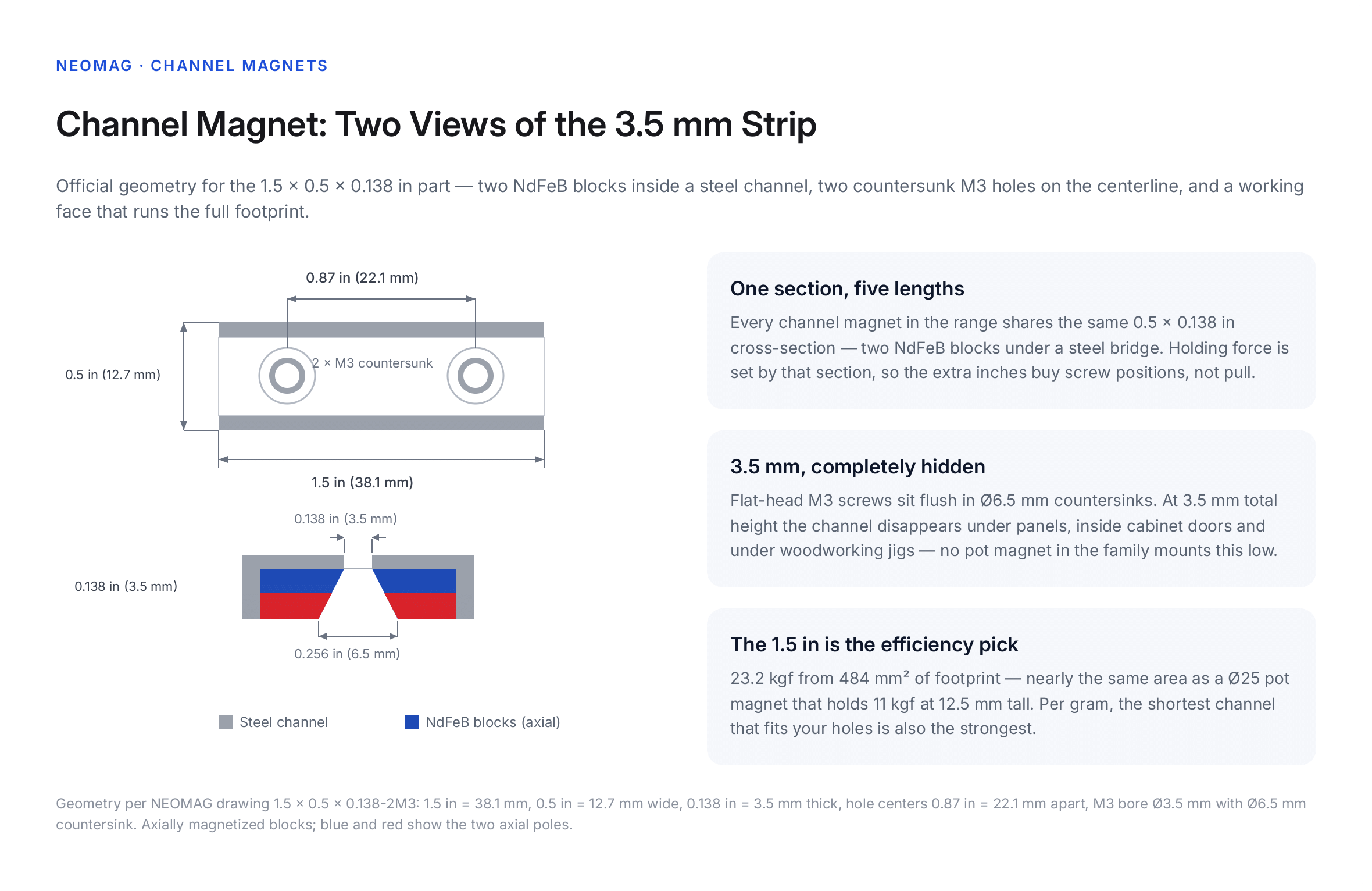
A channel magnet (also called a rectangular pot magnet, rectangular mounting magnet, magnetic channel or channel mounting magnet) is a NdFeB magnet assembly inside a long steel channel: two axially magnetized blocks sit side by side under a steel bridge, the working face runs the full 0.5 inch × length footprint, and a row of countersunk holes in the top takes flat-head M3 screws.
Where it sits in the family:
In channel magnets the steel channel does the same job as in every pot magnet: it closes the magnetic circuit around the blocks, so the flux exits the working face instead of leaking sideways, and the field behind the part is nearly zero. Because the channel carries almost no dead steel volume — the walls are fractions of a millimeter — channel magnets hold far more pull per gram than any round pot in the family.
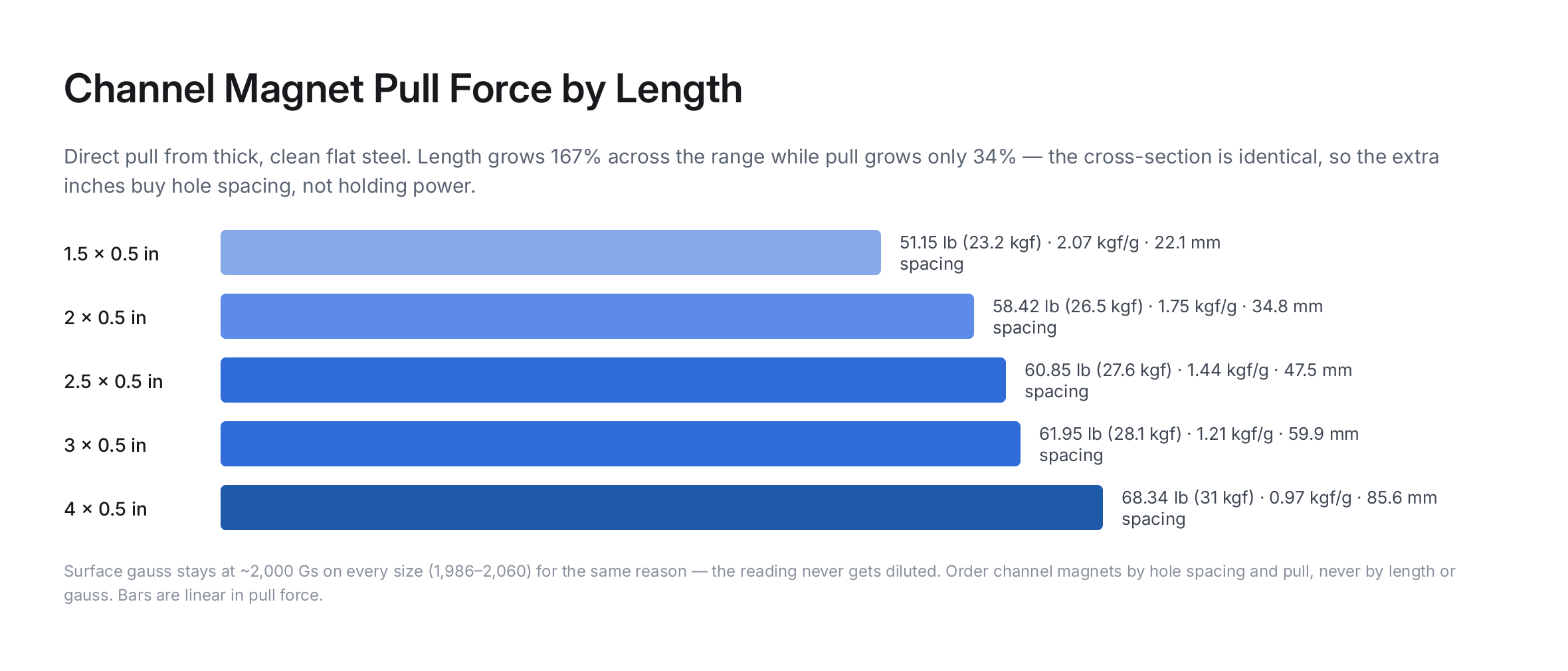
The channel category runs from 1.5 to 4 inches — five lengths of the same 0.5 × 0.138 inch section:
| Length | Hole spacing | Weight | Pull force | Surface gauss |
|---|---|---|---|---|
| 1.5 × 0.5 in (38.1 mm) | 0.87 in (22.1 mm) | 11.2 g | 51.15 lb (23.2 kgf) | ~1,986 Gs |
| 2 × 0.5 in (50.8 mm) | 1.37 in (34.8 mm) | 15.1 g | 58.42 lb (26.5 kgf) | ~2,015 Gs |
| 2.5 × 0.5 in (63.5 mm) | 1.87 in (47.5 mm) | 19.2 g | 60.85 lb (27.6 kgf) | ~2,000 Gs |
| 3 × 0.5 in (76.2 mm) | 2.36 in (59.9 mm) | 23.2 g | 61.95 lb (28.1 kgf) | ~2,003 Gs |
| 4 × 0.5 in (101.6 mm) | 3.37 in (85.6 mm) | 32 g | 68.34 lb (31 kgf) | ~2,060 Gs |
All 5 channel magnets are 0.5 in wide, 0.138 in (3.5 mm) thick, axially magnetized, nickel-plated, ±0.5 mm tolerance, 80 °C standard, with two countersunk M3 holes. Longer lengths, other hole patterns, threaded or plain versions are made to drawing via custom magnets; the standard vs custom guide explains when that is worth it.
Read down the table and the rule of this series jumps out: from 1.5 to 4 inches — 2.67× the length and nearly 3× the weight — pull rises only 34%, from 23.2 to 31 kgf. The cross-section never changes: every channel magnet in the range carries the same two blocks in the same 0.5 × 0.138 in channel. Holding force is set by that cross-section, so the extra inches add steel, weight and screw positions — not holding power.
What the extra length actually buys is hole spacing, and that is exactly how to choose:
| You need screws at… | Choose | Pull you get |
|---|---|---|
| ~22 mm centers (1.5 in) | 1.5 × 0.5 in | 23.2 kgf |
| ~35 mm centers (2 in) | 2 × 0.5 in | 26.5 kgf |
| ~48 mm centers (2.5 in) | 2.5 × 0.5 in | 27.6 kgf |
| ~60 mm centers (3 in) | 3 × 0.5 in | 28.1 kgf |
| ~86 mm centers (4 in) | 4 × 0.5 in | 31 kgf |
Three practical rules:
Each part in the channel magnets range carries two countersunk M3 holes — the catalog notation reads M3 (d0.138/0.256), meaning a Ø3.5 mm (0.138 in) bore with a Ø6.5 mm (0.256 in) countersink seat. A flat-head M3 screw sits flush with the 3.5 mm top surface, so channel magnets disappear under a panel, inside a cabinet door or under a woodworking jig with nothing to snag. Countersunk geometry and screw head angles follow the standard countersink conventions; machine the mating surface flat and the head disappears completely.
Because the bores pass through the magnet blocks, treat them like the T1 countersunk series: no washers, no thread-locker compounds that attack nickel, and no prying against the bore edge — the steel channel takes the load, and the bore is the one place the assembly is weakest.
Catalog pull is direct pull off thick, clean, flat steel. Four factors change what channel magnets deliver in service:
The blocks inside channel magnets are sintered NdFeB in the N42-class range — the grade property table shows why grade matters less inside a closed steel channel than in a bare magnet. Standard rating is 80 °C continuous; above that the magnet loses pull reversibly at first, then permanently. For oven or engine-bay duty, ask about higher-temperature builds via custom magnets; the Curie temperature guide and temperature stability overview cover the physics.
All 5 channel magnets are axially magnetized: the working-face poles of both blocks sit in one plane under the steel bridge — the standard pot magnet orientation adapted to a rectangular footprint. Multi-pole and custom arrangements are possible in custom assemblies.
Every part in the channel magnets range ships nickel-plated (Ni-Cu-Ni) — channel, bridge and countersinks included — the standard NdFeB surface treatment, adequate for dry indoor service. For humidity, salt spray or outdoor duty, zinc and epoxy platings are available as custom finishes; the coating selection guide and the coatings explainer compare every option. Rubber-jacketed versions live in the rubber-coated magnets family when you need grip over pull.
The flat strip with a screw pattern decides the application list for channel magnets — anywhere a magnet must disappear into a surface:
More use cases across the range: 15 key industrial NdFeB applications.
Send us five items and quoting is same-day, following the procurement requirement guide:
Two spec traps worth naming: quote the hole spacing (0.87 in on the 1.5 in channel, 3.37 in on the 4 in), not just the overall length, and remember the section is fixed — if your jig truly needs more than ~31 kgf, the answer is a second channel or a round pot from the family, not a longer one. Dimensional expectations follow NdFeB tolerance standards; ±0.5 mm covers all stock channel magnets, and processing is in-house for custom hole patterns.
A rectangular NdFeB assembly: two axially magnetized blocks inside a steel channel 0.5 in wide and 3.5 mm thick, with two countersunk M3 holes down the centerline. Flat-head screws mount it flush to a surface, and the steel channel concentrates the pull on the working face — that construction separates channel magnets from the round pot magnet versions of the family.
From 51.15 lb (23.2 kgf) on the 1.5 in channel to 68.34 lb (31 kgf) on the 4 in, measured as direct pull from thick flat steel. Levered or peeling loads derate quickly — split the load across two channels if the force grabs one end.
Only marginally: from 1.5 to 4 inches, pull rises 34% while length rises 167%. The cross-section is identical on all five sizes, so length buys hole spacing, not holding power. Pick the length whose screw holes land where yours are.
M3 flat-head machine screws: Ø3.5 mm bore, Ø6.5 mm countersink seat, flush in the 3.5 mm surface. Snug them gently — the holding force comes from the magnet, and the bore edge is the fragile spot.
Holding force is set by the cross-section — the same two magnet blocks under the same 0.5 × 0.138 in steel channel on every size. Extra length adds steel, weight and screw positions, which is why the 4 in channel holds just 31 kgf against the 1.5 in channel's 23.2 kgf.
3.5 mm — 0.138 in — total height, countersinks included. No pot magnet in the family mounts that low: the closest, the Ø25 female thread pot, needs 12.5 mm of height for 11 kgf, while the 1.5 in channel holds 23.2 kgf in a near-identical footprint.
By your screw pattern. Hole spacing runs 22.1 / 34.8 / 47.5 / 59.9 / 85.6 mm across the range — match it to your jig, shelf or cabinet drilling, and the pull will land between 23 and 31 kgf regardless of the choice.
Because the cross-section never changes: all five channel magnets read ~2,000 Gs (1,986 to 2,060). Unlike round pots, where bigger diameter dilutes the pole reading, length adds nothing to dilute — so gauss tells you nothing about which size to buy. Order channel magnets by pull and by hole spacing.
Nickel plating (Ni-Cu-Ni) on all stock channel magnets, rated 80 °C continuous. Zinc and epoxy platings and higher-temperature grades are available as custom builds.
Yes. Every stock length has tiered pricing down to 1,001+ pieces, custom hole patterns and lengths are made to drawing, and mixed channel and pot magnet orders ship together from the same production line.
Browse the full channel magnets category for live pricing on all 5 lengths, or send your screw pattern, load case and environment through contact us — we will match the spacing, the bore and the length to your assembly. For a round flush mount, the T1 countersunk series and T2 counterbore series cover Ø16–120 mm; for hanging loads, the T3, T4 and T7 carabiner series; and for the family overview start at pot magnets.