Counterbore pot magnets — also sold as cup magnets or mounting magnets — are the strongest screw-down option in the neodymium range. A NdFeB ring magnet sits in a steel cup, and the steel does two jobs at once: it protects the brittle magnet, and it short-circuits the field back onto the working face, so the assembly holds several times harder than the bare magnet inside.
This page covers our counterbore pot magnets in full: 15 stock sizes from 16 mm to 120 mm diameter, real measured pull force up to 480 kg, which screw each bore takes, and where the steel cup wins — and loses — against a bare countersunk magnet.
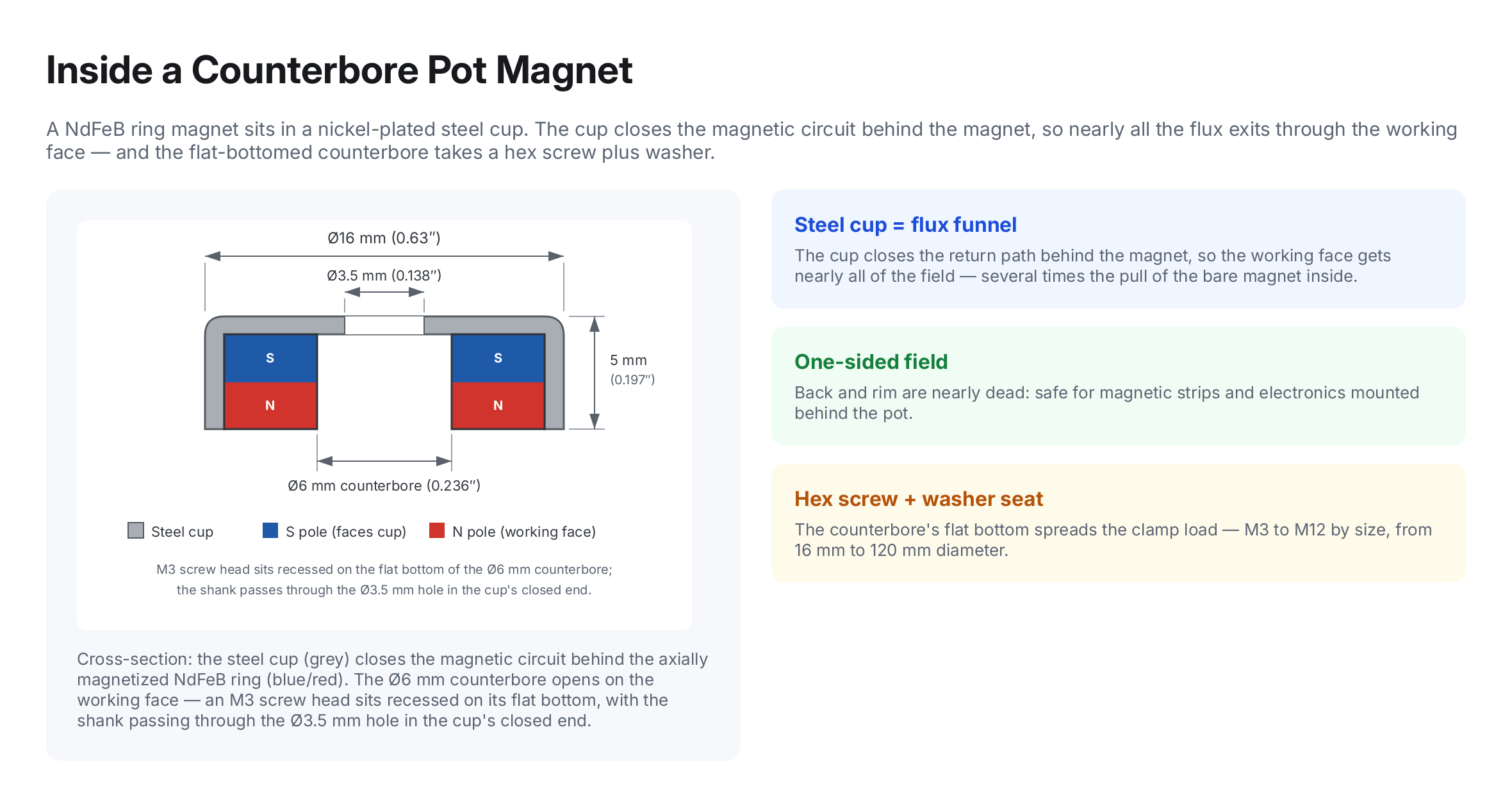
A counterbore pot magnet is a neodymium ring magnet housed in a nickel-plated steel cup, with a counterbore hole in the working face: a flat-bottomed enlarged bore that lets a standard hex or pan-head screw (plus washer) clamp the assembly flush to the surface.
See counterbore geometry for the machining background. Both are screw-mount holes; the choice depends on which screw head you want sitting on the magnet.
The steel cup is the performance story. Because the cup closes the magnetic circuit on the back side, almost all the flux exits through the front working face — a counterbore pot magnet holds far more than the equivalent bare magnet of the same diameter. That is why counterbore pot magnets hold several times more than the bare magnet inside — and the field on the back and sides is nearly zero, so the assembly will not wipe magnetic strips or disturb nearby electronics mounted behind it.
The counterbore pot magnets category runs from 16 mm to 120 mm in diameter:
| D × H | Bore d1 / seat d2 | Screw | Weight | Pull force |
|---|---|---|---|---|
| 16 × 5 mm | 3.5 / 6.0 mm | M3 | 6.5 g | 9.92 lb (4.5 kgf) |
| 20 × 6 mm | 4.5 / 8.0 mm | M4 | 9 g | 15.43 lb (7 kgf) |
| 25 × 7 mm | 5.5 / 9.0 mm | M5 | 18.5 g | 22.05 lb (10 kgf) |
| 32 × 7 mm | 5.5 / 9.0 mm | M5 | 36 g | 52.91 lb (24 kgf) |
| 36 × 7 mm | 6.5 / 11.0 mm | M6 | 41 g | 57.32 lb (26 kgf) |
| 42 × 8 mm | 6.5 / 11.0 mm | M6 | 81 g | 79.37 lb (36 kgf) |
| 48 × 11 mm | 8.5 / 15.0 mm | M8 | 142 g | 165.35 lb (75 kgf) |
| 55 × 12 mm | 8.5 / 15.0 mm | M8 | 206 g | 220.46 lb (100 kgf) |
| 60 × 15 mm | 8.5 / 15.0 mm | M8 | 312 g | 286.60 lb (130 kgf) |
| 67 × 15 mm | 8.5 / 15.0 mm | M8 | 395 g | 385.81 lb (175 kgf) |
| 75 × 18 mm | 10.5 / 17.0 mm | M10 | 585 g | 518.09 lb (235 kgf) |
| 80 × 18 mm | 10.5 / 17.0 mm | M10 | 674 g | 617.29 lb (280 kgf) |
| 90 × 18 mm | 10.5 / 17.0 mm | M10 | 863 g | 793.66 lb (360 kgf) |
| 100 × 18 mm | 10.5 / 17.0 mm | M10 | 959 g | 881.85 lb (400 kgf) |
| 120 × 18 mm | 12.5 / 20.0 mm | M12 | 1,550 g | 1,058.22 lb (480 kgf) |
All 15 counterbore pot magnets are axially magnetized, nickel-plated, ±0.5 mm tolerance, 80 °C standard. Rubber-capped versions of most counterbore pot magnets are available on request — see coatings below. Outside this range, assemblies are made to drawing via custom magnets; the standard vs custom guide explains when that is worth it.
Each of the counterbore pot magnets takes one screw size — match it and the assembly clamps metal-to-metal:
| Screw | Bore d1 | Head seat d2 | Used on |
|---|---|---|---|
| M3 | 3.5 mm | 6.0 mm | 16 mm |
| M4 | 4.5 mm | 8.0 mm | 20 mm |
| M5 | 5.5 mm | 9.0 mm | 25 / 32 mm |
| M6 | 6.5 mm | 11.0 mm | 36 / 42 mm |
| M8 | 8.5 mm | 15.0 mm | 48 / 55 / 60 / 67 mm |
| M10 | 10.5 mm | 17.0 mm | 75 / 80 / 90 / 100 mm |
| M12 | 12.5 mm | 20.0 mm | 120 mm |
Two rules that prevent most installation failures:
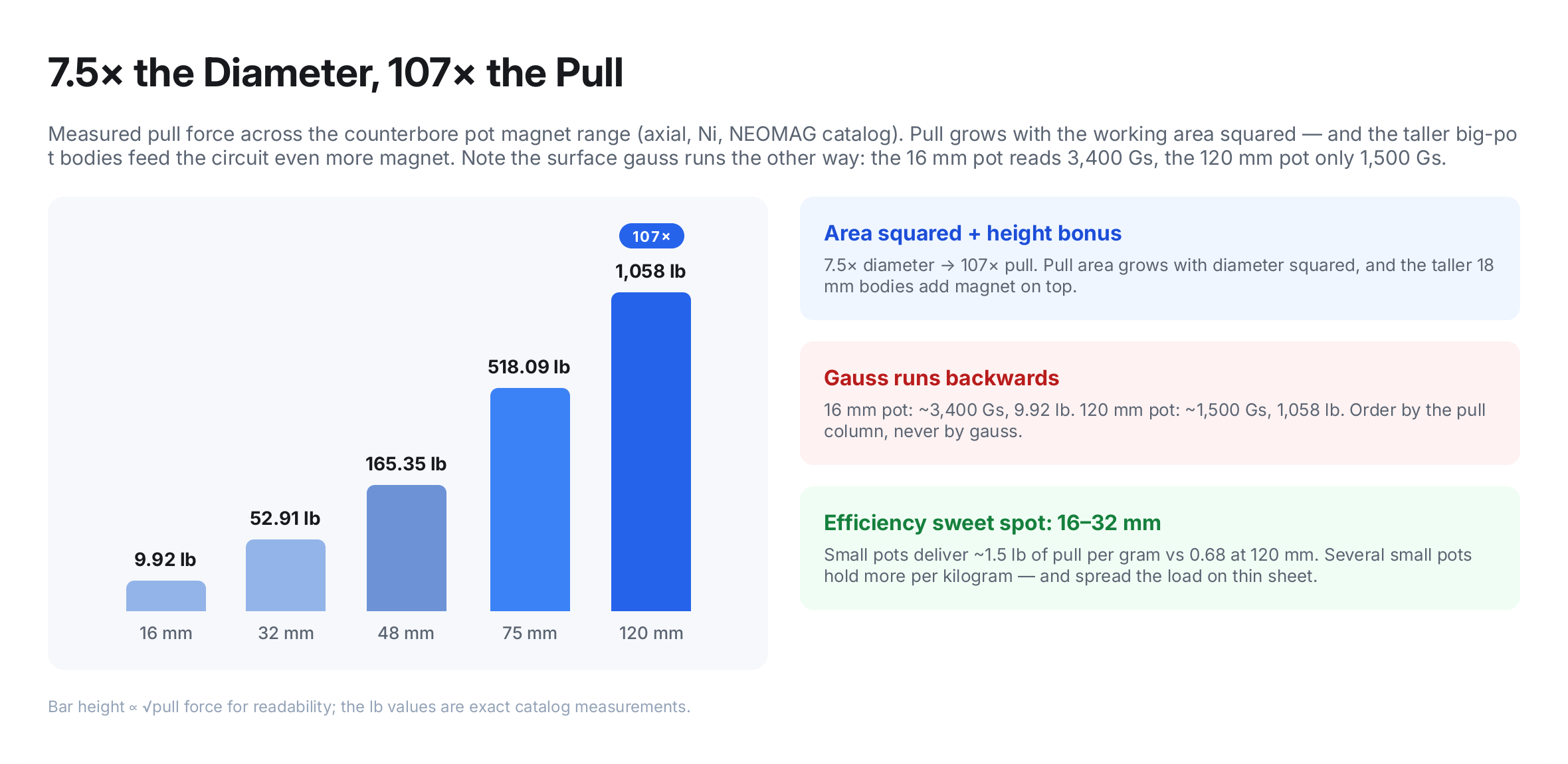
The catalog data tells a clear story — bigger pots are disproportionately stronger:
| Size | Pull force | Surface gauss | Pull per gram |
|---|---|---|---|
| 16 × 5 mm | 9.92 lb | ~3,400 Gs | 1.53 lb/g |
| 32 × 7 mm | 52.91 lb | ~1,700 Gs | 1.47 lb/g |
| 48 × 11 mm | 165.35 lb | ~2,600 Gs | 1.16 lb/g |
| 75 × 18 mm | 518.09 lb | ~1,900 Gs | 0.89 lb/g |
| 120 × 18 mm | 1,058.22 lb | ~1,500 Gs | 0.68 lb/g |
Read the three columns together and three patterns fall out of the counterbore pot magnet range:
Diameter multiplies, not adds. Going from the 16 mm pot to the 120 mm pot is a 7.5× diameter increase — and a 107× pull increase. Pull area grows with the square of diameter, and the taller bodies (5 → 18 mm) feed the circuit more magnet, so big pots over-deliver.
Surface gauss runs the other way. The 16 mm pot reads ~3,400 Gs and holds 9.92 lb; the 120 mm pot reads ~1,500 Gs and holds 1,058 lb. Gauss is a point reading on the pole face — the big cup spreads its field over a huge area at lower intensity, and holds 100× more. Order by the pull force column, never by gauss; background in how to measure surface gauss with a gaussmeter and identical volume, different pull.
Small-to-mid sizes are the efficiency sweet spot. The 16–32 mm pots deliver ~1.5 lb of pull per gram; the 120 mm pot delivers 0.68. If your design allows several small pots instead of one large one, the multi-pot layout holds more per kilogram of magnet — and spreads the load better on thin sheet steel.
Every figure above is measured flush against thick, clean steel in direct tension. Real installations lose force from all directions at once:
Always test in the actual assembly; the magnetic circuit between pot and workpiece decides the real number.
Same screw-down job, very different numbers. From our own catalog:
| Assembly | Size | Pull force |
|---|---|---|
| Counterbore pot magnet | 16 × 5 mm | 9.92 lb |
| Countersunk disc | 15 × 10 mm | 6.61 lb |
The pot is smaller in diameter, half the thickness, and still holds 50% more — that is the steel cup at work. The bare countersunk disc's cone also puts the screw head flush, which the pot's counterbore duplicates with a washer-ready flat seat.
Choose the bare countersunk magnet when you need the smallest, cheapest, lightest screw-fix and moderate force. Choose counterbore pot magnets when force per screw matters — doors, fixtures, gates, heavy tooling. For the full pot magnet family including other bore styles, see pot magnets.
The NdFeB ring inside the cup follows the standard grade system — see grades and magnetic properties of sintered NdFeB and N35 vs N42 vs N52 explained:
| Suffix | Max operating temperature |
|---|---|
| (none) | 80 °C |
| M | 100 °C |
| H | 120 °C |
| SH | 150 °C |
| UH | 180 °C |
| EH | 200 °C |
Counterbore pot magnets in permanent installations (gate stops, machine fixtures) can see direct sun or process heat — specify the suffix, not just the grade. Curie point and reversible loss are covered in Curie temperature and operating temperature of magnets.
Every counterbore pot magnet is axially magnetized with the working face as one pole; the steel cup closes the circuit behind it. The result is a one-sided magnet: strong on the face, nearly dead on the back and rim — exactly what you want on a wall, cabinet or machine frame. The principle is explained in orientation and magnetization of NdFeB magnets and magnetic field orientation of sintered NdFeB.
Stacking note: pots attract face-to-face strongly and resist rotating out of alignment — two pots clamped by screws at fixed positions do not need clocking.
The steel cup is nickel-plated for corrosion resistance; coating selection generally follows how to select coating for NdFeB magnets and surface treatment of sintered NdFeB.
The upgrade worth knowing about is the rubber cap: a bonded rubber jacket over the working face that adds three real functions to counterbore pot magnets:
Rubber costs some direct pull (the cap adds a slight gap) and gains working friction — usually the right trade on vertical surfaces. The full comparison of finishes is in neodymium magnet coatings explained.
Where counterbore pot magnets earn their keep:
Cross-industry context: 15 key industrial NdFeB applications.
Eight items settle an RFQ — the procurement requirement checklist walks through each:
If more than two items deviate from stock, start from custom magnets.
A neodymium ring magnet inside a steel cup, with a flat-bottomed counterbore hole that takes a hex or pan-head screw plus washer. The steel cup doubles down on holding force and shields the back side. Geometry background: counterbore vs countersink.
From 9.92 lb (4.5 kg) at 16 mm to 1,058 lb (480 kg) at 120 mm in direct tension on thick steel — the size table lists every stock size. Real-world force drops with air gaps, paint and thin workpieces.
M3 through M12 by diameter — full mapping in the screw table. Use a hex or pan-head screw with a washer on the flat counterbore seat.
Counterbore = flat-bottom hole for hex/pan heads with washers. Countersink = 90° cone for flat-head screws, seat flush with the surface — that is the countersunk series. Both screw down; the pot versions hold several times more than bare magnets of the same size.
The steel cup short-circuits the field's return path, so nearly all the flux exits through the working face. In our catalog the 16 × 5 mm pot holds 9.92 lb while a bare 15 × 10 mm countersunk disc holds 6.61 lb — the pot is smaller, thinner, and still wins by 50%.
The big cup spreads its field over a far larger area at lower intensity — ~1,500 Gs — while holding 1,058 lb. Gauss is a point reading, not a force number; the pull force table is the column to order from.
Yes, but the magnet then supplies friction, not direct tension — bare steel on smooth painted steel slides. Specify the rubber cap for grip, and let the screw carry the load.
80 °C standard. Higher suffixes (M/H/SH/UH/EH) run to 200 °C — see the temperature table. Heat costs pull reversibly before it costs the magnet permanently.
They add a slight gap, so direct pull drops a little — but rubber gains friction on smooth and painted surfaces, protects the workpiece, and blocks corrosion. On vertical installs of counterbore pot magnets it is usually the right trade.
Yes — all 15 sizes carry tiered quantity pricing and live stock in the counterbore pot magnets category. Rubber-capped and custom-drawn assemblies are quoted per run.
Browse the full range of counterbore pot magnets for stock sizes, or take your drawing to custom magnets. For the rest of the shape family, start at neodymium magnets learn more.