Neodymium countersunk magnets are the screw-down option in the neodymium family: a countersunk hole lets a standard flat-head screw clamp the magnet flush to wood, plastic, sheet metal or concrete — no adhesive, no bracket, no waiting for glue to cure.
This page covers the full specification set for neodymium countersunk magnets: the 15 stock sizes, which screw each one takes, real measured pull force, grades, coatings and how the countersunk hole changes performance compared with a solid magnet.
A neodymium countersunk magnet is a NdFeB magnet with a 90° conical hole in one face. The cone matches the angle of a standard flat (countersunk) screw head, so when the screw is driven in, the head sits level with the magnet surface and pulls the magnet hard against the mounting surface.
That mechanical fixing is the whole point:
For buyers, neodymium countersunk magnets trade a little raw force for a screw fixing that outlasts any adhesive — the sections below quantify both sides of that trade.
Every stock neodymium countersunk magnet in our store is axially magnetized (poles on the two flat faces), plated Ni-Cu-Ni, and available in both round (disc) and rectangular (block) bodies.
The neodymium countersunk magnets category splits into two series — round discs and rectangular blocks:
Disc series (D × T):
| Size (D × T) | Screw | Weight | Pull force |
|---|---|---|---|
| 10 × 3 mm | M3 | 1.1 g | 1.87 lb (0.85 kgf) |
| 10 × 5 mm | M4 | 2 g | 2.20 lb (1.0 kgf) |
| 10 × 10 mm | M4 | 4 g | 6.61 lb (3.0 kgf) |
| 12 × 3 mm | M3 | 1.8 g | 2.54 lb (1.15 kgf) |
| 12 × 5 mm | M4 | 3 g | 3.75 lb (1.7 kgf) |
| 12 × 10 mm | M5 | 7.5 g | 3.97 lb (1.8 kgf) |
| 15 × 3 mm | M4 | 3 g | 4.19 lb (1.9 kgf) |
| 15 × 5 mm | M5 | 4.8 g | 4.41 lb (2.0 kgf) |
| 15 × 10 mm | M6 | 10 g | 6.61 lb (3.0 kgf) |
Block series (L × W × T) — the rectangular neodymium countersunk magnets:
| Size (L × W × T) | Screw | Weight | Pull force |
|---|---|---|---|
| 10 × 10 × 3 mm | M4 | 1.4 g | 1.81 lb (0.82 kgf) |
| 10 × 10 × 5 mm | M4 | 2.4 g | 2.31 lb (1.05 kgf) |
| 10 × 10 × 10 mm | M4 | 6 g | 3.53 lb (1.6 kgf) |
| 15 × 10 × 3 mm | M4 | 2.5 g | 2.98 lb (1.35 kgf) |
| 15 × 10 × 5 mm | M4 | 4 g | 4.74 lb (2.15 kgf) |
| 15 × 10 × 10 mm | M4 | 10 g | 5.51 lb (2.5 kgf) |
So the stock envelope for neodymium countersunk magnets is 10–15 mm across, 3–10 mm thick, with M3 through M6 screws. Anything outside it — bigger discs, different cone angles, other screw standards — goes through custom magnets; see standard vs custom neodymium magnets for how that decision usually works.
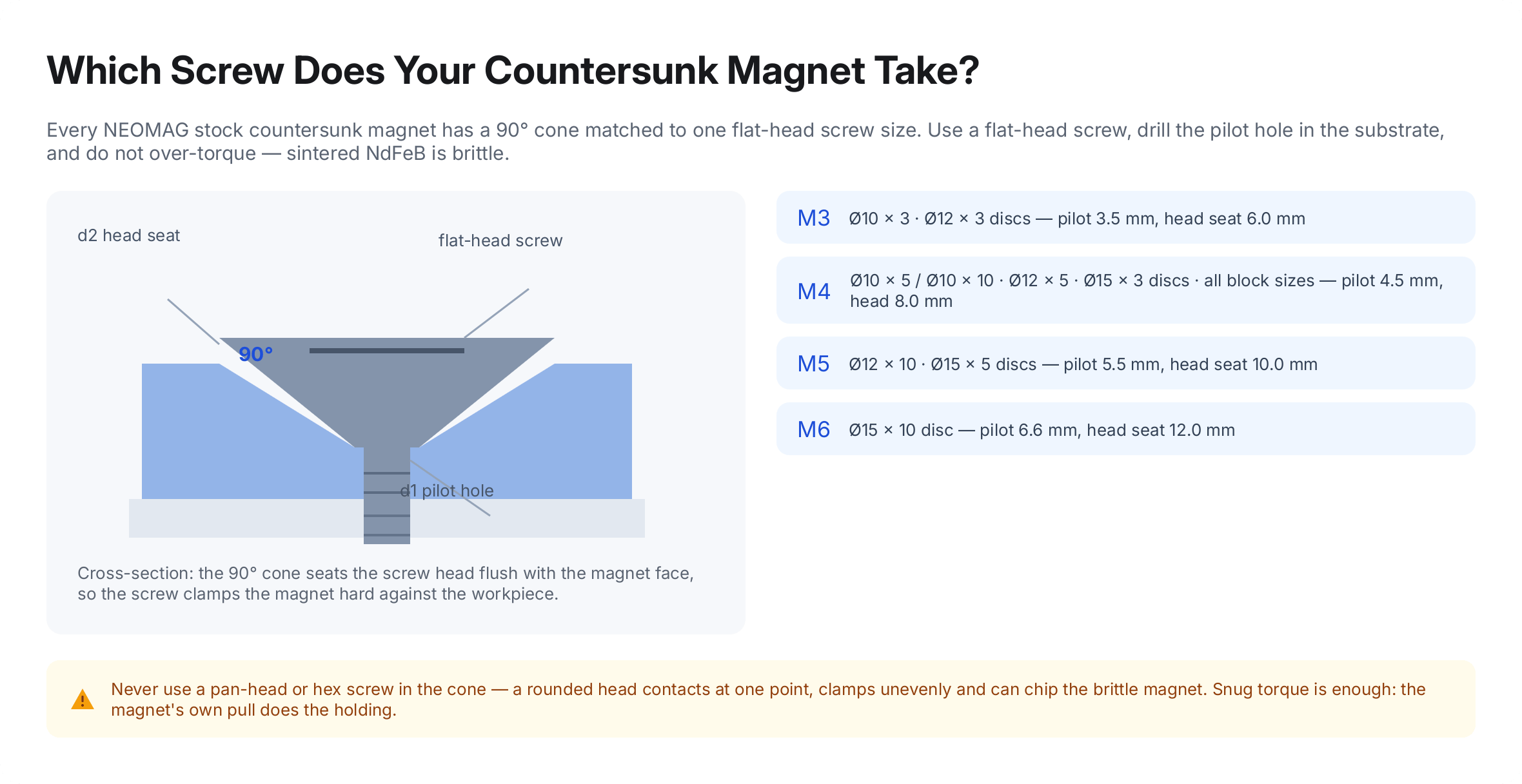
Each magnet takes exactly one screw size, and matching it matters more than most buyers expect:
| Screw | Pilot hole (d1) | Head seat (d2) | Cone angle | Used on |
|---|---|---|---|---|
| M3 | 3.5 mm (0.138") | 6.0 mm (0.236") | 90° | 10 × 3 · 12 × 3 discs |
| M4 | 4.5 mm (0.177") | 8.0 mm (0.315") | 90° | 10 × 5 / 10 × 10 · 12 × 5 · 15 × 3 discs · all block sizes |
| M5 | 5.5 mm (0.217") | 10.0 mm (0.394") | 90° | 12 × 10 · 15 × 5 discs |
| M6 | 6.6 mm (0.256") | 12.0 mm (0.472") | 90° | 15 × 10 disc |
Three rules that prevent most installation problems:
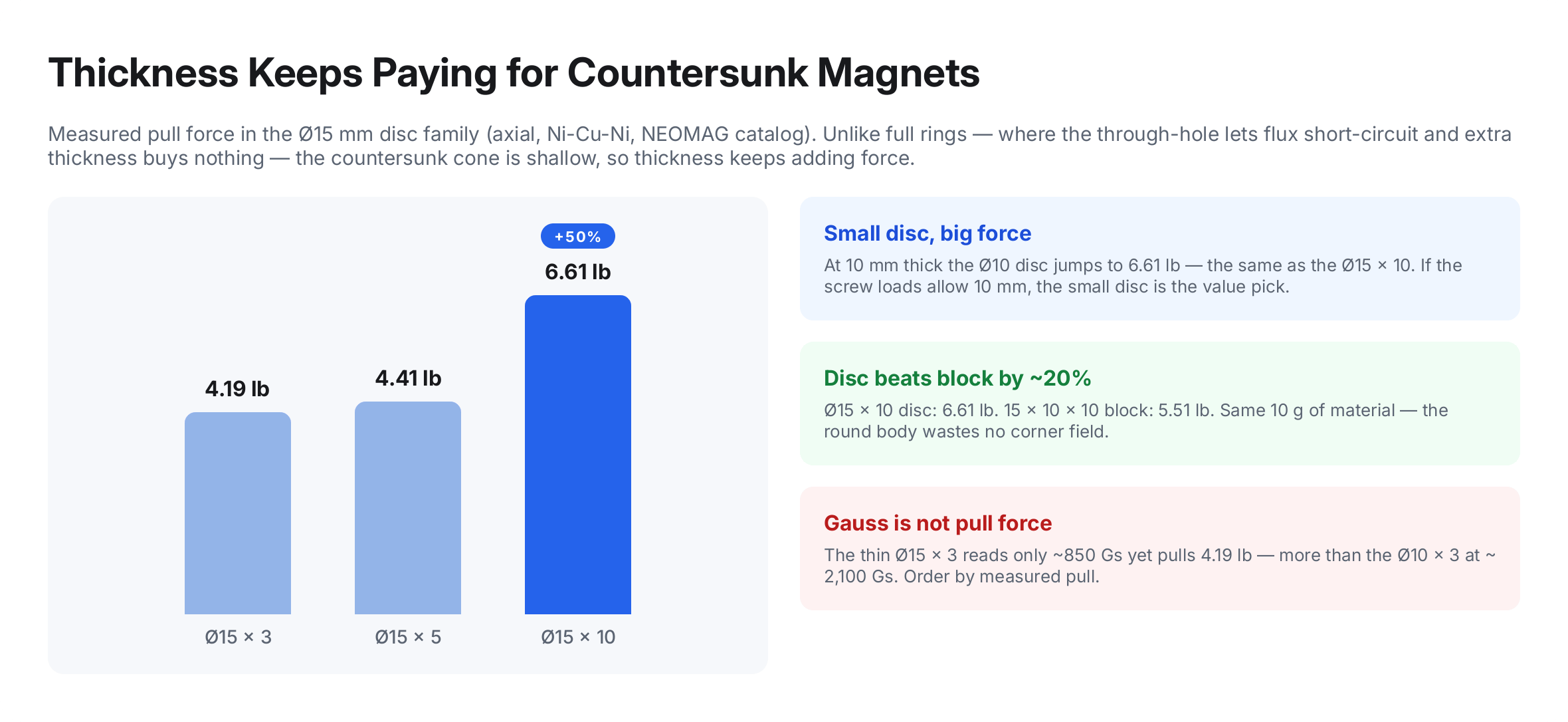
Unlike a full ring, whose through-hole lets flux short-circuit, a countersunk cone is shallow — and the data shows thickness keeps paying:
Neodymium countersunk magnets keep gaining with thickness because the cone is too shallow to give the field a shortcut back through the magnet:
| Disc size | Pull force | Surface gauss |
|---|---|---|
| Ø15 × 3 mm | 4.19 lb | ~850 Gs |
| Ø15 × 5 mm | 4.41 lb | ~1,400 Gs |
| Ø15 × 10 mm | 6.61 lb | ~3,000 Gs |
Doubling thickness from 5 mm to 10 mm still buys +50% force. Compare that with our ring magnet data, where added thickness past a point bought nothing: the countersunk cone is too shallow to give the field a shortcut back through the magnet.
Two more patterns worth knowing before you order neodymium countersunk magnets:
At 10 mm thick, the Ø10 disc jumps to 6.61 lb — the same force as the much larger Ø15 × 10. If your screw loads allow a 10 mm thick part, the small disc is the value pick.
Disc beats block at the same nominal size. The Ø15 × 10 disc and the 15 × 10 × 10 block carry almost identical material (10 g), yet the disc holds 6.61 lb against the block's 5.51 lb — about 20% more. The round shape wastes no corner field — one reason discs are the default body for neodymium countersunk magnets. Choose the block only when the footprint must fit a square pocket or the two mounting holes help alignment.
Why is the pull force lower than a solid disc of the same size? The cone removes material exactly where the field wants to travel. Our catalog's 10 × 5 mm countersunk disc holds 2.20 lb; expect a solid Ø10 × 5 disc to hold noticeably more. If you need every gram of force and can give up the screw, order a disc — or bolt a pot magnet down instead.
One more reason to compare measured data on neodymium countersunk magnets: the thin Ø15 × 3 mm disc reads only ~850 Gs but pulls 4.19 lb — more than the Ø10 × 3 disc at ~2,100 Gs and 1.87 lb. Surface gauss is a point reading, not a force number; see how to measure surface gauss with a gaussmeter and our note on identical volume, identical grade — different pull.
All three are "magnets with a hole", but the jobs differ:
The magnet shapes guide compares all eight families side by side.
Stock neodymium countersunk magnets are supplied in the standard N-grade families — see grades and magnetic properties of sintered NdFeB and N35 vs N42 vs N52 explained:
| Suffix | Max operating temperature |
|---|---|
| (none) | 80 °C |
| M | 100 °C |
| H | 120 °C |
| SH | 150 °C |
| UH | 180 °C |
| EH | 200 °C |
Long-term heat costs pull force before it costs the magnet: reversible loss starts well below the Curie point (~310 °C). The physics is in Curie temperature and operating temperature and temperature stability of permanent magnets. For neodymium countersunk magnets mounted near heat sources — lamps, machinery, engines — specify the suffix in the RFQ.
Every stock countersunk magnet is axially magnetized: poles on the two flat faces, one face north and the other south. Practical consequences:
All 15 stock neodymium countersunk magnets are plated Ni-Cu-Ni. Custom coatings follow the same map as the rest of the range — full comparison in neodymium magnet coatings explained:
Environment-based selection is in how to select coating for NdFeB magnets and surface treatment of sintered NdFeB. Treated timber and damp plasterboard are the classic killers of bare Ni-Cu-Ni — spec epoxy there.
Where neodymium countersunk magnets earn their keep:
Cross-industry use cases: 15 key industrial NdFeB applications.
Eight items settle an RFQ — the procurement requirement checklist walks through each:
If screw size plus body size plus coating all deviate from stock, start from custom magnets rather than forcing a standard part.
M3, M4, M5 or M6 depending on size — the mapping is in the screw table above. Use a 90° flat-head screw so the seat matches the cone.
Yes. The cone removes material on the flux path, so a countersunk magnet holds less than a solid disc of the same dimensions — and much less than a pot magnet. The trade-off is the mechanical screw fixing. The comparison continues in countersunk vs ring vs pot.
Either. Axial magnetization puts one pole on each flat face, so pull force is the same both ways. Mount the flat side to the workpiece when you want the screw head flush on the outside.
Catalog pull is measured flush against a thick steel plate. Paint, an air gap under the screw head, a rough surface or elevated temperature all cut real force — often by half. Always test in the actual assembly.
No — use a flat-head screw matched to the 90° cone. A rounded head contacts the cone at one point, clamps unevenly and can chip the brittle NdFeB.
N35–N42 covers most holding jobs at the best price; N52 buys the most force from the smallest body — see N35 vs N42 vs N52. Add the temperature suffix separately; grade and heat rating are different decisions.
Ni-Cu-Ni for dry indoor use, epoxy for treated wood, humidity or outdoor service, parylene for miniature assemblies. Full decision tree in neodymium magnet coatings explained.
No. Sintered NdFeB is hard and brittle — drilling can crack the magnet, ruin the coating and release dust. Order the size you need; see common processing methods for neodymium magnets.
Yes — every stock part has tiered quantity pricing and live stock counts on its product page in the countersunk magnets category. Custom parts are quoted per production run.
Keep fingers clear of the closing gap — these snap hard against steel. Separate pairs with spacer film, store away from magnetically sensitive devices, and re-pair them in attracting orientation for storage.
Browse the full range of neodymium countersunk magnets for stock parts, or take your drawing to custom magnets for a made-to-spec quote. For the other shapes in the family, start at neodymium magnets learn more.