Neodymium ring magnets are the shape you reach for when the magnet has to mount on something — a shaft, a screw, a sensor barrel, a rotary encoder. The center hole changes more than mounting, though: it changes how the magnetic circuit closes, and it means ring magnets do not follow the same pull-force rules as solid discs.
This page covers the full specification set for neodymium ring magnets(https://www.neodymium-magnetics.com/product-category/neodymium-magnets/ring-magnets/) — sizes, the hole, magnetization direction, grades, coatings and real measured pull force — so you can pick a part or brief us on a custom ring with confidence.
A neodymium ring magnet is a circular NdFeB magnet with a concentric center hole. Three dimensions define it:
That is OD × ID × T, always in that order. A "20 × 10 × 2 mm" ring is 20 mm across, 10 mm in the hole, 2 mm thick.
The hole is the point. It lets the ring slide onto a shaft, seat over a boss, take a screw, or wrap around a sensor — while the magnet itself stays symmetric around the axis of whatever it is mounted on. That symmetry is why rings dominate rotating and sensing applications.
All neodymium ring magnets in our online store are sintered NdFeB, nickel-plated (Ni-Cu-Ni), and axially magnetized. Diametrical and multi-pole magnetization are available as custom ring magnets.
Our neodymium ring magnets category currently covers 15 standard stock parts:
| OD | Available IDs | Available thicknesses |
|---|---|---|
| 10 mm | 5 mm | 2 / 3 / 5 / 10 mm |
| 15 mm | 3 / 5 / 8 mm | 2 / 3 / 5 mm |
| 20 mm | 10 mm | 2 / 3 / 5 / 10 mm |
| 25 mm | 10 mm | 2 / 3 / 5 mm |
| 30 mm | 20 mm | 3 mm |
So the stock envelope runs from a 10 × 5 × 2 mm ring at 0.7 g to a 30 × 20 × 3 mm ring at 11.3 g. Outside that envelope, custom neodymium ring magnets are made to drawing — see standard vs custom neodymium magnets for how that split works.
Tolerances on all stock rings are ±0.02 inch (±0.5 mm); the full tolerance stack is explained in dimensions and geometric tolerances of NdFeB magnets.
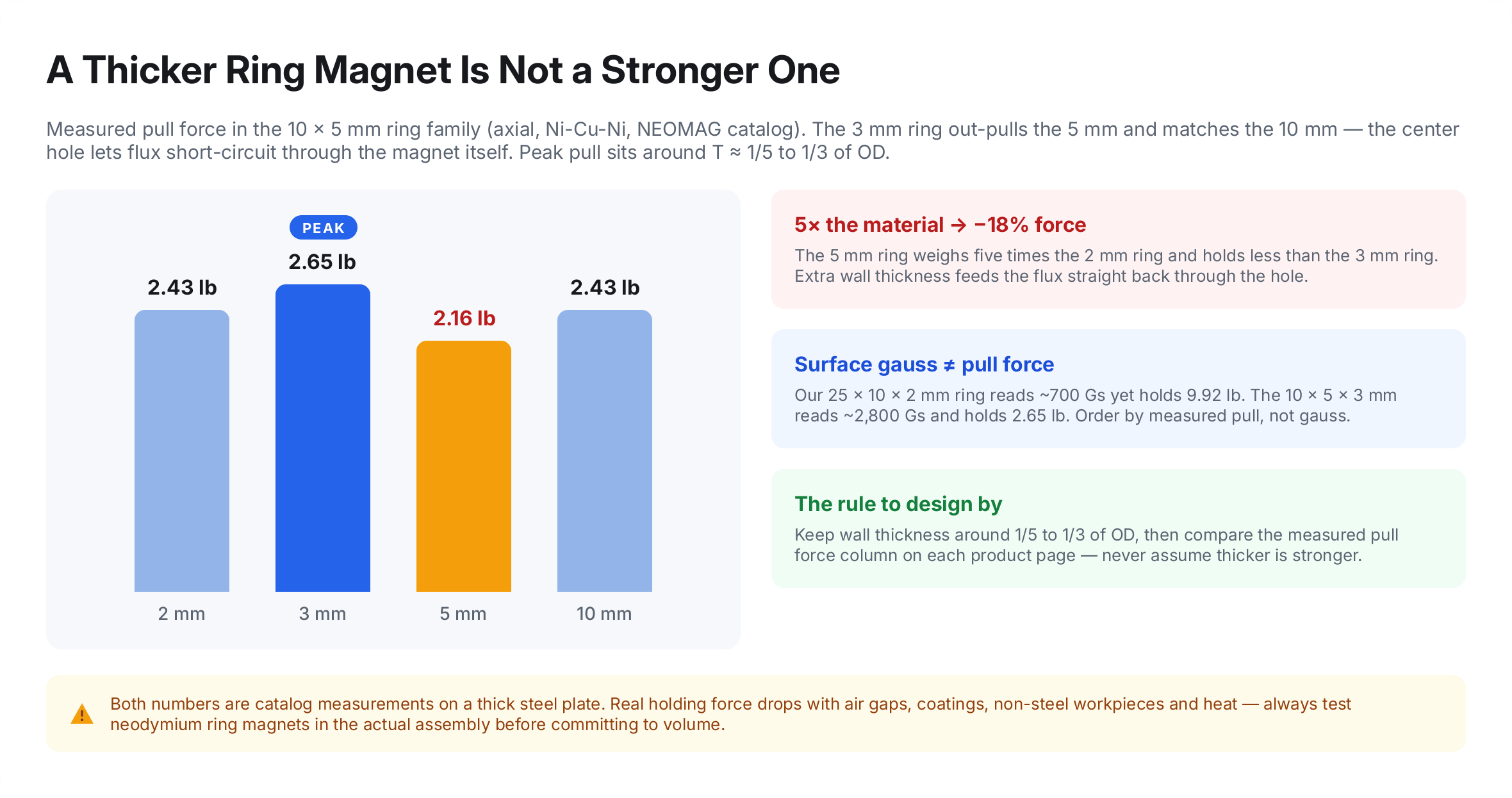
Here is where neodymium ring magnets behave differently from every solid shape, and it is the single most useful thing on this page: measured pull force does not climb steadily with thickness. The hole changes the game.
Take the 10 × 5 mm family, all axially magnetized, from our catalog:
| Size (OD × ID × T) | Weight | Pull force | Surface gauss |
|---|---|---|---|
| 10 × 5 × 2 mm | 0.7 g | 2.43 lb (1.1 kgf) | ~1,800 Gs |
| 10 × 5 × 3 mm | 1.0 g | 2.65 lb (1.2 kgf) | ~2,800 Gs |
| 10 × 5 × 5 mm | 2.0 g | 2.16 lb (0.98 kgf) | ~2,500 Gs |
| 10 × 5 × 10 mm | 4.0 g | 2.43 lb (1.1 kgf) | ~3,000 Gs |
Read that again: the 5 mm ring — five times the material of the 2 mm ring — holds less than the 3 mm ring. And the 10 mm ring, with 5.7× the material of the 3 mm ring, is back down at 2.43 lb.
The same pattern shows in the 25 × 10 mm family:
| Size (OD × ID × T) | Weight | Pull force |
|---|---|---|
| 25 × 10 × 2 mm | 5 g | 9.92 lb (4.5 kgf) |
| 25 × 10 × 3 mm | 8 g | 11.90 lb (5.4 kgf) |
| 25 × 10 × 5 mm | 17 g | 10.58 lb (4.8 kgf) |
Peak pull at 3 mm; the 5 mm ring is heavier and weaker.
Why the hole does this. In a solid disc, added thickness pushes the working point further from the demagnetizing field — that is why discs keep gaining (slowly) up to around 3 mm. In neodymium ring magnets, part of the flux from each pole face can return through the hole instead of through the steel workpiece. The thicker the ring wall relative to the hole, the more the magnet becomes its own magnetic short-circuit, and the less of its flux does useful holding work.
The practical rule for neodymium ring magnets: thickness has a sweet spot, and in our stock families it sits around T ≈ 1/5 to 1/3 of OD. Beyond it, you are buying weight, not force. If your assembly can take it, compare the measured pull force column on each product page instead of assuming "thicker is stronger" — the numbers above come straight from our catalog.
The hole is area that carries no flux, so two rings with the same OD and thickness but different IDs will not pull the same. But the penalty is smaller than most buyers expect, because the flux concentrates in the material around the hole.
Compare two 2 mm-thick rings of similar OD from our catalog:
| Size (OD × ID × T) | Weight | Pull force |
|---|---|---|
| 15 × 5 × 2 mm | 2 g | 5.29 lb (2.4 kgf) |
| 20 × 10 × 2 mm | 3 g | 8.38 lb (3.8 kgf) |
The 20 × 10 ring has a proportionally larger hole (half its diameter) and still delivers more force, because its wall carries more total material in the useful flux path.
What the hole buys you:
If you do not need the hole, a disc of the same diameter will always hold more per gram — see ring magnets vs disc magnets below.
Neodymium ring magnets are the clearest demonstration of why you should never order by surface gauss alone. From our own catalog:
The 25 mm ring reads four times lower gauss and holds nearly four times more weight. Gauss is a field strength reading at one point on the pole face; pull force depends on total flux and contact area. For how to measure each properly, see how to measure surface gauss using a gaussmeter and our note on identical volume, identical grade — different pull.
Stock neodymium ring magnets are supplied in the N-grade families covered in our grades guide (N35 vs N42 vs N52 explained here). The grade number is energy density; the suffix is the heat rating:
| Suffix | Max operating temperature |
|---|---|
| (none) | 80 °C |
| M | 100 °C |
| H | 120 °C |
| SH | 150 °C |
| UH | 180 °C |
| EH | 200 °C |
Curie temperature — where the magnetization collapses permanently — sits near 310 °C, but long before that the magnet loses a percentage of its pull at every degree. The distinction between reversible loss and permanent demagnetization is covered in Curie temperature and operating temperature of magnets and temperature stability of permanent magnets.
Neodymium ring magnets in motors and rotary assemblies usually run warm; if your ring spins inside a motor or coupling, specify the temperature suffix in the RFQ, not just the grade.
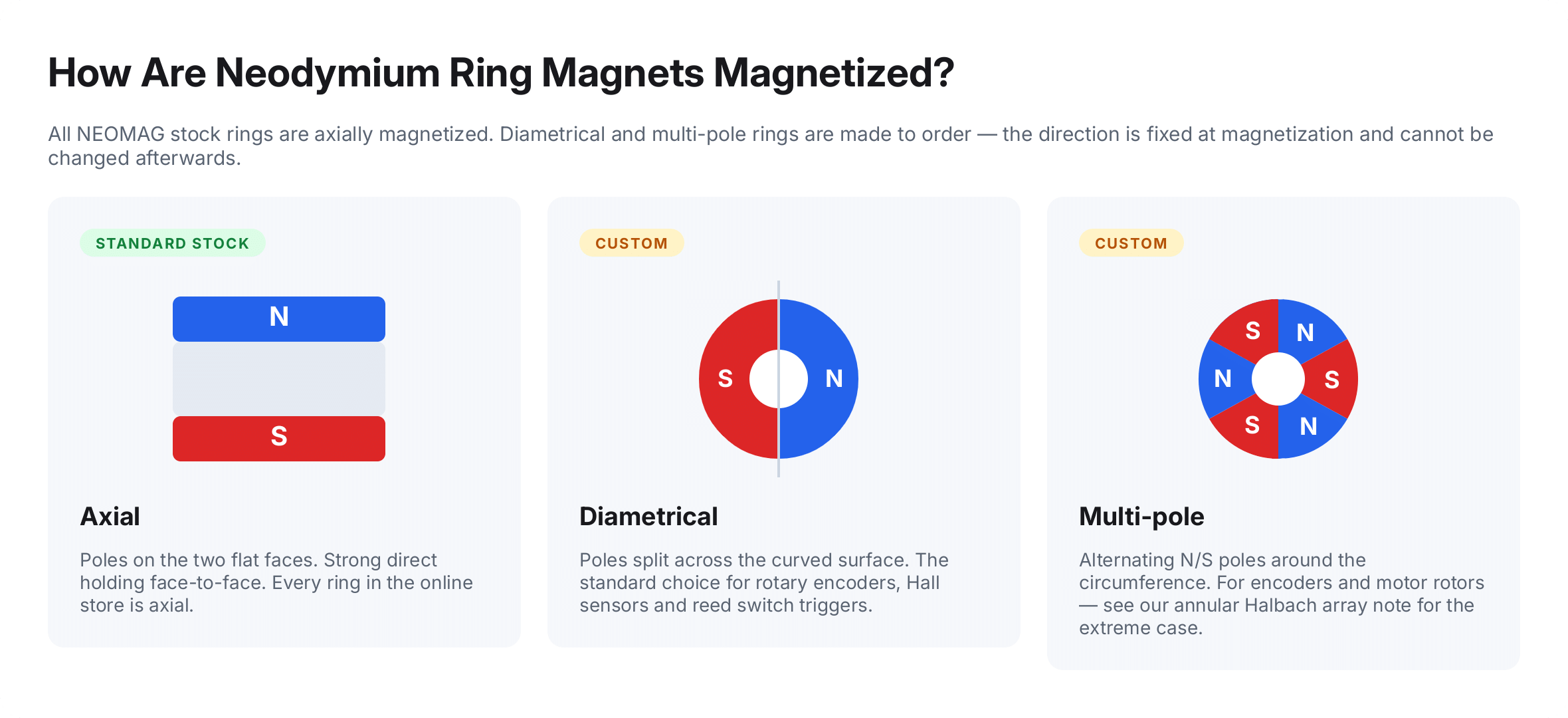
Three options, one of which is standard stock:
You cannot re-magnetize sintered neodymium ring magnets in the field — the direction is fixed at the magnetizing fixture. State it in writing on the drawing before production. For sensor-side context, how a Hall element works explains what the ring's field needs to look like.
All stock neodymium ring magnets are plated Ni-Cu-Ni, the standard bright finish — see the full comparison in neodymium magnet coatings explained. For custom neodymium ring magnets, the usual options are:
Coating selection guidance by environment is in how to select coating for NdFeB magnets and surface treatment of sintered NdFeB.
Neodymium ring magnets share the round family with three siblings — same circle, different jobs:
A quick overview of every shape lives on the magnet shapes guide.
Where neodymium ring magnets actually get used:
Broader use cases across industries are collected in 15 key industrial NdFeB applications.
Before you request a quote, have these eight settled — the procurement requirement checklist walks through each:
If more than two of these are "custom", start from custom ring magnets rather than forcing a stock part to fit.
OD from 10 mm to 30 mm, ID from 2 mm to 20 mm, thickness from 2 mm to 10 mm — 15 SKUs in the ring magnets category, all with live stock. Anything outside that is made as a custom ring.
Every stock ring is axially magnetized — poles on the two flat faces. Diametrical and multi-pole rings are available through custom ring magnets.
No — a disc of the same OD and thickness holds more, because the ring's hole carries no flux. You accept that loss in exchange for shaft or screw mounting. The comparison logic is the same as in ring vs disc above.
The hole lets part of the flux short-circuit back through the magnet itself. In our catalog the 10 × 5 × 3 mm ring out-pulls the 10 × 5 × 5 mm ring (2.65 lb vs 2.16 lb) despite half the material. Compare measured pull force instead of assuming thickness helps — the full explanation is in how dimensions affect pull force.
Yes, as a custom part. Diametrical magnetization is the standard choice for encoders, Hall sensors and rotating triggers. The direction is set during magnetization and cannot be changed afterwards — confirm it on the drawing before production.
OD is outer diameter, ID is the hole (inner diameter), T is thickness. A 20 × 10 × 2 mm ring is 20 mm across, with a 10 mm hole, 2 mm thick. Keep the OD × ID × T order consistent in RFQs and drawings.
For holding and mounting, N35–N42 is the value choice; N52 buys the most field from the smallest ring — see N35 vs N42 vs N52. Match the temperature suffix to the real operating environment; grade and heat rating are separate decisions.
Ni-Cu-Ni for normal indoor service, epoxy for humidity or salt exposure, parylene for medical and miniature assemblies. The decision tree is in neodymium magnet coatings explained.
Yes — every stock ring has tiered quantity pricing on its product page, and 20,000-piece-level stock is common across the ring magnets category. Custom rings are quoted per production run.
Ni-Cu-Ni plating is scratchable — separate rings with spacer film, keep them away from magnetically sensitive devices (cards, pacemakers, precision instruments), and store paired rings with keepers or in their original packaging. Magnetized rings snap together hard; keep fingers clear of the closing gap.
Browse the full range of neodymium ring magnets for stock parts, or send your OD × ID × T and application to custom ring magnets for a made-to-drawing quote. For the other shapes in the family, start at neodymium magnets learn more.