Threaded pot magnets solve a mounting problem the screw-hole series cannot: there is no hole to align. A threaded stud sticks out of the back of the pot, so you screw the magnet into a bracket, ball joint, fixture or hook from whatever direction the assembly needs — then the rubber-coated face grips the steel.
This page covers our rubber-coated external thread pot magnets: 5 stock sizes from 22 mm to 88 mm diameter with M4–M8 studs, real measured pull force up to 26 kgf, and the one spec most suppliers gloss over — why the rubber jacket that makes these magnets so grippy also lowers their direct pull.
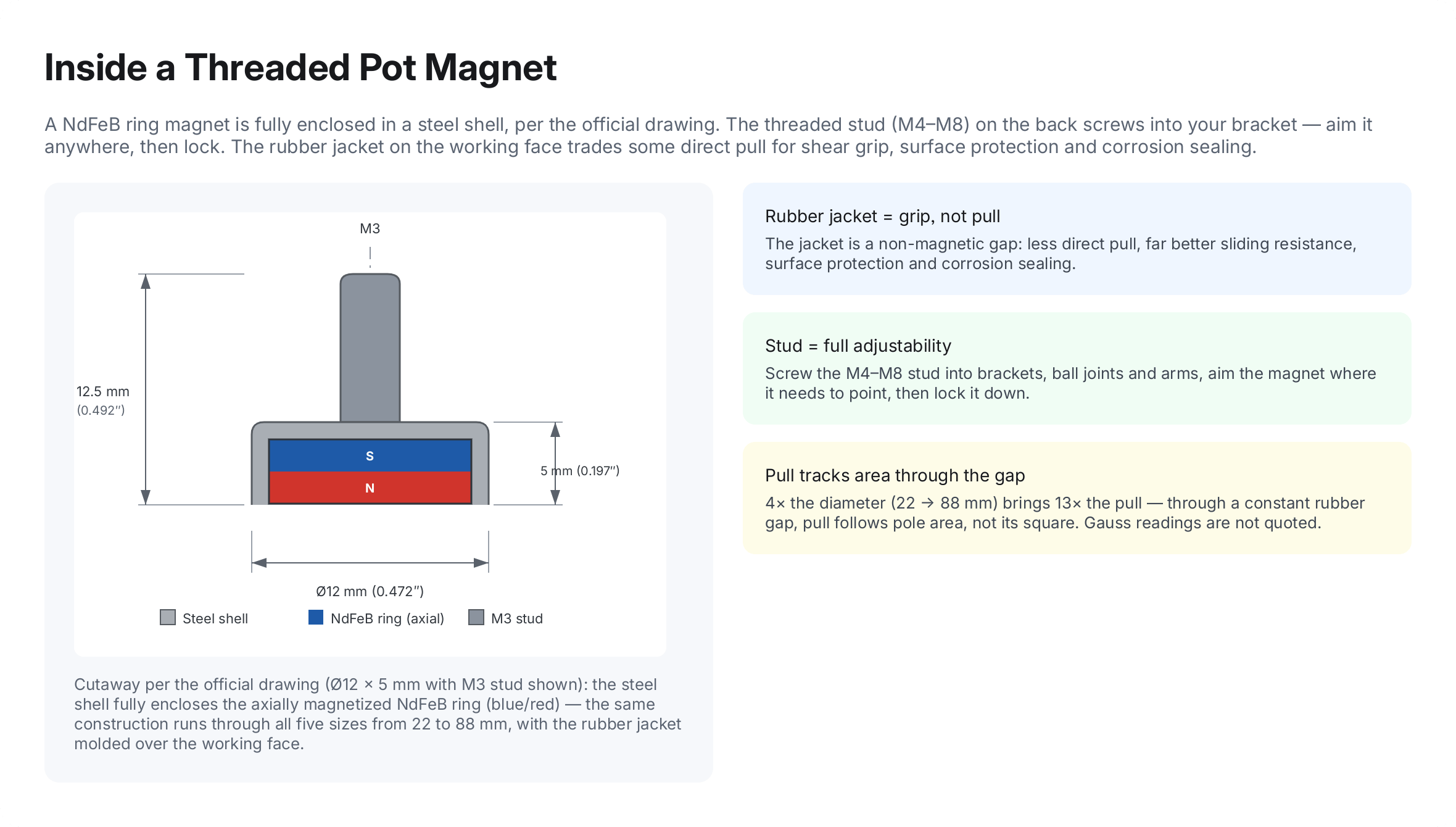
An external thread pot magnet (also called a male thread pot magnet or threaded stud magnet) is a neodymium ring magnet in a steel cup whose back carries a protruding male thread. You drill no hole in the magnet side at all — the stud threads into your hardware, which is why threaded pot magnets dominate adjustable mounts: camera fixtures, lighting arms, sensor brackets, ball-joint bases.
All 5 threaded pot magnets on this page are rubber-coated on the working face. That rubber jacket is the defining feature of the series — and the reason its pull numbers look different from every bare-steel pot magnet. The cup still closes the magnetic circuit behind the magnet; the rubber simply adds a thin non-magnetic gap in front of the working face.
The external thread category runs from 22 mm to 88 mm in diameter:
| D × H | Stud | Weight | Pull force |
|---|---|---|---|
| 22 × 6 mm | M4 × 10 mm | 11 g | 4.41 lb (2 kgf) |
| 31 × 6 mm | M4 × 10 mm | 16.5 g | 4.41 lb (2 kgf) |
| 43 × 6 mm | M6 × 15 mm | 36 g | 13.23 lb (6 kgf) |
| 66 × 8 mm | M8 × 15 mm | 112 g | 35.27 lb (16 kgf) |
| 88 × 8 mm | M8 × 15 mm | 204 g | 57.32 lb (26 kgf) |
All 5 threaded pot magnets are axially magnetized, rubber-coated over a nickel-plated steel cup, ±0.5 mm tolerance, 80 °C standard. Larger diameters, stainless builds and different stud threads are made to drawing via custom magnets; the standard vs custom guide explains when that is worth it.
The stud is the interface your assembly designs around, so it is worth more than one line in the table (threaded fastener basics for background):
| Thread | Stud length | Torque capacity | Used on |
|---|---|---|---|
| M4 × 0.7 | 10 mm | far above the magnet's pull | 22 / 31 mm |
| M6 × 1.0 | 15 mm | far above the magnet's pull | 43 mm |
| M8 × 1.25 | 15 mm | far above the magnet's pull | 66 / 88 mm |
Three practical rules:
This is the spec most suppliers gloss over, so here is the physics: rubber is non-magnetic, so the jacket adds a small air gap in front of the working face. Magnetic pull falls off sharply with gap distance — the same effect that makes even half a millimetre of paint matter. The result is visible in the table above: the 31 mm rubber-coated pot holds 2 kgf — less than the 16 mm nickel-plated T1 countersunk pot at 4.5 kgf, despite being nearly twice the diameter.
What the rubber buys you instead:
The engineering rule of thumb: specify threaded pot magnets for shear, vibration and delicate surfaces; specify bare countersunk or counterbore pots for maximum normal pull. The same steel cups exist in both styles, so switching series does not change your bracket design.
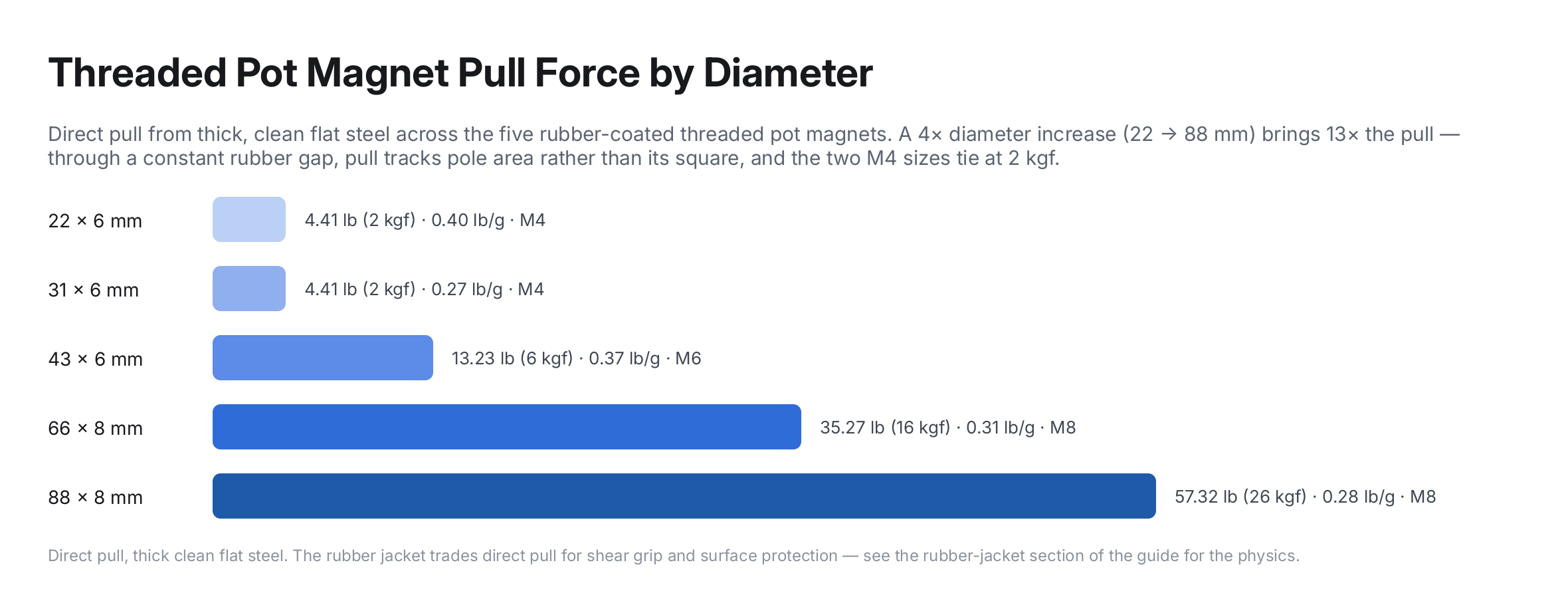
Even through the rubber jacket, the same geometry laws apply — they just show at half volume:
| Size | Pull force | Pull per gram |
|---|---|---|
| 22 × 6 mm | 4.41 lb (2 kgf) | 0.40 lb/g |
| 31 × 6 mm | 4.41 lb (2 kgf) | 0.27 lb/g |
| 43 × 6 mm | 13.23 lb (6 kgf) | 0.37 lb/g |
| 66 × 8 mm | 35.27 lb (16 kgf) | 0.31 lb/g |
| 88 × 8 mm | 57.32 lb (26 kgf) | 0.28 lb/g |
Three patterns in the threaded pot magnets range:
Diameter pays, but by area, not by square. Going from 22 mm to 88 mm is a 4× diameter increase — and a 13× pull increase. Through a constant rubber gap, pull tracks the pole area (4× diameter = 16× area), whereas the bare pots in the T1 series over-deliver past area scaling because taller cups add magnet volume. Here the jacket thickness stays fixed, so pull rises with area and stops there.
The two M4 sizes pull the same. The 22 mm and 31 mm pots both hold 2 kgf — at that scale the rubber gap, not the magnet volume, sets the ceiling. Choose 31 mm for stability, lever-arm and shear footprint, not for more pull; choose 22 mm to save weight and cost.
Surface gauss is not quoted — deliberately. A gauss probe reads the field through rubber poorly, and the number would mislead. Order threaded pot magnets by pull force and application, never by gauss; background in how to measure surface gauss.
The same five cups exist in a female-thread version: the bore is tapped instead of carrying a stud, so you can screw in a hook, eyebolt, knob or rod end.
| External thread (stud) | Internal thread (bore) | |
|---|---|---|
| Mounting direction | magnet screws into your part | accessory screws into the magnet |
| Best for | brackets, ball joints, adjustable arms | hooks, eyebolts, hanging points |
| Face stays clear? | yes — stud is on the back | yes — bore is on the back |
| Available sizes | 22 / 31 / 43 / 66 / 88 mm | 43 / 66 / 88 mm and more |
Browse the female versions: 43 mm M4 internal thread, 66 mm M6 internal thread, 88 mm M6 internal thread. Rule of thumb: if the load hangs from the magnet, internal thread; if the magnet hangs on the load or must aim somewhere, external thread. Both share the rubber-coated face, and both ship from the rubber-coated magnets family.
Catalog pull is direct pull off thick, clean, flat steel. Threaded pot magnets are unusual because their worst case and best case differ less than for bare pots:
The ring magnets inside are sintered NdFeB in the N42-class range — the grade property table shows why grade matters less inside a closed cup. Standard rating is 80 °C continuous; note that the rubber jacket itself is the temperature limiter alongside the magnet — above its rating the jacket hardens and loses grip before the magnet loses pull. The Curie and operating temperature guide and the temperature stability overview cover the physics; hotter builds are quoted via custom magnets.
All 5 threaded pot magnets are axially magnetized: the working pole faces the rubber jacket, the back pole closes into the steel cup — the standard pot magnet orientation that makes the cup multiply the front-face pull. Custom assemblies can orient the stud differently or use multiple poles; ask through the custom magnets channel.
The jacket is a textured TPV/rubber layer over the nickel-plated cup — grippy, non-marking and corrosion-sealing. It is what separates threaded pot magnets from every bare-steel series in the range. If your application does not need shear grip, the bare equivalents in the T1 and T2 series deliver 2–4× more direct pull at the same diameter; the coating selection guide and the coatings explainer compare every option across the range.
The adjustable stud plus grippy face decides the application list for threaded pot magnets:
More use cases across the whole range: 15 key industrial NdFeB applications.
Send us five items and quoting is same-day, following the procurement requirement guide:
Dimensional expectations follow NdFeB tolerance standards; ±0.5 mm on diameter and height covers all stock threaded pot magnets.
A neodymium ring magnet in a steel cup whose back carries a protruding male thread. You screw the stud into a bracket, ball joint or fixture, and the rubber-coated face grips the steel — no hole needs to be drilled through or into the magnet. That is why threaded pot magnets dominate adjustable mounts.
From 4.41 lb (2 kgf) at 22 mm to 57.32 lb (26 kgf) at 88 mm, measured as direct pull from thick flat steel. The rubber jacket lowers direct pull versus bare pots of the same size — and raises sliding resistance in return.
The rubber jacket is a non-magnetic gap right at the working face, and pull falls off fast across any gap. The 16 mm T1 pot with a bare steel face converts more of its field into pull. The rubber pot wins where things slide, vibrate or must not be scratched.
M4 × 10 mm studs on the 22 and 31 mm pots, M6 × 15 mm on the 43 mm, and M8 × 15 mm on the 66 and 88 mm pots. The magnet's pull is always the weak link — the thread itself is far stronger than the rating.
If the magnet screws into your part (brackets, arms, ball joints), external thread. If an accessory screws into the magnet (hooks, eyebolts, knobs), internal thread. Both exist in the same rubber-coated cups.
Yes — that is one of their strengths. The rubber conforms to paint and galvanizing where a rigid steel face would rock, at the cost of some pull. Keep paint thin and clean for best results.
Better than rigid pots. The jacket conforms to tubes, guards and curved panels and keeps contact area where a steel cup would touch on one edge.
80 °C continuous as standard. The rubber jacket and the magnet both limit: above the rating the jacket hardens and loses grip. Higher-temperature jackets and magnets are available as custom builds.
Yes — the bare steel equivalents are the T1 countersunk and T2 counterbore series with 2–4× more direct pull at the same diameter, mounted by screw instead of stud.
Yes. Every stock size has tiered pricing, custom threads and diameters are made to drawing, and mixed external/internal thread orders ship together from the same production line.
Browse the full external thread pot magnets category for live pricing on all 5 sizes, or send your thread, load direction and environment through contact us — we will match the stud, the jacket and the diameter to your assembly. For maximum normal pull with a screw mount instead, step over to the T1 countersunk or T2 counterbore series, and for the family overview start at pot magnets.