Countersunk pot magnets are the flush-mount option in the neodymium pot magnet range. A NdFeB ring magnet sits inside a nickel-plated steel cup, and the working face carries a 90° countersink that swallows a flat-head screw completely — nothing protrudes past the magnet body after installation.
This page covers our countersunk pot magnets in full: 15 stock sizes from 16 mm to 120 mm diameter, real measured pull force up to 480 kg, the flat-head screw each countersink takes, and how to choose between the countersunk T1 and the counterbore T2 — because the two are mechanically identical apart from that one hole.
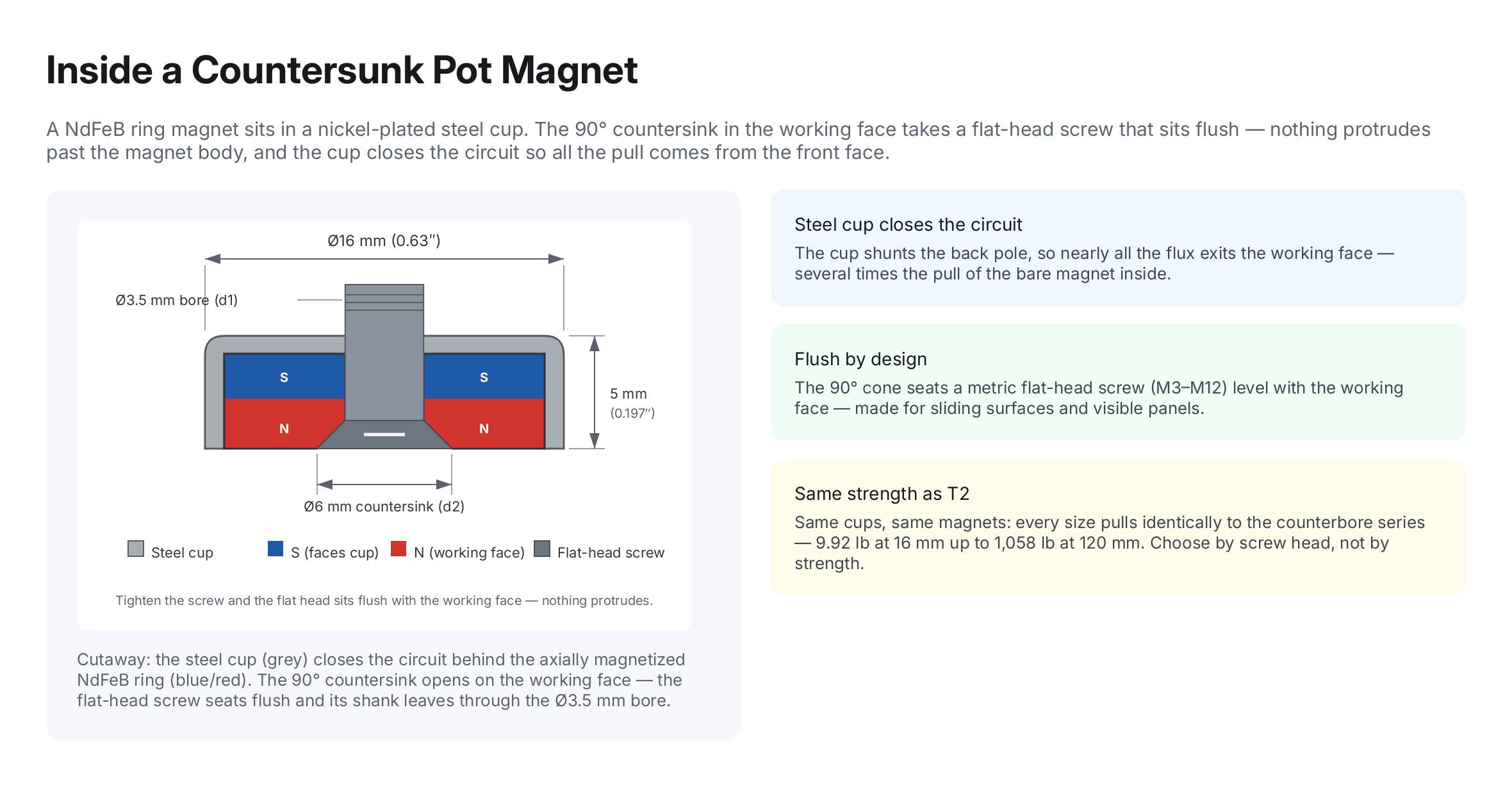
A countersunk pot magnet is a neodymium ring magnet housed in a steel cup, with a countersunk hole in the working face: a 90° conical recess that lets a flat-head screw sit flush with — or slightly below — the magnet surface. Tighten the screw and the pot clamps itself to the mounting surface with no protruding hardware.
See countersink geometry for the machining background. All three are mounting solutions; the choice comes down to how the magnet must sit on your equipment.
The steel cup is the performance story. Because the cup closes the magnetic circuit on the back side, almost all the flux exits through the front working face — the same principle behind every magnetic circuit. Countersunk pot magnets hold several times more than the bare magnet of the same diameter, and the field on the back and sides is nearly zero, so the assembly will not wipe magnetic strips or disturb electronics mounted behind it.
The countersunk pot magnets category runs from 16 mm to 120 mm in diameter:
| D × H | Countersink d1 / d2 | Screw | Weight | Pull force |
|---|---|---|---|---|
| 16 × 5 mm | 3.5 / 6.0 mm | M3 | 6.5 g | 9.92 lb (4.5 kgf) |
| 20 × 6 mm | 4.5 / 8.0 mm | M4 | 9 g | 15.43 lb (7 kgf) |
| 25 × 7 mm | 5.5 / 9.0 mm | M5 | 18.5 g | 22.05 lb (10 kgf) |
| 32 × 7 mm | 5.5 / 9.0 mm | M5 | 36 g | 52.91 lb (24 kgf) |
| 36 × 7 mm | 6.5 / 11.0 mm | M6 | 41 g | 57.32 lb (26 kgf) |
| 42 × 8 mm | 6.5 / 11.0 mm | M6 | 81 g | 79.37 lb (36 kgf) |
| 48 × 11 mm | 8.5 / 15.0 mm | M8 | 142 g | 165.35 lb (75 kgf) |
| 55 × 12 mm | 8.5 / 15.0 mm | M8 | 206 g | 220.46 lb (100 kgf) |
| 60 × 15 mm | 8.5 / 15.0 mm | M8 | 312 g | 286.60 lb (130 kgf) |
| 67 × 15 mm | 8.5 / 15.0 mm | M8 | 395 g | 385.81 lb (175 kgf) |
| 75 × 18 mm | 10.5 / 17.0 mm | M10 | 585 g | 518.09 lb (235 kgf) |
| 80 × 18 mm | 10.5 / 17.0 mm | M10 | 674 g | 617.29 lb (280 kgf) |
| 90 × 18 mm | 10.5 / 17.0 mm | M10 | 863 g | 793.66 lb (360 kgf) |
| 100 × 18 mm | 10.5 / 17.0 mm | M10 | 959 g | 881.85 lb (400 kgf) |
| 120 × 18 mm | 12.5 / 20.0 mm | M12 | 1,550 g | 1,058.22 lb (480 kgf) |
All 15 countersunk pot magnets are axially magnetized, nickel-plated, ±0.5 mm tolerance, 80 °C standard. Rubber-capped versions of most sizes are available on request — see coatings below. Outside this range, assemblies are made to drawing via custom magnets; the standard vs custom guide explains when that is worth it.
Each size of the countersunk pot magnets takes one screw size — match it and the flat head disappears into the cone:
| Screw | Hole d1 | Cone opening d2 | Used on |
|---|---|---|---|
| M3 | 3.5 mm | 6.0 mm | 16 mm |
| M4 | 4.5 mm | 8.0 mm | 20 mm |
| M5 | 5.5 mm | 9.0 mm | 25 / 32 mm |
| M6 | 6.5 mm | 11.0 mm | 36 / 42 mm |
| M8 | 8.5 mm | 15.0 mm | 48 / 55 / 60 / 67 mm |
| M10 | 10.5 mm | 17.0 mm | 75 / 80 / 90 / 100 mm |
| M12 | 12.5 mm | 20.0 mm | 120 mm |
Two details that prevent most installation failures:
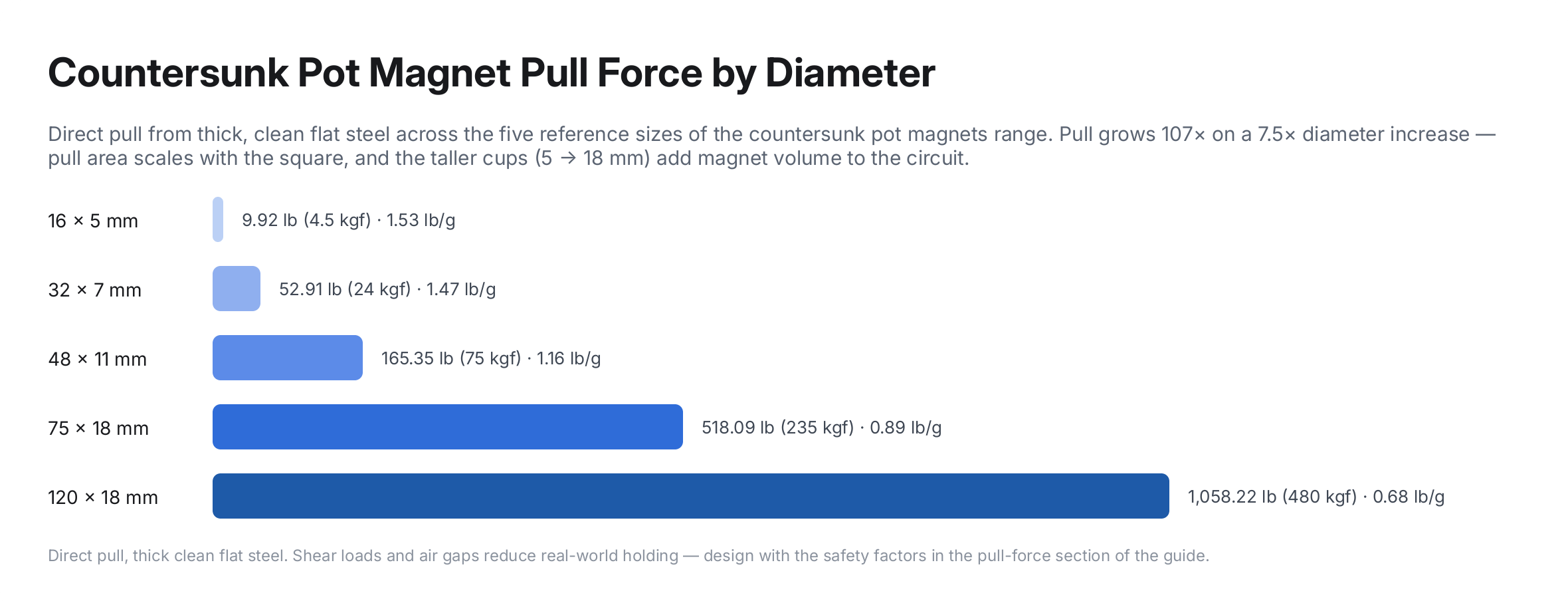
The catalog data tells a clear story — bigger pots are disproportionately stronger:
| Size | Pull force | Surface gauss | Pull per gram |
|---|---|---|---|
| 16 × 5 mm | 9.92 lb | ~3,400 Gs | 1.53 lb/g |
| 32 × 7 mm | 52.91 lb | ~1,700 Gs | 1.47 lb/g |
| 48 × 11 mm | 165.35 lb | ~2,600 Gs | 1.16 lb/g |
| 75 × 18 mm | 518.09 lb | ~1,900 Gs | 0.89 lb/g |
| 120 × 18 mm | 1,058.22 lb | ~1,500 Gs | 0.68 lb/g |
Read the three columns together and three patterns fall out of the countersunk pot magnets range:
Diameter multiplies, not adds. Going from the 16 mm pot to the 120 mm pot is a 7.5× diameter increase — and a 107× pull increase. Pull area grows with the square of diameter, and the taller bodies (5 → 18 mm) feed the circuit more magnet, so big pots over-deliver.
Surface gauss runs the other way. The 16 mm pot reads ~3,400 Gs and holds 9.92 lb; the 120 mm pot reads ~1,500 Gs and holds 1,058 lb. Gauss is a point reading on the pole face — the big cup spreads its field over a huge area at lower intensity, and holds 100× more. Order by the pull force column, never by gauss; background in how to measure surface gauss with a gaussmeter and identical volume, different pull.
Small-to-mid sizes are the efficiency sweet spot. The 16–32 mm pots deliver ~1.5 lb of pull per gram; the 120 mm pot delivers 0.68. If your design allows several small pots instead of one large one, the multi-pot layout holds more per kilogram of magnet — and spreads the load better on thin sheet steel.
Catalog pull force is measured as direct pull off thick, clean, flat steel. Four real-world factors change what countersunk pot magnets actually deliver in your assembly:
The steel cup is worth several times the magnet's own strength. Compare the smallest pot against the closest bare countersunk disc:
| 16 × 5 mm pot (T1) | Ø15 × 10 mm countersunk disc | |
|---|---|---|
| Pull force | 9.92 lb (4.5 kgf) | 6.61 lb (3 kgf) |
| Height | 5 mm | 10 mm |
| Magnet material | less (cup takes volume) | more |
| Field behind the part | ~zero | full |
The pot is smaller and half the height, yet holds about 50% more — and unlike the bare disc, its back face is magnetically silent, so it can sit on top of wiring, sensors or magnetic strips. That is the entire value of the pot construction: the cup closes the circuit so the front face does the work. The bare disc still wins on cost per kilogram of holding force at very large diameters, and discs keep gaining strength as they get thicker, so at Ø25 mm and above the gap narrows — but for flush screw mounting from 16 to 120 mm, countersunk pot magnets are the stronger assembly.
These two series share the same steel cups, the same ring magnets and therefore the same pull force at every size — 16 × 5 mm holds 9.92 lb in both, 120 × 18 mm holds 1,058 lb in both. For countersunk pot magnets the decision is purely about the fastener; the only mechanical difference is the hole:
| Countersunk T1 | Counterbore T2 | |
|---|---|---|
| Hole form | 90° cone | cylindrical flat-bottom seat |
| Screw | flat head (M3–M12) | hex or pan head + washer |
| Finish height | flush — nothing protrudes | head sits in the seat, may stand proud |
| Clamp load | on the cone, no washer | spread by the washer |
| Best for | sliding/track surfaces, visible faces, safety-critical flush fit | maximum clamp reliability, vibration duty |
Choose the T1 countersunk when the surface must stay smooth — sliding guides, conveyor tracks, drawer and door hardware, or any face people and products touch. Choose the T2 counterbore when the screw, not the geometry, is the priority: the washer spreads clamp load and survives vibration better. If you are unsure which screw head your assembly ends up with, decide the hole after the fastener — both series exist in all 15 sizes, and both are listed in the pot magnets family overview.
The ring magnets inside countersunk pot magnets are sintered NdFeB in the N42-class range — the grade property table shows why grade matters less in a closed cup than in a bare magnet. Standard rating is 80 °C continuous; above that, reversible losses begin, and sustained heat past the Curie temperature demagnetizes permanently. For oven-side or engine-bay mounting, ask about higher-temperature builds via custom magnets — the temperature stability guide explains the trade-offs.
All 15 countersunk pot magnets are axially magnetized: one pole on the working face, the other closed into the cup. That is what makes the pot construction work — the cup short-circuits the back pole, leaving the front face to grip. Diametrical or multi-pole arrangements are possible in custom assemblies; see orientation and magnetization of NdFeB magnets for the fundamentals.
All countersunk pot magnets ship nickel-plated (Ni-Cu-Ni) — the standard for sintered NdFeB surface treatment, and enough for dry indoor service. For humidity, salt spray or outdoor exposure, move up to rubber-capped versions or epoxy builds; the coating selection guide and the coatings explainer cover the full comparison.
Rubber caps do three jobs on a countersunk pot magnet: they add shear grip on smooth steel, they protect the surfaces you are clamping, and they seal against moisture. The trade-off is holding force — expect roughly a 20–30% reduction in direct pull, which the added friction usually repays in sliding applications.
The flush screw head is what decides the application list for countersunk pot magnets:
More use cases across the whole range: 15 key industrial NdFeB applications.
Send us five items and quoting is same-day, following the procurement requirement guide:
Dimensional expectations are set by NdFeB tolerance standards; ±0.5 mm on diameter and height covers all stock countersunk pot magnets.
A neodymium ring magnet inside a steel cup, with a 90° conical countersink in the working face so a flat-head screw mounts it flush to the surface. The cup closes the magnetic circuit and multiplies holding force versus the bare magnet inside.
From 9.92 lb (4.5 kgf) at 16 × 5 mm to 1,058 lb (480 kgf) at 120 × 18 mm, measured as direct pull from thick flat steel. Shear loading and air gaps reduce the real-world value — design with a safety margin.
One flat-head screw per size across the countersunk pot magnets: M3 on the 16 mm pot up to M12 on the 120 mm pot. The d1/d2 table above lists the exact hole and cone opening for each. Metric 90° heads seat fully; test-fit imperial 82° heads first.
Same strength at every size — choose by screw head. Countersunk (T1) takes a flat head and sits flush; counterbore (T2) takes a hex or pan head with a washer and holds clamp load better under vibration.
The steel cup closes the magnetic circuit behind the magnet, so nearly all the flux exits through the working face. The 16 × 5 mm pot holds 9.92 lb versus 6.61 lb for the Ø15 × 10 mm bare countersunk disc — while being half the height. That is why countersunk pot magnets are the default where both strength and flush mounting are required.
Gauss is a point reading, not a total. The big cup spreads its field across a much larger pole face at lower intensity — and holds over 100× more. Always order by pull force, not by surface gauss.
Most imperial flat-head screws use an 82° included angle versus the 90° countersink, so they seat on the rim and lose clamp contact. Use metric screws, or request a custom 82° countersink for imperial hardware.
80 °C continuous as standard. Above that the magnet loses pull reversibly at first, then permanently — see the Curie and operating temperature guide. Higher-temperature grades are available as custom builds.
Yes, by roughly 20–30% in direct pull. In sliding or shear applications the cap's friction usually recovers more than it costs, and it protects the clamped surface from scratches.
Yes. Every stock size has tiered pricing from 50 pieces, OEM custom builds are made to drawing, and the range shares tooling with the counterbore series so mixed T1/T2 orders ship together.
Browse the full countersunk pot magnets category for live pricing on all 15 sizes, or send your screw size, working environment and load case through contact us — we will match the countersink, the coating and the pot to your assembly. If your fastener changes mid-project, the counterbore T2 series covers the same 15 sizes with hex-screw mounting.