Carabiner pot magnets are the no-fastener option in the pot magnet range. A neodymium ring magnet sits in a domed steel shell, and the shell itself rises into a steel eyelet on the back — you clip a carabiner, hook or lanyard straight through the hole instead of threading a bolt or driving a screw. Nothing is fastened, nothing is threaded: the accessory clicks on and off in a second.
This page covers our carabiner pot magnets in full: 4 stock sizes from 25 mm to 42 mm diameter with Ø5–6 mm eyelet bores, real measured pull force up to 40 kgf, and the dimension chain no listing explains — total height equals cup height plus the eyelet tab (verify it in the table below), which sets your clearance envelope before you commit to a spot.
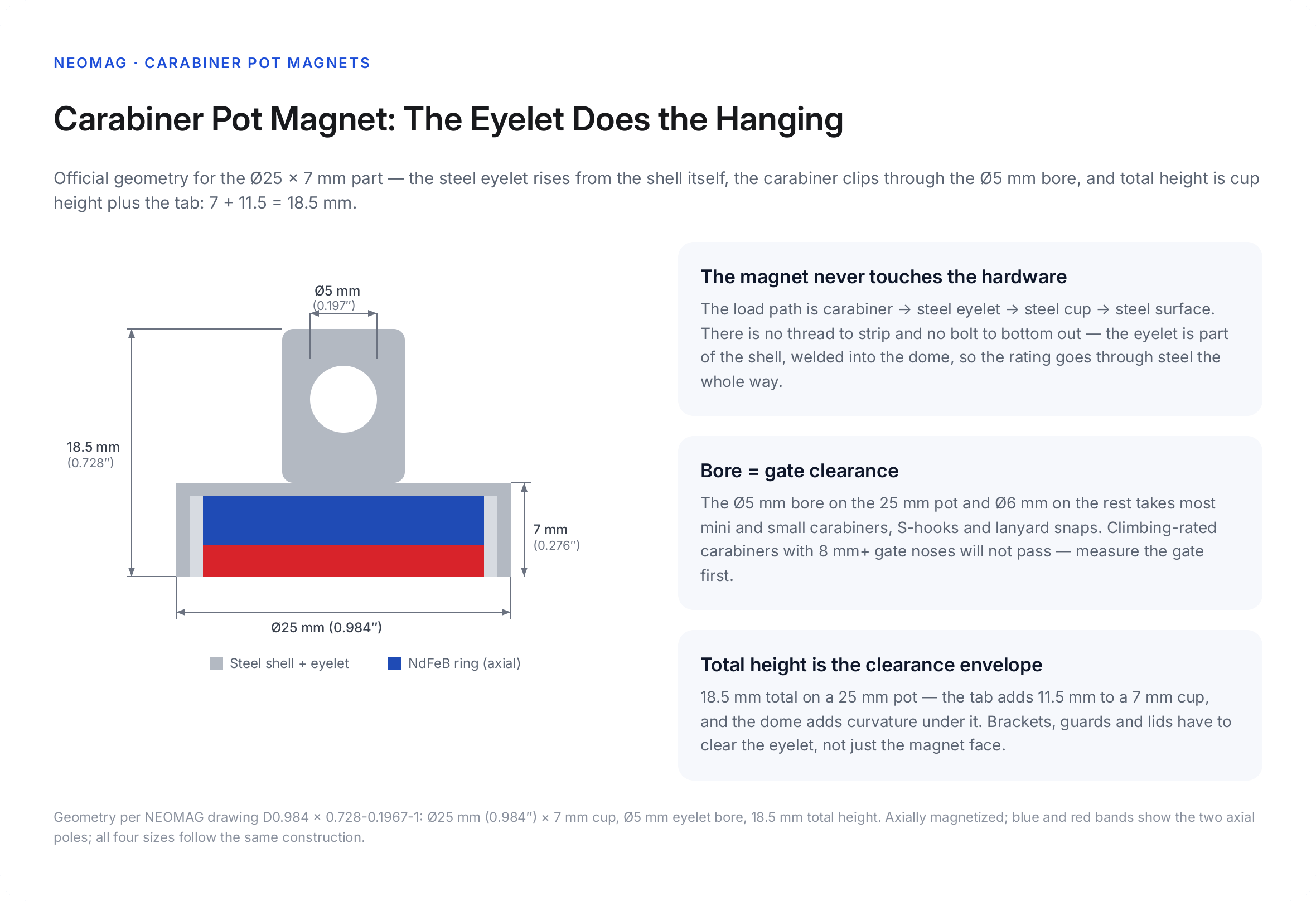
A carabiner pot magnet (also called an eyelet pot magnet or carabiner mounting magnet) is a neodymium ring magnet in a nickel-plated steel shell whose back carries a flat steel tab with a round through-hole. The tab is part of the shell — welded into the dome, not bolted on — so the load path goes carabiner → eyelet → steel cup → steel surface, and the magnet itself never touches the hardware. Any carabiner, S-hook or lanyard whose gate clears the bore clips straight through.
Where it sits in the family:
In carabiner pot magnets the steel shell does the same job as in every pot magnet: it closes the magnetic circuit behind the magnet, so nearly all flux exits the working face, and the field on the back and sides is nearly zero. The domed back also gives the eyelet tab a full-thickness steel root — the reason carabiner pot magnets carry their rating through the shell, not through the magnet.
The carabiner category runs from 25 mm to 42 mm — four sizes, one per hanging duty:
| D × cup H | Total H | Eyelet bore | Weight | Pull force |
|---|---|---|---|---|
| 25 × 7 mm | 18.5 mm | Ø5 mm | 26 g | 22.05 lb (10 kgf) |
| 32 × 7 mm | 18.5 mm | Ø6 mm | 42 g | 39.68 lb (18 kgf) |
| 36 × 7 mm | 17.5 mm | Ø6 mm | 53 g | 61.73 lb (28 kgf) |
| 42 × 8 mm | 18.0 mm | Ø6 mm | 79 g | 88.18 lb (40 kgf) |
All 4 carabiner pot magnets are axially magnetized, nickel-plated, ±0.5 mm tolerance, 80 °C standard, with a bare steel working face. Protective rubber caps are available on request; larger diameters, different eyelet geometries and imperial bores are made to drawing via custom magnets, and the standard vs custom guide explains when that is worth it.
Read down the table and a rule appears: total height minus cup height is the eyelet tab — 10 to 11.5 mm on all four sizes. 25 mm pot: 18.5 − 7 = 11.5 mm tab. 36 mm pot: 17.5 − 7 = 10.5 mm tab. 42 mm pot: 18 − 8 = 10 mm tab. Unlike the threaded series, where the boss height equals a usable thread depth, the tab's height buys you nothing to screw into — it exists purely as the clip point, and every one of the 4 carabiner pot magnets follows the rule.
That gives you two numbers to design around, not one:
| Pot | Eyelet bore | Tab height | What clips through |
|---|---|---|---|
| 25 mm | Ø5 mm | 11.5 mm | mini carabiners, key rings, S-hooks, wire gate clips |
| 32 mm | Ø6 mm | 11.5 mm | small carabiners, hooks, lanyard snaps |
| 36 mm | Ø6 mm | 10.5 mm | small carabiners, hooks, lanyard snaps |
| 42 mm | Ø6 mm | 10.0 mm | small carabiners, hooks, shackles |
Three practical rules:
The T4 series and the T3 series both hang loads through fasteners; carabiner pot magnets hang them through a clip. Choose by how often the accessory must come off:
| Carabiner eyelet (T7) | Female thread (T4) | External thread (T3) | |
|---|---|---|---|
| Attach / detach | one click, tool-free | screw the bolt in | screw the magnet on |
| Accessory | carabiner, hook, lanyard | eyebolt, hook, knob | bracket, ball joint |
| Aiming | fixed by the tab | rotate the accessory | aim the whole magnet |
| Pull range | 10 – 40 kgf | 1.9 – 250 kgf | 2 – 26 kgf (rubber-coated) |
| Face | bare nickel — full pull | bare nickel — full pull | rubber jacket — grip over pull |
| Diameter range | 25 – 42 mm | 10 – 75 mm | 22 – 88 mm |
Rule of thumb for carabiner pot magnets: if the accessory changes daily — tents, cable runs, seasonal signage — the clip wins. If the load is semi-permanent or needs precise aiming, use a thread. For grip on curved or vibrating steel instead of pull, the rubber-jacketed versions live in the rubber-coated magnets family.
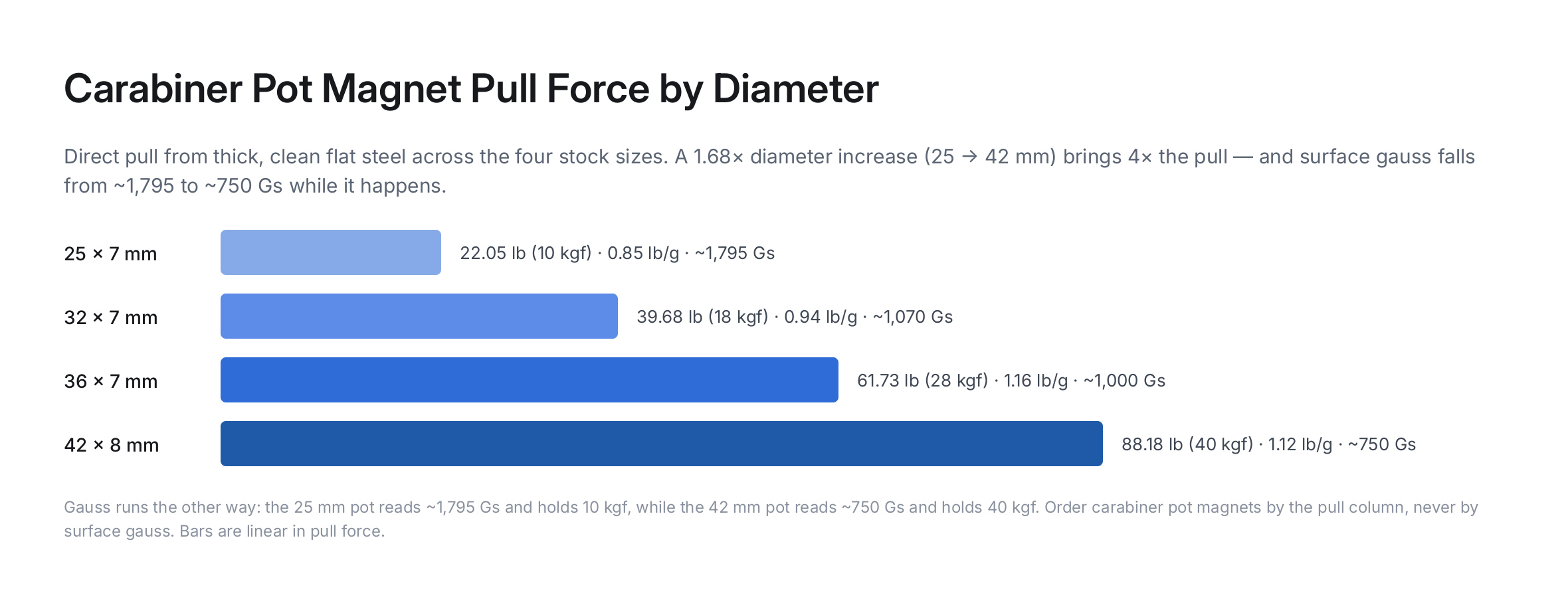
Even with the eyelet stealing no magnet volume, the geometry laws hold — and they hold hard:
| Size | Pull force | Surface gauss | Pull per gram |
|---|---|---|---|
| 25 × 7 mm | 22.05 lb | ~1,795 Gs | 0.85 lb/g |
| 32 × 7 mm | 39.68 lb | ~1,070 Gs | 0.94 lb/g |
| 36 × 7 mm | 61.73 lb | ~1,000 Gs | 1.16 lb/g |
| 42 × 8 mm | 88.18 lb | ~750 Gs | 1.12 lb/g |
Three patterns in the carabiner pot magnets range:
Diameter drives the pull. From 25 mm to 42 mm is a 1.68× diameter increase — and a 4× pull increase. Pole area grows with the square of diameter, and the 42 mm pot's taller cup (8 vs 7 mm) feeds the circuit more magnet, so the big pot over-delivers: 79 g of assembly holds 40 kg — about 500 times its own weight.
The 36 mm punches above its weight. Stepping from 32 to 36 mm (+26% area) lifts pull from 18 to 28 kgf (+56%) — the best pull-per-gram in the range at 1.16 lb/g. If a quote-sized quantity sits between the two sizes, the 36 mm is usually the better buy. Background in do magnets with identical volume exert the same force.
Surface gauss collapses as pull climbs. The 25 mm pot reads ~1,795 Gs and holds 10 kgf; the 42 mm pot reads ~750 Gs and holds 40 kgf — 4× the pull at less than half the point reading. Gauss is a spot measurement on the pole face, not a capacity: order carabiner pot magnets by the pull column, never by gauss. How to take the reading properly is in how to measure surface gauss with a gaussmeter.
Against the threaded family at matching diameters, carabiner pot magnets hold their own: the 25 and 32 mm sizes sit about 10% under the T4 female thread series (10 vs 11 kgf, 18 vs 20 kgf), while the 36 and 42 mm carabiner pots run 27% and 14% stronger (28 vs 22 kgf, 40 vs 35 kgf) — the eyelet costs no magnet volume, while the T4 bore does. The 36 mm gap is unusually large and worth a grade confirmation at quote time; the rest is within the ±10% family spread.
Catalog pull is direct pull off thick, clean, flat steel. Four factors change what carabiner pot magnets deliver in service:
The ring magnets inside carabiner pot magnets are sintered NdFeB in the N42-class range — the grade property table shows why grade matters less inside a closed shell than in a bare magnet. Standard rating is 80 °C continuous; above that the magnet loses pull reversibly at first, then permanently. For oven or engine-bay duty, ask about higher-temperature builds via custom magnets; the Curie temperature guide and temperature stability overview cover the physics.
All 4 carabiner pot magnets are axially magnetized: one pole on the working face, the other closed into the shell — the standard pot magnet orientation that makes the cup multiply front-face pull. Multi-pole and diametrical arrangements are possible in custom assemblies.
Every part in the carabiner pot magnets range ships nickel-plated (Ni-Cu-Ni) — shell, dome and eyelet — the standard NdFeB surface treatment, adequate for dry indoor service and the reason these pots keep their full bare-face pull. For humidity, salt spray or outdoor duty, move to epoxy plating or fit a rubber cap over the working face; the coating selection guide and the coatings explainer compare every option. Remember the trade: a rubber cap adds a non-magnetic gap and cuts direct pull by roughly 20–30%, but adds anti-slip grip and protects the surface underneath — exactly what you want on painted beams and delicate equipment.
The clip-on eyelet decides the application list for carabiner pot magnets — anywhere an accessory must attach, detach and re-attach quickly:
More use cases across the range: 15 key industrial NdFeB applications.
Send us five items and quoting is same-day, following the procurement requirement guide:
Two spec traps worth naming: quote total height (cup + tab), not just cup height, and match the eyelet bore to your carabiner's gate, not just its body. Dimensional expectations follow NdFeB tolerance standards; ±0.5 mm on diameter and height covers all stock carabiner pot magnets, and processing is in-house for eyelet changes.
A neodymium ring magnet in a domed nickel-plated steel shell, with a flat steel eyelet tab rising from the back. A carabiner, hook or lanyard clips through the tab's hole, so loads hang from the shell while the bare face grips steel — that construction separates carabiner pot magnets from the screw-through and threaded versions of the family, and it is why they are the fastest to deploy of all four.
From 22.05 lb (10 kgf) at 25 mm to 88.18 lb (40 kgf) at 42 mm, measured as direct pull from thick flat steel. Hanging loads add a lever effect, so keep the load line close to the magnet axis.
The bore is Ø5 mm on the 25 mm pot and Ø6 mm on the 32, 36 and 42 mm pots. Most mini and small carabiners pass; climbing-rated carabiners with 8 mm+ gate noses will not. Measure your gate wire before ordering.
Because the steel eyelet tab on the back adds 10 – 11.5 mm to the cup — total height = cup height + tab, on all 4 sizes. That is why a 42 mm pot measures 18 mm tall, not 8 mm.
If the accessory must clip on and off repeatedly — tents, cables, signage — carabiner pot magnets (T7). If the load is semi-permanent, a female thread (T4) or external thread (T3) gives aiming and adjustability the tab cannot.
28 kgf against 18 kgf — a 56% jump for 26% more pole area. The 36 mm ring is the most efficient in the range at 1.16 lb/g; if a quote sits between the two sizes, take the 36 mm. We confirm the exact grade of each ring at quote time.
Gauss is a point reading on the pole face. The large pots spread their field over a much bigger area at lower intensity — and hold far more. Order carabiner pot magnets by pull force, never by surface gauss.
Yes. A rubber cap over the working face adds anti-slip grip and protects painted or delicate surfaces, at the cost of roughly 20 – 30% direct pull. It is a sliding-fit accessory, so the bare-face option stays intact.
Yes — any S-hook, snap hook, shackle or lanyard whose nose clears the Ø5 / Ø6 mm bore works. For heavier or dedicated hardware, the bore and tab are made to drawing.
80 °C continuous as standard. Higher-temperature grades and coatings are available as custom builds; see the Curie and operating temperature guide for the physics.
Browse the full carabiner pot magnets category for live pricing on all 4 sizes, or send your carabiner size, load case and environment through contact us — we will match the eyelet, the dome and the diameter to your assembly. For a threaded hang, the T4 female thread series covers 10–75 mm and the T3 threaded series covers 22–88 mm; for a screw-through mount, the T1 and T2 series; and for the family overview start at pot magnets.