Magnetic hooks are the simplest way to hang something on steel: no drill, no adhesive, no wall anchor — press the cup onto a steel surface and hang. Behind that simplicity is a neodymium assembly with a tapped boss and a screwed-in hook, and the numbers on the datasheet hide a subtlety most buyers miss: the published pull force is the magnet's, not the hook's. A 250 kgf magnetic hook does not hang 250 kg.
This page covers our MH-T1 magnetic hooks in full: 11 stock sizes from Ø10 to Ø75 mm, measured pull from 1.9 to 250 kgf, the thread that actually sets your working load, and the derating you must apply when a load hangs rather than pulls. If you buy hooks for warehouses, workshops, retail or OEM fixtures, the tables below are the selection tool.
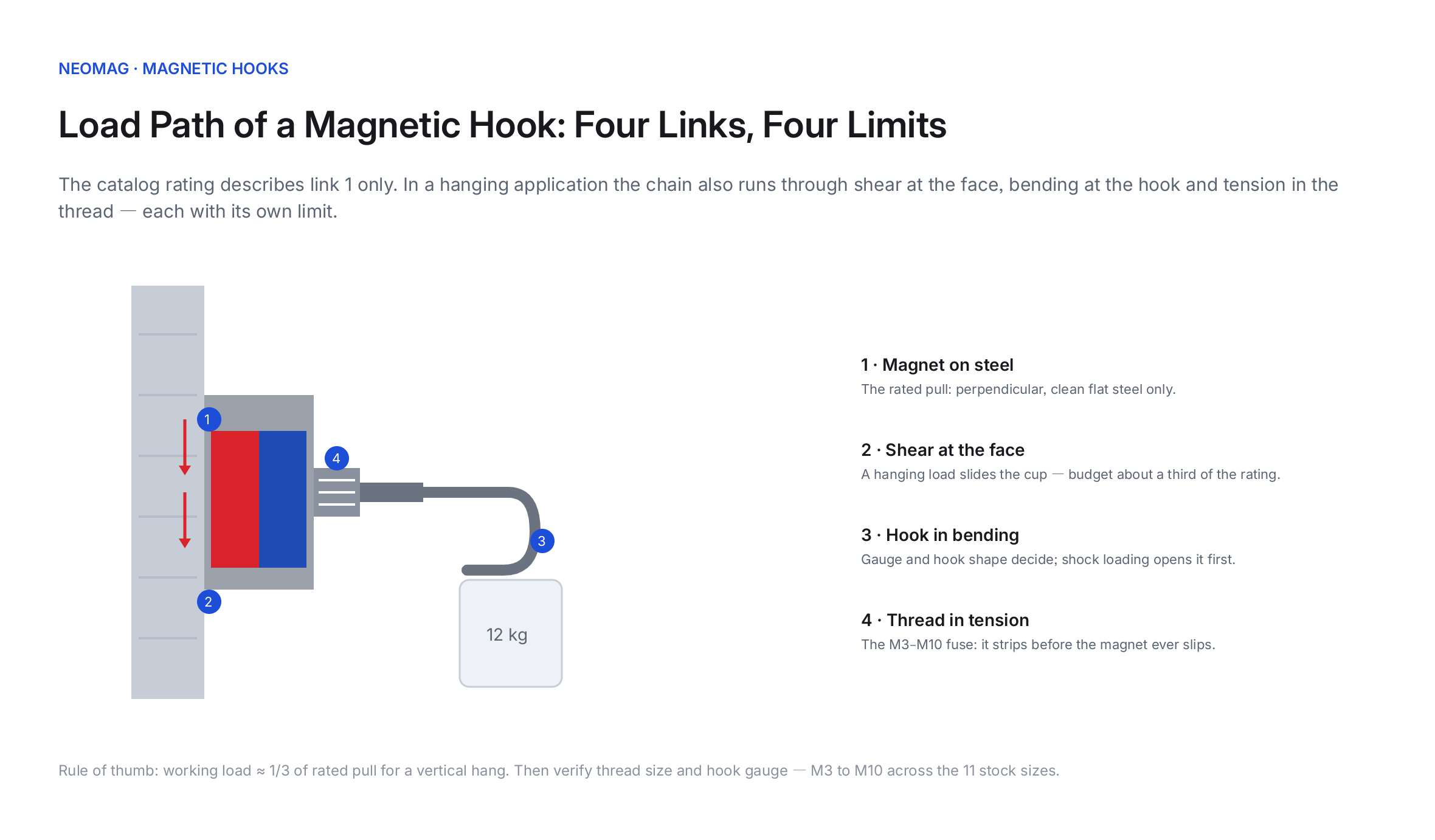
A magnetic hook is a pot magnet with a threaded boss and a steel hook screwed into it. Magnetic hooks differ from plain pot magnets only in that interface — everything else, from the cup geometry to the axial magnetization, is the same platform. The neodymium magnet sits inside a steel cup that concentrates the flux onto the working face and shields the magnet from impact; the hook screws into the cup's tapped centre and carries the load. Three properties follow from that construction:
Every MH-T1 hook ships with axial magnetization, nickel plating, a ±0.5 mm dimensional tolerance and a maximum operating temperature of 80 °C — the standard N-grade ceiling, explained in our guide to neodymium magnet temperature ratings.
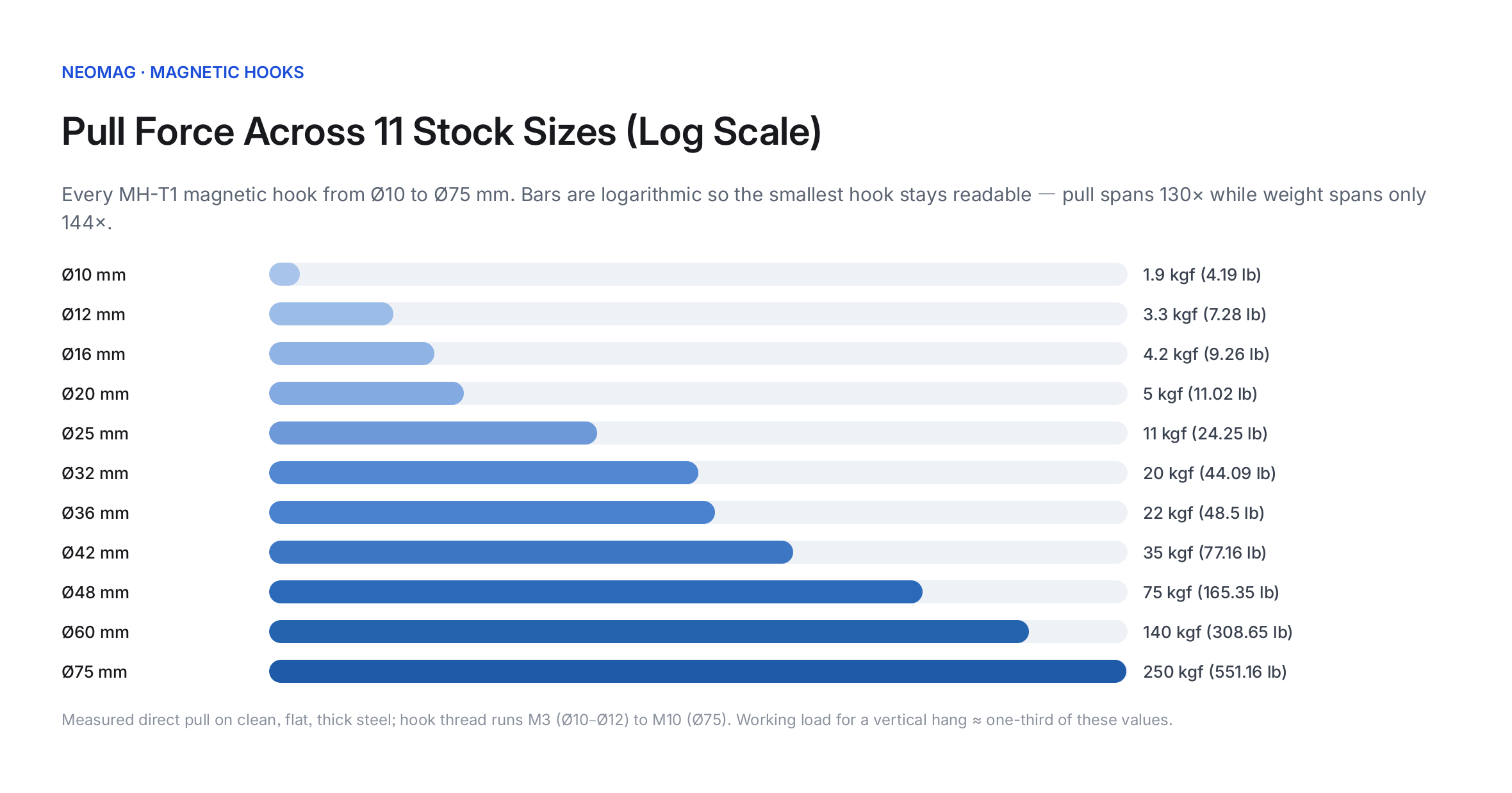
All eleven sizes share the same architecture; only diameter, cup thickness and hook thread change. Pull force is manufacturer-measured direct pull on clean, flat, thick steel.
| Diameter | Cup thickness | Overall height | Hook thread | Pull force | Weight |
|---|---|---|---|---|---|
| Ø10 mm (0.394 in) | 5 mm | 30 mm | M3 × 7 | 4.19 lb (1.9 kgf) | 4.7 g |
| Ø12 mm (0.472 in) | 5 mm | 30.5 mm | M3 × 7.5 | 7.28 lb (3.3 kgf) | 5.7 g |
| Ø16 mm (0.630 in) | 5 mm | 36.1 mm | M4 × 8 | 9.26 lb (4.2 kgf) | 10.6 g |
| Ø20 mm (0.787 in) | 6 mm | 37.1 mm | M4 × 8 | 11.02 lb (5 kgf) | 16.1 g |
| Ø25 mm (0.984 in) | 7 mm | 43.9 mm | M5 × 9 | 24.25 lb (11 kgf) | 29.8 g |
| Ø32 mm (1.26 in) | 7 mm | 48.0 mm | M6 × 8 | 44.09 lb (20 kgf) | 49 g |
| Ø36 mm (1.42 in) | 7 mm | 48.0 mm | M6 × 8 | 48.5 lb (22 kgf) | 56 g |
| Ø42 mm (1.65 in) | 8 mm | 50.0 mm | M6 × 7 | 77.16 lb (35 kgf) | 95 g |
| Ø48 mm (1.89 in) | 11 mm | 58.9 mm | M8 × 13 | 165.35 lb (75 kgf) | 175 g |
| Ø60 mm (2.36 in) | 15 mm | 64.0 mm | M8 × 15 | 308.65 lb (140 kgf) | 347 g |
| Ø75 mm (2.95 in) | 18 mm | 73.9 mm | M10 × 16 | 551.16 lb (250 kgf) | 679 g |
Two things stand out when the eleven rows sit together. Pull force spans 130× (1.9 → 250 kgf) while weight grows only 144× (4.7 → 679 g) — efficiency stays remarkably flat, around 0.4 kgf per gram at every size. And the thread grows in steps, not continuously: M3, M4, M5, M6, M8, M10. That second observation matters more than it looks.
Every value in the pull-force column describes the cup on steel, measured by pulling perpendicular to the surface. It says nothing about how much weight the hook can hang, for two reasons.
First, hanging is shear, not pull. A load hanging from a hook pulls parallel to the steel surface, while the rating is measured perpendicular to it. Magnetic assemblies lose roughly two-thirds of their rated force in this direction: expect the hook to slide or peel at around one-third of the published pull. An Ø25 mm magnetic hook rated 11 kgf is a realistic holder for 3–4 kg of hanging load, not 11 kg.
Second, the hook and thread have their own limits. The hook is bent steel wire or plate; a concentrated load can open it or straighten it. The thread takes the load in tension and the boss in shear; an overloaded M5 thread strips before a Ø25 cup ever slips. Treat the thread as the mechanical fuse: it is the cheapest part to size correctly.
The practical reading, for a vertical hang: design working load ≈ one-third of the pull force, then verify against the thread size and hook gauge. That single rule prevents most field failures with magnetic hooks — and it is the reason we publish the cup rating and the thread side by side on every listing rather than the pull number alone.
Sorting the magnetic hooks range by thread makes the scaling rule obvious — thread size tracks pull force almost linearly:
| Thread | Hook sizes | Pull force span | Typical load per hook (1/3 rule) |
|---|---|---|---|
| M3 | Ø10 / Ø12 | 1.9–3.3 kgf | 0.6–1.1 kg |
| M4 | Ø16 / Ø20 | 4.2–5 kgf | 1.4–1.7 kg |
| M5 | Ø25 | 11 kgf | ~3.7 kg |
| M6 | Ø32 / Ø36 / Ø42 | 20–35 kgf | 6.7–11.7 kg |
| M8 | Ø48 / Ø60 | 75–140 kgf | 25–47 kg |
| M10 | Ø75 | 250 kgf | ~83 kg |
For OEM buyers this is the fastest sizing shortcut in the catalog: pick the thread your fixture can accept (M6 tapped holes are common on jigs), then choose the largest cup that thread supports. If the application needs more holding than the thread allows, the answer is more hooks — not a bigger single hook.
Field failures with magnetic hooks almost never involve a broken magnet. They fall into three predictable modes, and each has a cheap design fix:
A hook user who understands these three modes buys the right size the first time — and a magnetic hooks programme with a documented load rule stops improvising at the rack.
The most common request we get is "how many hooks for this banner / cable run / signage". The arithmetic is short. A 12 kg banner on a steel beam, hung outdoors where wind adds motion:
That requirement is met by three Ø42 mm magnetic hooks (35 kgf each, M6) or one Ø60 mm hook (140 kgf, M8) plus a fail-safe tie. Most teams overshoot by picking the biggest hook available; the better answer is usually two or three mid-size hooks spread along the rail, because each hook also stabilises the next. Our engineering team runs this calculation daily — send the load and surface and we will return a hook count, not just a part number.
Across the entire MH-T1 range, pull force per gram sits between 0.31 and 0.58 kgf/g, with most sizes clustered at 0.37–0.43. Magnetic hooks do not get more efficient as they grow — unlike channel magnets, whose thin steel walls reach 2.07 kgf/g. The cup-and-hook architecture spends its mass on the same ratios at Ø10 as at Ø75, which makes sizing predictable: doubling the weight buys roughly double the force, no surprises either way. The Ø12 mm outlier at 0.58 kgf/g is the smallest hook with a full M3 boss — a useful part when weight matters more than absolute force.
Surface gauss runs inversely to size in this range: the Ø25 mm hook measures about 2,500 Gs at its face, the Ø75 mm hook about 1,000 Gs. That is not a defect — flux from a small pole spreads over a short distance, so the peak reading near the surface is high; the large cup spreads the same flux density over a much bigger area, and that area is what produces 250 kgf. This is the same inversion documented across the pot magnet family: gauss does not size a holding application — pole area does.
MH-T1 is the fixed-hook workhorse. When the job needs a different interface, the same cups appear in other styles: eyebolt magnets for shackles and ropes, swivel hooks where the load must rotate, rubber-coated hooks for painted and delicate surfaces, ferrite hooks for budget and wet areas, ceiling hooks for overhead suspension, and small plastic hooks for retail and office use. For the structural differences behind these variants, start from the magnetic hooks category.
Magnetic hooks appear wherever a hanging point must be added without drilling:
We manufacture magnetic hooks end to end — we form the cups, magnetize in-house and assemble the hooks, which is why all eleven sizes ship from stock and custom variants move fast:
Standard MH-T1 covers most hanging jobs. For OEM fixtures we adjust thread length and pitch, hook geometry, cup coating, magnetization and packaging — and we will review your load case rather than just quoting a part number. Send the drawing or sample through the custom magnets page, or request a quote directly from the contact page.
Q1: How much weight can a magnetic hook hold? A: Use about one-third of the published pull force for a vertical hang, because hanging loads the magnet in shear. An Ø25 mm hook rated 11 kgf is a realistic 3–4 kg holder; an Ø75 mm hook rated 250 kgf handles roughly 80 kg, thread permitting.
Q2: What is the difference between a magnetic hook and a pot magnet? A: The magnet is the same — a neodymium disc in a steel cup. Magnetic hooks add a tapped boss and a screwed-in hook, so they carry hanging loads instead of clamping flat parts. See the pot magnet overview for the clamp-side family.
Q3: Why do small magnetic hooks show higher gauss than large ones? A: Flux from a small pole spreads over a short distance, so peak surface readings are higher. Holding force depends on total pole area, which is why the Ø75 mm hook holds 130× more than the Ø10 mm hook despite measuring less than half the gauss.
Q4: Will magnetic hooks hold on painted or powder-coated steel? A: They will hold, but at a fraction of the rated force — a 0.5 mm coating can cut force by half or more. Clean the surface, remove loose paint at the contact patch where possible, and derate the load accordingly.
Q5: Do magnetic hooks work on stainless steel? A: Only on ferritic stainless grades. Austenitic 304 and 316 are effectively non-magnetic and will not hold; aluminium, brass and plastics do not work either.
Q6: What is the maximum temperature for standard magnetic hooks? A: 80 °C (176 °F) for every MH-T1 size — the standard N-grade limit. Above that, irreversible demagnetization begins; our temperature ratings guide explains the grade options.
Q7: Can the hook be replaced or changed? A: Yes — the hook screws into a standard tapped boss, so M5, M6, M8 and M10 hooks can be swapped or replaced in the field. Match the replacement thread to the original length so it seats fully.
Q8: How do I stop a magnetic hook from sliding sideways? A: Reduce the load, add a second hook, or choose a rubber-coated version for extra friction. A hook that slides is usually working in shear above its realistic limit, not a defective magnet.
Q9: Are magnets strong enough to damage the item being hung? A: The magnetic field behind the cup is nearly zero, so sensitive items hanging on magnetic hooks see little field. Keep the hook away from pacemakers, magnetic stripes and electronics during handling.
Q10: Can I get custom thread sizes or hook shapes? A: Yes. We produce custom magnetic hooks with different threads, hook geometries, coatings and pull targets for OEM programmes — send the drawing and load case through the custom magnets page.
Tell us the load, the surface and the thread your fixture accepts — we will confirm the size and quote from stock. All eleven MH-T1 sizes are available now, with U.S. buyers served from our Redlands, California warehouse.