Swivel magnetic hooks solve the problem a fixed hook creates: the load never approaches from the same angle twice. The hook pivots around the cup's centre, gravity swings it plumb, and the magnet underneath keeps working straight through its strongest axis.
This page covers our MH-T3 swivel magnetic hooks: 6 stock sizes from Ø16 to Ø42 mm, 7 to 44 kgf measured pull, a total profile of just 11–15.5 mm, and the selection rules that differ from our fixed magnetic hooks and eye bolt magnets.
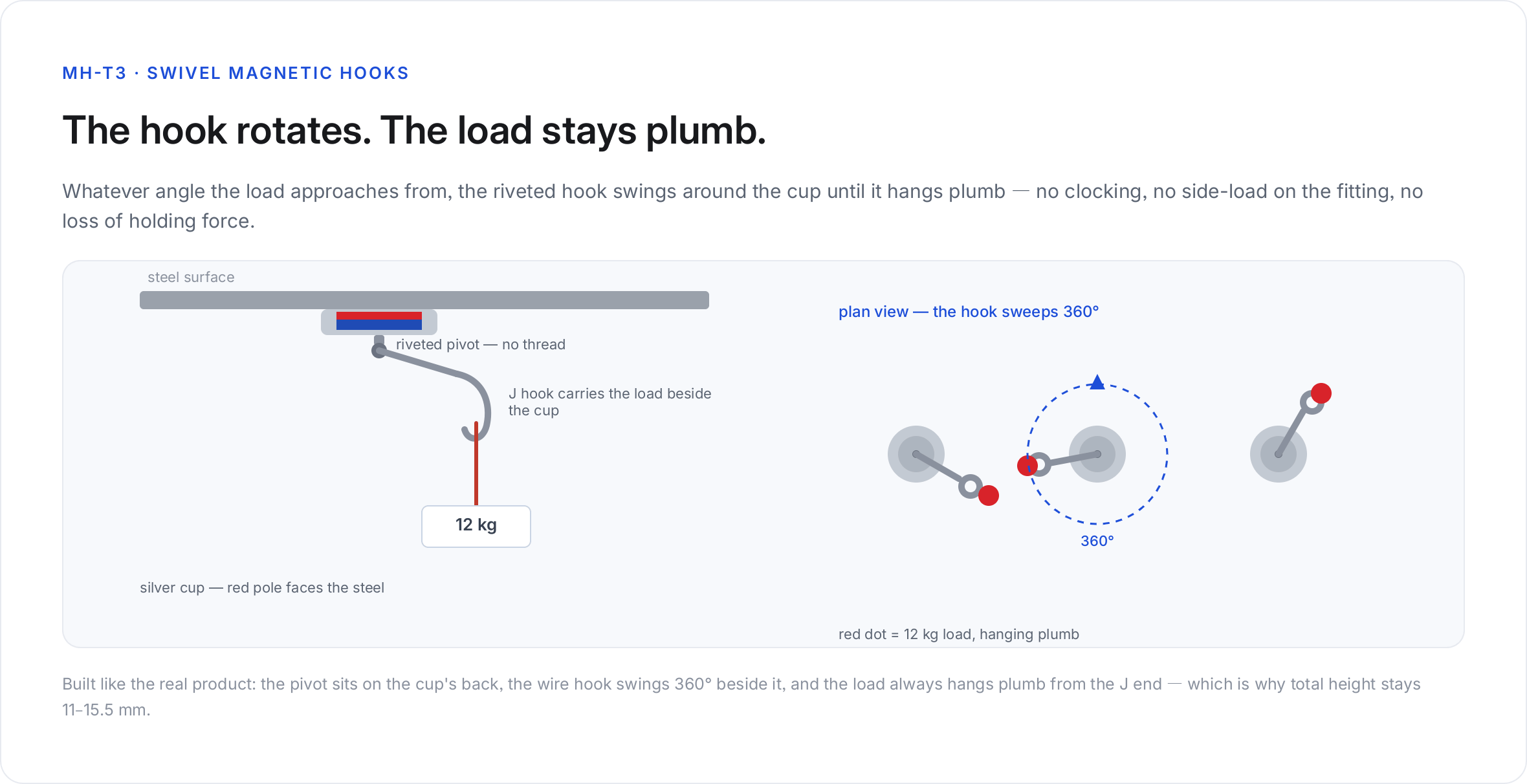
A swivel magnetic hook is a neodymium pot magnet with a hook that rotates 360° on a steel rivet instead of screwing into a threaded boss. The neodymium magnet sits in a steel cup that concentrates flux onto the working face; the hook rides on a shoulder rivet through the centre of the cup and turns freely under load.
Two consequences follow, and they define the whole product:
Buyers also search for swivel magnetic hooks as rotating magnetic hooks, magnetic hook assemblies, swivel hook magnets and 360° magnetic hooks — same assembly, same six sizes.
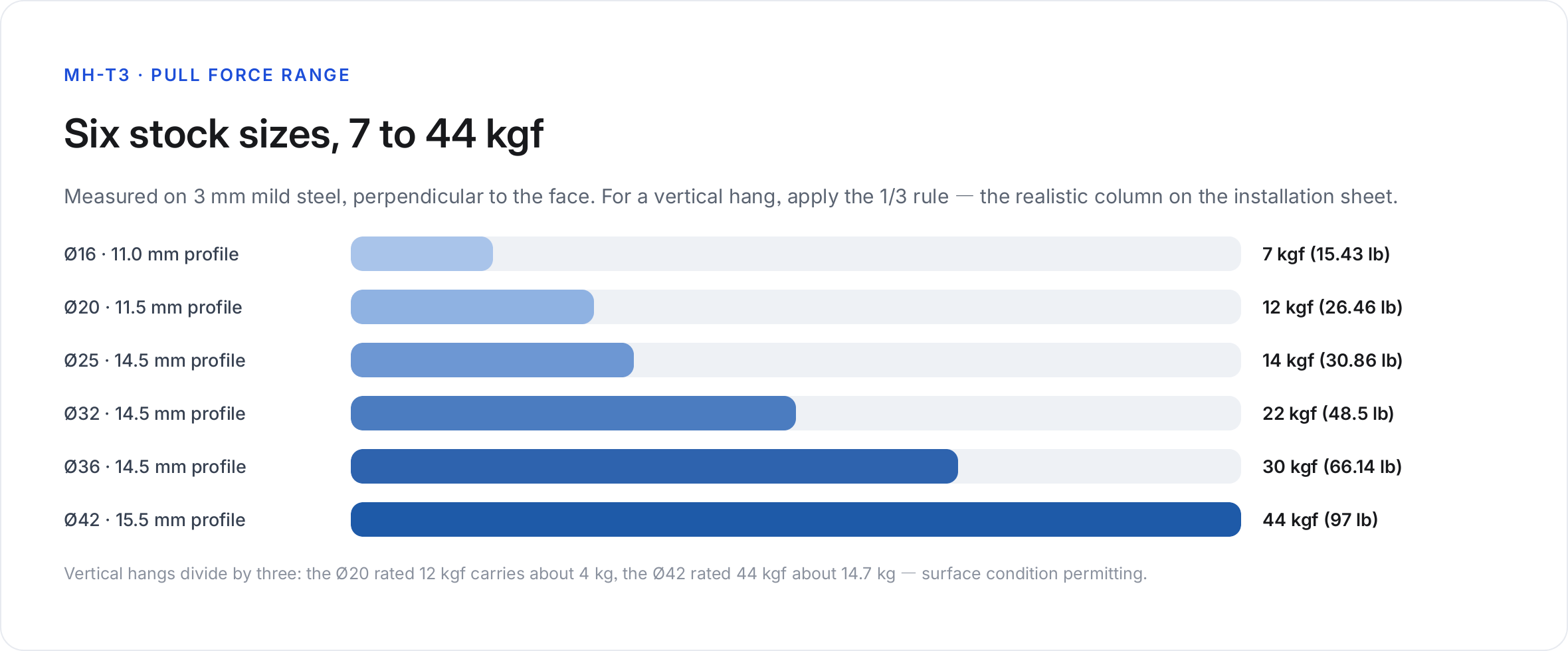
Every one of the swivel magnetic hooks below is nickel-plated, axially magnetized, rated to 80 °C, and measured on 3 mm mild steel, perpendicular to the face. "Total length" is the sweep of the hook from cup edge to hook tip — the clearance it needs to swing.
| Model (Ø × pot height) | Ø mm | Total height | Total length | Pull force | Weight | Surface gauss | Unit price |
|---|---|---|---|---|---|---|---|
| 0.63″ × 0.197″ | 16 | 11.0 mm | 43 mm | 7 kgf (15.43 lb) | 11.6 g | 2,088 Gs | $0.39 |
| 0.788″ × 0.236″ | 20 | 11.5 mm | 45 mm | 12 kgf (26.46 lb) | 18.1 g | 2,497 Gs | $0.70 |
| 0.984″ × 0.197″ | 25 | 14.5 mm | 65 mm | 14 kgf (30.86 lb) | 31 g | 2,500 Gs | $1.20 |
| 1.26″ × 0.276″ | 32 | 14.5 mm | 68 mm | 22 kgf (48.5 lb) | 45 g | 1,050 Gs | $1.64 |
| 1.417″ × 0.276″ | 36 | 14.5 mm | 70 mm | 30 kgf (66.14 lb) | 51 g | 1,200 Gs | $1.95 |
| 1.654″ × 0.315″ | 42 | 15.5 mm | 73 mm | 44 kgf (97 lb) | 68 g | 950 Gs | $3.41 |
Three things to notice before you pick a size:
Always in stock for sampling — swivel magnetic hooks ship in 1–2 business days: the Ø16 starter size, the Ø20 best-value, the Ø32 mid-range, and the Ø42 top of the range.
On a fixed hook, a load that pulls at an angle puts the fitting in bending — the failure mode that returns most cheap hooks. On swivel magnetic hooks, the pivot removes that failure before it exists: the hook turns until the load hangs straight down from the pivot axis.
That has practical consequences at both ends of the installation:
The swivel principle is the same one that keeps boat anchors and crane loads aligned: let the joint rotate, and the structure never sees the twist.
| Fixed hook (MH-T1) | Eye bolt (MH-T2) | Swivel magnetic hooks (MH-T3) | |
|---|---|---|---|
| Connection | Open hook, threaded boss | Closed eye, threaded boss | Hook on a rivet, no thread |
| Load direction | Fixed to the boss | Fixed to the eye plane | Rotates to follow the load |
| Total height | 30–74 mm | 30–74 mm | 11–15.5 mm |
| Fitting replaceable | Yes | Yes | No |
| Pull range | 1.9–250 kgf | 1.9–250 kgf | 7–44 kgf |
| Unit price at Ø25 class | $0.90 | $0.90 | $1.20 |
Choose swivel magnetic hooks when the load direction changes — swinging signage, hoses and cables that get pulled and released, rotating displays, doors and panels that flex. Choose the fixed hook for cheap, high-cycle picking where the load always approaches the same way. Choose the eye bolt when the line must not come off — a closed loop with rope, chain or carabiner — and you have the height budget for it.
If the surface is painted or curved, the same cups exist in the rubber-coated MH-T4 range; if the pull numbers here are more than you need, the ferrite MH-T5 range costs less per unit.
Rotation fixes the fitting, not the magnet — the 1/3 rule applies to swivel magnetic hooks exactly as it does to the fixed range. The pull force in the table is still a perpendicular measurement, and a vertical hang still loads the cup in shear:
design working load ≈ one-third of the pull force
| Size | Pull force | Realistic vertical hang |
|---|---|---|
| Ø16 | 7 kgf | ~2.3 kg |
| Ø20 | 12 kgf | ~4 kg |
| Ø25 | 14 kgf | ~4.7 kg |
| Ø32 | 22 kgf | ~7.3 kg |
| Ø36 | 30 kgf | ~10 kg |
| Ø42 | 44 kgf | ~14.7 kg |
On a vertical steel wall — the most common mounting for swivel magnetic hooks — that one-third rule is your starting point. Add the usual derates on top: painted or powder-coated steel costs 30–50%, steel thinner than 1.5 mm costs half, and a load that slams and swings costs another third to a half. The swivel absorbs the direction changes, but it cannot put holding force back into the magnet.
A fixed hook needs headroom above the cup; swivel magnetic hooks need sweep room around them. The hook tip travels a circle with a radius equal to the total length — 43 mm on the Ø16, 73 mm on the Ø42.
Measure the sweep before you order, not after: it is the one dimension installers forget.
The pivot on swivel magnetic hooks is riveted at the factory. That buys the low profile and the free rotation, and it costs you modularity:
We say this plainly because distributors occasionally order MH-T3 expecting swivel magnetic hooks with replaceable fittings. If your program needs field-swappable ends, order MH-T1 or MH-T2 stock and treat the swivel as a dedicated-feature product.
The magnets in swivel magnetic hooks do not degrade in normal service — the pivot is the part with a service life:
For static hanging — signage, storage, decoration — the pivot is a non-issue. For dynamic service, it is the component to inspect at your maintenance interval.
Dividing pull by weight across swivel magnetic hooks gives 0.45–0.66 kgf/g — a wider spread than our fixed-hook family, because the swivel keeps every cup thin:
| Size | Pull | Weight | Efficiency |
|---|---|---|---|
| Ø16 | 7 kgf | 11.6 g | 0.60 kgf/g |
| Ø20 | 12 kgf | 18.1 g | 0.66 kgf/g |
| Ø25 | 14 kgf | 31 g | 0.45 kgf/g |
| Ø32 | 22 kgf | 45 g | 0.49 kgf/g |
| Ø36 | 30 kgf | 51 g | 0.59 kgf/g |
| Ø42 | 44 kgf | 68 g | 0.65 kgf/g |
The Ø20 and Ø42 are the efficiency picks; the Ø25 exists for its low weight and thin pot rather than raw pull. If you are kitting out a fleet or a production line in the hundreds, the per-gram number matters more than the per-unit price.
Swivel magnetic hooks are usually picked by pull alone. Run the full check:/n/n1. Weigh the load and apply the 1/3 rule. A 10 kg hang needs 30 kgf of rated pull.
Swivel magnetic hooks adapt well to program work:
Our custom magnet service quotes drawings in 48 hours; most swivel variants need one sample round to lock.
Every lot of swivel magnetic hooks is pull-tested on 3 mm mild steel, and the pivots are sample-checked for free rotation before packing. Standard sizes ship from stock in Redlands, California for North American buyers — 3–7 day transit instead of a 30-day ocean leg. Custom assemblies typically quote in 48 hours and sample in 7–10 days.
Ten questions we answer every week about swivel magnetic hooks.
Q1: How much weight can a swivel magnetic hook hold?
A: Use about one-third of the rated pull for a vertical hang. The Ø20 rated 12 kgf holds roughly 4 kg; the Ø42 rated 44 kgf holds about 14.7 kg, surface condition permitting.
Q2: What is the difference between a swivel hook and a fixed magnetic hook?
A: The fitting. A fixed hook is screwed into a boss and points one way; a swivel hook is riveted and rotates 360°, so the load always hangs plumb and nothing to align. The swivel is also far flatter — 11–15.5 mm versus 30–74 mm.
Q3: Can the hook be replaced or swapped for an eye bolt?
A: No. The hook is riveted, not threaded. If you need a replaceable fitting, order MH-T1 or MH-T2, whose bosses accept standard M3–M10 fittings.
Q4: Does the rotation wear out?
A: The steel pivot develops slight free play after years of constant swinging, but it retains the hook. For static hanging it is a non-issue; for dynamic service, inspect it at your maintenance interval.
Q5: Will it hold on painted steel?
A: Yes, at a fraction of the rating — a 0.5 mm coating can cut force by half. Clean the contact patch and derate; see the coatings guide for finish options.
Q6: What is the maximum temperature?
A: 80 °C (176 °F) for all MH-T3 sizes, standard for N-grade magnets. Higher grades are available on request.
Q7: How much clearance does the hook need?
A: Sweep room, not headroom. The tip travels a circle equal to the total length — 43 mm on the Ø16 up to 73 mm on the Ø42. Leave a hook-width between units on shared rails.
Q8: Do swivel magnetic hooks work on stainless steel?
A: Only on ferritic grades. Austenitic 304 and 316 are effectively non-magnetic and will not hold.
Q9: Why is the Ø25 weaker than the Ø20 in efficiency terms?
A: The Ø25 uses a thinner 5 mm pot to stay light and flat, trading pull for profile. If pull per gram is the goal, choose the Ø20 or Ø42.
Q10: What is the lead time for custom swivel hooks?
A: Drawings quote in 48 hours, samples in 7–10 days, production in 3–4 weeks. Stock sizes ship in 1–2 business days from California.
Send us the load, the steel thickness and how the load moves — we will confirm the 1/3-rule number, check your sweep clearance and quote the size. Stock swivel magnetic hooks ship from California; custom hook geometries are quoted within 48 hours.
Contact our engineering team or browse the full magnetic hooks range to compare all seven sub-types side by side.