Rubber coated pot magnets are mounting magnets that solve the two problems bare steel pots create: they scratch the surface they hold, and they slide off smooth vertical steel. Two neodymium discs under a steel return plate, jacketed in rubber, with a female thread rising through a central boss — that combination holds without marking, grips sideways far better than bare steel, and accepts whatever accessory your application needs, screwed into the back of the magnet. Sign fitters, film crews and vehicle-accessory brands buy them for exactly these three properties, in that order.
This page covers the RCM-T1 family of rubber coated pot magnets: five sizes from Ø22 mm to Ø88 mm, 2 to 26 kgf measured pull, M4 and M6 female threads, $2.25 to $13.20. Below the spec table you will find the honest reading of the numbers — including one size that pulls less than the size below it, and why that is not a mistake — plus the grip arithmetic that makes these the specified answer for sliding and delicate-surface jobs.
If your accessory needs a male stud instead of a threaded socket, the same bodies exist with external thread in the rubber coated magnets category; the pull figures are identical.
Every one of the five rubber coated pot magnets on this page is built from four parts, one of them hidden:
Because the jacket covers the working face of every rubber coated pot magnet, the rubber is what the application actually feels: rubber on painted steel, rubber on glass, rubber on a car panel. That is a different tribological situation from steel-on-steel, and it is the reason these assemblies behave unlike any bare pot of the same rating.
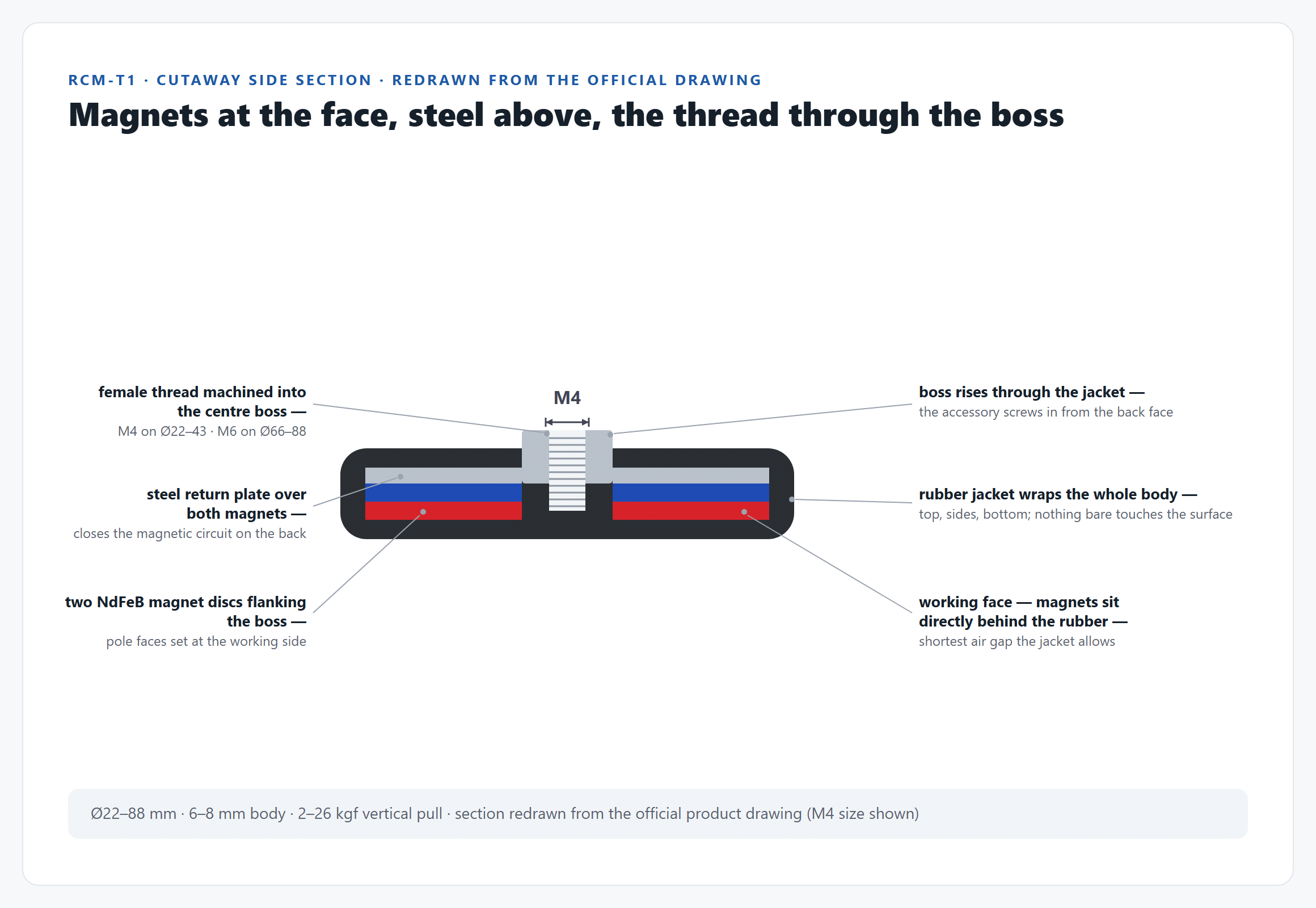
Three jobs, in order of how often they matter:
The honest cost: the rubber layer adds an air gap at the working face, so vertical pull is lower than a bare pot of the same diameter would deliver. Rubber coated pot magnets trade peak force for grip, protection and repeatability — and for most mounting applications that is exactly the right trade.
All five SKUs are rubber-jacketed steel pots with a female thread through a central boss on the back face. Pull figures are vertical pull-off on thick clean steel, measured the same way as every magnet in our catalogue — which is what makes these five rows directly comparable with the rest of the range.
|
Diameter |
Height |
Thread |
Weight |
Pull |
Price |
|
0.866 in / 22 mm |
0.236 in / 6 mm |
M4 |
0.353 oz / 10 g |
8.82 lb / 4 kgf |
$2.38 |
|
1.22 in / 31 mm |
0.236 in / 6 mm |
M4 |
0.564 oz / 16 g |
4.41 lb / 2 kgf |
$2.25 |
|
1.693 in / 43 mm |
0.236 in / 6 mm |
M4 |
1.13 oz / 32 g |
13.23 lb / 6 kgf |
$3.93 |
|
2.6 in / 66 mm |
0.315 in / 8 mm |
M6 |
3.6 oz / 102 g |
35.27 lb / 16 kgf |
$7.27 |
|
3.465 in / 88 mm |
0.315 in / 8 mm |
M6 |
6.98 oz / 198 g |
57.32 lb / 26 kgf |
$13.20 |
Reading notes: the thread is machined into the steel centre boss and opens through the jacket on the back face, centred, so an attached eyebolt or rod loads the assembly along its axis — the strongest direction. And the two larger sizes step up to M6 and 8 mm of height, because the bigger discs carry thicker magnets behind a thicker rubber face.
One row breaks the pattern, and it deserves a plain explanation: the Ø31 pulls 2 kgf — half of what the smaller Ø22 delivers. Buyers see it every time a rubber coated pot magnet table is read honestly, so here is the engineering:
A rubber coated pot magnet is a fixed-geometry stack: rubber face, two magnet discs, steel return plate and boss, all sealed inside a moulded rubber jacket. The Ø22 and the Ø31 use the same magnet thickness inside a bigger housing — the larger rubber footprint spreads the same flux over more area, and flux density at the face drops. Pull force follows flux density, not footprint. The same dip appears in the hook versions of this family — see the rubber coated magnetic hooks page, which documents it in the same terms.
Practically: do not size up for more force in this family. The Ø31 exists for coverage and stability on larger accessories, not for pull. If the job needs more force, jump to the Ø43 (6 kgf) or the Ø66 (16 kgf). It is the most common mis-order in this range, and the one our engineering team mentions first on quotation requests that specify "the biggest one you have".
The same five rubber coated pot magnet bodies exist with an external threaded stud instead of the socket, listed alongside these in the rubber coated category. Pull is identical size for size — the thread does not touch the magnetic circuit. What changes is the accessory direction:
|
|
Female thread (this page) |
External thread |
|
Accessory mounts |
screws into the magnet face |
screws onto the magnet's stud |
|
Profile when unused |
the socket sits in the back face — nothing on the working side |
a stud always sticks out |
|
Typical accessories |
eyebolt, hook, rod, camera plate, cable clip |
nut-fixed brackets, magnets as the male element of an assembly |
|
Threads in range |
M4 ×3, M6 ×2 |
M4 ×2, M6 ×1, M8 ×2 |
|
Best when |
the magnet is the base and the part comes and goes |
the magnet is a component inside a bigger fixture |
For uncoated housings with the same female-thread idea, the female thread pot magnets range is the bare-steel counterpart — higher pull, no surface protection, no rubber grip.
The socket turns one rubber coated pot magnet into a reusable mounting point:
Because the thread is in the magnet itself, every accessory is tool-swappable in seconds and the magnet stays put — the reuse cycle is where these assemblies pay for themselves against adhesive mounts.
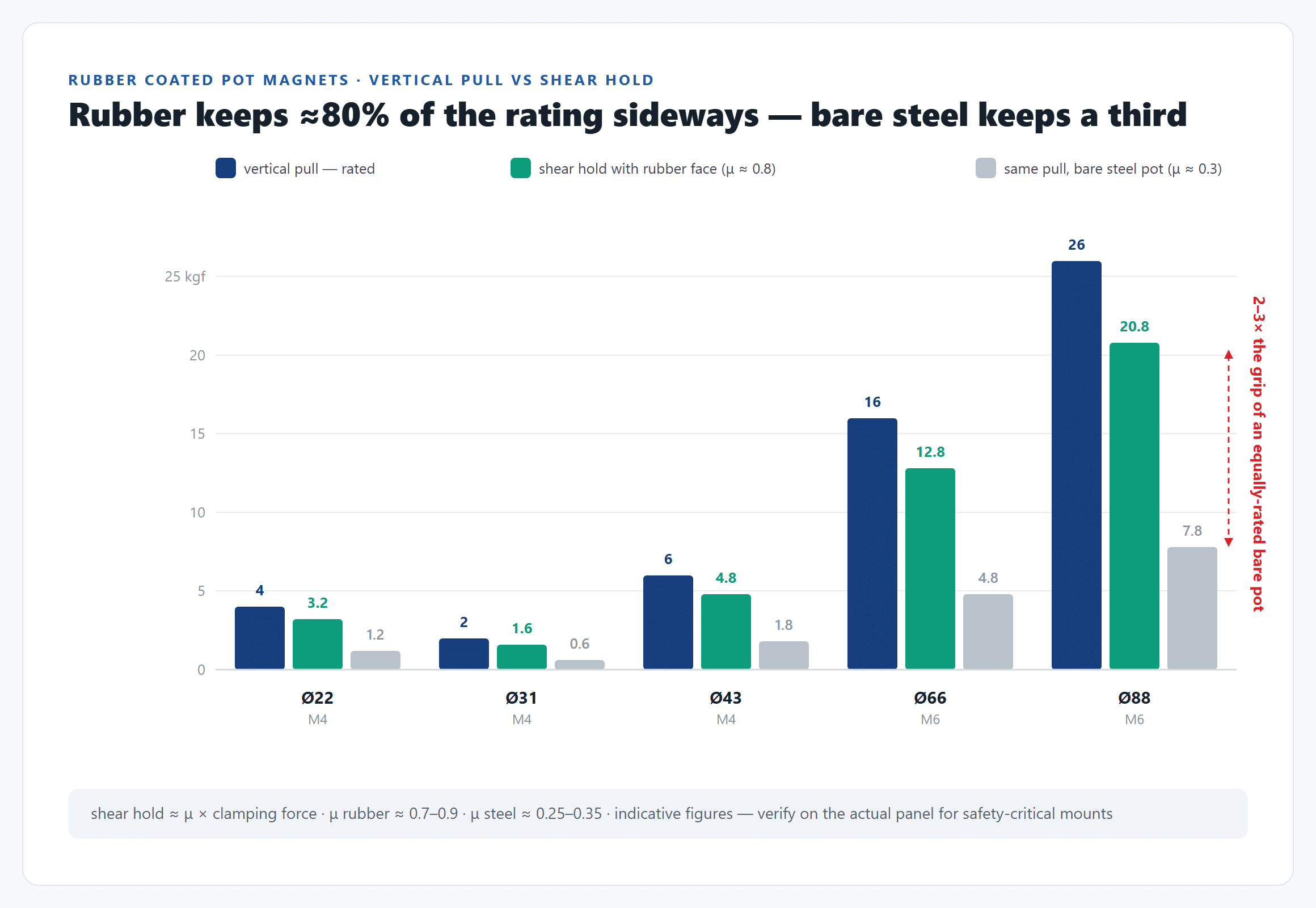
The pull versus shear rule says a bare steel magnet holds roughly a third of its rating when the load slides, because steel-on-steel friction is low. Rubber coated pot magnets rewrite that term:
|
Size |
Vertical pull |
Expected shear hold, rubber face (μ ≈ 0.8) |
Same pull, bare steel pot (μ ≈ 0.3) |
|
Ø22 |
4 kgf |
~3.2 kgf |
~1.2 kgf |
|
Ø31 |
2 kgf |
~1.6 kgf |
~0.6 kgf |
|
Ø43 |
6 kgf |
~4.8 kgf |
~1.8 kgf |
|
Ø66 |
16 kgf |
~12.8 kgf |
~4.8 kgf |
|
Ø88 |
26 kgf |
~20.8 kgf |
~7.8 kgf |
Read the last two columns as the design decision: on a vertical painted panel or a smooth machine frame, a rubber coated pot magnet holds two to three times what an equally-rated bare pot holds before it starts to slide. That, plus the scratch-free face, is why sign fitters, film crews and car-detailing suppliers specify rubber over steel even though the steel pot wins the vertical pull test.
Beyond the five stock rubber coated pot magnets we build OEM programmes for signage brands, vehicle-accessory makers and fixture builders: custom diameters and jacket colours, higher-temperature grades, alternative thread standards, and pre-assembled accessory kits. Because the magnet, cup, jacket and thread insert are all produced in-house, a custom assembly is a drawing and a quantity — start at custom magnets or contact us directly.
Q1: Will the rubber coating reduce the pull force? A: Yes, modestly — the rubber adds an air gap at the working face, so a rubber coated pot magnet pulls less than a bare pot of the same diameter. What you gain is surface protection and 2–3× the shear grip on smooth surfaces.
Q2: Why does the Ø31 magnet pull less than the Ø22? A: Both are rubber coated pot magnets built with the same magnet thickness; the Ø31 spreads that flux over a larger rubber footprint, so flux density — and therefore pull — drops. The Ø31 is for coverage and stability, not force. Jump to Ø43 or Ø66 if you need more hold.
Q3: What can I attach to the female thread? A: Anything with a matching M4 or M6 male thread: eyebolts, hooks, threaded rod, camera plates, cable clips. It screws in from the back face and swaps in seconds.
Q4: Will these scratch glass or painted panels? A: That is what the rubber prevents. Keep grit out from under the face of your rubber coated pot magnet — a trapped steel filing, not the rubber, is what marks a surface. Wipe the face before each mount.
Q5: How much can they hold sideways? A: On smooth clean steel, roughly 80% of the vertical rating thanks to rubber friction (μ ≈ 0.8) — about 3.2 kgf on the Ø22 and 20.8 kgf on the Ø88. Bare steel pots manage about a third of their rating in the same test.
Q6: Are they suitable for outdoor and salt environments? A: A rubber coated pot magnet survives salt better than a plated pot — the jacket shields the steel. Rinse with fresh water after marine use and inspect the jacket for cuts; the magnet inside is still nickel-plated as a second line of defence.
Q7: What temperature can they take? A: 80 °C continuous with standard grades — mind hot dashboards and machinery near heat sources. Higher-temperature magnets inside the same jacket are a custom order.
Q8: M4 or M6 — which thread do I need? A: Match your accessory: the Ø22/31/43 carry M4, the Ø66/88 carry M6. If you are buying accessories too, pick the size class whose thread matches the hardware you already own.
Q9: Do the female and external thread versions pull the same? A: Yes — size for size the figures are identical, because the thread does not touch the magnetic circuit. Choose by accessory direction: socket for back-mounted accessories, stud for fixture building.
Q10: Can we order custom jacket colours or threads? A: Yes — on custom rubber coated pot magnets, jacket colour, diameter, thread standard and pre-assembled kits are all standard OEM options; see the custom section above.
Five rubber coated pot magnets, one line, $2.25 to $13.20 — and every pull figure measured the same way as the rest of the catalogue, so the comparison is honest. Browse the rubber coated magnets category for stock, or contact us with the surface you need to hold and the accessory you need to mount. Engineering answers the same day — including the advice to size down when the Ø31 tempts you.