External thread pot magnets are rubber-coated neodymium bases that carry a male threaded stud instead of a socket: the magnet is the base, and whatever you attach screws onto it. A stud gives you three things a socket cannot — a nut clamps the assembly through panels and brackets without threading the magnet itself, the magnet drops into a fixture as its male element, and the accessory hardware stays on your side of the joint, not inside the magnet. The rubber jacket does the rest: no scratches on the surface it holds, and far more sideways grip than bare steel.
This page covers the RCM-T3 family of external thread pot magnets: five sizes from Ø22 mm to Ø88 mm, 2 to 26 kgf measured pull, M4 to M8 studs, $2.86 to $12.00. The bodies are the same rubber-jacketed section as our female thread versions — two neodymium discs, a steel return plate, a moulded jacket — with the centre boss carrying a stud instead of a tapped hole. Below the spec table you will find the honest reading of the numbers, including one size where the catalogue rating differs from its female counterpart, and exactly what we advise buyers to do about it.
If you would rather screw accessories into the magnet and keep the back face flat, the same five external thread pot magnet bodies exist with a tapped socket — see the rubber coated pot magnets with female thread. Pull figures, threads and prices are compared side by side below.
Every one of the five external thread pot magnets on this page is built from the same four-part section as the female-thread family, with one part turned around:
Because the jacket covers the working face of every external thread pot magnet, the rubber is what the application actually feels: rubber on painted steel, rubber on glass, rubber on a car panel. And because the stud stands proud of the back face, the whole assembly behaves like a component you bolt into a design, not a part you fasten things onto.
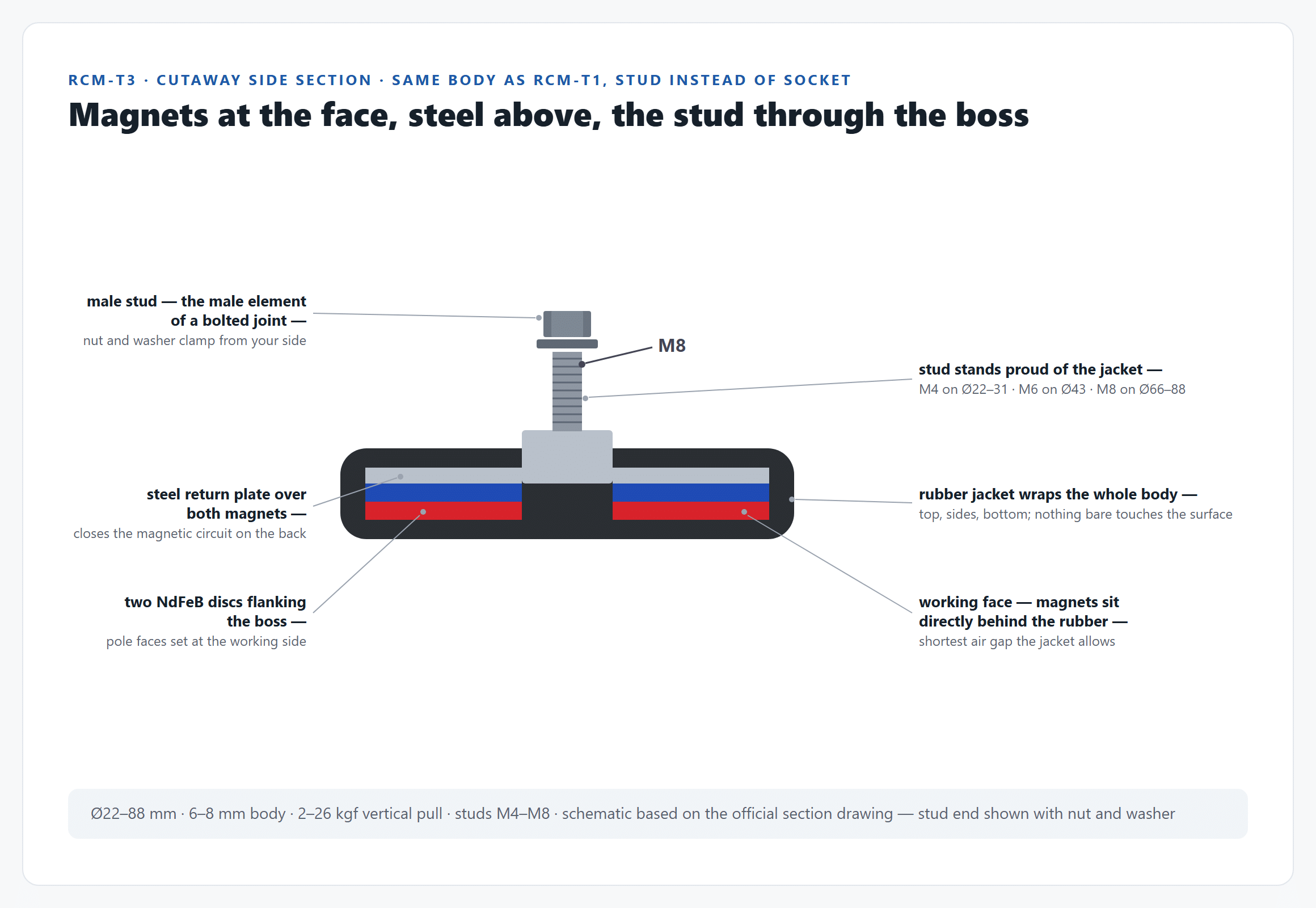
Three jobs, in order of how often they matter:
The honest cost: the rubber layer adds an air gap at the working face, so vertical pull is lower than a bare pot of the same diameter would deliver. External thread pot magnets trade peak force for grip, protection and clean integration into fixtures — and for most mounting applications that is exactly the right trade.
All five external thread pot magnet SKUs are rubber-jacketed steel pots with an external stud on the back face. Pull figures are vertical pull-off on thick clean steel, measured the same way as every magnet in our catalogue — which is what makes these five rows directly comparable with the rest of the range.
| Diameter | Height | Stud | Weight | Pull | Price |
|---|---|---|---|---|---|
| 0.866 in / 22 mm | 0.236 in / 6 mm | M4 | 0.388 oz / 11 g | 4.41 lb / 2 kgf | $2.97 |
| 1.22 in / 31 mm | 0.236 in / 6 mm | M4 | 0.582 oz / 16.5 g | 4.41 lb / 2 kgf | $2.86 |
| 1.693 in / 43 mm | 0.236 in / 6 mm | M6 | 1.27 oz / 36 g | 13.23 lb / 6 kgf | $3.94 |
| 2.6 in / 66 mm | 0.315 in / 8 mm | M8 | 3.95 oz / 112 g | 35.27 lb / 16 kgf | $7.28 |
| 3.465 in / 88 mm | 0.315 in / 8 mm | M8 | 7.2 oz / 204 g | 57.32 lb / 26 kgf | $12.00 |
Reading notes: on external thread pot magnets the stud stands proud of the back face, centred, so the load path runs through a nut and washer on your side. The studs step up faster than the female-thread range — M4 on the two small sizes, M6 on the Ø43, and M8 on both large sizes — because a stud carries its load through a nut on your side, where a heavier thread costs nothing. The Ø88's M8 stud is rated well beyond the magnet's 26 kgf pull, so on this family the bolt is never the weak link.
One number deserves a plain explanation before you order: the catalogue lists the Ø22 external thread pot magnet at 2 kgf, while its female-thread counterpart is listed at 4 kgf. The thread configuration does not touch the magnetic circuit, so a real difference of that size is unlikely — but we publish the lower figure until our engineering team confirms the female row, because the safe rule with two conflicting ratings is simple: design to the smaller one.
The second thing the table shows is what the external range does not have: no Ø31 dip. The Ø31 external thread pot magnet pulls the same 2 kgf as the Ø22 — equal, not half — because the two bodies share the same magnet thickness and the ratings were never scaled off a smaller row. (The female range shows a genuine dip there; see the female thread page for its explanation, and the rubber coated magnetic hooks page for the same effect in the hook family.)
Practically: across these external thread pot magnets, sizing up never costs you force. The Ø31 buys you 40% more footprint on the same 2 kgf hold; the Ø43 doubles it; the Ø66 and Ø88 are the fixture-grade sizes.
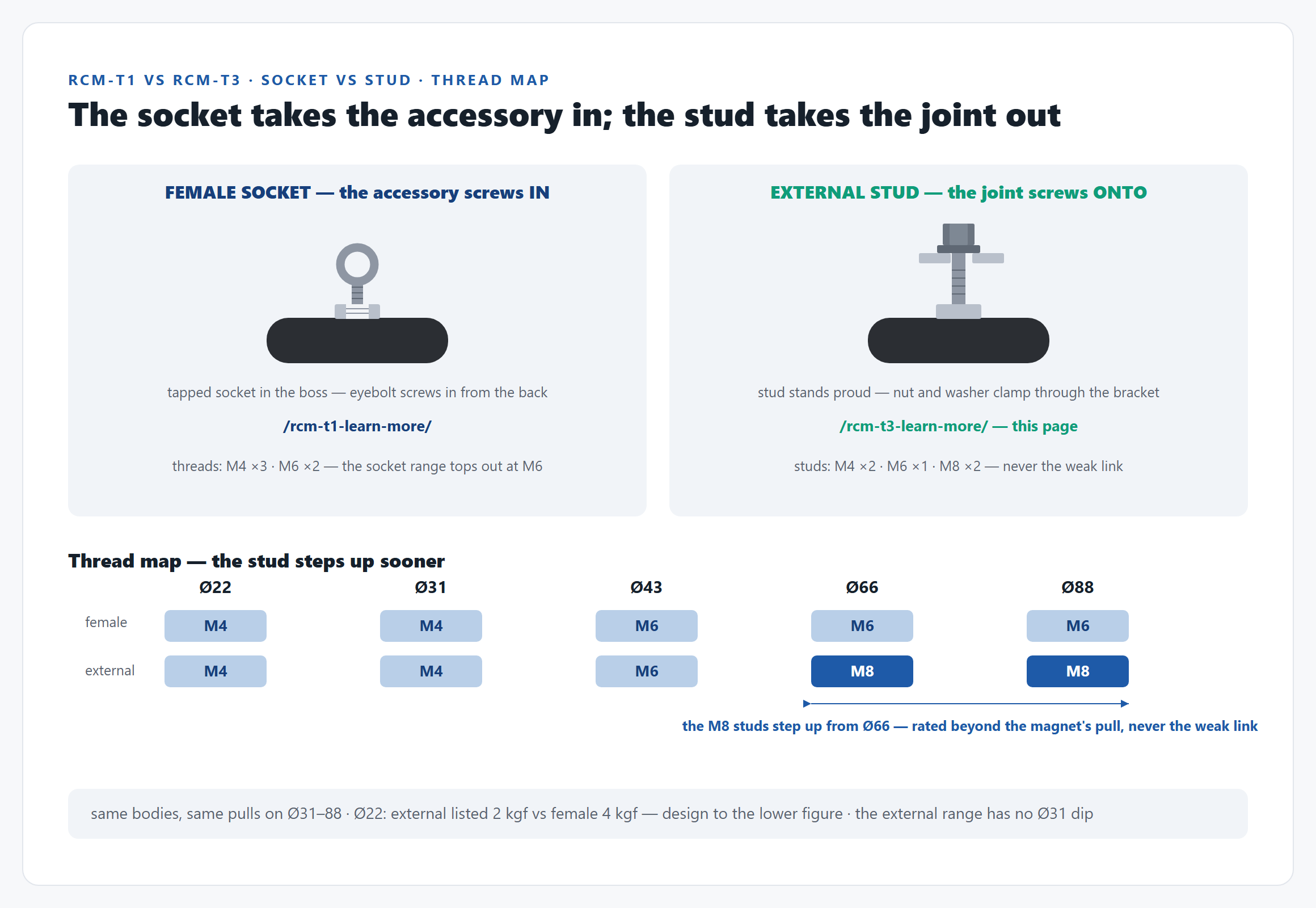
The tapped-socket counterparts of these external thread pot magnets are listed alongside them in the rubber coated category. What changes is the accessory direction:
| External stud (this page) | Female socket | |
|---|---|---|
| Accessory mounts | screws onto the magnet's stud | screws into the magnet face |
| Magnet's role in the joint | the male element of a bolted joint | the base; the part comes and goes |
| Typical hardware | nut + washer through a bracket, threaded rod, machine feet, adapters | eyebolt, hook, rod, camera plate, cable clip |
| Studs in range | M4 ×2, M6 ×1, M8 ×2 | M4 ×3, M6 ×2 |
| Threads vs load | M8 on the two large sizes — never the weak link | M6 tops out on the Ø88 |
| Best when | the magnet bolts into a fixture or through a panel | the magnet sits on a surface and the accessory swaps |
Two smaller differences worth knowing before you choose. First, the stud versions weigh 1–6 g more per size — the protruding steel adds a little mass, nothing that changes handling. Second, the price rows cross over: the studs cost a little more at Ø22–66, and measurably less at Ø88 ($12.00 against $13.20), because the M8 stud is cheaper to produce than the tapped M6 socket it replaces. For uncoated housings with the same stud idea, the male thread pot magnets range is the bare-steel counterpart — higher pull, no surface protection, no rubber grip.
The stud turns one external thread pot magnet into a component of a bolted joint:
Because the load path runs through the nut and the jacket, every attachment is tool-swappable in seconds and the magnet itself is never threaded, drilled or otherwise modified — the reuse cycle is where external thread pot magnets pay for themselves against adhesive mounts.
The pull versus shear rule says a bare steel magnet holds roughly a third of its rating when the load slides, because steel-on-steel friction is low. Rubber rewrites that term on every external thread pot magnet: on smooth clean steel, expect roughly 80% of the vertical rating as shear hold — about 1.6 kgf on the Ø22 and 20.8 kgf on the Ø88 — two to three times what an equally-rated bare pot manages. The full per-size arithmetic, with the indicative-figures caveat, is tabulated on the female thread page; the jacket is the same, so the numbers transfer.
(Indicative figures: real shear depends on surface dust, paint texture and rubber condition — verify on the actual panel for safety-critical mounts.)
Beyond the five stock external thread pot magnets we build OEM programmes for signage brands, vehicle-accessory makers and fixture builders: custom diameters and jacket colours, higher-temperature grades, alternative thread standards, longer studs, and pre-assembled nut-and-washer kits. Because the magnets, plate, jacket and stud are all produced in-house, a custom assembly is a drawing and a quantity — start at custom magnets or contact us directly.
Q1: Are the pull figures the same as the female-thread versions? A: On the Ø31–88 the catalogue ratings match size for size. On the Ø22 the external thread pot magnet is listed at 2 kgf against the female's 4 kgf — the thread does not touch the magnetic circuit, so we treat the lower figure as the safe rating until engineering confirms the female row. Design to the smaller number.
Q2: Why do the larger sizes use M8 studs instead of M6? A: A stud carries its load through a nut on your side of the joint, where a heavier thread costs nothing to use. So the range steps up to M8 on the Ø66 and Ø88 — both rated far beyond the magnet's pull, which means the bolt is never the weak link on external thread pot magnets of this family.
Q3: What can I attach to the stud? A: Anything with a matching nut or thread: nut-and-washer through a bracket, threaded rod, machine feet, male-to-female adapters that turn the stud into an eyebolt or camera fitting. It screws on from the back and swaps in seconds.
Q4: Will these scratch glass or painted panels? A: That is what the rubber prevents. Keep grit out from under the face of your external thread pot magnet — a trapped steel filing, not the rubber, is what marks a surface. Wipe the face before each mount.
Q5: How much can they hold sideways? A: On smooth clean steel, roughly 80% of the vertical rating thanks to rubber friction (μ ≈ 0.8) — about 1.6 kgf on the Ø22 and 20.8 kgf on the Ø88. Bare steel pots manage about a third of their rating in the same test.
Q6: Is there a Ø31 dip like on the female-thread page? A: No — the Ø31 external thread pot magnet pulls the same 2 kgf as the Ø22, equal rather than half. The dip is a feature of the female-thread and hook ratings, not of this table. Here, sizing up never costs you force.
Q7: What temperature can they take? A: 80 °C continuous with standard grades — mind hot dashboards and machinery near heat sources. Higher-temperature magnets inside the same jacket are a custom order. Keep the exposed stud lightly oiled in corrosive environments.
Q8: Which stud does each size carry? A: M4 on the Ø22 and Ø31, M6 on the Ø43, M8 on the Ø66 and Ø88. If you are buying hardware too, pick the size class whose stud matches the nuts and rods you already own.
Q9: Do the stud versions cost more? A: Only on the small sizes. The rows cross over on external thread pot magnets: studs cost slightly more at Ø22–66 and measurably less at Ø88 ($12.00 against the socket version's $13.20), because the M8 stud is cheaper to produce than the tapped M6 socket it replaces.
Q10: Can we order custom studs, jacket colours or kits? A: Yes — on custom external thread pot magnets, stud length and standard, jacket colour, diameter and pre-assembled nut-and-washer kits are all standard OEM options; see the custom section above.
Five sizes, one line, $2.86 to $12.00 — and every pull figure measured the same way as the rest of the catalogue, so the comparison is honest. Browse the rubber coated magnets category for stock, or contact us with the surface you need to hold and the bracket you need to bolt through. Engineering answers the same day — including the note that the M8 studs on the two largest external thread pot magnets will never be the weak link in your design.